Oklahoma Is Now Releasing Pen-Raised Deer into the Wild as Part of a Vast CWD Experiment

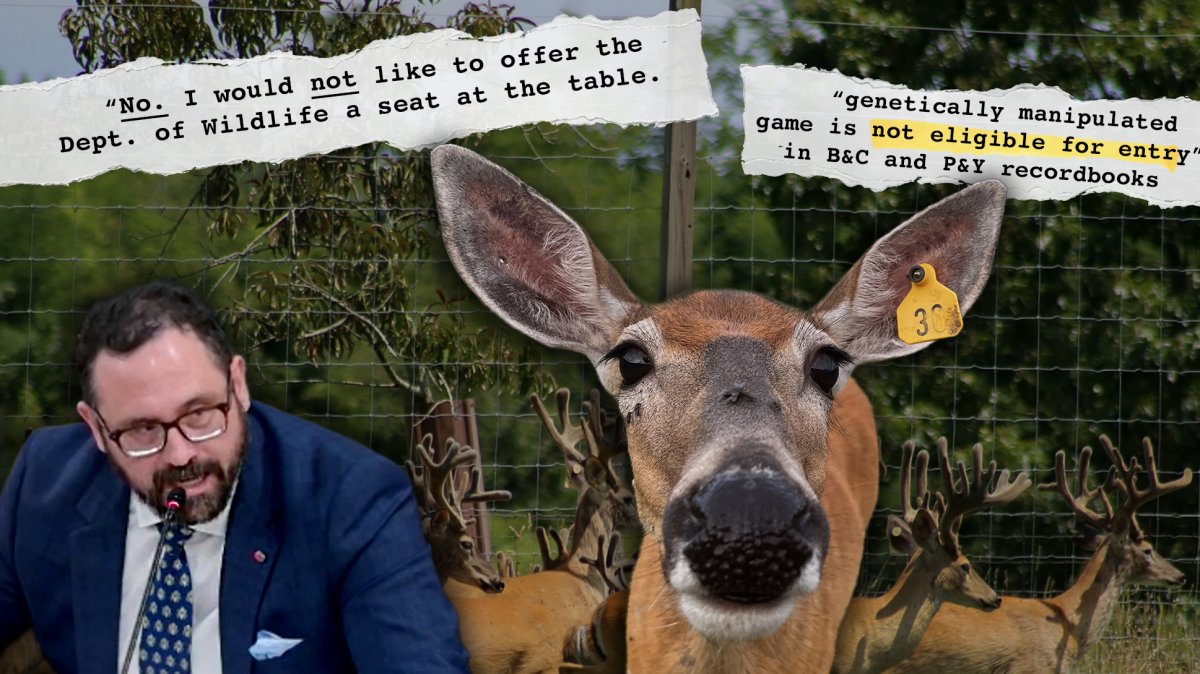

Earlier this year, a pen-raised whitetail deer was let out into the wild somewhere in northeast Oklahoma. This was allowed under a new and highly controversial state law that aims to combat chronic wasting disease by authorizing the release of commercially-bred, genetically engineered whitetails into the native deer population.
Translation: Oklahoma has officially launched a novel and statewide CWD experiment with its wild deer as the guinea pigs.
This pilot program is generating intense pushback from the broader scientific community, as well as national conservation organizations, and even the state’s Department of Wildlife — all of whom are voicing their concerns about the unproven science supporting the program. They worry it could jeopardize Oklahoma’s wild deer herd, and by extension, deer hunting and hunters.
Meanwhile, some state lawmakers want to go even further. A bill that has already cleared the state House and could reach the Senate as soon as Monday would double down on the CWD experiment by removing the Oklahoma Department of Wildlife Conservation from the process. ODWC’s regulatory authority would then be transferred to the Oklahoma Department of Agriculture, Food and Forestry.
“The unintended consequences [of this] could be devastating to our thriving deer herd,” ODWC chief of wildlife Bill Dinkines said in a statement released Tuesday. “Based on what we [have] heard from some of the nation’s leading CWD experts, the release of captive white-tailed deer into free-ranging populations for the purpose of CWD prevention or management is not justified and is not worth the risk.”
Dinkines’ concerns are shared by the Oklahoma Wildlife Commission, which released its own position statement opposing the current bill. Commissioners noted their concerns about the unintended “biological and regulatory consequences” that could “diminish the value of Oklahoma’s deer resource.” They warned that by moving forward with the bill, lawmakers would be undermining a key tenet of the North American Model of Wildlife Conservation: “that wildlife shall be managed by trained professionals in the public trust,” and not commercialized or privatized.
“HB 3270 represents a shift toward monetization of wildlife resources and risks placing private commercial interests over public trust management,” the Commission’s position statement reads. “The Commission respectfully maintains that the management of Oklahoma’s wild deer herd should remain under the authority and expertise of the Commission and Wildlife Department.”
“When you release a captive deer onto the landscape, it would be like dropping me in the middle of Iraq right now, or Afghanistan.”
—Grant woods
A group of wildlife biologists and CWD experts also shared their perspectives on the issue during a Wildlife Commission meeting on Monday. Dr. Grant Woods, a wildlife biologist who specializes in deer research, explained to commissioners how the release of captive deer puts the state’s billion-dollar deer hunting industry at risk. It’s impossible to say with absolute certainty that a pen-raised, genetically durable deer does not have CWD, he explained, and a deer that appears to be healthy could still spread the disease.
Woods said that in addition to these CWD risks, the idea is completely unfeasible based on what we know about the survival and reproductive rates of captive deer in the wild.
“When you release a captive deer onto the landscape,” Woods said, “it would be like dropping me in the middle of Iraq right now, or Afghanistan.”
The Theory Behind Captive Deer Releases
The practice of releasing pen-raised deer into the wild was established under the 2024 CWD Genetic Improvement Act, which aims to “enhance the genetic durability of Oklahoma deer against chronic wasting disease.”
This idea of “genetic durability” is based on a burgeoning scientific theory that whitetails can be selectively bred to make them less susceptible to CWD. Most of the supporting research has come out of Texas, where a prominent genetic researcher at Texas A&M has been using genetic predictions to determine a deer’s susceptibility to CWD. In a peer-reviewed study published in 2020, Dr. Chris Seabury concluded that this susceptibility is both heritable and predictable.
“I showed that I could predict with greater than 80 percent accuracy which animals would become CWD positive at known positive facilities based on their genetic profiles,” Seabury told Outdoor Life in 2023. “We know what deer are most susceptible, and that’s really the key.”
Seabury’s research has so far revolved around whitetail deer in captive breeding facilities, where he has determined what he refers to as a deer’s “genomically estimated breeding value.” Using those values as a guideline, Seabury has shown that breeders can use GEBV’s to create what he calls more “durable” deer. Seabury doesn’t like the word “resistant” and has said that a “spectrum of resistance” to CWD would be a more accurate way to look at it.
Some Oklahoma lawmakers have been paying close attention to Seabury’s theory, which they seem to view as a silver bullet in the fight against CWD. The law they passed in 2024 put the theory into practice by establishing a pilot program wherein ODWC would begin testing Oklahoma’s wild deer in order to establish a genetic baseline for the herd.
That same law also directed ODAFF to begin authorizing the release of genetically durable pen-raised deer between Feb. 1 and April 15, 2026.
The logic here is that genetically durable, pen-raised deer would breed with wild deer and over time, spreading their more durable genes throughout the state’s wild population. With more genetically durable deer on the landscape, the spread of CWD could theoretically be slowed or stopped — at least among whitetails. It’s unclear what effect (if any) this could have on Oklahoma’s free-ranging elk, which can also contract CWD.
However this initiative put hunting and conservation groups like the National Deer Association on high alert.
NDA’s policy director, Catherine Appling-Pooler, who is also an Oklahoman and a deer hunter, says the inclusion of a possible stocking program was the organization’s primary concern when the CWD Genetic Improvement Act passed in 2024. It remains their top concern today.
“In 2024, this idea of releasing captive deer was not informed by science, and now in 2026, it is still not being science-led,” says Appling-Pooler, who previously worked as the legislative liaison for ODWC. “This is not a decision being made by wildlife professionals, and our fear is that wildlife professionals are now being completely removed from the process.”
Which brings us to the one deer release that’s already occurred and was confirmed by ODAFF on Wednesday. The timeline, source, and other details behind this release are unclear, and a public records request with ODAFF had not been fulfilled as of Friday. An ODAFF spokesperson did clarify that the deer’s release occurred somewhere in northeast Oklahoma.
State veterinarian Dr. Rod Hall explains that the new law required anyone who wanted to participate in the new release program to send an application to ODAFF. Applicants must also pay a $500 fee to secure that release permit. He says they received and approved two permits, both from registered deer breeders. It’s unclear how or if these deer breeders are benefitting from their participation in the pilot program.
“We had a total of six [deer] that were proposed to be released that we approved. We verified that they met the genetic markers and all,” Hall says. “I have not talked to those two people to make sure they still intend to release them, but my assumption is that they will within the next week [before the release window closes on April 15.]”
ODWC spokesperson Micah Holmens tells OL that the agency has heard about the releases, but that they were not involved in the issuance of any permits. He directed all other questions about past or upcoming releases to ODAFF.
The Politics of Deer Management
During a contentious hearing before the House Energy and Natural Resources committee on Feb. 25, the bill’s author, Rep. Nick Archer, explained why he had drafted HB3270, which was introduced to the House Wildlife committee on Feb. 10 as a feral hog bill. On Feb. 24, however, less than 24 hours before it was heard in the Energy and Natural Resources committee, HB3270 was gutted and re-written to amend the 2024 CWD Genetic Improvement Act.
“Representative, are you familiar with the term ‘shuck and jive?’” Rep. Jim Grego asked Archer at the start of the debate. “[And] would you agree this could be an example of that? Where we have a bill and we’re studying the bill, then at the last minute we totally pull everything out and we drop new language, and it [effectively] doesn’t give us enough time to really study the new language?”
Archer responded that yes, he could see how Grego would see it that way. In explaining his rationale to lawmakers, Archer implied that this change was necessary because the 2024 CWD Genetic Improvement Act is being delayed and undermined by state wildlife managers. Archer spoke of the agency’s continued “unwillingness to come to the table,” and claimed that ODWC has been “consistently and habitually ignoring the law” by not completing genetic testing quickly enough.
At another point during the committee hearing, Rep. John George also criticized Archer for bringing forward a new version of HB3270 that was nothing like the legislation George voted to move forward as a member of the House Wildlife committee. He said he would like to hear the perspective of state wildlife managers on the new version of the bill, and he asked Archer if an ODWC representative who was in attendance could come forward to speak.
“No, I would not like to offer the Department of Wildlife a seat at the table,” Archer responded. “They have not made any effort in good faith to move forward on this. And so, no, I would prefer they didn’t speak.”
The ODWC, as well as the Commission that oversees the agency, says it has continued to follow the science and the letter of the 2024 law. In their position statement, commissioners pointed out that ODWC’s commitment was to collect 1,000 DNA samples from native deer for genetic analysis.
“To date, approximately 550 samples have been collected, analyzed, and returned with results, and the Department will soon be sending the remaining samples to complete this objective,” the Commission wrote.
Holmes says ODWC wildlife biologists and other agency staff “have been very active and very willing to meet with legislators.” He says the agency will move forward with genetic testing as they try to provide science-based information to guide policies that would affect Oklahoma’s wildlife.
“We were there at that committee meeting as well,” Holmes tells Outdoor Life. “And we were not given the opportunity to speak, unfortunately.”
At the end of that committee hearing, Archer’s bill was put up to a vote and narrowly passed by a 6-5 vote.
Read Next: Texas Lawmaker Who Breeds Deer Wants to Abolish the State Wildlife Agency That Regulates Deer Breeders
Rep. Rusty Cornwell, who is also a deer breeder, recused himself from that vote because of his deep ties to the industry. Cornwell said during the hearing that he “liked the message in [the bill],” and that he believes the idea of genetic durability could be viable in some scenarios. But he also raised concerns about removing ODWC from the process, and the potentially harmful effects that releasing captive whitetails could have on Oklahoma’s wild deer herd and its deer hunting industry.
In a letter sent to the Oklahoma Wildlife Commission, Tony Schoonen, the CEO of the Boone and Crockett Club, and Justin Spring, the executive director of the Pope & Young Club, outlined their concerns around the release program and what it could mean for their respective record books.
“If such a policy proposal does advance and individuals initiate the release of captive-raised deer into the wild, our respective records committees would be forced to consider the implications for accepting record book entries from anywhere in Oklahoma,” their letter reads. “This decision would be made in light of the Boone and Crockett Club’s longstanding position that genetically-manipulated game is not eligible for entry.”
CWD Experts Weigh In
Because of these shared concerns, the Oklahoma Wildlife Commission held a public meeting on Monday and invited three CWD experts to share their perspectives on HB3270 and its advancement of the release program.
Dr. Mark Ruder, the director of the Southeastern Cooperative Wildlife Disease Study, noted how the concept of genetic durability is based on two peer-reviewed papers by Dr. Seabury. He didn’t discredit Seabury’s work, but he said the two studies have not been enough to establish a consensus within the broader scientific community. Ruder also spoke to the limitations of Seabury’s research, which has dealt solely with captive deer and not wild deer. He said the idea of building a release program around this theory is akin to putting the cart before the horse.
“I go back to the building blocks of science,” Ruder told commissioners. “Very seldom do we publish one paper and [say,] ‘Well I solved that. I’m outta here.’ That just doesn’t happen. And I fear that’s where we’re at right now.”
The next expert to address the Commission was Dr. Jennifer Malberg, who leads CWD research at the USDA-APHIS National Wildlife Research Center. Malberg spoke to the unintended consequences that releasing captive deer could have, including: the unintentional release of CWD-positive deer, the emergence of new CWD strains, and the spread of other diseases.
Malberg pointed to a letter from the CWD Research Consortium, which concluded that despite ongoing research, there are still “critical knowledge gaps and scientific uncertainties” regarding the relationship between CWD and deer genetics. She noted that genetic durability is not the same as being CWD resistant.
“They still get the disease,” she said, “and that’s a really important point to make.”
Malberg also pointed out that even in a controlled environment, Seabury’s GEBV predictions are accurate 81 percent of the time, according to the two peer-reviewed studies.
“If you release 100 deer onto the landscape [based only on their GEBV score],” Malberg said. “Nineteen of those would be positive.”
That would be nearly four times the number of CWD-positive cases (five in total) that have so far been confirmed in Oklahoma.
“From an outsider perspective, what Oklahoma has is low CWD prevalence based on surveillance, healthy deer herds with good age class structure, and nothing atypical, meaning no reason to think that CWD here is anything but the dominant strain elsewhere,” Malberg concluded. “So the one question I would ask: If this is the situation that you’re in, and knowing the potential unintended consequences, why roll the dice?”
And with an estimated 875,000 wild deer in Oklahoma, changing the herd’s genetics would require a massive number of pen-raised deer releases. This would also assume that the pen-raised deer survive and successfully breed in the wild.
Read Next: Here’s What Top Chronic Wasting Disease Researchers Can’t Say on the Record
During his presentation, Woods pointed to research that’s been conducted on breeder ranches, and which showed that captive bucks had a 38 percent survival rate within their first year of release. (Captive bucks also have much lower reproductive rates than their wild counterparts, according to other research.) A separate study in Alabama found that captive does had slightly higher survival rates that captive bucks, around 54 percent, in a similar release scenario.
Theoretically, Woods said, “achieving even a tiny shift in wild genetics” would require the release of at least 187,500 captive deer.
Read the full article here