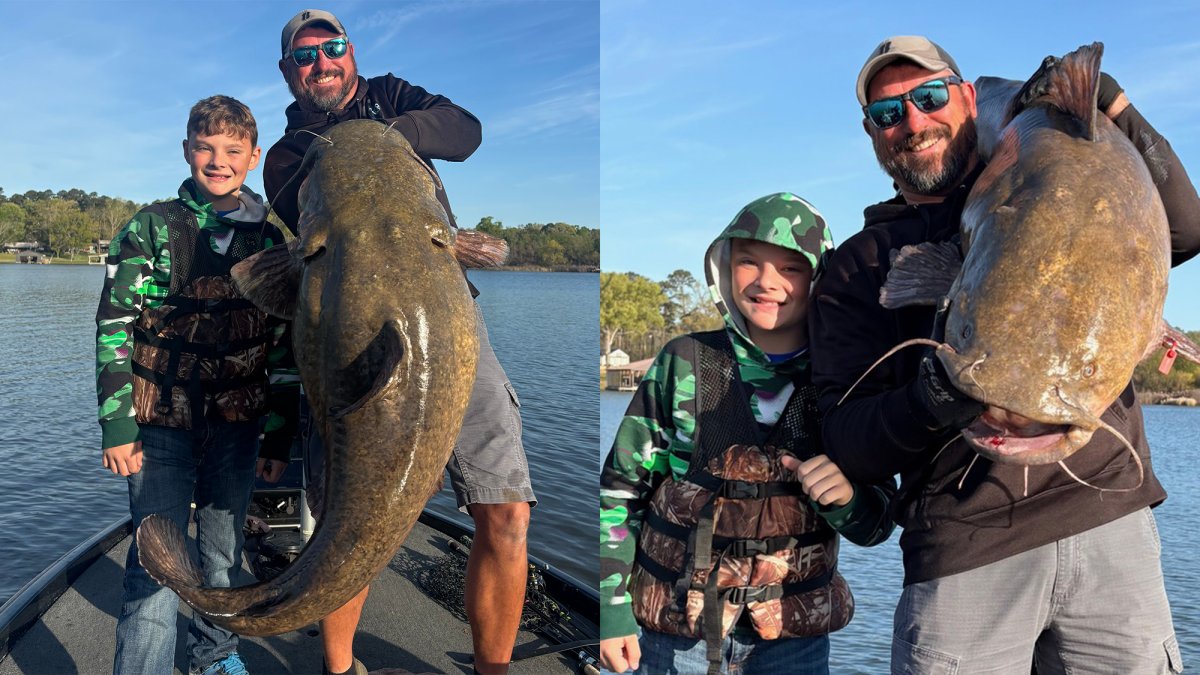

It was about 8 a.m. when Tucker Sepaugh hooked into a giant catfish.
It was March 19, and Tucker was fishing with his dad, Aaron, and veteran guide William Oliver in northeast Texas. They were targeting big flatheads on the 4,700-acre Lake Tyler when a rod got bit.
Tucker picked up the heavy-duty custom bait-casting rod and put his 90-pound body to work battling the deep cat. But it soon became obvious that the flathead was more fish than the 11-year-old could reasonably handle.
“After about a minute or so his arms straightened out, fatigued from the fish. It was just too much for him,” Oliver, 39, tells Outdoor Life. “Tucker had to get help from his dad to stop the catfish’s run.”
Knowing that Tucker was either going to lose the rod to the fish or get pulled into the lake, Aaron and Oliver helped bring the catfish to the boat.
Because Tucker needed assistance, the 72-pound flathead was not eligible as a record-setting catch. (No more than one angler can touch the rod for it to be a record.) Had Tucker miraculously landed the fish on his own, the 72-pounder would have set a Texas youth record for the heaviest flathead catfish ever caught in the state.
The current state youth record is a 70-pound flathead was caught in 2010 by Ashleigh DeFee from Lake Tawakoni.
“We weighed the fish after I hauled it aboard, then I tagged it and released the fish back into the lake,” says Oliver, a full-time fishing guide from Chandler. “We were only looking for big catfish that day, and we caught three or four – tagging them all and releasing them.”
Oliver has tagged over 1,000 catfish on Lake Tyler and nearby Lake Palestine. He targets big flathead catfish using forward-facing sonar and has learned a lot from his FFS efforts and his tagging.
His tagging is lawful in Texas, where he works with state biologist Jake Norman to share information about the catfish he catches and releases.
“I’ve found that the big catfish like cover such as logs, stumps, brush piles, those sorts of things, and they hold to them very tight,” he says. “Over the years I’ve learned that big catfish use the same spots and they can travel great distances from one log or brush pile to another one.
“Forward-facing sonar really helps spot fish on that kind of cover, but they are much more difficult to identify than some other species like crappies or bass because they hold so tight to logs and brush.”
Oliver says his clients have caught flathead catfish from brush piles miles apart from where he’d previously released them, and often just days apart.
“I used to think that flathead cats were very territorial and didn’t move around much,” he said. “But that’s not so.”
Oliver says one 31-pound flathead that he tagged and released was caught nearly four miles away a week later by another client. Another time, one of Oliver’s clients released a 12-pound cat that he tagged and released; another client caught the same fish six days later, nearly six miles away.
Read Next: How to Catch Channel Catfish — and Why You Should Target Them This Spring
“I use side sonar to locate good cover spots and use FFS to inspect a spot and find specific big catfish on cover,” he says. “My sonar isn’t special. Lots of anglers use the same Garmin units. But catfish hold so tight to cover that it takes practice to learn what to look forward on sonar screens to pinpoint cats, even big ones.”
Read the full article here