I Was Bowhunting in Old Mexico with the Legendary Lee Brothers When Tragedy Struck


This story, “Tuxpan Tigre,” appeared in the July 1960 issue of Outdoor Life.
I couldn’t blame my friends for thinking my jaguar hunt in Mexico was a reckless plan.
They weren’t entirely wrong.
The trip to Nayarit, Mexico, from my home at Sacramento, California. was to be made in a light plane that I’d pilot myself, and there are hazards in flying a light plane into a region that has only a few primitive landing strips. I planned to get my jaguar with a bow and arrows, though my experience with archery equipment was limited to three months of target practice. I’d never hunted the dangerous jaguar before with any kind of weapon, nor had I ever been in the part of Mexico where the hunt would take place.
I started thinking about a jaguar hunt in January of 1959, shortly after I got interested in archery.
I knew that the jaguar was the third largest cat in the world, outweighed only by the African lion and the Asian tiger. The jaguar is a fighter, too. He’s likely to kill hounds that trail him, and among the natives of Mexico and South America there are many tales of missing friends and kin — victims of the spotted menace they call el tigre, the tiger.
I’ve been a general gun nut and a rifle hunter for years. My rifle hunts for deer and bear have taken me to Utah, Colorado, Nevada, and Idaho. But the prospect of a bow hunt for jaguar had that extra appeal of a new experience in a far place. The idea soon monopolized my thoughts.
There were ready answers to the questions of vacation time and transportation. I was due a vacation from my job at McClellan Air Force Base, where I have worked 18 years as a fire fighter with the crash-fire unit. Additional income from my 17 rented housing units allows me to support a half interest in a light plane that’s ideal transportation for my out-of-state hunting trips.
I chose the Lee brothers of Tucson, Arizona, as guides and outfitters for my jaguar hunt on the basis of stories I’d read about them and their famous cat-trailing hounds. They’ve outfitted dozens of jaguar hunts in Mexico and South America.
I found a partner for my trip in Pat Ward, a real estate man from Carmichael, California. Still hampered by a back injury he got in an automobile accident, Pat was more interested in taking movies of the area and its people than in the actual hunting.
Vintage OL Stickers
Browse the Collection
Once the basic plans were set, I joined the Valley Bowhunters Club of Sacramento and began to sharpen my shooting skill with this new weapon. For three months I practiced as much as aching muscles would allow. When my index finger became raw, I fash-ioned a protective thimble for it and went on with my practice.
Pat and I were scheduled to meet the Lee brothers at Tuxpan, Mexico. They’d have a base camp set up near there when we arrived. All arrangements about dogs and camp equipment were left to them.
Pat and I took off from Sacramento at dawn on March 17 and headed south. We arrived in Tucson, Arizona, that afternoon and stayed in a motel overnight. Next morning we took off for Nogales on the Mexican border. There we filed an affidavit of sojourn. Then we flew on to Hermosillo, where we were checked through Mexican customs. I can’t speak Spanish, so at this point I putmy tongue away and started using my hands.
Luckily, Pat Ward knew enough of the language to solve some of our problems. After a reckless ride in a taxi to the main part of town, we exchanged our money for an equal amount of theirs. After converting gallons to liters, pounds to kilos, dollars to pesos, and miles to kilometers (with people I couldn’t even converse with) I found myself heading for Guaymas an hour later, still trying to figure how much a gallon the gas was and who came out best in the money exchange.
By late afternoon we were over the primitive landing field at Los Mochis, on Gulf of California. Coming in for a landing, we narrowly missed a goat and scared a week’s production of milk from a cow. We taxied to the parking area, only to find siesta time was being observed. After some haggling over price and exchange of coins, Pat persuaded an attendant to fill our plane tanks. Barrels were rolled out to the airplane and gas transferred to our tanks in open pails. Then we subjected ourselves to another careening taxi ride to a hotel in the village. All our Mexican taxi drivers were wild as stock-car racers.
Next morning we left early for our final leg of the journey to Tuxpan, where we landed. I’m still not sure it was an airport, but it was level, anyway. Pat found someone to take us into town, where we waited at a hotel for Dale Lee.
The people seemed curious about my bow and arrows, and expressed doubt as to their effectiveness on a jaguar. Dale had hired nine locals and set up a base camp about 20 miles northwest of Tuxpan. Some of the Native helpers brought their wives to camp, and with the wives came the children, pigs, and chickens. We had quite a settlement. From camp we were able to catch fish as fast as we put our lines in the water, or take a shotgun and get a good supply of ducks in a few minutes. The next 10 days we all ate, slept, sweated, and rejoiced together as one unit. I made many friends, and have only the highest respect for these people. Though they lack almost all the luxuries we enjoy, they are the happiest people I ever met. Once you break through the outer shell of wariness, for these people have just cause, you find them friendly, helpful, cheerful even when things go wrong. They’re not bothered by heart attacks or ulcers.
We learned that shortly before we arrived a jaguar had killed five of Dale’s dogs, and wounded four more, before it got away. The big cats were here.
Our hunting started the morning after we arrived, when we loaded two motor boats with 15 dogs, personnel, portable camp gear, and headed for camp No. 2. After about five hours of poling and motoring, we set up this out camp on the edge of a lake of mixed fresh and salt water, called Agua Brava. This lake is surrounded by marshy jungle. There are crocodiles, birds by the thousands, snakes, turtles, and many kinds of mammals.
After making camp and feeding the dogs, we got about three hours’ sleep before starting the first hunt. Then we loaded some of the helpers and all the dogs into the boats and started up one of the many streams leaving the lake. We used an animal caller, made from a gourd about the size of a basketball. Both ends of the gourd were cut off and a skin stretched tight over one end. A leather thong soaked in beeswax dangled from the center of the skin through the open end of the gourd. By pulling this string, the locals made an amplified grunting noise similar to that of a jaguar.
Every ten minutes or so a guide would make a grunting noise with the caller, then we’d listen for an answer. We cruised and called at intervals until long after dark. Then we stopped and made another camp where we slept till dawn. We released the dogs and hunted most of the next day before we returned to camp No. 2 tired and hungry.
When I took off my shirt in camp I saw I was covered with hundreds of small ticks. By turning my bare back to the hot sun, I forced them to crawl around to the front where I could pick them off. A local helped me with a ball of sticky beeswax, passing it against the ticks to pull them off.
In half an hour I was free from ticks, only to start an endless battle with the tiny bugs the natives call “ja-jens” (pronounced hey hens). However you spell or pronounce its name, the ja-jen is the most vicious insect nature ever devised. You can hardly see them, but they are all biting mouth. If they were as big as bumble bees, I think they would rule the world.
After getting a few hours sleep at camp No. 2 we went out again about 1 a.m. and called till dawn. Still no answer. We selected a likely spot and released three dogs.
If any less than three dogs jump a jaguar, it may kill them rather than run. Dale usually releases at least 10 dogs as soon as the lead dogs pick up a scent. Even with a large pack of dogs, it’s important to get to a treed jaguar as soon as possible. He may jump down and start killing dogs in a running fight. For this reason, you have to stay as close as possible to the dogs at all times.
Most of the chase will be through mud a foot deep and heavy undergrowth. After fighting the mangroves, mud, heat, insects, and vines for six or seven hours, you earn a rest, but you have to keep going. I soon found out why a jaguar is a rare trophy.
After about four hours of following the dogs, which seemed to be running in circles, I sat down to rest. Then the dogs seemed to step up their tempo. They seemed to be in no concentrated spot, but all around me. The jungle was hot, I was tired, hungry, and sleepy. I started wondering what I was doing here, up to my knees in mud, hunting an animal I’d never even seen with a doubtful weapon.
Then the dogs were coming my way. I could hear growling and snarling, dogs yelping, water splashing, limbs breaking. I looked at my bow, and it seemed awfully small. The only gun was with Dale, and he’d promised not to use it unless absolutely necessary. The last time I’d seen him, he had slipped in the mud, and completely submerged his gun. Even if I’d wanted to run, I wouldn’t have known which way to go or how far, as I seemed to be in the middle of all the activity.
Suddenly a guide broke out of the undergrowth excitedly calling “tigre, tigre,” and motioning for me to follow him. We came to a large thicket, where I could hear the jaguar snarling and spitting at the dogs.
I had only five arrows — four in the bow quiver and one notched ready to shoot. I previously found out there were too many vines and limbs to carry a back quiver. I gave one arrow to the man and motioned for him to follow me and hand it to me as soon as I used the one I had notched. I still couldn’t see anything, so I started crawling to where I heard the commotion.
When I was within 20 feet of the jaguar, I could see it clearly. It was about eight feet off the ground on a limb, with the dogs below it. This is the most dangerous time for the dogs. When they see you, they get overly brave. Fortunately, the jaguar was high enough so that no dog could reach it, although they would jump up at it and it would spit and swipe at them. The animal was looking away from me and to my left.
I found enough room to draw my bow. I couldn’t see enough of the jaguar’s head and neck, so I aimed behind the shoulder and slightly low, where the heart should be. I released the arrow, expected to see the cat explode in a fit of fury.
The bear broadhead with razor inserts hit about three inches higher than I’d aimed. But the solid hit was of no apparent concern of the jaguar. It just glanced back over its shoulder at me as if I’d made some insulting remark.
I reached back for the arrow which the man had, but he wasn’t there; he’d stopped about 10 feet behind me. I took another arrow out of the bow quiver and notched it. I could then see blood running from the jaguar’s shoulder. My fingers weren’t quite as nimble as they should have been. As I started to draw again, the cat looked at me and then at the dogs. He knew he had to come out either where I was, or where the dogs were. He elected to go through the dogs.
A dog was cut open when the jaguar went through them, and they took off in the loudest commotion you ever heard. The chase lasted about 100 yards. Then the noise subsided some. When I arrived, the jaguar was dying and the dogs were biting and mauling it relentlessly.
I asked Dale to call them off, as I would like to have a little jaguar hide left to take back with me. He said that they wouldn’t hurt it. Besides, it was the only fun they got out of the chase. He was right. When we skinned the big cat there wasn’t a tooth mark on the tough hide.
All the men gathered around and gave different versions of the kill at the same time. They were elated that the bow had killed the jaguar. The chatter lasted all the way back to camp No. 1.
We rested a day at base camp while the jaguar hide was dressed and packed with salt for shipment to a taxidermist. One man was assigned to care for the dogs. He sewed up the dog that was injured on the kill. (A couple of years ago this same man saved Lily, one of Dale’s prize dogs, in a jaguar fight. The jaguar had killed one dog, and had Lily down, when he stepped in with his machete and killed the jaguar by hitting it behind the head.)
A dog was cut open when the jaguar went through them, and they took off in the loudest commotion you ever heard.
After spending some time with Pat Ward, who was busy filming things in and around base camp, I decided to try for a second jaguar. We boated back to camp No. 2 for the second phase of the hunt. We spent the evening calling and traveling, napped a few hours, then put in a long day hunting with the dogs. The Native guides would occasionally stop to climb a tree and reach into a hole to see if there were any baby parrots in it. There was a cash market for parrots. For an ocelot, they would get $40, which was almost a year’s wages. A crocodile brought from $30 to $50.
While hunting, I came upon a boa, one of the big jungle snakes, sleeping on a limb. I poked it with my bow. It raised its head and looked at me, then went back to sleep very unconcerned. We saw many iguanas, which are lizards three or four feet long. We were frustrated in all our early efforts to find that second jaguar.
Returning to Camp No. 2 from a short hunt that failed, the guides caught a couple of turtles about 14 inches in diameter. One had 35 eggs in it, which were devoured with delight. While we wet·e resting the dogs and ourselves, I caught 10 catfish more than 14 inches long from my bed, which was a platform of sticks on stilts in the edge of the river. A local waded out into the river and threw out a net that brought in about 50 fish with one haul. One fish with a native name that sounds like “tebolda” grows up to six feet long. It’s an excellent food fish.
The next evening at 9 p.m. we left for the western shore of Lake Agua Brava, about six miles from camp No. 2. Dale’s favorite jaguar hound, Lily, was at the bow of the first boat, eager to get ashore. Suddenly, out of nowhere, a fish about 14 inches long hit a man sitting beside me full in the chest. Then another fish bounced off the bow of the boat. Dale said these were “leaping Lisas,” a fish admired by the Natives for its fine eating quality. The fish would sometimes leap as high as five feet into the air when our boat passed through a school of them.. We collected four of them in the boat by the time we’d crossed the lake.
Reaching the opposite shore, we worked up a likely looking stream as far as we could with motors. Then we used poles and pulled ourselves along with the mangrove trees growing around and over the water. There’s a small black snake that lies on limbs over the streams and drops into the water at the first sign of danger. They are harmless, but very annoying.
The night was very dark by now. The jungle was silent, except for water birds we startled or the splashing of a large fish trying to escape to deeper water. About 2 a.m. we started calling with the animal caller. An eerie silence fell over the jungle. Dogs were tense, natives strained to listen for a distant answer.
After an hour of unanswered calling, things relaxed a bit. The dogs tried to curl up wherever possible to take short naps. Men dozed. Then it came — a roar of response from a prowling jaguar maybe a mile away. Everyone was alert and listening. Dogs quivered with excitement. Lily stood erect and silent, waiting for her part in the hunt. There was no further sound.
The man handling our caller strummed it again. The big cat answered a little closer. Ten minutes later the jaguar was only a quarter of a mile away, responding to the call with a loud series of grunts, very deep and coarse. Its voice radiated a sure and fearless tone that made all other creatures of the jungle offer silent respect to this animal that is surely king of his domain. The night seemed even darker, and a tingle ran up my spine.
The next roar came within 200 yards of our boat. With the eager dogs tied short to the sides of the boat, we now started to move away from the sound. Dale wanted the jaguar to follow the boat, so we could double back behind him and put the dogs on his track when dawn arrived.
At dawn, we were in position with the dogs. I strung my bow, positioned four extra arrows in the bow quiver. The dogs took up the scent at once. Within an hour, the barking centralized at one spot. El Tigre was treed. Running, stumbling, wading, we rushed to the location of the sound, arriving breathless and soaked. In a mangrove, about 50 feet up, sat the jaguar, calm and unconcerned.
I was out of arrows now, and the jaguar still looked very dangerous.
I drew and released an arrow aimed at the rib cage behind the shoulder. The shaft penetrated its mark up to the feathers. The jaguar growled, whirled and bit off the protruding head of the arrow. I released another arrow, hitting within an inch of the first one. As the jaguar turned to face me, I released a third arrow that buried itself in the animal’s chest. Snarling, it retreated a step back on the limb as the fourth arrow struck diagonally across the chest.
I was out of arrows now, and the jaguar still looked very dangerous. But while I stood there wondering what to do next the big cat slowly relaxed and fell dead into the dog pack.
We returned with great jubilation to camp No. 2 to pack up for the journey back to base camp. Lily and the rest of the dogs, we agreed, had done a wonderful job. Next day we steered our loaded boats out into the lake, not knowing of the tragedy ahead.
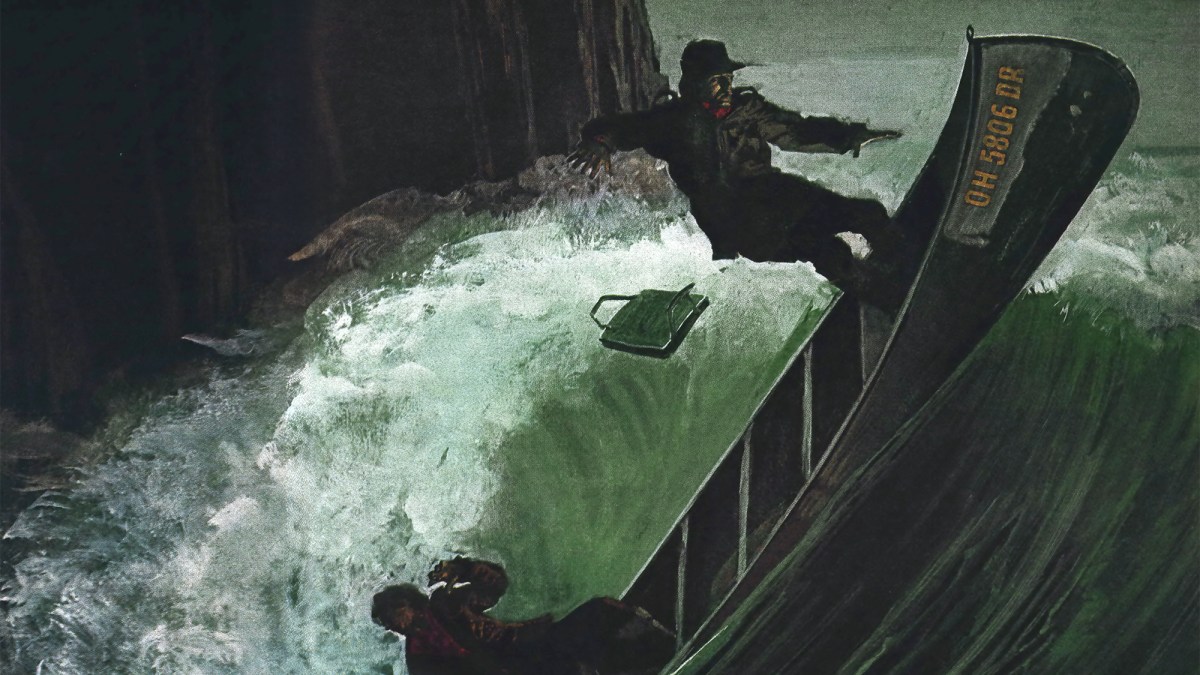
The first boat left for camp No. 1 at 10 a.m., loaded with 15 dogs and five men, plus assorted provisions. I left in the second boat about five minutes later, riding with Dale and the rest of our helpers. The trouble came at the southwest end of Lake Agua Brava as we steered for the main stream that would take us to home camp. The water here was choppy.
Suddenly Dale stood up and shouted, “Something’s wrong with the boat up ahead!”
I looked up in time to see the bow come out of the water. Then the lead boat rolled bottom up.
Dale yelled, “The dogs are tied to the boat. They’ll drown if they’re not cut loose.”
At full speed, we headed for the stricken boat. With the choppy water, and the full load, we couldn’t progress very fast. As we approached, we could see two natives hanging onto the overturned boat. Another was clinging to a floating gas can, and two others were swimming for the shore.
Dale and I stripped off our clothes and dived in with knives to cut dogs loose. The water was so murky I had to feel my way under the boat. The depths were full of struggling dogs. I cut as many loose as I could, came up for air, dived again.
After three or four dives, Dale and I had done all we could. There were two dogs floundering for shore, so weak they were making no progress. I saw one go under. I grabbed the other, and swam for shore. At times, I wasn’t sure I could make it. Dale stayed with the overturned boat.
Some men who were fishing nearby saw the situation and rowed out to help. When I reached shore, both the dog and I were too weak to crawl out. A Native man helped us.
Soon the rescue boat returned, with Dale in it. Dale got out carrying the limp body of Lily, which he’d recovered from the boat. I gave her artificial respiration for half an hour. All I accomplished was to get a painful sunburn. Eight of the 15 dogs were lost, including such leaders as Lily, Major, and Bloocher.
Read Next: O’Connor in Botswana: Charged by a Cape Buffalo That Refused to Die
The jaguar was in the boat that had capsized, but luckily was wedged under a seat, so he was recovered. However, all the machetes carried by the locals were gone. This represented a major loss to them. They use a machete for everything from making their beds to opening turtles for food, and the big knives are costly to people with too little cash income. Arriving at base camp, we told our tales and retired early. About midnight I was awakened by an assortment of discomforts I immediately recognized as dysentery. This is a common tourist illness in Mexico, so I had brought along a prescription I took at once. The next day I stayed close to camp.
The third day, Pat and I bade farewell to our friends, who shouted invitations to come back as we boarded the plane. As the wheels left the ground, we looked back and watched time and distance slowly erase from sight an experience that will live forever in our minds.
This story has been minimally edited to meet contemporary standards.
Read the full article here