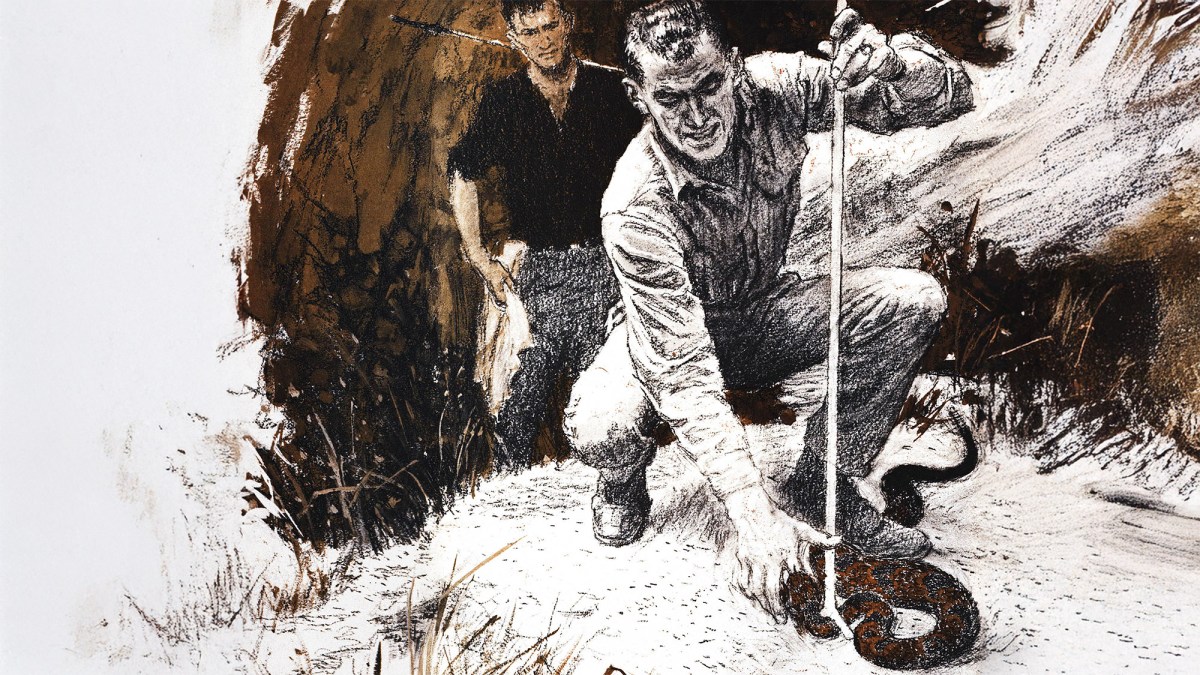

This story, “Once Too Often,” appeared in the July 1966 issue of Outdoor Life.
The snake was stretched full length on a big, flat rock, and it was the biggest timber rattler I’d ever seen.
I wasn’t really snake hunting that Sunday afternoon. It was the third week in July, not the best time to find either rattlers or copperheads, and I’d climbed the mountain above Lovelton, about 20 miles from home, mostly to check on some small mountain ash trees I hoped to dig up and transplant later. I knew I’d be in snake country, however, and I was carrying a forked stick, snake hook, and muslin bag just in case.
I’d sat out a heavy thundershower in my car before starting up the old logging road that led to the ledge where the trees were. Although the sun had come out again, the air was humid, and everything was soaking wet. All in all, I didn’t expect to encounter any snakes, and I dropped my guard and did something I’m usually careful not to do.
In a snake area you don’t walk around gazing all over the countryside. Instead, you concentrate on a small semicircular area in front of you and to the left and right as you walk. In that way, although it’s not unusual to get close to a rattler before you spot it, you’re ready, and there’s not much chance it will take you by surprise.
Related: Our Professor Gives Extra Credit for Catching Live Rattlesnakes. That’s How We Stumbled into a Snake Den
I wasn’t doing that, however. I was wandering along, looking around, and was just two steps from the snake when I saw it. I’m not afraid of snakes, but this one gave me a real start. The sight of it out in the open, thick-bodied and sinister, was something I’ll remember as long as I live. Our timber rattlers in the Pennsylvania mountains have two color phases, black and yellow. Color is not related to the sex of the snake. This was a black one with blotches faintly outlined in pale yellow, a beautiful but deadly looking animal.
The snake had not made a sound. Without moving from my tracks, I reached over and pinned him behind the head with my forked stick. The reaction was violent. The snake rattled angrily, thrashed wildly, and sprayed considerable rattlesnake musk or scent.
This musk is emitted from two scent glands, one on either side of the vent. If the tail is off the ground, for instance, when the snake is being handled or bagged, it can spray the musk three feet or more. The smell of the musk has been compared with that of sliced cucumbers, freshly mowed thistles, and various other things. My own feeling is that it doesn’t really smell like anything but rattler musk. It’s not unpleasant, but once you come in contact with it, you’re not likely to forget the odor. This time, because of the humidity, the scent seemed to hang in the air. Under these conditions I’d have known I was very close to a rattlesnake if I’d been wearing ear plugs and a blindfold. I didn’t want to take the snake home alive, something I frequently do. After looking it over and speculating on its length, I killed it as I usually do by severing the backbone just behind the head quickly and cleanly with my penknife.
Then I took time to look around.
There was a large, flat rock beside me, and when my eyes followed its edge, I spotted the head of a second rattler just barely showing no more than five feet away. The rest of the snake was back under the rock and there was no way to get it out, so I left it alone and looked around.
You can imagine my surprise when I spotted a third snake about 20 feet away on the ledge, stretched out as the first one had been. It was another fine, big specimen, and like the other two, it had not rattled. I walked cautiously over to the snake, pinned it, and killed it as I had the first.
I dropped the two dead snakes into my bag with due caution. Even the freshly severed head of a rattler can deliver a severe bite, and a freshly killed snake can bite about as hard as a live one by reflex action if it is handled while the head is still intact.
I had become aware that I was in a prime snake area, and I kept my eyes glued where they belonged. I had gone no more than 75 yards when I came across a fourth rattler, also stretched out on a rock. There must have been something about the humid weather that afternoon that they liked. I killed this one, put it into the bag with the others, and decided I had enough. When I measured them later, the three snakes were 51, 47, and 45½ inches long. The 51-incher was the largest I have ever encountered. They made quite a load, and I had 3½ miles to hike back to my car, so I called it quits and started down the mountain.
I hadn’t traveled a quarter of a mile when I spotted two more, one big, the other small, coiled at the edge of the logging road. They hadn’t been there when I walked up an hour before, but the favorable conditions had brought them out. That was in 1963, and I hadn’t yet acquired snakeproof boots or snake tongs. Catching that pair with no tools except the forked stick and the hook posed a problem. I managed it by pinning one and lifting the other out into the road with the hook. Then I kept the second snake on the defensive while I hooked the first one out. I pinned and killed them one at a time on the road.
My score that afternoon was six rattlers seen and five killed, including the largest I have ever met. Not bad for a trip that wasn’t even intended as a snake hunt.
There was one curious thing about those six snakes: not one had rattled or shown any sign of alarm or hostility until I used my forked stick, even though I was close when I first saw them and no more than a step or two away when I pinned them. It proves one thing that every snake hunter learns.
You can’t count on a rattle.
If you get near enough, the snake’s quite likely to strike first and rattle afterward, if it rattles at all.
I’m 45 years old, an optometrist at Pittston, Pennsylvania, about halfway between Scranton and Wilkes-Barre. I grew up and have lived all my life in that area, except for 3 1/2 years in the army during World War II. I’ve fished and hunted since I was a boy.
I’ve been tying my own trout flies for 25 years. Until two years ago, I spent almost every Wednesday from dawn until dark or after dark on a trout stream, and just about every Sunday afternoon the same way. That went on from the start of trout season until bass fishing time. Then my routine changed. From dawn until 10 a.m. each Wednesday, I fished for bass. The rest of the day I hunted woodchucks or crows. I have .22 Hornet, .220, .270, and .30/06 rifles, and I handload all my ammunition.
This activity continued until spring of 1964. That year, I didn’t make one trip to a trout stream or bass lake or shoot a single woodchuck. And 1965, except for four or five brief trout-fishing jaunts, was the same.
Why a complete and puzzling change in my lifelong habits? I got interested in snake hunting. Next thing I knew, I came down with a real hard case. I still hunt small game and deer in the fall in both the gun and the archery season, but only because snakes are in hibernation then. So far as I am concerned, hunting rattlers and copperheads the way I and a few of my partners do it outranks any other outdoor sport available in our part of the country for thrills, excitement, and a stimulating degree of danger. When you go snake hunting, you know you’re after something that can fight back, and you can’t afford to forget it for a second.
My snake hunting started slowly. I’ve been interested in snakes as far back as I can remember, but despite all the fishing and hunting I had done in rattlesnake country, I never encountered one in the wild until 1957. Returning from a fishing trip that June, just out of Towanda I saw a timber rattler on the road. I stopped to look it over. I’d read that you could kill a snake by hitting it sharply behind the head with a small switch. I tried this, and it worked. I put the dead snake in my empty creel and took it home.
Read Next: I Watched a Giant Rattlesnake Kill a Man
Two weeks later, on the way back after another fishing trip, the same thing happened.
I decided that if rattlers were that plentiful in the woods, I could have fun hunting them. It took me quite a while to learn the tricks. In the first four years, from that June through the summer of 1961, I tramped more miles than I can even estimate, spent countless hours searching for snakes, and found a total of exactly five. The trouble, I learned later, was that I didn’t know where or when to look.
In 1962, things picked up. My score that year climbed to 25. I matched that figure in 1963, almost doubled it in 1964 with a kill of 48, and took 62 last year.
Just about all of my rattler hunting is in Wyoming County, north of Pittston, in the vicinity of Noxen, Forkston, or Lovelton. There are many other areas within an 80-mile radius of my home that I’m sure would provide as good hunting, but it seems easier to go back to familiar places. The country I hunt has an abundance of snakes, and the den sites are easy to reach. Many old logging roads and gameland roads, closed to vehicles, lead to good ledges at the top of the mountains.
Since 1963, I’ve picked up four partners who share my enthusiasm and go with me on many hunts. One is Gerald Schaefer, whom I met that summer. He was teaching biology and studying for his master’s degree, which he now has, at Louisiana State University. When we met, he was spending vacation with his parents at Tunkhannock. He’d hunted snakes since he was in junior high school and had studied them extensively in college. He taught me much of what I now know about the sport. The best and safest way to start is to go on several trips with an experienced snake hunter and learn the ropes first hand.
Another partner is Glenn Spencer, who works as a maintenance man at Dalle.s for the Pennsylvania Game Commission. Glenn has been hunting snakes for 25 years. Between those two, I’ve had expert coaching. The last two years, Barry Spencer, a son of Glenn’s cousin, has teamed up with us. He furnishes the jeep transportation. My nephew, Harold Kuschel, 17, completes our quintet of regulars.
When we go out on Sunday afternoons with the jeep, two to four of us usually hunt together. Sometimes there’s an outsider along as spectator. On Wednesdays, I walk, and nine times out of 10 I go alone. Hunting on foot has one advantage. You can get to a lot of out-of-the-way spots the jeep can’t reach.
Our hunting is done in ledge areas in the vicinity of the winter dens. The ledges range in height from six to 30 feet, and sometimes they are several hundred feet long. The ledges are broken by crevices and fissures, and loose rocks of all sizes lie on them and below them. Ferns, huckleberry bushes, and small trees provide the ample cover snakes require; they can’t survive direct sunlight or high temperatures. The snakes hibernate in these ledges, but we have yet to locate any single rock or crevice to which large numbers return year after year.
We start hunting in May, shortly after snakes emerge from hibernation. The earliest I’ve taken one was May 5. May and June are the most productive months, and success depends on the weather, location of the ledge, and being there on a day with the right temperature and humidity. Often, a rainstorm seems to be the signal for the snakes to come out, but hunting them is like hunting any game — sometimes you find none on what appears to be an ideal day.
I’ve read that ledges facing south are best. But early in the season, I find more rattlers in ledges facing west. The snakes mate shortly after coming out of winter quarters, and for a while they’re likely to be found in pairs. Later, though you may find several in a relatively small area, they won’t be lying together. As the weather warms, the rattlers scatter in all directions and move to their summer feeding grounds, traveling as far as two miles or more. They have three basic requirements — food, water, and cover. If conditions are right, some snakes can usually be found around the den areas all summer. Although rattlers do most of their hunting at night, especially in hot weather, they’re also likely to prowl during the day.
In the summer, both rattlers and copperheads are likely to be found almost anywhere — in berry patches, yards, fields, and gardens — and even around buildings. Since picnickers, hikers, swimmers, and berry pickers are in the woods then and children are at play, summer is when most snake-bites occur. On the last trip I made to Dark Hollow for copperheads, I checked a spot that almost unfailingly yields one or two. I found that every rock of suitable size had been picked up and moved to build an outdoor fireplace. Why someone wasn’t bitten on that cookout, I’ll never know.
We get our best hunting for copperheads between Tunkhannock and Mehoopany, where the Lehigh Valley Railroad parallels the north branch of the Susquehanna River. Copperheads seem to thrive near civilization better than timber rattlers do, maybe because of their more secretive habits and marvelous camouflage, and also because they don’t rattle and give themselves away.
I don’t spend as much time hunting copperheads as I do rattlers, but they fascinate me. The copperhead is less to be trusted than the rattlesnake, and it’s more difficult to detect, especially if it’s coiled in dead leaves. Copperheads move quicker than rattlers, but they’re not so likely to attempt escape. Usually they strike at anything that comes within range, even snake tongs.
I have flipped a flat rock over to capture a copperhead under it, only to have the rock land alongside another copperhead hidden in dry leaves and grapevines without causing the second snake to move. Copperheads are tricky, v1c10us, and likely to stand their ground. The rattler, on the other hand, usually has a getaway route handy and uses it if he can.
Fortunately, the copperhead’s bite is less dangerous than that of the rattlesnake. The venom is less toxic. An adult copperhead averages only about three feet in length, and a full-grown rattler close to four. Since the length of the fangs and the amount of venom injected depends on the size of the snake (an adult timber rattler may have fangs half an inch long), the copperhead’s bite is less deep and severe.
All of the snakes my partners and I catch now are taken home alive. At a later date, they are killed if there’s no demand for live ones. I’ve been unable to find any market for them, but the Pennsylvania Game Commission keeps several in a display at Dallas, and Gerald Schaefer does some trading with collectors in other countries.
We do not collect any harmless snakes unless someone has put in a request for them. We use homemade tongs to lift the snakes out into the open, and we use either a hook or a forked stick to pin them. A forked stick is safe enough if handled properly and carefully. You can make a satisfactory hook by bending a ¼-inch steel rod into an L and fitting it to a broken golf club.
To pick up a rattler or copperhead, I first pin it by pressing the head firmly to the ground and putting my foot on the body or foot or so back to prevent thrashing. I wear snakeproof boots on most of my hunts now. Next, I put my thumb on one side of the neck and my middle finger on the other side. I press down on the top of the head with my index finger. With that grip, the snake is less able to twist its head or free itself. Once you have the snake hard and fast, remove the hook, grab the body with your other hand, and pick the snake up. A snake lifted by the neck alone is likely to thrash hard enough to break either your grip or its own neck.
One warning — if you have a foot on a snake’s body, expect it to use your foot for leverage in an attempt to draw its head back when you first take hold of it. A big snake is quite strong.
It’s best to grab a snake quickly once you have it pinned. The longer you hold its head down, the more irritated and hard to handle it becomes. Many bites happen when the snake is picked up, so be very cautious.
Sacking your catch is simple. We use muslin bags 39 inches deep and 12 to 14 inches wide. Get the snake started into the bag tail first. Small ones can be dropped right in. A big one is apt to stand on its tail, so you must wait until it relaxes before releasing your hold on its neck. Once the snake falls to the bottom, twirl the bag and tie a knot well up on the twisted section. When you walk, carry the bag so that it doesn’t bump your legs or body. The snake can easily strike through the bag.
Many people have asked me about rattlesnake meat. I have read of snake hunters who express great distaste for eating what they catch, but I don’t feel that way. We have tried fresh rattlesnake and find it very tasty. The meat is white and clean and reminds me of frogs’ legs in flavor and texture. Friends who have tried rattler meat all report it tastes good.
There’s nothing complicated about our way of cooking snake meat. We skin and dress the snake. Then we cut it into three or four-inch lengths and fry it in butter or bacon fat as though it were fish. Some cooks prefer to cut the meat into steaks about half an inch thick because the thin pieces look less like snake. Now and then, rattlers bite themselves in their struggles to escape — by accident I think — but it’s still possible to eat the meat. Rattler venom is not poisonous if taken internally, provided you do not have a cut, sore, or other opening in your mouth or digestive tract, and thorough cooking destroys any venom that might be present.
If a snake hunter pick up poisonous snakes often enough, he stands a very good chance of being bitten. One false move can lead to trouble, and it hap-pens sooner or later to just about everybody who handles these reptiles. I knew that as well as anybody. Nevertheless, I picked up a live rattler once too often.
It happened on Memorial Day of 1963. I’d passed up a chance to go to Canada on a fishing trip, because late May is one of the best periods for snake hunting. My nephew Harold and I headed for a series of ledges at the top of South Mountain.
We caught one medium-size rattler, sacked it alive, found a big blacksnake, and let it go after teasing it to hear it vibrate its tail in the dry leaves to put on a good imitation of a rattlesnake’s buzzing. We ate lunch beside a clear mountain brook, left our snake and the knapsack, and went on hunting along Possum Brook Road.
We had gone about a mile when we found a rattler in grass at the roadside, lying in the round coil they assume when resting. It’s not at all like the U-shaped loops of their fighting stance, although they can strike from it if they need to. Harold pinned the snake, and I picked it up with my left hand. He was a good 44-incher. We had extracted venom from the first one we caught, and wanted a little more. I like to keep a small quantity of the dried venom crystals on hand to show to Boy Scout troops and other groups for whom I often speak on snakes and snake hunting. I prefer to use my right hand for the milking operation, so I dropped the snake on the road, intending to pick it up again.
The rattler made a bee line for the woods. I pinned it with a forked stick in a place covered with dead leaves and pine needles, and I made the cardinal mistake of not making sure the fork was tight up against its head. Next, I reached down by the side of its head instead of coming up behind the stick. That was all the rattler needed. It had a fraction of an inch of neck slack, enough to twist its head and make a lightning-fast stroke with one fang.
It cut a slit a quarter of an inch long in my index finger between the big knuckle and the first joint. My nephew was standing just behind me but hadn’t seen what happened.
“I’ve been bitten,” I told him calmly. I’ve been asked many times how I felt then, and my stock answer is: “Stupid.”
At first, all I felt was a slight burning, and that alone did not necessarily indicate that any venom had been injected. Even a razor nick will burn. After three or four minutes, however, an area the size of a dime around the cut turned white and started to swell. There was no longer any doubt: I had a genuine case of poisonous snakebite. How serious, only the next hour or so would tell.
I was carrying a snakebite kit, as I always do on my rattler hunts, but the small suction cup would not stay in place, so I sucked out what poison and blood I could by mouth. While I was doing that, Harold sterilized the small knife from the kit, and I undertook to lengthen the cut and make another at right angles to the snakebite. That sounds simple, but it proved otherwise. For some reason, I expected the finger to be numb. It wasn’t, and the knife hurt like blazes. I managed. to grit my teeth and lengthen the cut. All this was done while we were standing there with the snake still pinned.
When I needed two hands, Harold took charge of the forked stick I didn’t want to pick up the snake, and my young nephew had never handled live rattlers, so before things got any worse I decided to kill the reptile in the usual way, by severing the backbone close the head. That was before I started taking rattlers home alive, and we ordinarily killed them on the spot, not wanting to turn them loose.
Killing this one proved to be a very painful chore, because the swelling had progressed to my thumb and across my hand to the wrist, and the pain and soreness were severe. I was also beginning to feel a strange, numb, tingling feeling in my lips and tongue. We held a short conference, and agreed on a start for the nearest hospital.
It was a good four miles back to the car. I realized now that the bite was more severe than I’d thought. I wasn’t at all panicky, but I knew that men had died from the bite of a timberrattler before they could walk as far as we had to go.
We started down the mountain at a slow walk. Whatever happened, I knew better than to hurry or exert myself. When we got back to the spot where we’d left the first rattler in the bag, I killed it, again because I was reluctant to let it go, and that was pure torture. I had to hold the snake in my left hand and use the penknife with the swollen, half-helpless right, and it was almost more than I could manage.
It took us an hour and a half to get to the car. By then, the swelling had reached my elbow. But my general condition did not seem much worse, and I could still walk. Harold and I had figured out that the Nesbitt Hospital in Kingston, across the Susquehanna from Wilkes-Barre, was the closest. He had no driver’s license and the Memorial Day traffic was very heavy, so I turned down his offer to drive. By that time, the fingers of my right hand were so puffy I couldn’t bend them, and the palm was swollen to twice its normal size. Shifting gears was pure murder.
We finally parked in front of the hospital, and when I tried to get out of the car, I realized my toes had that numb feeling and my legs wouldn’t do what I wanted them to. I took 10 or 12 staggering steps, regained some measure of control, and got to the nurse at the desk. “A rattlesnake bit me,” I mumbled.
She hurried me into the dispensary and called a doctor. I repeated my story, and he looked at the cut. There were no puncture marks. “You’re sure it was a rattlesnake?” he asked.
“It’s out in the car,” Harold said quickly. “We’ve got two of them. I’ll go bring them in.” The doctor turned down that offer for proof in a hurry. I was put to bed and treatment started at once. The hospital had anti-venin on hand, and luckily the skin test for horse-serum sensitivity proved negative. One 10-cc vial was injected in five or six places in the swollen arm.
The doctor also made a cross incision at the site of the bite.
I experienced no nausea or dizziness, but the pain was severe. For the next 12 days, I went through the typical snakebite victim’s ordeal.
A few days after I was bitten, I developed what is known as serum sickness, a delayed reaction to the horse blood from which antivenin is prepared. It can happen even though the preliminary skin tests are negative.
My lymph glands became swollen and sore, my entire back broke out in blisters, and a series of blisters appeared on my arm from the wrist almost to the armpit. Next, many small blisters popped up on my tongue, and I had very severe pain in my arm and shoulder muscles. Finally, my fingers and toes became stiff and sore, as though I had arthritis.
These symptoms did not all occur at once, for which I am thankful. Each time I figured I could leave the hospital, something else showed up. I can’t say how much of my suffering was due to rattler’s venom and how much to serum sickness, but I was a sick snake hunter for almost two weeks. Released 12 days after being admitted, I had lost an average of a pound a day. I had a very sore hand for weeks afterward, and my index finger still gets numb and cold in weather much below 60°. It even bothers me when I’m hunting and fishing on cool days. All this misery resulted from not more than a single drop of venom, if indeed it was that much, delivered by one fang, and in a cut, not a puncture.
It was a dreadful experience, as snakebite almost always is. When it was all over, friends asked me whether I was ready to give up snake hunting. Not by any means. I’m still at it, almost to the exclusion of other outdoor activities except when the snakes are not abroad, and I expect to be at it the rest of my life. I won’t drop my guard again, however.
Related: The 8 Most Dangerous, Venomous Snakes in the U.S.
There’s a peculiar excitement about snake hunting that’s hard to describe. No matter how many fish you have caught or how many deer you have shot, the next hard strike you get or the next big buck you see still gives you a thrill. Every hunter and fisherman knows that, and its even more true when you’re hunting poisonous snakes, I suppose because of the danger. Almost every hunt includes something the inexperienced would count a close call.
Snake hunting is a sport that costs next to nothing, yet it’s almost equivalent to a tiger hunt. I’ve had more than one spectator come close to a nervous breakdown just watching the proceedings. Quit snake hunting? I should say not!
Read the full article here