Where to Hunt Spring Snow Geese: These Are Your Best Bets for DIY and Guided Hunts

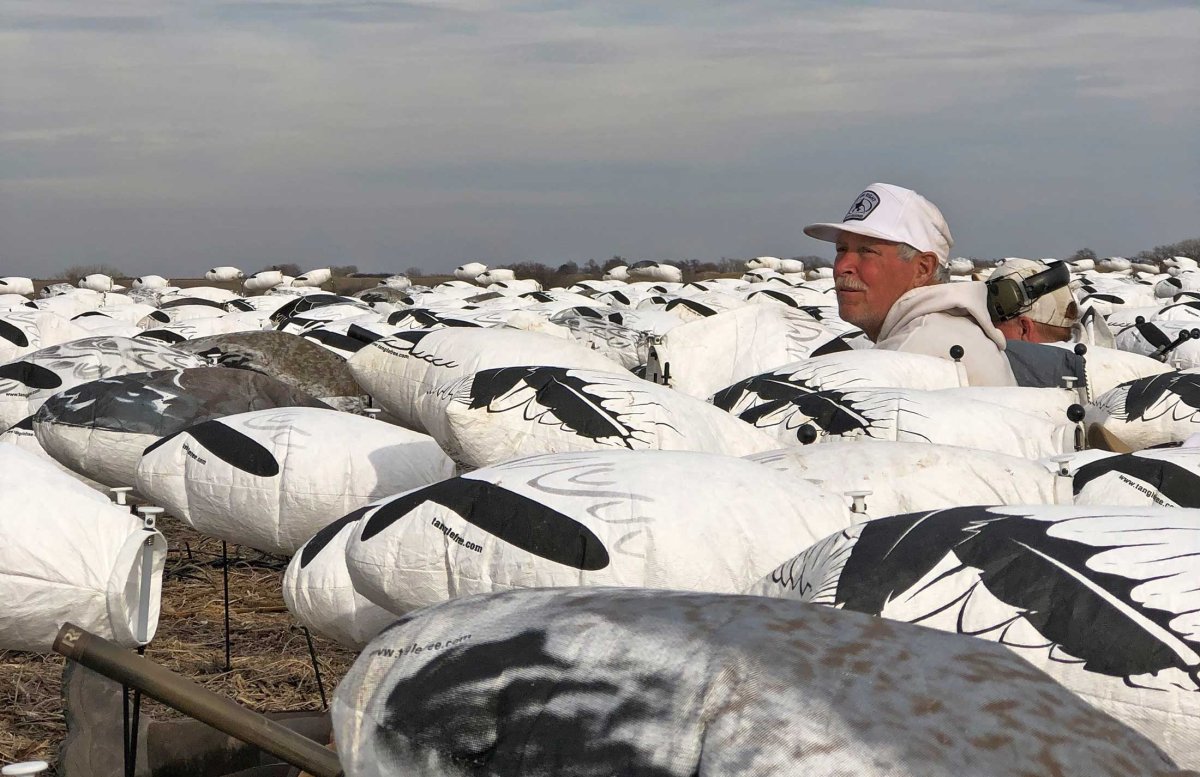

Each spring, millions of snow geese leave the continental United States and migrate northward to the Canadian arctic. And for decades now hunters have been able to target snows in the spring under incredibly liberal regulations.
However, the snow goose population has dropped substantially in the last few years. In fact, many predict that the spring snow goose conservation season won’t last much longer. But for now, the season is still on and there’s still millions of snows to chase.
Having success on a spring snow goose hunt largely comes down to timing. If you’re a little early or a little late, you’ll likely be watching empty skies. Since timing changes season to season, you’ve got to do real time research to keep up with the migration. But use this guide to spring snow goose hunting to help unravel the mystery of where to point your rig come March.
Arkansas
Arkansas is to spring snows like Florida is to spring gobblers; it’s typically the first to open (February 1) and it’s one of the last to close down, usually around the last week of April.
But just because Arkansas offers 90 days and a God’s plenty of snows doesn’t mean it’s a slam dunk. In fact, and ask anyone who’s chased the white birds down Arkansas way, it typically is quite the opposite. Factors in this challenging equation include gaining access to private ground and tremendous hunting pressure. In terms of access, much of the private ground in Arkansas is already spoken for; however, that’s not necessarily a bad thing. There are dozens upon dozens of guide services specializing in spring snows down here.
If you’re new to the game, it makes sense to go with a guide rather than trying to outcompete local hunters for access.
Mound City, Missouri
“It’s the refuge system down here that helps us tremendously in terms of spring snow geese and consistency,” says Kirksville’s Tony Vandemore, co-owner of Habitat Flats Outfitting headquartered in Sumner, Missouri. Today, as it’s been for several years now, Vandemore’s name is synonymous with spring snow goose hunting.
And so is the town of Mound City in northwest Missouri’s Holt County. Here you’ll find the famed Squaw Creek NWR, which will, as Vandemore says, hold in excess of a million white geese at the peak of the northern migration. Southeast of Mound City, the 11,000-acre Swan Lake NWR also harbors plenty of spring birds.
“These refuges, and Squaw Creek in particular, make these birds much easier to pattern,” Vandemore says. “We know where they go at night, and we know where they’re coming from in the morning. There’s still a lot of scouting involved, but dawn and dusk are pretty well set. On the downside, a refuge like Squaw Creek also concentrates hunting pressure. It’s damn near impossible to hide 1.4 million snows from other guys.”
Much like Arkansas, this is mostly a private land game. You’ll have a better time booking an outfitter than trying to go DIY here.
Swan Lake NWR Area, South Dakota
The state of Missouri is a bottleneck for snows migrating north; however, these same birds tend to spread out over much of eastern South Dakota at some point in early to mid-March. And that’s a good thing for hunters when you consider the plentiful public and private land opportunities.
South Dakota’s pothole region provides excellent roosting and loafing waters for transient white geese. The state’s refuge system, too, works as an attractant. Not to steal Vandemore’s thunder, a local who asked that his name and GPS coordinates remain anonymous said, “we have the same situation in South Dakota in terms of refuges and large open-water roosts. Lake Thompson, Sand Lake NWR, and the whole of the James River Valley serves as a lay-over for snows in-transit.”
Here you’ll have better luck going the DIY route. You can still get permission by door knocking in South Dakota, though success rates vary. There’s also a ton of Conservation Reserve Enhancement Program land that allows public hunting on private ground. Just check the local regulations before barging into any private land.
Riverton, Iowa
Viewed from above, it quickly becomes obvious why migrating birds would use the Missouri River as a navigational tool as they head northward into Saskatchewan and points beyond. Lying slightly east of this great blue line, Iowa’s Interstate 29 passes to the west of the Riverton and Forney Lake wildlife management areas, traditionally the focal points of Hawkeye State spring snow goose action. Here, it’s the refuge portions of the WMAs that hold the birds. Gunners, both locals and out-of-towners, set their spreads on private lands in proximity to these safe havens, thus making the drive-scout-knock-ask routine a necessity.
“The Riverton area can still be good,” says Travis Mueller, Territory Manager for Banded Holdings, “but it’s not what it used to be for spring snows. Squaw Creek refuge (Missouri) holds so many birds, and then it’s a short hop north to get to Desoto Bend and beyond. It’s hit or miss — but it can be good.”
North of Council Bluffs, the Desoto Bend NWR will annually stage birds, making the fields between the Missouri River and the sediment hills, aka Loess Hills, to the east prime real estate for snow geese hunters.
Kearney and Grand Island, Nebraska
Drive from North Platte east to Lincoln on Interstate 80 any day, mid-March, and the chances are damn near 100 percent there will be white geese around. Skeins passing high overhead, huge flocks in the corn stubble, and congregations huddled on the roadside borrow ponds. There’s still private ground to be hunted, just for the asking, on either side of the interstate; however, as the popularity of this fantastic spring opportunity has grown in the past decade, it’s only gotten tougher to gain free hunting access.
“Come spring, you can finds snow across the state,” ” says Matt Zvolanek, the influencer behind the popular High Prairie Sportsman YouTube channel. “You do have the Missouri River (corridor) with birds coming north from the Loess Hills. And there’s the Rainwater Basin (in south-central Nebraska) that sees both snows and sandhill cranes.”
As for public hunting opportunities, Zvolanek said that while they do exist, “it’s going to be a lot of work to get those big spreads onto public ground.” Traditional door-knocking can be productive; however, there’s also plenty of outfitters who will already have access locked down.
Read Next: Best Snow Goose Decoys
Eastern Washington
Say the words Eastern Washington to any waterfowler and most will think mallards. Or Canada geese. They’re right, of course. However, this region also gets a good flight of spring snow geese.
“This will be my 30th season I’ve guided in the Columbia Basin,” says goose calling legend, Bill Saunders, of Kennewick, Washington. “And I can say that those first couple years (1994-95), if I saw a snow goose, it was a big deal. And if you shot one, it was a really big deal. Then, 15 or 20 years ago, we were starting to see a few, and by few, I mean 500 to 1,000 a day.”
Today, and while eastern Washington snow numbers aren’t what they are in the Midwest, Saunders says that “when we build up big, we’re probably in that 75,000 to 90,000 range.”
These birds will hold on Washington’s McNary Refuge, along with impoundments like Potholes Reservoir and Moses Lake. Across the Columbia, snows will stage on Oregon’s Cold Springs Refuge in Umatilla County, as well as on the Columbia itself. “You know, we’ve gone from having very few birds to where, several years in a row, I could honestly say I’m seeing twice as many snows every year,” he says.
“There are freelance opportunities for snows here,” said Saunders. “If a guy gets on the Internet and does his homework, [he’ll find] there are a lot of public hunting opportunities around here. You can set up on a migration corridor. You can knock on doors. If you get away from the refuge, it might be possible to get permission on a [private] place. Yes, there are opportunities for the average guy to get out there and hunt spring snows.”
Read the full article here