
This column, “Balancing Act,” appeared in the Aug. 2006 issue of Outdoor Life.
It’s one of the most commonly used words in the entire shooting lexicon, yet it’s possibly the least understood. Its effect on how well we perform with our shotguns, rifles and handguns is profound, but no single definition explains why or how. We even say we know it when we see it (and feel it). But do we really say what we mean when we’re talking about a gun’s balance?
Balance has been described in countless ways, two of which have been accepted in some shooting circles as “classic” definitions. For example, we often hear that a “well-balanced” shotgun is one where the weight feels equal in — or between — the shooter’s hands. A century ago and before, when double-barreled shotguns were lords of the hunting fields, the hinge pin (which connects the barrels to the action) was considered the near ideal balance point for a well-mannered gun. Shooters who were picky about their shooting ware and could afford to have guns built according to their personal whims would specify their desired balance point in reference to the hinge pin or the breech.
In the 1910 edition of his book The Gun, W.W. Greener is quite specific about balance, stating that a 5¾- to 6-pound shotgun with 27- to 28-inch barrels should balance 2 5/8 inches ahead of the breech. This seems to be calling it pretty close, but Greener tended to be rather exact, especially when proclaiming his superior knowledge of all matters pertaining to guns and shooting.
Balance Fundamentals
A time-tested method of measuring a gun’s physical point of balance (or center of gravity) is to dangle the gun in a suspended loop of string, shifting it fore and aft until it teeters evenly. I recently checked out a few of my meager collection’s side-by-side doubles in this manner. Most of them, particularly the older guns, balanced almost exactly on the hinge pin, arousing some suspicion that their balance might have been “refined” by their respective makers. One, a seductive nymph of a smoothbore by Farmars, had obviously been jimmied to get the balance on point. Another one, however, the recently introduced Ruger Gold Label, balanced about an inch forward of the point of barrel rotation (where the hinge pin would be if it had one). Whether the Ruger’s forward balance was deliberate or not I can’t say, but it is consistent with current thinking in some wing-shooting circles, which I’ll come back to in a moment.
In actual practice, the two classic definitions of “good” balance — weight-between-the-hands and at-hinge-pin balance — are pretty much one and the same. With most doubles the hinge pin — or point of barrel rotation — is about midway between where we normally hold the grip and where we hold the forend. But with the arrival of pump-action and autoloading repeaters early in the 20th century, balance and its finely measured distinctions were largely ignored. Of greater importance to designers and makers of fast-firing repeaters were a gun’s functional reliability and manufacturing cost. Happily, some of these new-era guns turned out to be nicely balanced: Winchester’s Model 12 pump is a good example.
Breaking the Rules
As the century progressed, designers and makers increasingly blurred the distinctions between weight and weight distribution, the latter being the true essence of balance. The poster gun for light weight achieved at the expense of poor balance has to be Winchester’s ill-fated M59 Win-Lite autoloader. But before condemning the M59 out of hand, as some writers and critics have done, we should acknowledge that its peculiar balance could be an advantage in certain hunting situations. If nothing else, the M59 teaches us that “balance” doesn’t need to conform to fixed ideas. In today’s rapidly changing gunning environments, we can even improve our wing-shooting performance by breaking some of the old rules.
In wing-shooting parlance, the M59 had a butt-heavy, “whippy” feel due to its light glass-fiber-wrapped barrel and the heavy inertia rod in the butt section. I owned an M59 several years ago and still consider it the fastest gun I ever used for hunting grouse. My pals and I tramped about four uphill miles through dense mountainside laurel thickets for every bird we flushed. The old 59 was also great for thick-cover bobwhites. Like the mountain thickets, the fast-disappearing birds allowed no time to “finesse” a shot with elegant style and follow-through, but only an instant to point and shoot. This is where the “whippy” M59 excelled. It’s one of the ironies of the gun trade that Winchester discontinued the M59 just as dense cover bird hunters were discovering its advantages. I know several grouse hunters who still snatch up every M59 they can find.
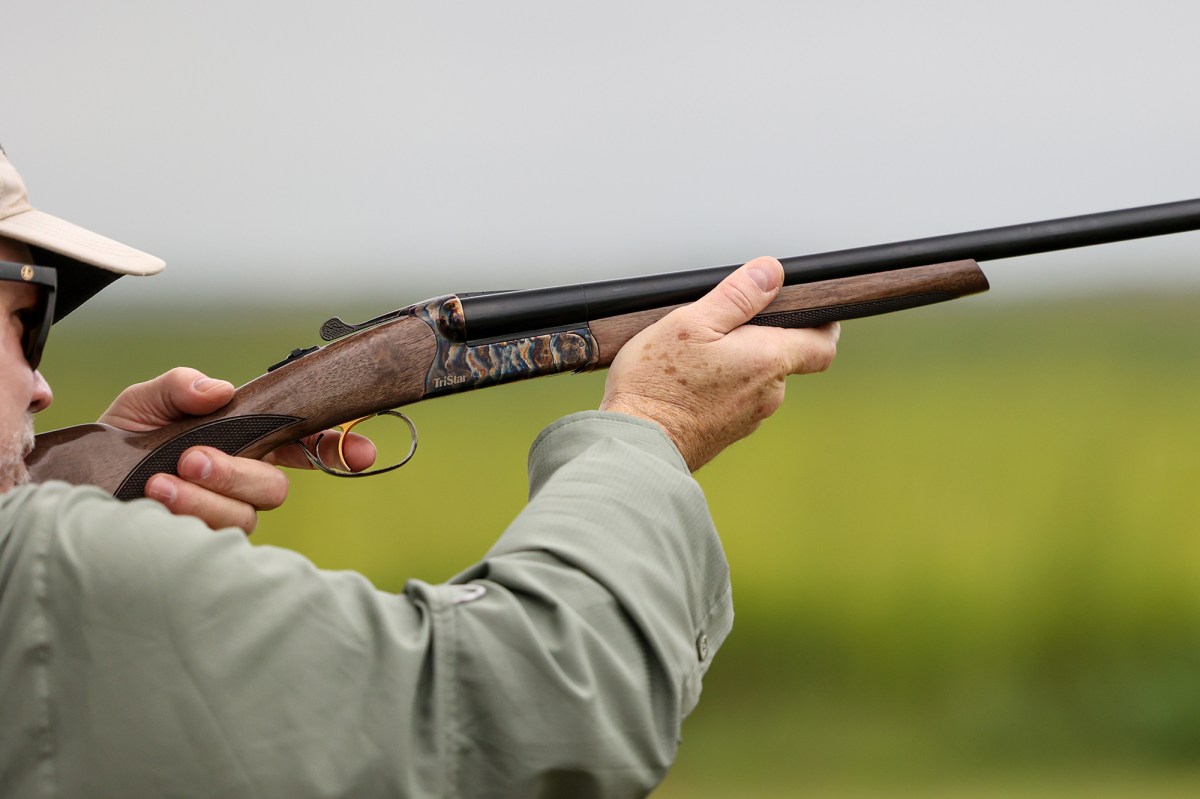
Taken out of its close-range, spot-shot element, however, the M59 was at a distinct disadvantage. For longer-range shooting — waterfowl, doves and almost all wing-shooting games such as skeet, trap and clays — the demand for balance shifts toward the muzzle, because a muzzle-heavy gun tends to swing more smoothly, maintains its direction of swing and contributes to a longer and smoother follow-through. This might be what the Ruger people had in mind with their Gold Label side-by-side.
Even if you’re not interested in skeet shooting, it’s worth spending an afternoon at a skeet club watching some good shots in action, especially at the center station, where the targets cross at nearly right angles to the shooter and require the longest leads. You’ll notice that in the hands of skilled shooters the guns don’t stop moving when the shot is fired but continue to move along the target’s path even after you hear the report and see the target smashed. Follow-through of this kind is a hallmark of good wing-shooting and is religiously cultivated by top shooters, who prefer guns with a forward balance because it makes their follow-through all the smoother.
You’ll also see fine follow-through at work watching a good waterfowl hunter plucking 50-yard honkers out of the sky or a top sporting clays shooter smashing high-tower targets that look like specks in the stratosphere.
The Long-Barreled Advantage
Though barrel lengths of 30 inches or more were once seen only on guns used for waterfowl or trap shooting, they have of late become favored by skeet and clays competitors. This is a sea change from times not long past when guns used for these games were mainly viewed as “upland guns you shoot in competition” and quick-handling 24- and 26-inch barrels were the norm. A while back I offered to sell what had once been a great skeet gun but soon learned that its 26-inch barrels were as out of fashion as high-button shoes.
One reason that longer barrels are now the rage is because the added weight at the muzzle end is regarded as an advantage in swing and follow through. This doesn’t mean that moving a shotgun’s balance point forward makes targets easier to hit. Rather, it makes them harder to miss.
The shift to longer, heavier barrels is not without certain disadvantages that shooters must adjust to. To get a better grasp of this and other elements of a firearm’s weight distribution — balance — we need only to remember what no less a gun nut than Isaac Newton (who was fascinated by ballistics) had to say about objects at rest and in motion and apply it to guns.
A shotgun at rest in your hands wants to remain at rest until you apply some muscle (force) to get it swinging after a winging target you want to hit. Conversely, applying Newtonian physics again, once the shotgun is in motion it wants to remain in motion. This, of course, is simple and obvious, but when we apply these basics to a gun’s balance, the situation gets a bit more complicated. To understand this idea more easily, you can demonstrate it yourself using a broom handle and some weights [see below].
Adding, say, 3 or 4 ounces to a gun’s center of gravity serves only to make the gun that much heavier. But add that same amount of weight at the muzzle — by making the barrel(s) longer — and the gun’s dynamics might be altered to an amazing degree.
A while back I shot a few rounds of skeet with a new gun sporting a full 32 inches of pipe plus another inch of choke tube extension. The experience was educational. At the center station the gun floated along like it was on rails, and hitting the targets seemed to require little more thought and effort than simply pulling the trigger. But at the No. 2 high house and No. 6 low house, which require faster handling, especially the doubles, the gun felt sluggish and unresponsive, requiring more muscle to overcome the long barrels’ inertia. This might not be a problem for today’s generation of huskier shooters, but for me the extreme weight-forward balance was simply too much of a good thing. I prefer a more “balanced” approach, if you get my meaning.
Next time you’re in a gun shop, try shouldering and swinging a few shotguns, paying particular attention to how their balance affects their dynamics. You’ll be surprised by the differences and might come away with a whole new appreciation of that much used and misused word, balance.
The Broom-Handle Balance Test
Begin your demonstration by taking a household broom and chopping off the handle to about 4 feet, which is more or less the length of a typical shotgun. Next, attach four weights of about a pound each that canbe slid back and forth on the broom handle. This is your new “testgun.” Yeah, I know it doesn’t look or feel like much of a shotgun, but in just a few minutes it will demonstrate to you how weight distribution — call it balance — affects your shooting.
1. Weight Back for Fast Risers
For your first test, mount the “gun” with all four weights slid back close to your shoulder. This makes your gun butt heavy and “whippy,” just like my old M59 Win-Lite, and you’ll see how quickly and easily the barrel can be pointed and its direction reversed — as if you were going after a double, or even a triple on a covey rise. But you’ll also quickly learn that the “barrel” has almost no inertia of its own and you must control all of its movement.
2. Weight Centered for Balance
Next, move two of the weights close to each of your hands and the other two somewhere in between. This will give your gun a more”balanced” feel, which you will quickly recognize as you mount and remount the gun as if swinging after a winging target. Your mounting and swinging will be noticeably smoother than with the butt-heavy configuration, but the muzzle action will not be as quick.
3. Weight Forward for Follow-Through
At this point, begin to experiment with the weights indifferent positions. You’ll soon discover dramatic changes in your gun’shandling as you move just one of the weights toward the muzzle. It doesn’t takemuch shifting of weight to make a big difference in the barrel’s moment ofinertia, which is a fancy way of saying that the barrel is a lever and theweight’s leverage is compounded as it gets closer to the muzzle. Workingagainst this leverage, you’ll find that it becomes increasingly harder to swingthe gun, but once the gun is in motion it’s also harder to stop the swing. Inother words the gun has a built-in follow-through, which makes it harder tomiss the target.
When Unbalanced Guns Work Best
Quick Skeet Shots
In skeet, “whippy” guns are ideal for stations 1, 7 and 8, where extremely fast shooting is required. But for the middle stations, where longer leads are required, a muzzle-heavy gun will help your follow-though.
Thick-Cover Grouse
Flushing grouse or fast-rising quail in heavy cover is a point-and-shoot affair with no time to finesse shots with a nice follow-through. Guns that are butt-heavy excel here because the muzzle naturally comes up first.
Long Crossers
For longer-range hunting for waterfowl and doves, the balance advantage shifts to guns that are more muzzle-heavy. The added weight offered by longer-barreled guns contributes to a longer and smoother follow-through.
Read the full article here