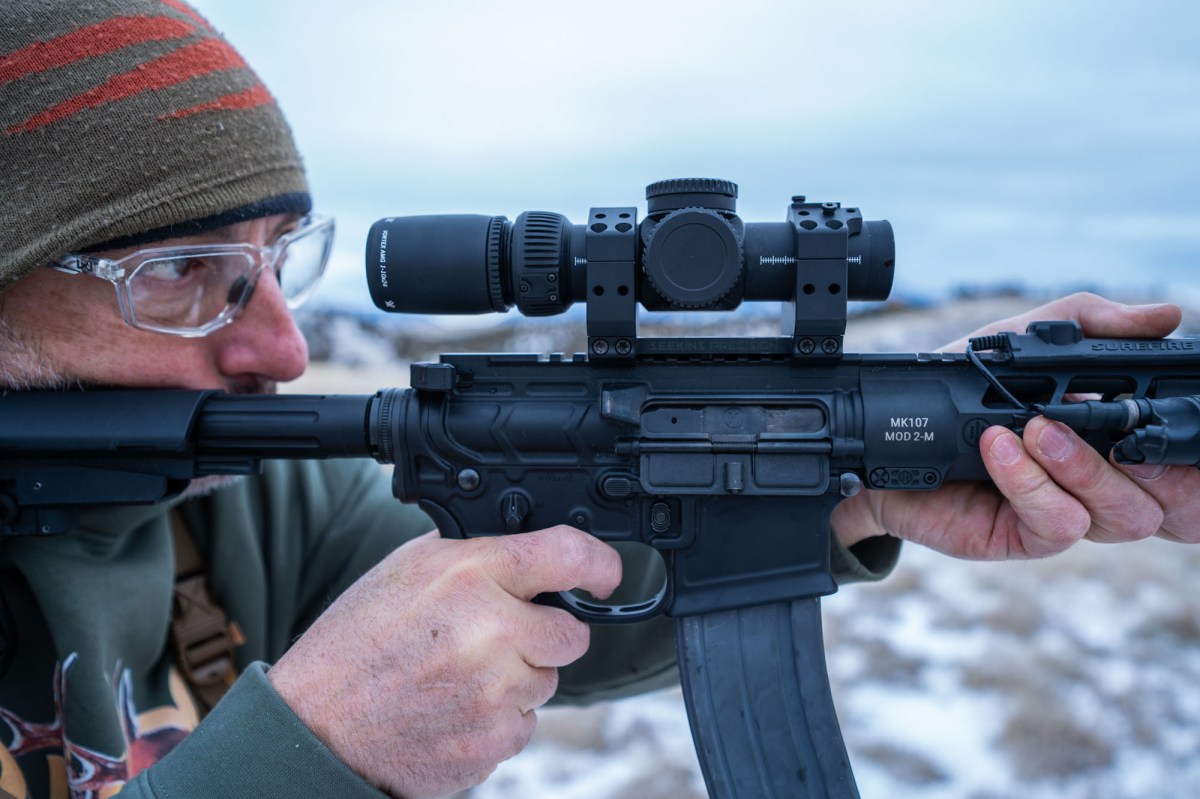

The first thing most people will notice about the Vortex AMG 1-10X24 is its eye-popping price. It lists for a stunning $6,399, with a street price of $4,000. Now it’s one thing for military units to pay top dollar for gear — it isn’t their money after all — but that’s a steep ask for your everyday shooter. Two questions immediately came to mind when I first laid my hands on one: Why on earth does it cost that much, and is it worth it?
To answer the first question, I spent several hours with the engineers and product managers who produced it. We got deep into the weeds covering every facet of the scope’s makeup, which I’ve distilled in the information below. By the end of that interview, I understood why it carries such a hefty price tag.
The second question is tricker. Determining something’s value is subjective. Most people certainly won’t need what the AMG 1-10X24 has to offer — but there will be many shooters clamoring to bring one home as soon as possible.
I’ve spent quite a bit of time running the AMG on a PWS SBR gas gun. I’ve put it through a lot of close-quarter drills, mostly running it at 1X with the reticle illuminated, as well as on longer-range targets where the scope’s precision capabilities shone.
Here’s my take: The Vortex AMG 1-10×24 offers unrivaled performance in an LPVO. What Vortex’s engineers accomplished considering the scope’s diminutive size is remarkable. The AMG 1-10 is one of the most complex scopes ever, requiring a level of manufacturing tolerances unlike anything we’ve seen in sport optics prior. The result is a compact and lightweight unit with next-level optical quality that’s built to survive the most demanding tasks. For someone desiring peak performance, no matter the price, this LPVO will be a serious temptation.
See It
Pros
- Innovative design
- Excellent optical quality
- True daylight-visible reticle illumination
- Compact size and weight
- Very durable
- Great ergonomics
Cons
- Cramped mounting dimensions
- Expensive
Specs
-
Magnification: 1-10x -
Objective Lens Diameter: 24 mm -
Reticle: EBR-9 (MRAD) -
Eye Relief: 3.3 inches -
Field of View: 116.0′ – 12.0′ @ 100 yards -
Turret Style: Capped, with Dual Zero -
Tube Size: 34mm -
Click Value: .1 MRAD -
Parallax Setting: 250 yards -
Length: 8.4 inches -
Weight: 18.8 ounces -
MSRP: $6,399 (About $4,000 street)
Key Features
-
First focal plane Christmas tree style reticle -
11 illumination levels (Nine visible, two night vision) -
Toolless Turret Adjustment -
30 MRAD of elevation and windage travel -
10 MRAD travel per rotation of turret -
Waterproof rating of 10 meters for 2 hours Fast-focus locking diopter
Vortex AMG 1-10×24 History
The driving force behind the AMG 1-10×24 (dubbed project “Eleanor” by Vortex’s engineers, a nod to the iconic car in Gone In 60 Seconds) was a request by the British Ministry of Defense. One of His Majesty’s special forces units wanted a 1-10X LPVO optimized for CQB missions, but still capable of precision at longer ranges. This customer specified a short overall length, which presented massive engineering challenges, and a short eye relief.
Naturally, this optic had to meet rigorous standards for durability while maintaining excellent optical clarity. At 1X they wanted the scope to behave like a top-of-the-line red dot, with daylight capable reticle illumination.
Vortex took it upon themselves to construct the scope with a compact 120-degree magnification throw, rather than the 180-degree throw you’d typically expect. This also added to the project’s complexity.
The company had to push themselves into new manufacturing terrain to accomplish all this.
Vortex completed delivery of all the AMG 1-10s the Brits had contracted for last year, and they are now offering that scope (which actually incorporates some improvements over the original) to the general public.
Cost Factors
Below I’ve broken out the major cost drivers for the scope. Some of these factors apply to more than one category. Likewise, there are numerous details in the scope’s manufacturing that I didn’t expound upon for the sake of brevity. But what follows certainly covers the high points.
Erector Tube
Right off, we’ll focus on the erector tube, which is a metal cylinder inside the scope that contains two lens cells. Those lens cells ride within channels machined into the sides of the erector tube. As the magnification is dialed up and down, those lens cells move closer and farther apart from each other.
The longer the scope’s erector tube, the more forgiveness you have from the standpoint of engineering and manufacturing. If the lens cells have four inches of movement on tap, that’s a much easier lift for the design to accomplish than say two. But also understand this isn’t a linear problem. Trying to get an erector tube to do the job in half the distance — two inches versus four — isn’t twice as difficult. It is orders of magnitude more complicated.
Then there’s the magnification range. If an LPVO has only a 5X zoom ratio – meaning you can dial it from 1X to 5X — that’s a lot simpler than creating a 10X range like you see here. Again, this is an order-of-magnitude problem.
The erector tube on the AMG 1-10X is smaller than any other LPVO’s with a 10X magnification range – and getting it to deliver optical excellence was one of the project’s paramount challenges.
120-Degree Throw
I also mentioned the 120-degree magnification lever throw. The Razor Gen III LPVO goes from 1X to 10X over 180 degrees of movement. The AMG accomplishes that in just 120 degrees. This is great for the end user, letting them dial the power up and down more quickly and efficiently – but this also adds to the complexity when designing the system.
Unbelievable Tolerances
Tackling all these challenges mentioned above necessitate the holding of unbelievable tolerances in the manufacturing process. If the lens cells are not held in perfect alignment with each other the image quality goes into the trash. They have to be perfectly straight in the tube – if they tilt in any way, the light moving through the scope is sent off track and the image will be severely degraded.
Five Microns
On some of the components of the erector system the manufacturing calls for holding pieces within 5 microns of tolerance. I don’t know if you realize how tiny that is but it is small. A micron is one-millionth of a meter. So there are 1000 microns in a millimeter.
Let’s put this another way – a typical red blood cell is 7 to 8 microns across – so these tolerances are smaller than the width of a red blood cell.
If you handload, you’ll often try to control your ammo down to a thousandth of an inch. And it isn’t uncommon to hear about manufacturing tolerances being a half a thousandth of an inch – or five ten-thousandths. That’s impressive – but that’s still more than twice as large as 5 microns.
For this type of tolerance you need to have unbelievably good machinery. Super sharp and precise tooling. But more than that, you need to control the temperature of the material you’re cutting – along with the temperature of the machinery and even the temperature of the concrete that the ultra-heavy granite tables that hold the machinery sit on. Because of thermal expansion, even a difference of a degree or two of temperature can cause the process to fall outside that 5-micron window.
So the complexity of this scope, from just that factor alone, cannot be understated.
Aspheric Lenses
Another challenge of this short form factor is getting the light to bend adequately in such a confined space. With a longer scope you have more running room to get the light to do what you want.
With less length you need to be more aggressive. The only way Vortex could accomplish this is by using aspheric lenses in some places.
An aspheric lens is what it sounds like. Unlike a normal lens with a continuous symmetrical shape, an aspheric lens has different radii over its surface. That allows a single aspheric lens to do the work of multiple traditional lenses.
But they are more difficult and more costly to make – about four times more expensive than traditional lenses.
In fact, when Vortex reached out to their partners and suppliers looking for quotes on these lenses and other materials, the most common response was “no quote.” Meaning those companies wouldn’t attempt to manufacture these components at any price.
Ultimately, this drove more of the manufacturing in house and led to Vortex making a massive investment in machinery and coming up with new manufacturing processes to overcome all the challenges this scope presented.
Costly Turrets
The windage and elevation turrets also add cost to the AMG 1-10, but for a reason that might surprise you. When you dial your scope to shift the point of impact, the erector tube moves slightly. There’s a spring that pushes against the side of the tube at a 45-degree angle that holds it in place with respect to the windage and elevation adjustment mechanisms.
The turrets need a precise thread pitch for each click to move the reticle the desired amount. The degree of movement that each click imparts on the erector tube is determined by the tube’s length. The longer the tube the more each click moves it — because the erector tube is essentially a lever arm that moves up and down to adjust elevation and side to side for windage.
On a scope like my Razor HD Gen III 6-36 , each click physically moves the erector tube about 20 microns — but on the AMG 1-10 with its short form factor, each click moves it just 5 microns, which requires components that are four times finer. That’s a demanding tolerance to hold and adds to the cost.
Weight Saving Cuts
Vortex wanted to get as much weight out of the scope without compromising its integrity. One area they identified is around the turrets and illumination control. On a traditional scope that area is rounded off. Machining round shapes is cost effective and efficient. To make these cuts Vortex needed to purchase a separate machine — it was costly, but it shaved about .6 ounces from the scope, which is meaningful.
It also looks cool and is going to be a signature element on AMG scopes going forward. It’s a bit of a flex by Vortex that distinguishes them from other optics companies.
Vortex AMG 1-10×24 Refinements
Just because something costs a lot to make doesn’t mean it does its job well. Fortunately, that isn’t a problem this scope has. Vortex incorporated many thoughtful and smart touches into its design that make the scope easy to use, whether aiming at a target, setting the zero, or mounting it in rings.
Toolless Turrets
Once you’ve used a scope with toolless turrets it feels like a big step backward to break out an Allen wrench to set a zero or make other adjustments. Toolless designs have become more prominent and are becoming an expected feature on top-end optics. The AMG has a knurled dial on each turret that can be loosened and removed by hand. The dial also has a coin slot, so you can use a falt-bit driver or a coin as well.
Dual Zero Settings
Once the dial is removed you can set the two zeroing rings on the elevation turret where you like. The rings pop free and each has an easy-to-see zeroing mark, so you can set the second ring for a second zero. A common use case would be switching from supersonic to subsonic ammo, where the point of impact can shift significantly at 100 yards. Having a second zero setting lets the operator quickly adjust their rifle.
Shark Fin Throw Lever
One subtle, but cool, feature on the AMG is this shark fin throw lever. The angled leading edge is less snaggy than a squared-off shape or cylindrical protrusion. If the fin has an impact while the rifle is being maneuvered it will glance off whatever it hit rather than experience a hard stop. The fin is fairly low profile, so you’re unlikely to have clearance issues with your mounts or accessories, but there’s still plenty of real estate to grab the lever and adjust the magnification.
Etched Mounting Index Marks
The index marks etched on either side of the 34mm main tube are pretty cool as well.They really speed up the process for an armorer who needs to mount a bunch of optics. After getting the first optic mounted the way you like you can just rinse and repeat with subsequent units. The marks are also handy for leveling the scope in its rings. Just align the index marks with the joint where the top and bottom rings meet and the reticle will be level.
Vortex AMG 1-10×24’s Innovative Illuminated Reticle
From a technical standpoint, the reticle in the AMG is one of the scope’s more fascinating features.
It is a true diffractive reticle design that provides some translucency while giving it daylight capable illumination.
The trick with LED illumination is to have enough light hit the reticle to make it truly daylight visible without requiring a ton of power. This is easier to accomplish with a second focal plane scope where the reticle size is fixed, and much tougher with a first focal plane optic like the AMG.
The difficulty lies in managing the light. If you just blast the reticle with a red LED, much of that light will end up bouncing around in the optic, degrading the image.
The AMG handles this with a series of small precise angled cuts in the reticle which angle the light straight back through the optic to the shooter’s eye.
The portion of the reticle that lights up – the center donut – is slightly translucent. This is because it consists of both the dark elements you see when it isn’t lit up and the reflective cuts that direct the LED light when it is turned on.
Of all the components in the scope, this is actually the most expensive.
Smart Holdovers
The reticle has a shooter friendly design that gives it great utility at every magnification setting.
It has numbered hashmarks along the horizontal crosshair that allow for measuring objects, holding off for wind, leading moving targets and the like.
Below that is a grid of dots, also numbered in mils, for holding over for elevation and correcting for wind. In the top of the reticle is a ranging grid to determine the distance to a human-sized target based on its height or shoulder width. It is fast and works well for that purpose.
Gray Reticle Edges?
One thing users will notice after spending a bit of time behind the scope is that the edges of the reticle aren’t ultra crisp. They are a little soft and almost gray. What gives?
Some people might conclude that this is an issue with the scope’s optical quality — but that’s not the case. The image the scope provides is unbelievably crisp and bright. What you’re seeing with the reticle is the result of how aggressively this scope has to bend the light because of its short form factor. A traditional scope that’s longer is more forgiving and doesn’t have to angle the light as severely. That soft-edge is due to the very physical nature of light. When it is pushed to that degree there will be some visible softness.
In a practical sense it has no bearing at all on the scope’s performance or shootability. And maybe the internet optics experts out there will understand this — but don’t be surprised when someone complains about this phenomena. If they state this has anything to do with the scope’s optical quality, just ignore them. They don’t know what they’re talking about.
Vortex AMG 1-10×24 Durability
All this technology and wiz-bang engineering doesn’t mean a thing if the scope is fragile. To pass the requirements set by the British Ministry of Defense the 1-10 AMG needed to withstand a battery of brutal testing.
It is waterproof — tested to a depth of 10 meters for 2 hours. They were able to accomplish this with the addition of an oversized O-ring in the battery compartment’s cap. Vortex also built a recoil and shock simulator to make certain it can take a beating. That machine not only simulates the recoil generated by specific rifles and rounds — like a .308 SCAR — but can mimic the bouncing an optic will experience in different types of military vehicles.
They also did a lot of drop testing from different heights to make sure it is battlefield capable.
Ergonomics
I’ve touched on many of the things in this scope that elevate it above what we’ve seen before. But one thing this scope has in common with all great optics is its ergonomics. It’s easy to use, the controls all work smoothly, and it is low profile. Dialed back to 1X the optic all but disappears in your field of view. For the type of close-quarters fighting it is meant for, you couldn’t ask for better.
Any Downsides to the Vortex AMG 1-10×24?
In terms of downsides, there’s the obvious issue of cost. This is an expensive optic. But once you realize what’s required to produce it, the elevated price tag makes a little more sense.
One other thing that is worth noting is that because it is so short, you don’t have as much mounting real estate on the main tube. The cantilever AR mounts I have on hand, for instance, won’t work with this scope. But the traditional straight-up design I employed does.
Conclusion
All-in-all the AMG 1-10×24 is a remarkable, and groundbreaking, optic. It establishes a new threshold in sport optics manufacturing, and it will be fascinating to see how the AMG line expands in the years to come. Without a doubt, this is one of the coolest, and most significant, scopes we’ve seen in a long time.
Read the full article here