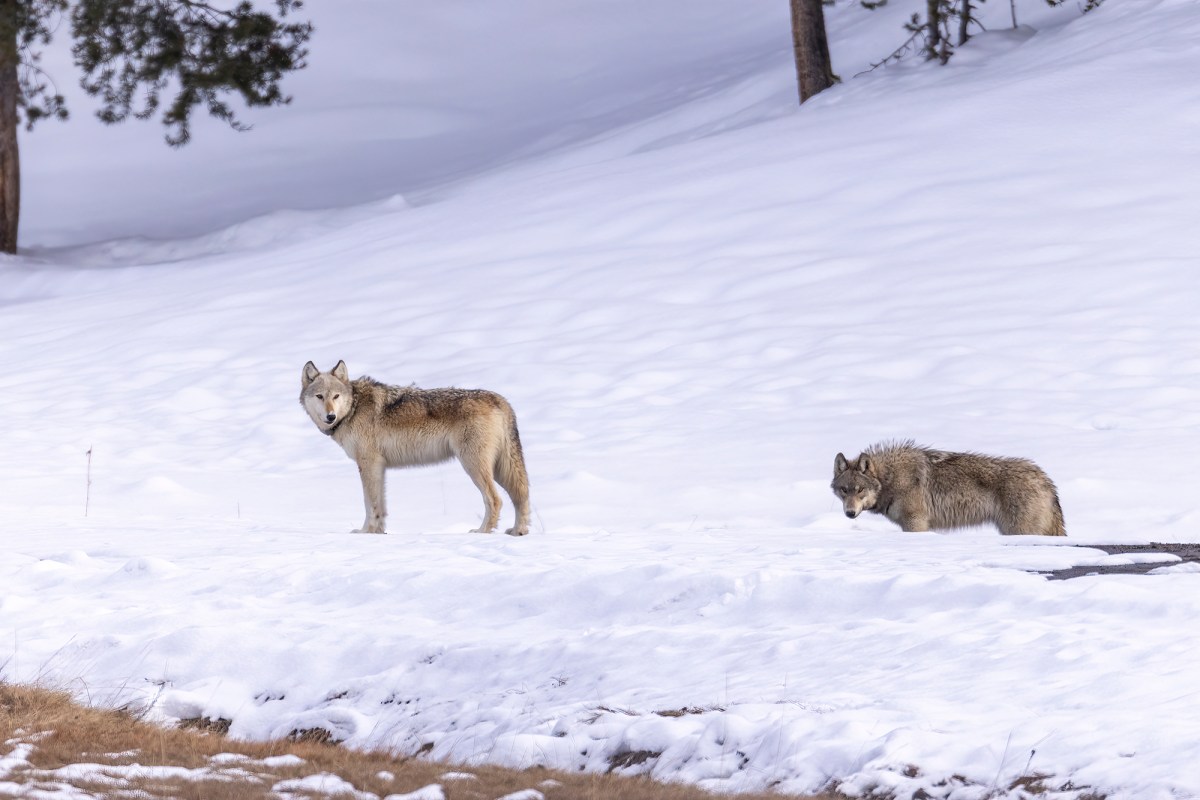

State agricultural officials killed three gray wolves in the north-central part of Utah on Jan. 9 in an effort to prevent the predators from establishing breeding pairs in the state.
The three wolves were discovered near livestock operations, says Utah Department of Natural Resources public information officer Faith Jolley. This was the first time the state has killed wolves in the region since 2010. The DNR could not immediately provide details on where the wolves may have come from.
The removal was not announced by either the Utah Department of Agriculture and Food, which carried out the removal, or the Utah Division of Wildlife Resources. Instead the news surfaced after a photo of three dead wolves began circulating among locals and the story was picked up by the Herald-Journal, a local news outlet. Jolley could not confirm the origin of the photo of three dead wolves that has appeared in local news outlets. The photo (below) was provided to Outdoor Life by a Logan resident who asked to remain anonymous, but who felt it was important to publicize the presence of wolves in the state.
The large carnivores were in a small “delisted” area of Utah that borders Idaho and Wyoming, where wolves are not federally protected. (The delisted area is north of I-80 and east of I-84, not far outside Salt Lake City.) Wolves in the rest of the state — if any exist — are still listed as a federally-protected endangered species and as a result are under the management of the U.S. Fish and Wildlife Service.
Jolley says the wolves were killed to comply with the Utah Wolf Management Act, which mandates wildlife officials prevent wolves from forming packs in the state.
“Lethal removals ensure they don’t establish breeding populations in Utah,” says Jolley. Killing the wolves also ensures “the animals do not migrate back into the delisted area of Utah.”
Lawmakers in 2010 directed the Utah Department of Wildlife Resources to “prevent any packs of wolves from establishing within the delisted portion of Utah,” reads a state fact sheet. The state does, however, cooperate with USFWS to trap and relocate any wolves spotted in areas where they’re still federally listed.
Wildlife officials across the West often trap and relocate large predators like wolves, mountain lions, and bears that are in close proximity to livestock instead of killing them. Because of Utah’s law, however, the state did not consider relocation, says Jolley.
Wolves are rarely spotted in Utah, though they occasionally wander into the state from Wyoming, Idaho, and, more recently, Colorado. Utah has confirmed 21 wolf sightings since 2004. The state also says one lone male wolf was spotted and confirmed in September 2025.
A coyote hunter mistakenly shot and killed a wolf in 2014 in the Tushar Mountains in southcentral Utah, says Jolley. She added that a trapper killed a wolf in the state in 2015.
“Nearly all confirmed sightings have been consistent with lone, dispersing wolves, and the DWR has been unable to verify any breeding behavior or established packs in Utah,” according to the DWR’s website. “With continuing wolf introductions in Colorado, dispersal into Utah is expected to continue and likely increase.”
Related: USFWS Will Terminate Colorado’s Wolf Program Unless the State Complies with This Ultimatum
Although Utah could legally provide wolves to Colorado, it did not consider trapping the wolves and offering to give or sell them to Colorado, even though its neighboring state has been struggling to find wolves for reintroduction. The USFWS recently informed Colorado that it could not continue importing wolves from Canada, which leaves just a handful of states that could legally provide wolves for its restoration program. Other regional states including Idaho, Oregon, Wyoming and Washington have also declined to provide wolves.
Read the full article here