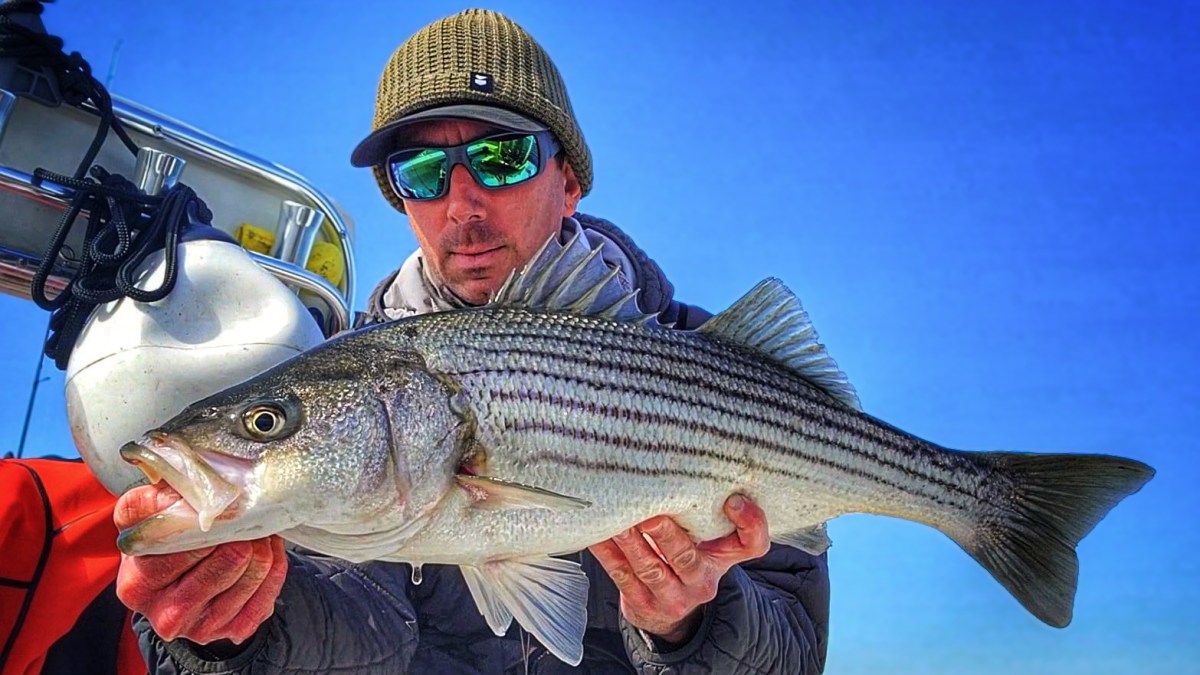

When is peak striper time along the Atlantic Coast? Most anglers from Delaware to Massachusetts will tell you late spring through mid-fall, and that’s accurate. Within that span everyone gets their piece of the action with migratory, ocean-running fish. But you don’t have to wait for warmer months to get your striper fix. What fewer people understand is that throughout their range, resident stripers and wintering migrators post up in back bays, tidal rivers, and brackish estuaries. When seasons reopen in March, it’s these fish that can make your drag sing for the first time after a long winter. Catching them, however, is not always intuitive.
The behaviors and habits of salty stripers in the very early season often buck what we know about them later in the year. They can be sluggish, bite windows can be shorter, and finding them can be your biggest hurdle. But Captain Brian Williams, who runs out of Ocean City, New Jersey, loves this challenge. He’ll start booking charters on March 1 and specializes in the back bay environments that will kick out the first bass of the year. If you’re itching to get on the striper board early, his insights from years of experience can make it happen.
It’s Electric
The good news is, if you find one striper in the early season, you’ve likely found the pile. This is especially true if the water temperature in still in the high 30s or low 40s. But because location is the biggest part of the equation, Williams doesn’t downplay the importance of good electronics during the first few weeks of the season.
“You obviously want a good, functioning fish finder this time of year, but side scan is really helpful,” he says. “That’s because these fish will move more than you might think early in the year. Sometimes they’re in a deep wintering hole, but if they’re in a transitional area between deep water and a mud flat, you’ll find them faster if you can look out to the side.”
Related: The Best Baits for Stirped Bass
Muddy bottom plays a large role in early-season success because it absorbs more sun and can heat the water in that area faster than the surrounding areas. With that in mind, Williams cautions against fishing in locations where the bottom is primarily sand. Its lighter color will reflect the sun and keep the water colder.
Temp Check
It’s not rare in March for Williams to make long runs up tidal rivers, even flirting with brackish water where the salinity level is lower. What he’s looking for are temperature breaks—hard lines where slightly warmer water meets colder water. These can be created because of a heated mud bottom or simply a switch of the tide, particularly during outgoing tide when colder ocean water that flooded in during high tide is being sucked back out.
“As long as the water is over 40 degrees, I’m confident,” he says. “What you have to remember is that unlike in the fall, once the water temperature starts coming up, it rarely drops drastically again. In other words, once the stripers start feeding, their aggression will only continue to build.”
Related: The Most Important Baitfish in the Ocean Will Fast-Track You to the Striper of a Lifetime
Even if you have a few slower days to start, the action will improve day by day. The temperature break Williams is looking for might be far up a river at the brackish line in the first few weeks of the season, but he’ll monitor it constantly while in transit. As it begins creeping closer to the open bay the fish will follow.
Bottom Feeders
Though dead sticking baits like sand- and bloodworms is popular and effective for early-season stripers, Williams doesn’t use much live or natural bait. The arsenal of lures he’ll tie on, however, varies greatly. If he sees fish hovering off the bottom with his electronics, he knows to fish more aggressively, throwing glide baits that can measure of to 10 inches. This scenario, of course, is a luxury. More often, it’s all about fishing low and slow.
“If you’re marking a bunch of fish and they are just glued to the bottom, you usually need to get your lure right in their faces for them to eat,” says Williams. “They’ll feed, but you have to slow down and be methodical.”
Williams’s weapon of choice is a 4-inch Fluke style finesse bait on a ¾-ounce jighead, and he always opts for an even lighter head if possible. Recently, freshwater-style NED rigs have also proven highly effective, as their vertical orientation on the bottom and subtle action does a great job of mimicking easy-target prey like shrimp, emerging sandworms, and small, lethargic baitfish.
Read the full article here