
It was late when I arrived at the hunting camp on New Zealand’s North Island. I had only a little time for gear prep and then it was off for bed. But seconds after my head hit the pillow — I heard it. Opening the sliding door of my room, I listened. The starlit night was silent. I waited. Then came another roar. It was distant, but there was no doubting the source.
I sat on the porch and listened intently. Another roar from a red stag once again boomed in the distance. Then another, from a different direction. Within 20 minutes, roaring stags surrounded our camp, nearly a dozen of them it seemed, and they carried on through the night. I kept my door open so as not to miss a single one — sleep would be impossible anyway.
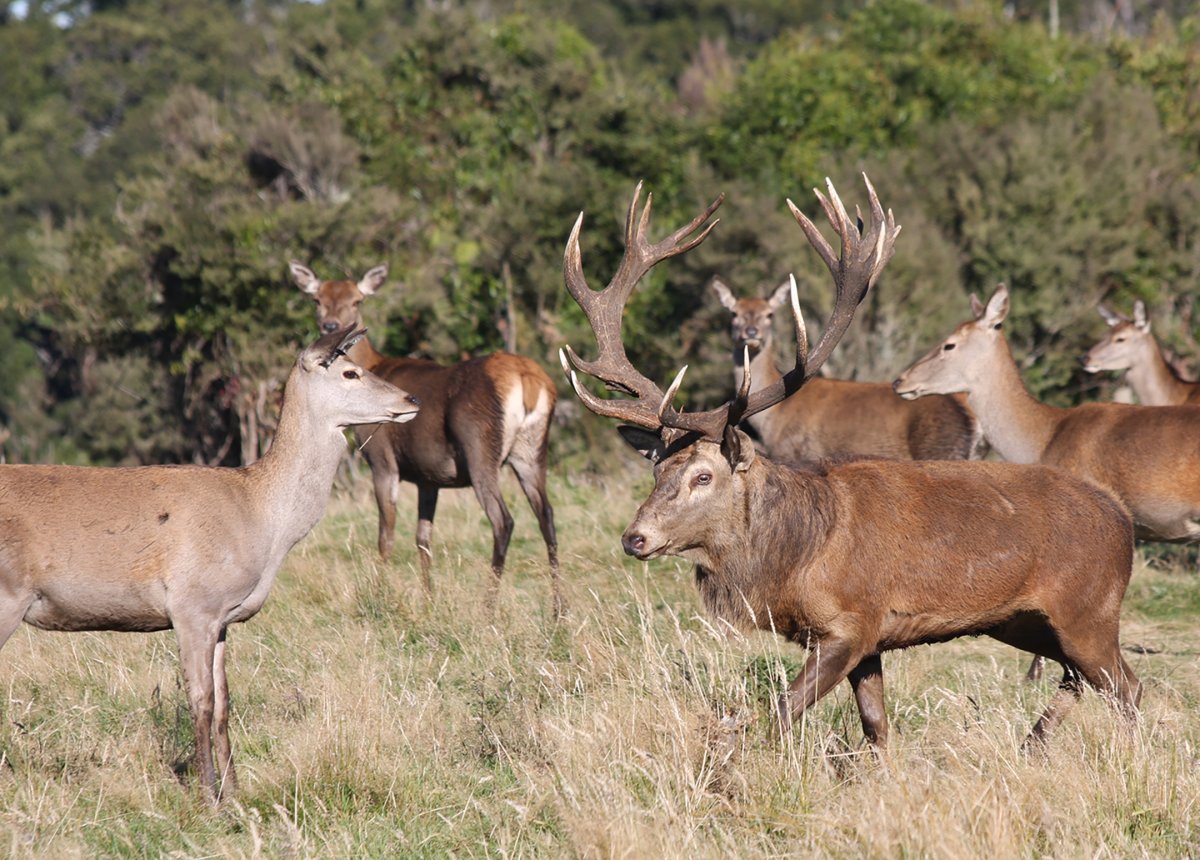
There are sounds in nature I wish every hunter could hear in person. Some of these are familiar, like the wild turkey gobble, and of course the bull elk bugling in the American West. But then there’s also bellowing lions in Africa, brown bears fighting in Alaska, and these, roaring red stags. As OL’s hunting editor Andrew McKean says, a red stag roar “sounds like it’s coming from carnivorous cattle. Guttural, lewd, more elemental, with barks, growls, and snarls that sound cranky and carnal.”
Majestic Red Deer Stag ROARS like a LION!
I’d hunted red stags a couple times prior, in Australia. But it was the dead of winter, far beyond the roar. This time was different. This was New Zealand and it was late March. The roar was underway.
Roars in the Dark
For more than a decade I’d heard about Gerald Fluerty. Then, finally, in 2008, we got to hunt together for the first time.
In the 1970s, Fluerty developed his renowned red stag skills while professionally hunting for New Zealand’s meat market. He grew up in a hunting family that homesteaded the country in the early 1800s. Following commercial hunting, Fluerty turned to guiding. Today, with over 50 years of red stag hunting experience, Fluerty is regarded among the best of the best.
Gerald and his wife, Brenda, run a small family outfitting business, Wildside Hunting Safaris near Taupo, on New Zealand’s North Island.
At 4:00 a.m. that first morning, Gerald knocked on my door. “Tea time,” he said. I was already dressed. The roaring of red stags had waned. “We’ll head out shortly,” Fluerty advised while pouring another cup of tea. “It’s a bit of a hike but I want to get to the head of the valley where that big stag has been hanging out. As cold as it is, stags should be talking this morning.”
By 4:30 we were walking through knee-deep, wet grass. We wound our way through dense stands of trees. Forty-five minutes later we sat on the edge of a timber patch. “We’ll wait for daylight,” Fluerty whispered. It was pitch dark. I still had no idea what the habitat that surrounded us would look like.
Before dawn a roar emanated below us. Another followed, this one closer. When a stag let out a roar mere yards from us, I could feel the reverberation. It was too dark to see. Following a powerful roar, the stag thrashed the brush, then all fell silent.
Finally, there was enough daylight to move. In the first two hours we laid eyes on a half-dozen stags. I would have been happy with any of them.
“There are quite a few hinds in this thick bush that the big stag has been tending,” whispered Fluerty. “With all these new stags showing up in the night, the big one is likely chasing them out. Let’s keep going, as long as they’re roaring, we’re in good shape.”
Read Next: The 10 Best Tasting Exotic Game Animals
A few hours later we found two stags fighting in the bottom of a draw. “That’s him,” Fluerty confirmed. The stag’s mass was unlike any we’d yet seen. For the first time I saw the difference between a good stag and an exceptional one.
As we commenced a stalk under the forest canopy, the battle of the stags escalated. The big stag rolled its rival then chased it up a ridge. “Let’s move fast, while he’s out of sight,” Fluerty said. “Once it chases the other stag off, it’ll come back to the hinds.”
We covered 350 yards in short order. I set the rifle in tripod shooting sticks then quickly snapped some range readings all while I trying to catch my breath. Within seconds the stag returned and crested a grassy knoll, panting hard. The stag paused, gazing across the opening into the trees where the hinds likely held. The 225-yard shot was simple. My stag hunt was off to an incredible start.
The Red Stag Backstory
Red deer are not indigenous to New Zealand. Starting in the mid-1880s they were introduced from Britain with the goal of creating sport hunting opportunities on the islands. More than 100 releases followed into the early 1920s.
Plentiful food sources, cover, and a lack of natural predators resulted in booming red deer numbers across much of New Zealand. By the 1930s red deer were considered a menace. This forced the government to develop cull hunting projects, which were followed by commercial hunting from helicopters in the 1960s. Commercial hunting grew in the 1970s and became a major economic stronghold for New Zealand. Most of the meat was exported to Europe.
In the 1970s the first commercial license was awarded to farm red deer in New Zealand. The transition turned the pest into a valued agricultural resource, with the meat and velvet-covered antlers being exported.
Today, New Zealand is the top producer of big red stags for sport hunters. Red deer thrive on private land, and still exist in public land locations too. I’ve hunted them on public lands and can attest to how tough it is. Imagine public-land elk hunting units in North America where coming away with any raghorn is a real achievement — that’s similar to the public land situation in New Zealand.
It’s on private land where stags have the ability to grow big. A number of outfitters, like Fluerty, conduct hunts on large estates that are fenced, as this is what allows stags to reach maturity while also keeping poachers out. The estates are often so large that you never see fences while hunting, and the stags have the instincts and wildness of their public-land brethren.
“Red stag hunting in New Zealand on private land has never been better,” Fluerty shared with me last month, while exhibiting at a sports shows in the U.S. “During the Covid years, New Zealand’s borders were closed and international hunters were unable to get into the country. One of the issues with high numbers of hunters like we experienced pre-Covid is that stags got taken too early. For years we thought eight-year old stags were fully mature and reached their maximum potential. However, we’ve recently found that at 10 years of age, or even older, red stags keep improving and grow in both body and antler size far beyond what we imagined. Now a lot of stags we’re seeing taken are in the 10-plus age group and they’re carrying loads of mass and lots of tines. They truly are setting new standards.”
“On public land where I grew up hunting red stags, the story is almost the opposite. A lot of local pressure is being placed on the wild herds. There are still decent trophy stags out there in places, but they’re very few and far between, nothing close to what it was back in the day.”
New Zealand offers a range of prized big game animals, from Himalayan tahr to stunning sika deer, big sambar to chamois, and beautiful fallow deer, to name a few. But the red stag is the big ticket that most often draws hunters to New Zealand from around the world.
Getting Close
Two days into my bowhunting quest with Fluerty, I realized how challenging even rut-crazed stags could be to outwit. With each passing day the rut intensified. Roars resonated all night and continued through much of the day. Big stags were hitting wallows and raking up fresh bundles of grass and piles of mud in their racks.
I was struck by the amount of ground rutting stags covered and how swiftly they moved. Stalking bugling bull elk back home seemed simple compared to this, typically because bulls hung with a harem or could be encouraged to pause by calling. With red stags, no matter how fast we walked, catching up to them was near impossible.
I reached full-draw on two stags but was unable to get a shot — one due to thick brush separating us, the other because of a stag’s unwillingness to hold steady.
Eventually Fluerty and I followed the guttural sound of a roaring red that seemed throatier, and rougher than the others. When we caught up to the stag and glassed from shadows in the timber, it was spinning in circles. Its massive rack was the pivot point as it pirouetted amid tall, golden grass. When it lifted its head, we had no idea how many points it carried. Grass adorned half the rack. Nostrils flared. The whites of its eyes, glowed.
“When it drops its head, let’s scoot across this opening and into that timber,” Fluerty pointed. From there we’d evaluate the wind and the stag.
When we got to the timber the stag was gone, or so we thought. Then it stood up and into view. It had laid down in a low spot in the grass and was dry wallowing. Its colossal rack had points jutting all directions. Immediately it began walking down the ridge on which we stood.
“You get set up, I’ll range,” Fluerty whispered. Arrow nocked, I listened. “If he comes down the left side it’s 32 yards to that stump, 12 to this log,” Fluerty nodded. “If it goes right, it’ll likely hit that trail and that tall clump of grass is 16 yards.” The wind was good. The stag stopped, looked back, and let out a roar. It was clearly the raspy stag we’d been chasing for over two hours.
The stag continued walking at us. A ray of sunshine broke through the clouds, illuminating the red pelage of the beast —— the coat glowed in direct light. The thick-chested stag continued our way, unaware of our presence. When it slowly veered right and passed behind a tree, I drew. The arrow instantly zipped the 16 yards into the stag, which bolted down a steep, grassy hillside and collapsed.
The 24-point rack was bigger than I thought, as was the stag’s body. I’ve taken a number of stags, before and after, on both islands of New Zealand and in parts of Australia. All pale in comparison to this majestic monarch and the time I was blessed to spend with Fluerty.
Tagging Along
In 2017 I accompanied a family of four to hunt with Fluerty. I’ve known the Stewart family for years, and it had been a dream of the theirs to hunt red stag, together. Zane and Macie were soon to be graduating from high school and the red stag hunt was to be their gift.
It was late March, spring break in the U.S., and the red stag roar was on fire in New Zealand. For five days, rarely was there a moment when we weren’t hearing or watching rutting red stags, or putting a move on one.
I tagged along with Fluerty who guided Macie and her mom, Dana. Zane and his dad, Chris, hunted with one of Fluerty’s guides. Macie shot her stag on the first morning, after following its roars through the rolling, wooded hills. When we finally caught up to it, heavy fog set in. It eventually lifted. When the stag stood, one shot ended her hunt.
The following morning, Fluerty found a rut-crazed stag that hadn’t a care in the world. It was focused on nine hinds that it had corralled. Once the stag forced the hinds into thick brush, we moved and waited for them to come out the opposite side. All the hinds eventually fed into a grassy meadow. Finally, 20 minutes later, the stag emerged. Dana made a perfect shot, just inside 200 yards. It was a heavy-racked brute, one you had to wrap your hands around to appreciate how massive it really was.
On the last day, Zane finally pulled the trigger. “I just didn’t want it to end,” he told me, rolling out of the prone position once he’d pulled the trigger. “This is so much like hunting elk back home, I love it!”
Chris was bowhunting, spot-and-stalk. He’d passed a number of stags, hoping for a giant. He had one opportunity in thick cover but failed to connect. Chris was good with that. “I could have shot over a dozen big stags this week,” he told me as we headed back to the lodge on the last night. “I had my chance and blew it, but seeing my wife and kids get stags, that’s all I really wanted. Besides, now I have an excuse to come back.”
Read Next: I Shot a Mountain Lion at 7 Paces
Chris is an avid elk hunter who’s taken many fine bulls with his bow he understood that the only way to shoot a massive stag was to pass on the smaller ones.
There are so many corners of the world for hunters to explore and animals for us to see. I’ve been lucky to have visited and hunted dozens of countries, but New Zealand is truly a special place. It’s one that I’ll keep going back to. You could arrive with only the clothes on your back and be taken care of by the locals. The islands are stunning, all the way from their snow-capped peaks to the crystal clear rivers that carve through the valleys. And if you want to experience the wildest rut hunt in the world, the red stag roar is it, and the time to go is now.
Note: For personally signed copies of Scott Haugen’s best selling books, visit scotthaugen.com. Follow his adventures on Instagram and Facebook.
Read the full article here