
This story, “The Head He Left Behind,” appeared in the April 1944 issue of Outdoor Life.
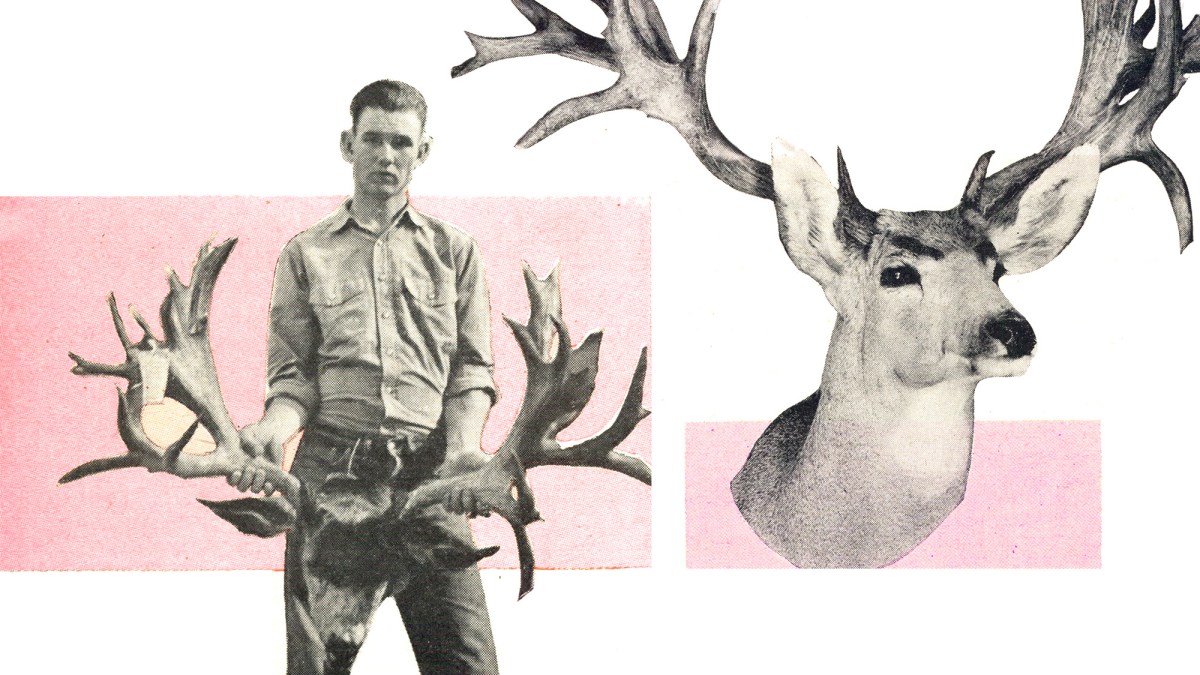
Supposing you shot a buck with 19 points on the right side of the antlers, 16 on the left, with a spread of nearly 47 inches, would you nonchalantly cut off the head and throw it into the nearest ravine?
Arthur Henke of Glenwood Springs, Colorado, did just that in 1940, and — but
maybe I’d better tell the whole story of how this record trophy came close to being left to rot.
The Colorado River, as it heads west of the Continental Divide, winds through the meadows and low hills of Middle Park. Then it cuts across two spurs of the Rocky Mountains, and has gouged out a deep canyon in each case. The west side of the second canyon rises in massive bulk to form the White River Plateau, a huge tableland, flat-topped, spotted with spruce and pine thickets and rolling grasslands. It always has been one of the West’s greatest game countries. Many thousands of fine mule deer and elk have been taken by hunters — Theodore Roosevelt included — on the big plateau.
All around its edges, streams have cut fantastic gorges through the limestone masses. One such stream is Grizzly Creek, slicing down from the top, past fretted cliffs, to dash into the Colorado River a few miles above Glenwood Springs.
That’s a good hunting spot, and Arthur Henke knew it when he said to himself, “Guess I’d better go get me a piece of venison before the season closes.”
The way up Grizzly Canyon is steep. The bottom of the gorge is thick with serviceberry and other bushes. Little shelves of rocky outcrop on the cliffs are garnished with spruce and fir. There are pockets where side gulches nick into the cliffs. It is good hunting territory — but it is also a place where a wily buck has plenty of chances to hide. Henke left Glenwood Springs in the forenoon and made his way up Grizzly. There were bucks in there if he could connect; big bucks, the kind called rim-rockers by the local folk; and Henke had seen their tracks. He was hunting alone, and just moseying along, when a buck moved ahead. It was a good big buck and he laid sights on it. He scored.
He was thinking of the good steaks and roasts in his buck as he dressed it out. The head was big, but it was darned heavy, and he had a long trek back. So he cut off the whole head and tossed it into a gully near by. After all, you can’t eat antlers — so why be bothered packing them out?
To many hunters in the Rockies, who go afield because they love to hunt, and because they want to hang up some meat in the shed, trophies are quite likely to be incidental. It never occurred to Henke that that head was of any importance.
I was sitting in my office in Denver that day. The peak of the hunting had passed. I’d made a swing around the big-game checking stations, where my field men were measuring and weighing animals to get some data for game-management plans.
The telephone jangled. I reached for it, and a nice gal’s voice said, “Glenwood Springs calling; will you accept the charges?”
“If it’s Harley Means, sure I will,” I answered.
“Hello,” came Harley’s voice. “Something’s come up here that I thought you ought to know about. A fellow at the checking station says he’s got a set of antlers from the buck he shot that are bigger than anything on record.”
To many hunters in the Rockies, who go afield because they love to hunt, and because they want to hang up some meat in the shed, trophies are quite likely to be incidental. It never occurred to Henke that that head was of any importance.
“Measure ’em, Harley, and find out. Or did you?”
“No. He threw the head away. But he says he can take me back to it. Think I should go?”
“Sure thing. Just don’t forget to let me know what you find.”
Several hours passed and I was thinking about something else when Harley Means called again.
“We sure got something,” he said, and I could feel the excitement in his voice. “You ought to see that head! It measures just short of 47 inches across, and ….”
Enthusiasm and figures blended into a stew of excited talk. “Oh boy, it’s really something,” Harley finished. “What’ll we do with it now?”
“I’ll call Coloman Jonas, here in Denver, and he or I’ll call you back,” I promised.
When Coloman was on the wire and I told him what the boys had found he got excited too. He’s done some of the world’s best taxidermy, and here was a chance to mount a spectacular head that might be an all-time state record. So he said he’d call Henke direct.
I learned afterward that Henke had brought his buck into the checking station when Harley Means, who now is adjutant in an Army air outfit, happened to be on duty. Even without the head the animal was big; and Henke was asked why he hadn’t brought it all in.
“Too much to tote,” he said. “How big are the largest mule-deer antlers you’ve measured here?” The boys told him and he said, “The ones on my buck would make those look like dwarfs.”
Harley began to get excited; so did Henke. By the time they were heading upcanyon, after phoning me, they were making a fire run for the trophy.
It was worth that trip, right enough. Big-game enthusiasts differ as to what basis of scoring should be followed in determining the “champion” head of antlered big game. Some authoritative lists use the measurement along the outside curve of the longer antler, from the bottom of the burr to the tip of the main beam. That single method is open to question. For some-times there are very old bucks that grow long, thin antlers with few points. One such scrawny old buck might turn up with a “champion” head if length of beam were the sole test.
Nor is it much better to base the order of rating on the number of points. One of the messiest heads I ever saw had 34 points; a malformed, freakish head of a senile buck. He was in such bad shape that he hadn’t shed the velvet by October.
A more inclusive score card might be developed along these lines: Add the length of the outside curve in inches, the rack, to get the total score. Combining these four factors should give a sound index of the over-all size of the head. Coloman Jonas suggests that the weight of the antlers with the skull plate should be included — though of course the girth of the antler is an index of heaviness.
However the scoring is figured, the head of the Grizzly Creek buck rates among the best. There are 19 points on the right antler that properly can be classed as “points,” and 16 on the left antler. The beam above the burr measures 5¼ inches around. Length of out-side curve along the main beam of the longer antler is 29 inches. The antler spread from outside point to outside point, across the head, measures 46 % inches. The antlers with the skull plate weighed 11 pounds 4 ounces, whereas the average is only 5 pounds.
Prior to the taking of this head, the big buck shot in the season of 1938 by Lawrence E. Roe of Allenspark, Colo., had been the largest head of record in the state. It was plenty big. It had 13 points on the right side, 11 on the left, a spread of 45 inches, and an outside curve of 29½.
A head taken some years ago in the Kaibab National Forest, on the north rim of the Grand Canyon, is the only one of record that seems to outclass the Grizzly Creek head on all counts. This Arizona buck was killed by Harold Williams. The outside curve of the antlers is 29 inches. The circumference of the beam is 8½ inches. The spread is 47½ inches. And there are 19 points on the right antler, 17 on the left.
Vintage OL Stickers
Browse the Collection
The head that stands at the head of the list, if length of outside curve is accepted as the feature determining rating, was killed in Wyoming in 1885. The hunter’s name is unknown. Owned by Mrs. J. C. Millais, the antlers have an outside curve of 34 inches. But the spread is only 37¼ inches, and there are but 14 points on the right antler, 13 on the left. A fine head, but apparently not so rugged and heavy as the three others I have cited.
A trophy buck is not an old buck. Rather, he is in the prime of life and probably from five to seven years old. The development of antlers is directly linked with the sexual virility of the animals. Many sportsmen do not know that after a buck has passed his prime and is no longer potent, the antler development declines each year. So it’s a foregone conclusion that any trophy head is from a buck that is at the peak of his active years.
Another factor that determines antler growth is feed. The buck sheds his antlers in midwinter and starts to grow a new set from scratch. Even the most massive of antlers are built up and hardened within six or seven months, in time for the beginning of the rutting season the following autumn. So to grow good antlers, food not only must be abundant but have a high horn-building content of lime. This, of course, is obtainable either in forage or from licks.
The three heavy heads cited came from areas rich in lime. The bucks that grew these great sets of antlers had plenty of lime in their “spinach.”
Read Next: My First Buck Was the Biggest Typical Mule Deer Ever Taken with a Bow. I Almost Discarded the Antlers
Deer heads like Henke’s come only once in a lifetime. Try as they may, some sportsmen never meet up with bucks carrying such regal crowns on their brows. At some spot, at a certain minute, a hunter gets a prize head in line with his sights; he’s just in the big luck.
But this head that belongs near the head of the class, almost got left in a gulch for chipmunks to chew on!
Read the full article here