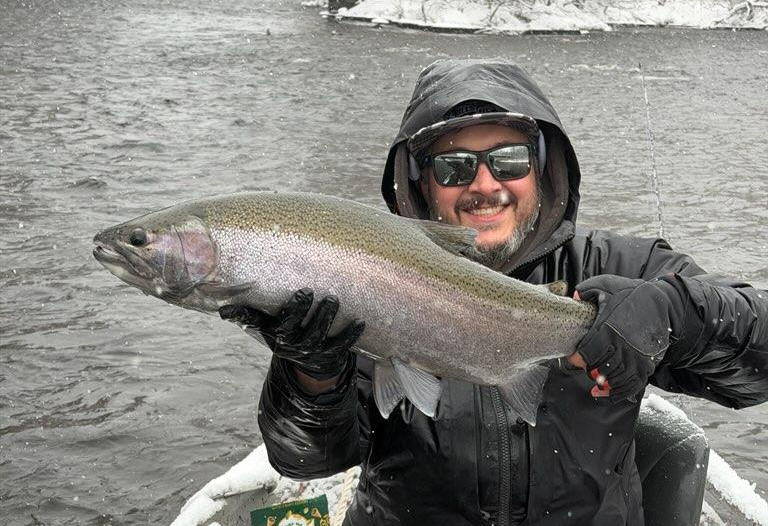

Catching a bucking Great Lakes steelhead during the coldest months of the year really gets the blood pumping. That’s a good thing, because it’s almost a guarantee you’ll need as much blood as possible flowing to your hands and feet. Attacking the tributaries from New York through Michigan in January and February isn’t for the faint of heart, but for the proud “frozen chosen,” winter is no match for their addiction.
Danny Colville joined their ranks long ago. A well-known personality in the Great Lakes scene and a maker of fine custom center pin reels, Colville has steelhead fished across the country, applying what he’s learned in places like Alaska and the Pacific Northwest to the rivers of Ohio, Pennsylvania, Canada, and everything in between. His knowledge of how these fish move, behave, and adapt during the coldest months runs deep, and while the first key to success is having the right conditions, Colville has some pointers for maximizing your effectiveness if you decide to brave the bitter chill.
Listen to this week’s episode of the podcast on Apple, Spotify, or wherever you get your podcasts.
Oil and Water
Throughout the range of the Great Lakes steelhead, your ability to target them in the middle of winter is dictated by Mother Nature. Period. As examples, New York’s Salmon River is a tailwater and often remains free of ice. Large rivers in Michigan will stay open due to the sheer volume of water moving through. Meanwhile, though, many Ohio and Pennsylvania rivers will lock up, only offering shots at fish during warming trends and thawing events that bumps the flows. But no matter where you’re fishing it will be cold, which can wreak havoc on your gear. That’s why Colville takes measures to ensure that frozen guides and broken rods are of as little concern as possible.
“I really like to use something called Stanley’s Ice Off Paste,” he says. “It almost feels like a lip gloss, and I always have it in the front pocket of my waders. I’ll just get a little bit on my finger and I just kind gloss in between each of the guides. It doesn’t stop the guides from freezing completely, but it slows the ice down, which is great because it lets me get in a few more drifts before I have to really clean them.”
When you’re already standing in water that’s near freezing, anything you can do to stay fishing and not remedying gear issues is a plus, but Colville takes it a step further than rubbing paste on the guides. When he builds center pin rods specifically for winter use, he adds oversized guides, including at the tip. It might look a bit awkward, but the wider the guides the longer it will take them to freeze up.
Bank on It
Once the water temperature hits the mid to low 30s, all steelhead spawning activity grinds to halt. At this point, the fish are just holding in the tributaries until spring when they return to the lake. Though there are exceptions to the rule, for the most part steelhead are going to seek specific refuge.
“The fish are looking for slow water that they’re not going to expel too much energy in and they’re looking for an undercut bank,” says Colville. “That’s typically where you’ll find a ton of them. These areas also let them avoid ice flows or debris if the water bumps up”
The problem is that these slower sections of good holding water often ice over first, especially if the water is low. Colville says high water in winter is always preferred, but you can also have too much of a good thing. Full-on winter blow-outs that dislodge too much ice and debris can be deadly for steelhead, and Colville notes it’s not uncommon to find some dead fish on the banks after these high-water events.
Swing Big
How steelhead piled into a wintering hole respond to your offerings can vary, but the more angling pressure they have on them, the harder they can be to fool. At times they can be so thick that you accidentally snag them. Colville’s ideal scenario is a finding a good winter run on a quieter river, but if that’s not possible for you, his suggestion is to go big right out of the gate.
“Sometimes in winter you don’t have a lot of options,” he says. “Let’s say there’s only one open hole and you know the fish are in there. In that scenario I’ll start with egg sacs and I’ll use a fairly big one, or a big bead. I’m trying to catch the most aggressive fish in the hole. I want the fish that wants that bigger meatball, that is willing to move around a lot. I want the alpha of the hole.”
Read Next: A Primer for Winter Steelhead Fishing Around the Great Lakes
Whether he’s successful or not with the go-big-first approach, Colville will start scaling back the size of his offering little by little. But what he will not do is beat on a single run all day if he can avoid it. Rather than get colder and more frustrated trying to force-feed fish that don’t want to chew for hours, he’ll move on to a different run and start over with a large egg sac or bead.
Read the full article here