Quick Strike Podcast: Definitely Don’t Skip This Easy Winter Maintenance for Your Fishing Reels


Back in the day, reel repair was big business for mom-and-pop tackle shops. They stocked parts and usually had someone on hand to help if your investment wasn’t operating up to snuff. And make no mistake, decades ago a good reel was an investment that anglers took care of because many couldn’t afford to just buy another one. That’s unfortunately not the case today. Short of buying top-shelf, very expensive reels, if you fish hard and really put your gear through the paces, inexpensive reels rarely last long. They are essentially disposable, and now that manufacturers no longer readily supply parts, getting them fixed is no easy task.
It’s very easy, however, if you happen to live in Chilliwack, British Columbia. That’s the hometown of Mike’s Reel Repair, a full-time operation run by Mike Marcotte that specializes in fixing all manner of fishing tackle. Marcotte’s dad started the business in the 1980s, and reels account for a lot of their work. If Marcotte can’t get a part for a reel, he’ll make one, and he’s seen reels abused in every which way. According to him, however, many headaches can be avoided if we all just take a little bit better care of our reels. Even if you can’t afford a high-end model, some occasional TLC will go a long way in extending the life of a more budget-friendly reel. So, as you wait for winter to give way to spring, use the time to heed Marcotte’s advice.
Listen to this week’s episode of Quick Strike on Apple, Spotify, or wherever you get your podcasts.
Get on a Roll
According to Marcotte, no component of a spinning reel is more abused and neglected than the line roller. That’s the hourglass-shaped piece on the bail arm that the line runs over as it winds onto the spool. What Marcotte says anglers forget is that a line roller needs to spin on its post to function properly. If it doesn’t, braided line can begin cutting a groove into the metal that will eventually cut your line, and monofilament will become badly twisted.
“The line roller is under constant tension,” Marcotte says. “If it’s not free spinning, you can hear a coffee grinder kind of noise when you reel. Now, in more expensive reels you’ll have one or two ball bearings inside that line roller, but on cheaper reels it just spins on a plastic bushing. In either case, it’s very easy for dirt or grit to get inside the roller and make it seize. Quiet often, anglers don’t even know it happened until it’s too late.”
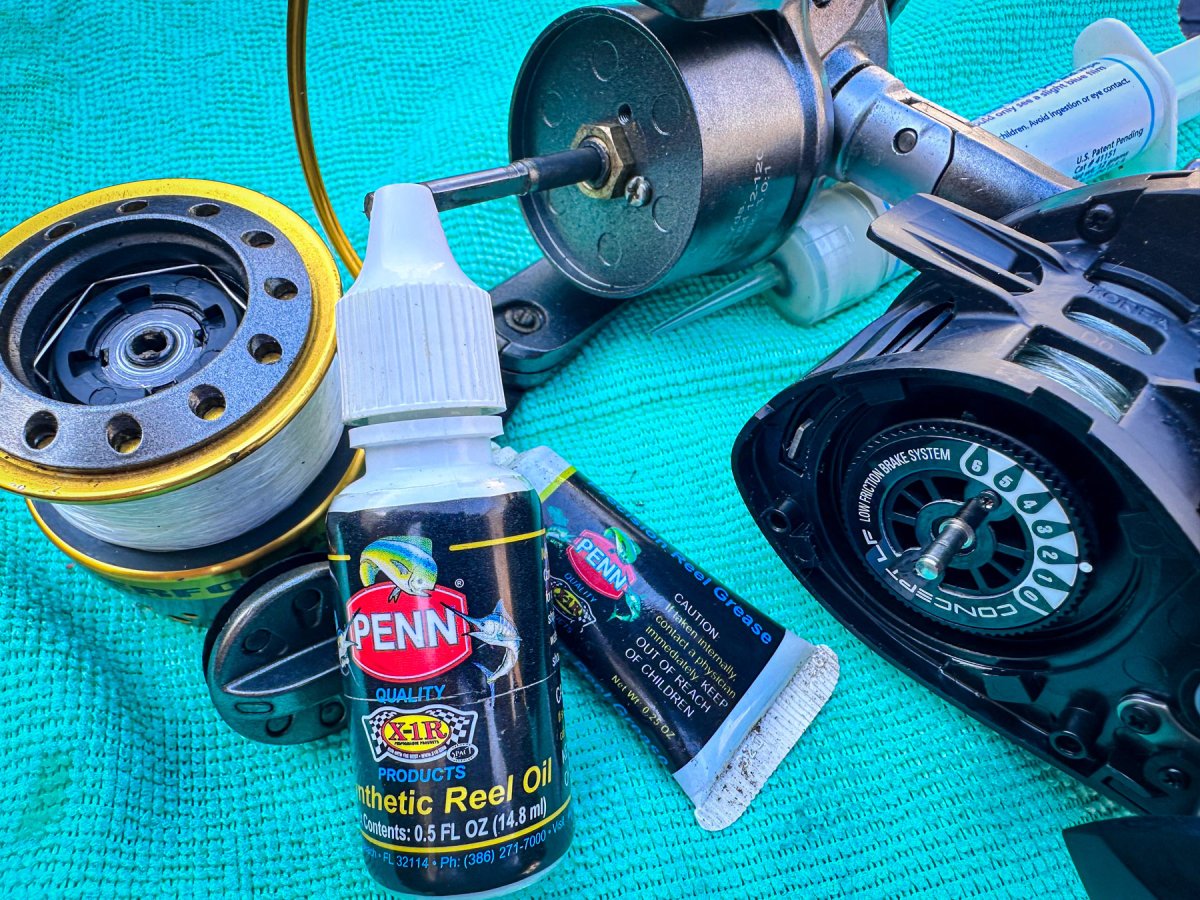
Unlike doing internal body work that can be more complex, taking a line roller off requires loosening just one screw. Marcotte says if you take it off and the interior is visibly dirty, a little bit of brake cleaner works great to strip off the old grease. Once it’s cleaned, Marcotte recommends putting in a single drop of oil, but not thick grease.
Leveled Off
When it comes to baitcasting reels, Marcotte says the most important part to keep in check is the level wind system. That’s the guide that moves back and forth across the front bar to evenly lay line on the spool as you reel. The guide rides on a series of crisscrossed gearing carved into the bar, and over time these can get easily gunked up, especially if you fish in water with heavy vegetation. And once this gear gets sticky, it can lead to bigger problems.
“There are a hundred different ways of cleaning that gear out,” says Marcotte. “You can hit it with compressed air, some guys just make sure it’s lubed with WD-40, but it doesn’t take much effort to keep that clean and oiled. I use everything from small picks to Q-Tips to clean them out, but as long as those grooved channels are clear and lightly oiled, your reel will perform much better.”
Since baitcaster side plates open up much more easily than those on a spinning reel, Marcotte also recommends adding oil to the ball bearings and the spool shaft. The trick, however, is using just a drop of oil, as over-oiling any part of any reel can lead to more problems than solutions.
Drag’s Screaming
Okay, so you’ve brought all your reels in a followed Marcotte’s advice. But when you put them back in the garage for the rest of the winter, he’s got one more tip. Regardless of reel price, it’s important that your drag function properly. A fast way to stop it from performing when you need it in battle is storing it in a tightened position for a long period of time.
“You never want to store a reel with the dragged locked down, especially if it’s an older model reel with felt washers,” Marcotte says. “If drag washers are under constant compression, they’ll squeeze out the oil that’s there to lubricate them. Then come spring, you’ll go to use the reel and find that the spool’s stuck.”
Marcotte says washers that aren’t properly lubricated can also burn and seize under the stress of a hard-running fish. If you remember to back the drag off once you’re done fishing for the day, however, you can add years of smooth performance to any reel.
Read the full article here