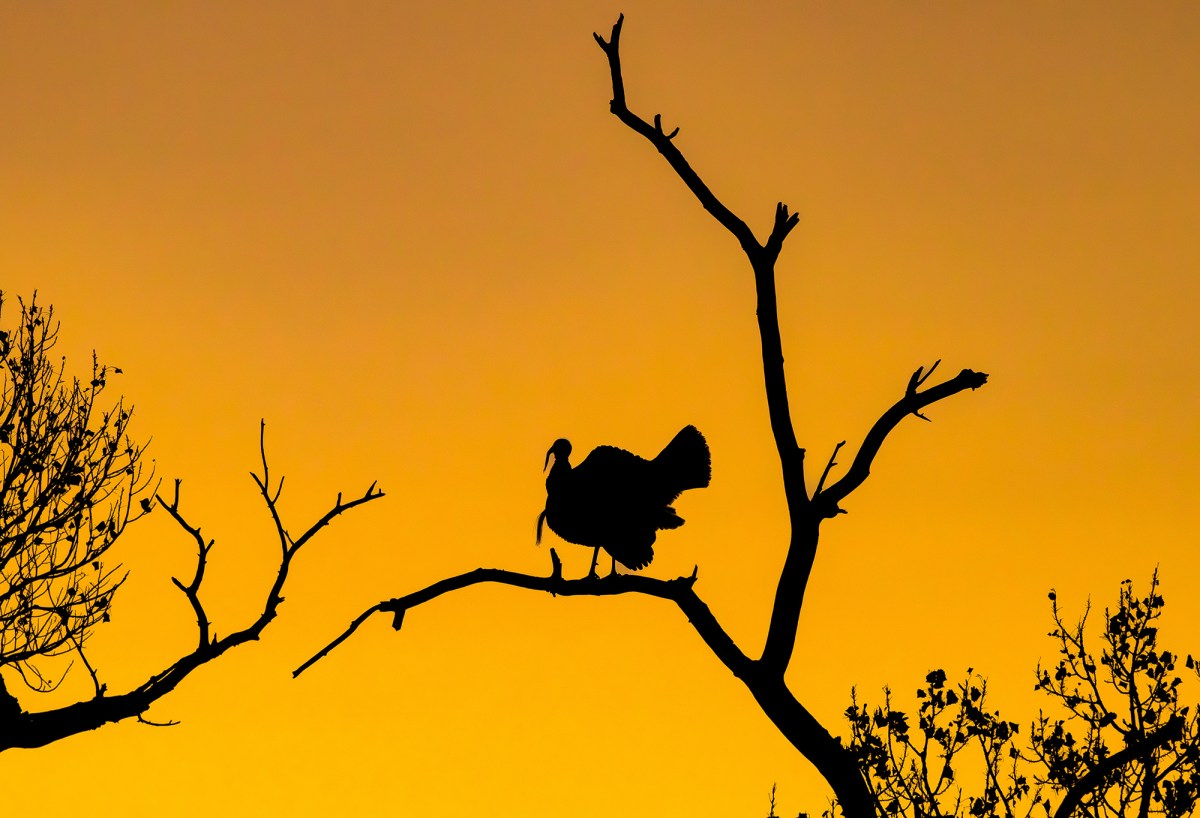

Patrick Wightman gets that America’s turkey hunters are cranky. Turkey populations are declining in most regions, none steeper than in the American Southeast. Seasons are shorter and shifting later in order to allow gobblers to breed hens before hunters hit the field. Meanwhile, bag limits are being reduced.
Reductions in opportunity are especially jarring for turkey hunters who recall the celebratory mood of the National Wild Turkey Federation around its Target 2000, an initiative to restore wild turkeys to all available habitat in 49 states. That work was declared accomplished in 2022, and the Turkey Federation largely turned its attention to improving habitat and defending our hunting heritage. That’s roughly the same time that hunters and wildlife managers started documenting widespread turkey declines below the Mason-Dixon Line.
Meanwhile, Wightman was deep in an academic career as a wild turkey researcher, documenting those same shifts in spring gobbling dynamics and in turkey distribution. Last month, Wightman became the NWTF’s national director of wild turkey research and science, and this week he’ll be introduced to the NWTF’s members at the annual National Wild Turkey Federation Convention and Sports Show in Nashville.
Related: The Best Slate Calls of 2026, Tested and Reviewed
Wightman approaches turkey management and population dynamics from the perspective as a decorated scientist but also as a hunter. A native of western New York, Wightman traces his interest in wildlife biology to hunting as a young boy with his father. In the short years since he earned advanced degrees from Louisiana State University and the University of Georgia, conversations around turkey camp have turned from stories of abundance to those of depletion.
Wightman intends to renew the NWTF’s investment in applied science, promoting research that investigates fundamental questions about turkey behavior, distribution, and life cycles, and assists wildlife agencies to balance hunting opportunity with turkey population dynamics. In that mandate, he follows the lead of the NWTF’s first director of research, the venerable Dr. James Earl Kennamer.
Much of Wightman’s field work has been at that very intersection of sustainability and hunting opportunity. His research, under the direction of the University of Georgia’s “Wild Turkey Doc,” Mike Chamberlain, has documented the impact of hunting on gobbling activity and on the ability of mature gobblers to successfully breed hens. By deploying remote recording devices on trees in turkey habitat, and then by comparing audible gobbling with location data from GPS devices attached to turkeys, researchers have concluded that hunting seasons that coincide with peak spring gobbling activity may be removing the very gobblers that are responsible for the majority of breeding.
Shifting seasons to later in the spring may make hunting harder, because gobblers aren’t as vocal, but may allow more breeding to occur. Obviously, that’s an important population-building consideration, but it may be more critical — and controversial — than ever as turkey habitat declines.
Wightman will deliver a couple of sobering perspectives to turkey hunters in Nashville. The first is that the turkey declines in the Southeast may be repeated across the country, as local flocks lose both habitat and breeding opportunity. The second is that it will take time to reverse the decline.
“As a turkey hunter myself, I get the frustration,” says Wightman. “Hunters should keep in mind that science is always working a little behind the curve. We researchers identify a problem, work to understand it, but it takes time to implement any changes. With a turkey lifespan of maybe three or four years, how many generations of turkeys will it take in order to see our research applied to meaningful changes in management? We’re not talking two or three years. We’re talking five years, maybe ten years. From a hunter’s perspective, I know that’s frustrating because we want answers now. But that’s not how science works.”
Listen to the author’s interview with Wightman on Apple, Spotify, or wherever you get your podcasts.
Read the full article here