
This story, “Catch Big Bass Right Now,” appeared in the April 1970 issue on Outdoor Life.
The small whitecaps pushed by a frigid March wind out of the northwest, slapped against our anchored boat. The partly overcast sky occasionally spat snow showers, and ice balls continually formed on the tips of our rods. Most fishermen did not consider this a day for fishing, and consequently my wife Betty and I had the whole lake to ourselves. The only thing that kept us casting was a strong dose of fishing fever we had developed over the long winter.
We were crawling our lures through the cold, murky water of Tucker Lake, a 150-acre stump-filled impoundment about 30 miles northeast of Jasper, Indiana, where I live. I’m a 29-year-old fishing-lure manufacturer and a part-time guide on Lake Monroe, Indiana’s hot new bass lake (see “Bass Like Wildfire,” OUTDOOR LIFE, March 1969).
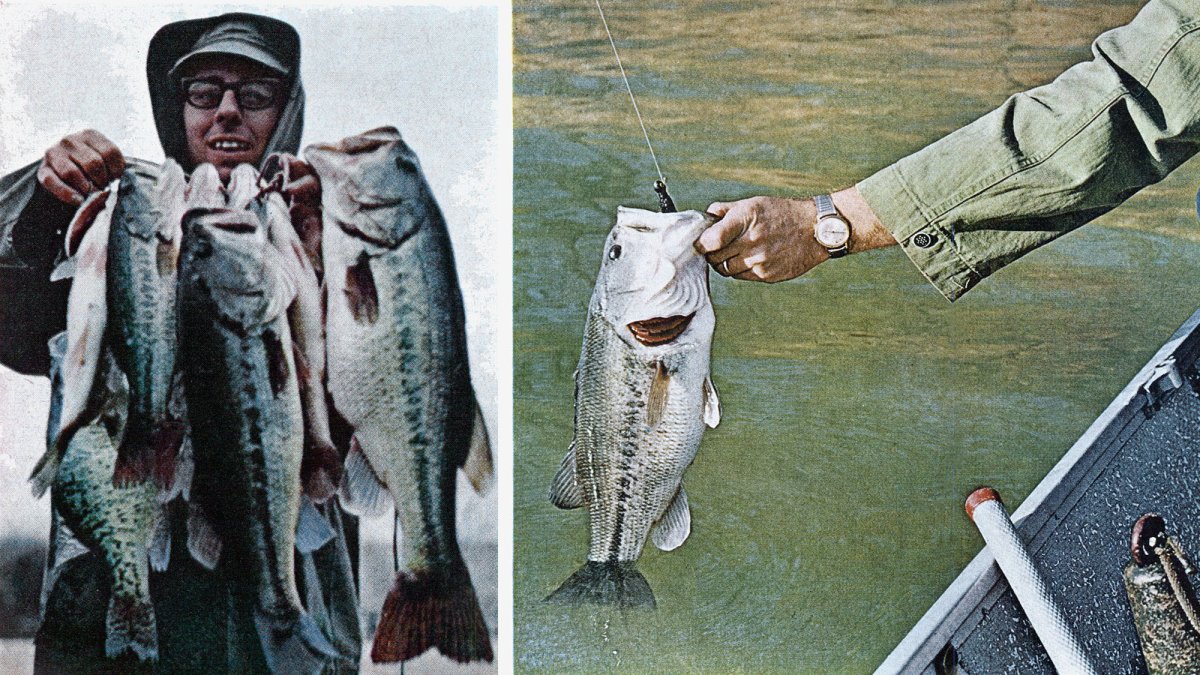
When Betty’s seemingly snagged lure started moving slowly toward the middle of the lake, I knew we were in business. After a short, furious battle Betty led a 4¼-pound bass to the boat, and I scooped it up. The largemouth had grabbed a deeply retrieved leadhead double-spinner lure.
Related: The Best Bass Lures, Tested and Reviewed
I strung the fish and then arched a long cast toward the same steep, ledgy shoreline. I let the lure settle to the bottom and then began retrieving it with a slow stop-and-go crawling action, making it hug bottom and drop from one ledge to another.
Halfway back to the boat the lure suddenly stopped. The boat rocked as I leaned back hard on my 5½-foot fiberglass rod. The rod danced and bent double, and the line peeled rapidly off my free-spool plugcasting reel against the tightly set drag. The bruiser headed for deeper water, and I applied all the pressure my outfit would take in order to wrestle him away from snags and obstructions and into open water. He made a couple of powerful surges, and then I slid the large oval net under the tired 6½-pound bass.
These two lunkers on consecutive casts warmed us up even more than the jug of steaming coffee that we always carry on such excursions.
We were getting in some early-spring bass fishing, which is often the best fishing of the entire season, especially for big bass. It usually occurs before most fishermen make their first casts of the year.
This fishing begins at different times in different parts of the country. Here in southern Indiana it starts shortly after ice-out, usually in March or early April.
Weather conditions trigger and control the caliber and the length of this hot early-spring action. After several months of semi-dormancy, bass have a gnawing appetite. A few consecutive unseasonably warm days or a warm rain that raises the water temperature a few degrees can set the bass off on a feeding spree, even though the water is still far below the temperature at which a bass’s metabolism rate is greatest. It is the change, not the temperature, that activates the fish. I have caught many bass of six to eight pounds after several warm days, when many of the shaded areas of the lakes were still covered with ice.
Steep, stumpy, rocky, and ledgy shorelines near deep water are almost always best for early-season fishing, since the fish still make their home in deep water but migrate to the nearest shoreline for short intervals on warm days to search for food. Prevailing winds and the position of the sun at this time of year warm the north and east shores of most lakes more rapidly.
Bass always hug the bottom during this season — not always in deep water, but never far from it. Shallow pockets and indentations along steep bluffs are occasionally loaded with big bass. I have caught limits of lunkers averaging more than four pounds from such places without moving the boat. Many of my fishing acquaintances in the South have hauled in daily limits of 15 bass averaging five to six pounds.
The more brush, stumps, roots, and rocks in an area, the better the fish like it. In addition to offering cover, these obstructions absorb heat and radiate it to the surrounding water. But you should try out different types of shoreline. When you find one that produces, stick with that type for the day.
Although balmy, sunny days seem to draw bass into shallower water and are frequently best, don’t neglect overcast, threatening weather. When you catch a fish, take note of the water depth, your speed of retrieve, and other pertinent conditions, and continue to fish accordingly. The light, temperature, barometric pressure, and food conditions will cause other fish to inhabit the same depths.
One warm afternoon in early April last year I went out to Beaver Lake, a 200-acre lake near Jasper, to try for some bass. Beaver is heavily fished in summer but deserted in early spring.
My first stop was a rocky, brushy point that extended into deep water. After a few casts I got a hard strike on my combination of jig and plastic lizard as I was inching it slowly along the bottom. The fish put up a long, hard struggle before he gave in to the pressure of my stiff rod and tightly set drag.
Read Next: The Best Bass Fishing Rods, Tested and Reviewed
I strung the 23-inch, six-pound largemouth and then continued to comb the water around the point. I got no more strikes there, so I headed the boat through choppy whitecaps across the wide main channel of the lake and eased it shoreward into calmer water along a steep, rocky bank that I knew occasionally harbored large bass. Then I started casting parallel to the bluff.
On my second cast I had retrieved the lure to within about 10 feet of the boat when I felt a slight resistance. I gave the rod a short twitch, trying to crawl the lure over what I figured was a large boulder. The line headed slowly toward the middle of the lake, then picked up speed and tightened. When the swimming fish began to pull my rod tip down, I struck hard. At that instant the bass rocketed off in the opposite direction with a powerful thrust and popped my 15-pound-test line.
I moved to similar areas — shallow shelves near deep-water dropoffs and concentrated mostly on the five to seven-foot depths. The bass attacked my slowly retrieved lure viciously. Two hours later, with five bass on the stringer, I returned to the spot where the big bass had broken my line.
After several approaching casts brought no response, I aimed a long cast about 10 feet past the big bass’s boulder-laden lair and started crawling my lure very slowly back through his bedroom. The lur·e soon bumped a large rock that it couldn’t pass. I reeled it up to the top edge of the boulder and tried to slide it across, but it stuck again. I lowered the rod tip a couple of feet, and the lead-head lure dropped toward bottom. Then J tried to crawl it over again. Suddenly I felt a jolting strike. Instinctively I yanked hard, but I felt nothing.
I reeled in an almost limp line and found that all but an inch of the plastic lizard had been ripped off the jighead. I quickly slipped on a replacement and fired another cast to the same spot. The fish hit before the lure reached bottom, but this time I paused momentarily before driving the hook home. I had him. The bass streaked off and literally turned my boat in a half circle with his powerful drives. I held my rod tip high and applied steady pressure. But this bruiser knew every trick in the book. and then some. After his second run and a long swing to the left, I felt a slack line arid at first thought the hook had slipped out. But I reeled in madly and soon discovered that the fish was heading directly toward me. He went under the boat and then came halfway out of the water on the other side.
I swung my rod around the front of the boat and kept a tight line. The hook held. The bass wallowed on the surface and then dashed again toward bottom. Now he began to tire, and his runs became shorter and weaker. He made one more short, furious flurry and then lay belly-up on the surface near the boat. I lowered the net into the water and carefully scooped him up.
Read Next: How to Fish a Spinnerbait: This Classic Bass Lure Is Just as Effective as Ever
Two identical lures hung from the same corner of the bass’s enormous mouth — the one attached to my line and the one he had stolen two hours before. I later found in his gullet the hookless plastic lizard that he had ripped off my weedless jighead. By striking the same lure three times in less than two hours, this 8 ¾-pound largemouth defied an old adage: “After striking a lure and escaping, bass sulk on the bottom without eating for a week or so.”
At this time of year you can limit your selection of lures to a handful — the type that can be fished very slowly on the lake bottom. The leadhead spinner lures are extremely effective, especially if the water is muddy or discolored, as are the jig-worms and the jig-and-pork-eel combinations. The deep-diving plug-type lures round out the selection.
The spinner lures and jigs, if properly designed, can be retrieved slowly along the bottom through brush and stumps without snagging. Always select lures with large, needle-sharp, extra-strong hooks.
Teadhead spinners are usually used with porkrind enticers. In lakes that contain shade, white is one of the best colors. In other waters, black, yellow, and combinations of these two are best. In early spring I prefer to get my boat close to shore and cast either parallel to the bank or out into deep water, from which I crawl the lures uphill toward shore. They can be retrieved slower uphill to better simulate the movements of crayfish and other bass food in cold water.
Give these spinner lures action by raising the rod with short twitches and pulls, then lowering it and retrieving the slack. On a good spinner lure the blades spin during the retrieve and flutter as the lure sinks during the pause, which is when most spring bass pounce on a lure. If you notice the strike or feel any resistance on the following pull, set the hook very hard a couple of times. The spinners offer a lot of water resistance, and an unusually hard jerk is required to drive the hook point into the bone-hard mouth of a bass. I’m convinced that more big bass are lost because of dull hooks and light lip-hooking than for all other reasons combined.
Video: Never Fillet Bluegills Again, Use This Method Instead
I prefer to set a hook by sweeping my rod sideways, not by jerking it upward, because I believe that a hook will bite and hold better in a corner of a bass’s month than it will in the hard upper portion.
Retrieve worm and eel jigs the same way you retrieve spinner lures, but give the fish several seconds to mouth the lure before you try to set the hook. These lures are best rigged with a single weedless hook at the head, and a sluggish bass usually needs several seconds to get the whole business into his mouth. Since worms and eels are soft, a bass will not drop them unless he feels too much tension from the line.
Plug-type lures also should be skipped along the bottom with a slow stop-and-go action. You’ll have to reel the floating-diving plugs rapidly at first to get them to the bottom, but then you should slow them down to a snail’s pace. Plugs should resemble crayfish or the predominant local baitfish in color and action. Frequently at this time of year, strikes of even big bass are barely noticeable. Because of this factor, I like to use a short stiff rod. Such rods are more sensitive to vibrations than are springy rods, and they also have more power for hook-setting. By grasping the rod very lightly just above the reel I get more balance and control and can “feel” the lure better.
Read Next: The Ned Rig: A Complete Guide to Baits, Gear, and How to Fish It
Always watch your line on the retrieve. Many strikes appear as just a slight twitch, especially when the lure is sinking on a slack line. Often a big bass will inhale a lure and you notice only a heavy feeling, as if your lure were being pulled through cold molasses.
The right methods and tackle are not your only big concerns at this time of year. Adequate clothing is especially important. A full-length water-repellent parka will not only protect you from rain but will also break the wind on long runs and shield you from spray thrown up by choppy water. Warm, light-weight, insulated underwear is valuable. And a pair of Polaroid sunglasses can make your trip more enjoyable, since the sun in March and April is at a low angle and produces bright reflections on the water.
Frequently there is little difference in ability between the successful fisherman and the unsuccessful one. As a part-time guide on Lake Monroe, I get to observe and talk with numerous anglers, and I’ve found that enthusiasm, confidence. stamina, and concentration breed success.
Approach bass fishing with an open mind. Be willing to work at it, study it, and observe all events and details. Keep telling yourself that you will succeed, that the bass will start feeding before long, that sooner or later you will locate them. Keep your lure working for you and concentrate on what it is doing, whether it’s crawling over brush, climbing or descending a ledge, or scratching a rocky, sandy, or mud bottom. By so doing you will learn the contours and makeup of the lake bottom, and this knowledge in itself will make you a better fisherman.
A good electronic depthfinder, by the way, is an invaluable tool for a bass fisherman, especially on unfamiliar water.
In mid-April several years ago I took a trip to Dale Hollow Reservoir on the Kentucky-Tennessee border. I was after the lake’s famous Junker smallmouth bass, and Jim Wisdom, proprietor of Wisdom’s Fishing Camp near Albany, Kentucky, told me of several prospective hotspots nearby. I cranked up the motor and headed toward several steep rocky points that extended into very deep water. Then I surveyed the lake bottom with my electronic fish locater.
At the first point I selected, a series of short steps dropped off from 10 to 15 feet deep on one side. It seemed like an excellent spot, so I coasted in, lowered the anchor, and started casting. Before long, four chunky smallmouths weighing 2 ½ to four pounds apiece had fallen for my black six-inch jigworm. Then the action slowed down.
I tried several other points but got no more strikes, so on the way back to the dock I again stopped at the rocky point where I had caught the four bass. As the boat neared the position, I lowered the mushroom anchor. It bumped bottom, stopped, and then slid down another 10 feet.
After combing the step area without success, I decided to try the dropoff that the anchor had slid down. This spot was on the other, shallower side of the point in an area I hadn’t surveyed with my depthfinder. On my third cast to the dropoff a Junker grabbed my plastic worm as it climbed the incline, and he tried to keep it.
The fish moved off with the power of a bulldog stung by a hornet. He showed me one dashing surge after another, making my reel sing and testing the flexibility of my stiff rod. After a long tug-of-war I had a flopping 5 ¼-pound smallmouth in the net on the boat seat beside me.
Read Next: Old-School Tips for Catching Giant Bass in Small Ponds
During the next two days of my trip I must have scratched two inches of gravel off the bottom in that area, which I discovered was an old roadbed that ran parallel to the shoreline and then swung away from the point and out across the lake bottom. I also had some of the most outstanding smallmouth fishing of my life.
So this year, dress warm and get out early. Take along a variety of bottom-nudging lures, and approach your fishing hole with enthusiasm, confidence, determination, and concentration. Take a strong stringer, too. You’ll probably need it.
Read the full article here