My Stepson and I Tagged Out at the Same Time. My Buck Was One of the Biggest Ever Taken in Colorado
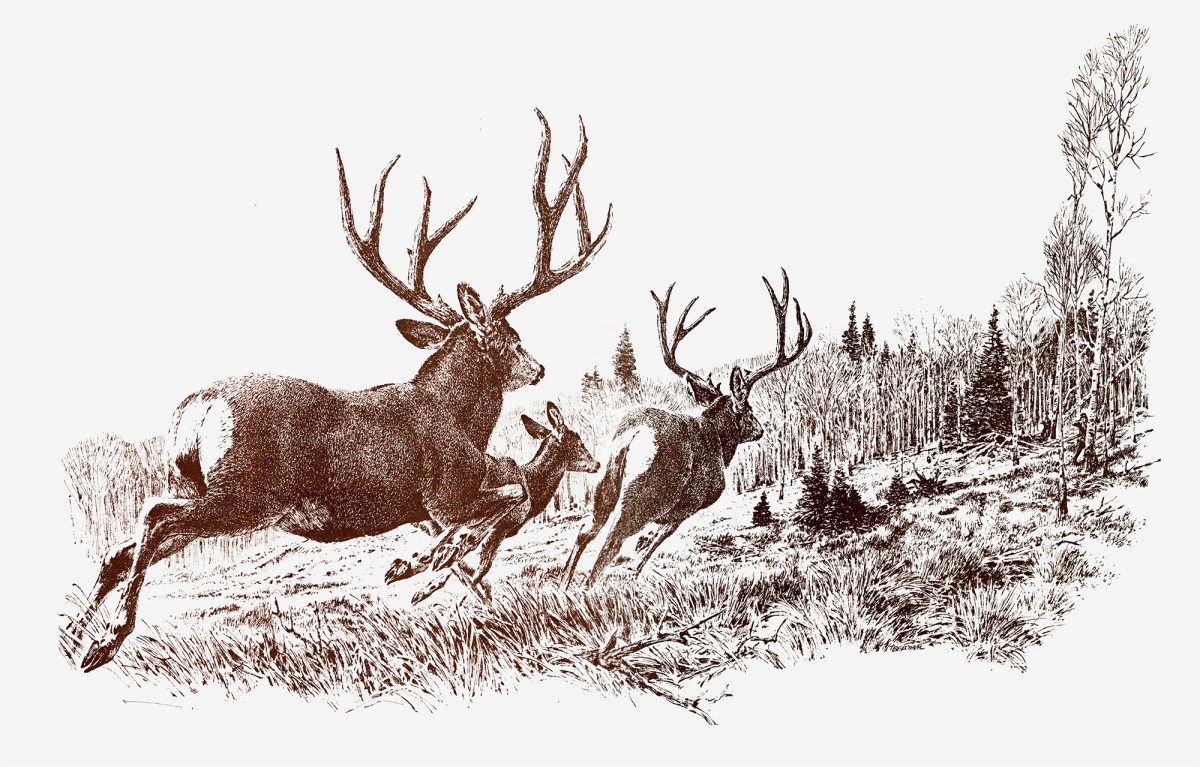

This story, “2-for-2 Trophy Hunt,” first appeared in the April 1978 issue of Outdoor Life. The author’s buck remains one of the biggertypical mule deer ever taken in Colorado; it now ranks as 20th in the state (as well as No. 64 of all time). The score entered into the books is 207 2/8, however, not the 209 and 3/8 listed at the end of the story.
Last July, in the Denver Museum of Natural History, I received the Boone and Crockett Club award for the No. 2 typical mule deer buck taken in North America during the previous three years. My trophy is also No. 14 in the all-time typical mule deer list. Getting the award was the highlight of my life, but something I saw in the museum also gave me an enormous sense of satisfaction.
The museum has many glassed-in wildlife displays that are remarkably true to life. Each one features several specimens of mounted animals arranged in lifelike settings. The entire background of each display is a curved wall that is painted with scenic details complementing the foreground setting. When you look at one of these displays you’re looking at what appears to be many square miles of natural wilderness habitat.
The mule deer display really caught my eye. In the foreground are several deer, including an average 10-point (Eastern count) buck. In the painted background is a tiny painting of an enormous trophy buck. You have to look for several minutes before you spot this buck. He appears to be far in the distance beyond several canyons, draws, and valleys. I’d bet that not one deer hunter in 10 notices that buck in the painting, and not one in 100 ever sees the biggest bucks in the wild. My award-winning buck wasn’t the first trophy deer I’ve taken. He’s the only one among more than 40 bucks I’ve killed that made the record book, but I’ve downed other giants with massive racks. And I’ve seen bucks that were as good or better than my award winner. When you hunt my way you’re almost bound to get your chance at a top trophy sooner or later.
My way is about as inexpensive as you can go. I can’t afford to hire guides or ent horses. The key to my system is to mix a lot of hunting knowledge with a maximum amount of hunting effort. That display in Denver really tells it all. The big bucks are always way back in the roughest country most hunters never see.
There are no gimmicks to my system. I do my trophy hunting on one million acres of public land. Most mule deer hunters don’t really hunt. They’re out in the woods with a rifle and they think they’re hunting, but they don’t really know what it takes to get close to with trophy racks.
I’m 34. I was raised on a farm in east Texas. Hunting and fishing was a way of life in my family, so I was in on the action when I was a small boy. I killed my first buck when I was nine.
My grandfather decided I was old enough to help get some meat. He fixed me up with a single-shot 12 gauge loaded with 00 buckshot. We didn’t have much trouble finding a small four-point whitetail. When granddad told me to shoot I touched off. Talk about getting kicked! That single barrel gun just about spun me around. But my aim was true, and the little buck went down in his tracks.
Through the years I killed lots of Texas whitetails, and I made weekend hunts in Oklahoma, Arkansas, and Louisiana. I got my share of deer, but I never saw a real trophy buck till 1965.
One of my brothers-in-law had been hunting deer in Colorado for several years. He finally came home with an 11-pointer with an antler spread of 29 inches. I didn’t realize deer could get so big. Right then I developed an enormous desire to hunt mule deer in the West, but I didn’t get there for years.
I didn’t realize deer could get so big. Right then I developed an enormous desire to hunt mule deer in the West.
I make my living as a painting contractor. By a stroke of luck I teamed up with another painter on a job in 1970. Wayne Webb and his dad hunted mule deer in Colorado three different times, but they hadn’t been back in a couple of years. I talked up a storm about making a hunt, and I guess my enthusiasm wore off on Wayne. We talked with his dad, and soon we were making specific plans.
This situation was made to order for me. Man’s fear of going alone into wilderness he has never seen and knows nothing about had kept me from going to Colorado for five years. Now I had a chance to go with guys who had experience. All our talk about hunting conditions, weather problems, and huge deer was like a dream to me. I cataloged all the information in my mind. I had learned years before that the more you know about deer and hunting conditions in a specific area the more successful you’re going to be. This first hunt would be just a preliminary training session for me. I already had it in my mind that I’d go back every year till I scored on the buck of a lifetime.
I got lucky on that first hunt. I dropped a seven-point, 175-pounder with a 24-inch spread. It was the largest deer I had ever taken. But I saw bucks other hunters had taken that were much better trophy animals. It had to be that they knew a lot more about how to find big-buck country than I did. The study of the subject became a passion with me. I read every book and magazine article I could find about deer hunting. The next year I got my own group together. Three of us went back into the same area I had hunted the previous fall. We didn’t do well. I finally killed a forkhorn. In 1972 we tried a new area, but stayed with it only two days and then moved on.
We were in the Montrose, Colorado, region. We weren’t just moving about aimlessly; we were looking for what I call good trophy country. I was following a principle that many deer hunters ignore. I think most hunters find a chunk of woodland that looks like it should be full of deer and hunt it without reading the signs that tell whether or not it is actually good hunting country.
A large chunk of deer range is something like a big lake. About 50 percent of the lake often contains no fish even though all of the water may look like good fish habitat. The other half of the lake contains fish, but only 10 percent or less of that water will contain big fish. Deer often occupy their habitat in the same manner. In a way, deer are like people.
Most people live in a town or city that provides the work and amenities they need. Mule deer are no different. They live in the given part of a range that best suits their needs for food, water, shelter, and safety. Big bucks utilize only a small part of the range. The trophy-hunter’s job is to find big-buck country.
Most of the so-called experts who give advice about deer hunting claim that pre-season scouting is the only way to locate good deer country. That sounds great, but it isn’t practical for most of us. How am I going to scout in Colorado when I live 1,000 miles away in Texas? Any non-resident deer hunter has the same problem. That’s why many of them hire guides. I knew when I first went to Colorado that I’d have to hunt there for years before I really knew the hunting country. I hunted 40 square miles of the Rockies before I wound up in the area where I downed my award-winning buck. The non-resident who hunts without a guide has to do his scouting while he’s hunting, but there are some shortcuts. One most important thing is to make local contacts. The best way is to spend your money with local people who know the hunting picture. I made it a point to buy my gas at the same gas station, groceries in the same little store, and hunting supplies and licenses in the same sporting-goods store every year.
Walk into these places once and you’re just another stranger. Leave some money in them often enough for things you need anyway, and you become a friend. Once the store-keepers get to know you and accept you as a serious sportsman, they’ll readily share their knowledge and offer advice. Some of them will also tell you about big bucks they have seen. Most hunters can’t resist bragging a little about trophy deer they have seen.
The only way a trophy buck gets his huge rack is to live long enough.
This usually takes at least four or five years. By the time a buck gets that old he has had plenty of narrow escapes from hunters. He knows that trouble is coming each fall when the woods come alive with cars, trucks and campers. When a smart deer sees camps being set up, hears chain saws cutting campfire wood, and sees many humans in the forest he knows a new hunting season is about to begin. He heads into the most remote and roughest part of his range.
Once the store-keepers get to know you and accept you as a serious sportsman, they’ll readily share their knowledge and offer advice. Some of them will also tell you about big bucks they have seen.
Big mule deer bucks always get into country that’s too rugged for the average hunter. They’re relatively safe there, and they know it. The guy who hunts no more than a mile or two from back-country roads or jeep trails is never going to see these big bucks. The only way you’ll get into trophy-buck country is to go into the very bowels of the roughest and roadless terrain. When you get down into one of those canyons, hunt it a while, and then start back out, you’ll have a real climb on your hands. By the time you reach the rim, you’ll feel like throwing your rifle away.
The way to hunt this type of country is to camp as far away from the towns as you can get. The campsite I use now is nearly 50 miles from Montrose, the closest community. From there I walk into my hunting area. It’s about eight miles from camp. I found the area on the third day of my 1972 hunt.
Before daylight that morning three of us drove a jeep trail that wound back into some good hunting country. From where we parked the jeep I headed out on foot into an area where 4WD’s can’t go. I finally got back into deep canyons and valleys where I began to see all kinds of deer sign. Once you find plenty of fresh tracks, fresh droppings, and well-used game trails, you know you’re in a deer concentration area. I worked on down into the bottom of a valley, still hunting and taking stands along the way.
Suddenly I spotted a large herd of deer — 40 to 50 animals. Later I watched a herd of elk that included a magnificent 10-pointer. I didn’t get a shot that day, but there was no question that I had found one of those very small parts of range that’s best suited to the needs of a lot of deer. I got into camp long after dark that night. I figured I had walked 18 to 20 miles over some of the roughest country in Colorado.
The next morning I was back in that valley before daylight. I heard deer running off in the dark. I found a good vantage point that allowed me to look out over much of the floor of the valley and took a stand there. Within the next hour I watched several deer move down a small draw about 500 yards away. I didn’t spot any big bucks, but it was obvious that the draw leading to the valley’s floor was a major travel route. I moved closer.
Shortly two does and a forkhorn came down the draw. One of the does kept looking back. I figured there might be a big buck following her, so I scoped every inch of the thickest cover. Suddenly I saw the flash of a deer’s ear. As I stared at the precise area I began making out parts of the deer’s body, including a very big rack. That buck was just standing there in a patch of spruce. He must have known something was wrong even though the other deer had no inkling of my presence.
I put the crosshairs on his lung area and touched off. The 10-pointer died instantly. I guessed his weight at 275 pounds. Then the work started. I was four miles into the canyon and seven miles from camp. I quartered that deer and packed the quarters out of the canyon. Then I walked to camp to get help.
An efficient camp is vital to efficient hunting. If you forget something or take the wrong gear, your hunt is ruined, even if you’re a millionaire. You just can’t commute to the closest motel when you’re 50 miles from town.
We use two, sometimes three tents. The two main tents measure 12×14 and l0xl0. I have another 9×9 tent we use occasionally for storage. Our main cooking stove is a three-burner butane unit with an oven. I also take two Coleman stoves. We use one in one of the tents to dry clothes and keep water and food from freezing; the other is a spare. The big tent is for eating and sleeping. Everything is dry in there at all times. You have to be dry and comfortable at night or you can’t hunt efficiently the next day. Selection of clothes is very important. Weather in the Rockies during hunting season can vary from 75° to 10 below. You have to take clothes for all conditions. And you have to take other items to match weather conditions. Snow chains for your vehicles are a necessity. An extra battery is good insurance, so is a set of booster cables. We take everything that might be needed. The contents of our medicine box are carefully selected. A month or so before we leave home, we take all of our camping gear out of storage and check every item. We collected all our equipment over a period of years. Once that expense is out of the way our trips turned out to be pretty cheap. We usually take $200 each and bring money back. The major expense now is $90 for a nonresident Colorado deer license. A few years ago it was only $50.
In 1973 some of my usual hunting companions couldn’t make the trip, so just my stepson, Gary Sligar, and I headed back to Colorado’s Uncompahgre National Forest. Gary was 16 that year. He hadn’t been West before, but he had learned a lot about deer hunting during our many years of hunting in Texas. There was no question about where we would hunt. We’d hike back into the valley where I’d seen all the deer and shot the 10-pointer in ’72.
The valley is about 400 yards wide and 1,000 yards long. It narrows as it rises to about 8,500 feet. One side is heavily forested with a mixture of pines, junipers, spruces, and aspens. Scattered aspens dot the valley’s floor and its western side. Just over the top of the western side, there’s a large expanse of jungle-like spruce thickets mixed with cedar and pine.
Suddenly I saw the flash of a deer’s ear. As I stared at the precise area I began making out parts of the deer’s body, including a very big rack.
The first morning Gary and I came in from the east side of the valley. We took stands for a couple of hours, saw no deer, and then began still-hunting toward the western slope. When we started up the slope we spooked three big bucks. They went up so fast we couldn’t get a shot. Gary took off running up the slope in hopes of seeing the bucks on the far side. He was puffing when he came back. “They ran into those greens and disappeared,” he said.
The greens Gary referred to were the spruce thickets. I could have kicked myself. The spruce thickets had to be a bedding area. If we had come into the valley from the west, we would have intercepted the deer moving toward their bedding ground. As it was, we pushed them into it.
The next morning we came in from the west, but we were a little too late because we had to hike several miles farther to make our new approach. The deer were already in the greens, all except one huge buck that we jumped. I had just enough time to snap off two quick shots before he bolted over the ridge. Both missed. I ran to the edge and looked down into the valley, hoping the buck would cross it. He was too smart for that. We found out later, from studying his tracks, that he went over the side and then doubled back into the greens.
That buck wore the most massive antlers I had ever seen. Before our hunt was over Gary killed an eight-pointer and I got a 10-pointer, but their racks weren’t nearly as impressive as his. Those antlers haunted me for a year before our 1974 hunt.
Three friends made that trip with Gary and me. John Medford is a painting contractor. H. R. Medford is a painter employed by me. Don Pugh is an air conditioner repair man. We camped in the same spot I had been using for several years. Some of the fellows did a little scouting the afternoon before opening day. Gary and I stayed in camp because I think scouting is the worst thing you can do when you already know where you’re going to hunt. It makes no sense to disturb the deer if you know where they are.
We hit the sack that night about 10 o’clock, but everybody was so excited about opening day that we didn’t get much sleep. By 1 o’clock John was out of his sleeping bag and digging around in our grocery box. Then we all got up. After two pots of coffee nobody could think about sleeping. We cooked up a batch of bacon and eggs and toast, polished it off, and stayed up the rest of the night.
Gary and I had just about finished our long hike to the valley when daylight began to break. We saw four does near the edge but no deer in the valley. That didn’t bother me because I figured the animals weren’t moving toward the greens yet. So we went down over the edge of the valley to the place where I wanted to take stands. I put Gary behind a large aspen tree near the top of the slope. I walked 40 feet farther down to another big aspen. I had a good view of the valley’s floor. My plan was to slope between Gary and myself. National Forest land is leased to ranchers during spring, summer, and fall, so it’s not unusual to see these trails in remote wilderness.
Within moments two does came out of the draw at the far end of the valley. They walked toward us on an angle and passed 100 yards away. Right after that three more deer came out of the draw. I saw antlers as soon as I spotted the deer. It registered on me right away that two of the animals were bucks with massive antlers. The deer were over 300 yards away, but even at that distance the antlers were more visible than the bodies. When you see a sight like that — when all your eyes can focus on are enormous racks — you know you’re looking at outstanding trophies.
I gestured to Gary so that he would get down and get ready to shoot. The two bucks and the doe hadn’t sensed us. I figured that the deer would keep coming in our general direction for 100 yards or so and then would turn broadside to go up the slope. They didn’t. When they got to the cattle trail they turned up it and walked straight at us.
The bigger buck began angling off to my side when he was about 80 yards away. I eased up my Sako .243, found his chest in my 3-to-9X Leupold scope, and sent a 100-grain slug on its way. The buck went to his knees, but regained his footing and ran straight ahead. He had no idea where the shot had come from. I fired again at almost point-blank range. The huge buck hunched up when my second bullet hit him in the lungs, but he still didn’t go down. He raced past me no more than 20 feet away. By that time I was well aware that Gary’s .270 Winchester was roaring.
I whirled around and fired again. That bullet put the giant down for keeps. At the same time I saw my buck going down, Gary’s ran into view. But he was dead on his feet. He caved in and hit the ground within 10 feet of my buck. I choked up. There’s no greater thrill than scoring on the best buck of your life, and it was almost impossible to believe that a father-and-son-team could drop two enormous bucks at the same time and in the same place.
When I fired my first shot all three deer had run straight at us. Mine ran past me while the other buck and the doe swerved around Gary. When they got by us, they closed ranks, but by then the two bucks were mortally wounded. It was just by chance that they fell together.
He raced past me no more than 20 feet away. By that time I was well aware that Gary’s .270 Winchester was roaring.
Gary was almost beside himself while we ran the 30 yards to the fallen deer. The first thing he did was count points. All Texans count the points on both sides of a buck’s rack, including the brow tines. “Mine’s got 14, yours has 12,” he yelled.
I got out my tape measure and found that the outside spread of my buck’s antlers was 37¼ inches. Circumference at the base of each antler was 7 ¼ inches. Gary’s buck had a 33-inch spread. I guessed the live weight of each deer at well over 300 pounds. I knew it would be an enormous job to pack all that meat out. After we dressed them out, I decided it would be best to hike back to camp and get help.
When we arrived at camp Bob King was at his nearby campsite. Bob is a police officer in Montrose, and he’s also a trophy hunter. He always takes part of his vacation during deer season, so he has plenty of time to hunt and he’s always more than willing to help other hunters. When he heard about our bucks he was just as anxious to get them out as he was to see the racks. He asked if we could get the animals in his jeep.
“No way,” I said. “We might get within 1,000 yards or so, but that would be it.”
Bob shortened that 1,000 yards a bit with some of the most incredible driving I’ve ever seen. Many times he had to back up and go forward again to get through the aspens. He went down one slope that was so steep I jumped out of the vehicle because I though it would surely turn over. Eventually even Bob decided he could go no farther. When he got his first look at my buck, he said he was absolutely certain it would make the record book.
Read Next: I Went Elk Hunting with a Wyoming Outlaw
Up until then I hadn’t even thought about the record book. I’d heard about the Boone and Crockett Club, but I had some strange idea that it was some kind of a setup for millionaires. Now I know that anybody can make the club’s record book — published jointly by the Boone and Crockett Club and the National Rifle Association — if he scores on a big-game trophy that’s outstanding enough to be listed.
The 1977 edition of the record book lists 288 entries in the typical mule deer category. These 288 bucks are the best typical mule deer ever taken by sportsmen in North America. With an official score of 209 3/8, mine ranks fourteenth.
Read the full article here