How to Use a Compass: The Survival Skill That Could Save Your Life When GPS Fails

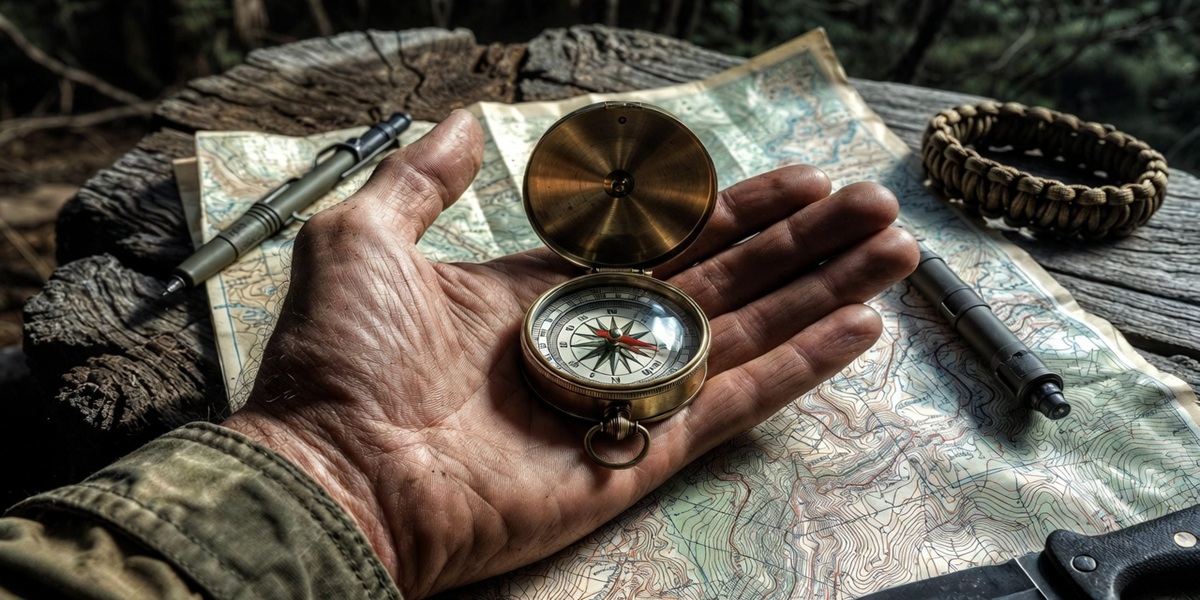

Every prepper knows the feeling. You are deep in unfamiliar terrain, your phone battery is dead, the nearest cell tower is miles behind you, and the trail you were following has disappeared into thick brush. This is the moment that separates prepared survivors from people who become search-and-rescue statistics.
Knowing how to use a compass is not optional survival knowledge. It is foundational. It is the skill that works when every battery-powered device has failed, when the grid is down, and when no one is coming to help you. A quality baseplate compass costs less than twenty dollars and will outlast every piece of electronic gear you own.
This guide will teach you exactly how to use a compass, from the basic mechanics to advanced field techniques, so that when the moment comes, you are ready.
Why Compass Skills Are Non-Negotiable for Preppers
GPS devices fail. Smartphones die. Solar flares, EMPs, and simple battery drain can render every piece of digital navigation technology useless in minutes. A magnetic compass, by contrast, requires nothing but the Earth’s magnetic field, which has been reliably present for billions of years and shows no signs of stopping.
During Hurricane Katrina, during the wildfires that have swept across the American West, and during every major grid-down event in modern history, people who knew how to navigate without technology survived at significantly higher rates than those who did not. The U.S. military still trains every soldier in land navigation with a map and compass for precisely this reason. It is the fallback that never fails.
If you carry a compass in your bug-out bag but have never practiced using it, you are carrying dead weight. This guide changes that.
Understanding Your Compass: The Parts You Need to Know
Before you can use a compass effectively, you need to understand what you are holding. The most practical compass for preppers and survivalists is the baseplate compass, also called an orienteering compass. The most trusted brands are Suunto and Silva, though the military-issue lensatic compass is also excellent once you learn its slightly different operation.
Here are the key components:
- The magnetic needle is the heart of the compass. One end, almost always red, points toward magnetic north. It floats freely on a pivot and will orient itself to the Earth’s magnetic field regardless of which direction you are facing.
- The rotating bezel is the circular ring around the compass housing marked with degrees from 0 to 360. North is 0 and 360, east is 90, south is 180, and west is 270. You rotate this ring to set and track bearings.
- The orienting arrow is a non-magnetic arrow etched or printed on the floor of the compass housing. You align this with the magnetic needle during use.
- The direction of travel arrow is printed on the baseplate and points away from you toward your destination when you are taking a bearing.
- The orienting lines are parallel lines on the floor of the housing that you align with the north-south grid lines on a map.
- The baseplate is the transparent rectangular platform the compass housing sits on. It usually has ruler markings along the edges for measuring map distances.
- Spend five minutes with your compass identifying each of these parts before you ever take it into the field. Familiarity under pressure starts with familiarity at home.
The Difference Between Magnetic North and True North
This is where most beginners make a critical error, and in a survival situation, that error can cost you miles of wasted travel in the wrong direction.
Your compass needle does not point to the geographic North Pole, which is what maps are drawn around. It points to magnetic north, a point in the Canadian Arctic that shifts slightly from year to year. The angular difference between true north and magnetic north at your location is called declination.
In some parts of the United States, declination is minimal and can be ignored for rough navigation. But in others, it is significant. On the West Coast, declination can be as high as 15 degrees east. On the East Coast, it can run 10 to 20 degrees west. If you are traveling on a bearing of 10 miles and your declination is off by 15 degrees, you will arrive nearly 3 miles from your intended destination.
Every good topographic map will show the declination for that region, usually in the map legend as a diagram showing the angle between true north and magnetic north. Learn to read and apply this correction before your life depends on it.
To adjust for east declination, subtract the declination value from your compass bearing. To adjust for west declination, add the declination value. Some quality compasses have an adjustable declination feature built into the bezel, which makes this automatic once properly set.
How to Take a Bearing in the Field
Taking a bearing means using your compass to identify the precise direction toward a destination. This is the most fundamental compass skill and the one you will use most often.
- Step one: Hold the compass level in front of you at waist or chest height, with the direction of travel arrow pointing away from your body toward your destination.
- Step two: Rotate your entire body, not just the compass, until the red magnetic needle aligns with the orienting arrow inside the housing. This is the “red in the shed” technique. When the needle sits perfectly inside the orienting arrow, you are facing your bearing direction.
- Step three: Read the degree number at the index line where the direction of travel arrow meets the bezel. This number is your bearing. Write it down.
- Step four: To travel that bearing, keep the red needle inside the orienting arrow and walk in the direction the travel arrow points. Select a landmark in the distance along that line of sight, such as a distinctive tree or rock, and walk to it. Re-check your bearing frequently, especially after crossing difficult terrain that forces you off a straight line.
A good practice interval is every 100 to 200 yards in open terrain, more frequently in dense forest or low visibility conditions.
How to Navigate From a Map to the Field
Map and compass navigation together is where this skill becomes truly powerful. This is how you move through unknown terrain with genuine confidence.
- Step one: Identify your current position and your destination on the map. Lay your compass on the map with the edge of the baseplate connecting the two points, with the direction of travel arrow pointing toward your destination.
- Step two: Without moving the baseplate, rotate the bezel until the orienting lines inside the housing are parallel to the north-south grid lines on the map, with the orienting arrow pointing toward map north.
- Step three: Pick up the compass and hold it level in front of you. Rotate your body until the red magnetic needle aligns with the orienting arrow. Apply your declination correction at this point if your compass does not do it automatically.
- Step four: The direction of travel arrow now points toward your destination. Sight along it, identify a distant landmark, and navigate toward it.
- This process takes about thirty seconds once you have practiced it enough. Practice it until it is automatic.
Triangulation: How to Find Your Exact Position
If you are lost and your map shows recognizable landmarks around you, you can pinpoint your exact location using a technique called triangulation. This requires you to take bearings on at least two, preferably three, visible landmarks that are also identifiable on your map.
- Step one: Identify a visible landmark, such as a mountain peak, a distinctive hilltop, or a radio tower. Take a compass bearing to that landmark using the method described above.
- Step two: Convert your field bearing to a back bearing by adding or subtracting 180 degrees. If your bearing was 60 degrees, your back bearing is 240 degrees. If it was 300 degrees, your back bearing is 120 degrees.
- Step three: On the map, place your compass on the identified landmark and draw a line along the back bearing direction away from it. You are somewhere along that line.
- Step four: Repeat with a second landmark at a significantly different angle, ideally 60 to 120 degrees away from the first. Draw the second back bearing line. Where the two lines intersect is your approximate position.
- Step five: A third landmark confirms the intersection and reduces error. The small triangle formed by three intersecting lines is called the “triangle of error.” Your actual position is somewhere within that triangle, and a smaller triangle means a more precise fix.
This is the same basic technique used by military land navigators and wilderness search-and-rescue teams. It works. Practice it before you need it.
Compass Navigation in Low Visibility and Night Conditions
A compass does not care whether it is dark, foggy, or snowing. This is one of its greatest advantages over visual navigation methods.
In low visibility conditions, shorten your sighting intervals significantly. Instead of picking a landmark 200 yards ahead, aim for 20 to 30 yards. If you have a partner, use the leapfrog technique: send your partner forward to the limit of visibility, guide them left or right by voice or signal until they are on your bearing, then walk up to their position and repeat.
For night navigation, a lensatic compass with tritium illumination is worth the investment. In the absence of one, a small headlamp on red light mode preserves night vision while giving you enough light to read your bezel.
Always move more slowly in low visibility. The biggest navigation errors happen when people rush and stop checking their compass frequently enough.
Practicing Compass Skills Before You Need Them
Reading about compass navigation and being able to execute it under stress are two completely different things. The gap between them is filled only by practice.
Start in a familiar park or open area. Pick a bearing, walk it for 100 yards, pick a new bearing, and try to return to your starting point. This simple exercise, called a compass course, builds the muscle memory you need for field use.
Progress to map and compass work in unfamiliar terrain. Print a topographic map of a nearby wilderness area from the USGS National Map viewer (Source) and practice identifying features and navigating between them.
Join a local orienteering club if one exists in your area. Orienteering is a competitive sport built entirely around map and compass navigation, and participants of all skill levels practice regularly in real terrain. The skills transfer directly to survival navigation.
Essential Compass Rules Every Prepper Should Know
Keep metal objects away from your compass when taking readings. Keys, knives, belt buckles, and firearms can all deflect the magnetic needle and give you a false reading. Hold your compass at least 6 inches from any metal object.
Never store your compass near strong magnets, speakers, or electronic devices for extended periods. Prolonged magnetic exposure can permanently demagnetize the needle.
Always double-check a bearing before committing to a long travel leg. A 10-second verification can save hours of corrective travel.
If your compass needle behaves erratically, spinning or refusing to settle, you may be near a large iron ore deposit, a power line, or a vehicle. Move at least 50 yards away and take the reading again.
Carry a backup compass. A quality button compass weighs almost nothing and can be tucked into a small pocket of your bug-out bag. When your primary compass is dropped into a river or lost in a fall, the backup becomes your lifeline.
Final Thoughts
A compass is the most reliable navigation tool ever made. No battery. No signal. No subscription. No failure mode except the ones you introduce through ignorance or carelessness.
Every prepper who is serious about survival preparedness owes it to themselves and their family to master this skill completely. Not to have a vague familiarity with it. Not to have watched a YouTube video once. To practice it until it is as natural as reading a road sign.
The wilderness does not care how many freeze-dried meals you have stockpiled or how expensive your bug-out bag is. It only responds to skill. Learn how to use a compass now, while the stakes are low and the consequences of a mistake are nothing more than a longer walk back to your car.
When the moment comes that you genuinely need this knowledge, you will be grateful you did not wait.
Always practice land navigation in familiar terrain before relying on these skills in a true emergency. Consider taking a formal wilderness navigation course through organizations such as NOLS or REI to develop hands-on proficiency under qualified instruction.
What If the Safest Place to Survive… Is Your Own Home?
Most people in the preparedness world spend countless hours planning how to bug out. They imagine grabbing their pack, heading into the wilderness, and living off the land until the crisis passes.
But in reality, experienced preppers know something important:
The majority of survival situations are best handled by staying put.
Your home already contains your food, water, tools, shelter, medical supplies, and everything you’ve worked hard to stockpile. Leaving it should be a last resort, not the default plan.
That’s why learning how to secure, organize, and defend your home during a crisis is just as important as knowing how to navigate with a compass.
This is exactly what The Bug-In Guide focuses on.
Instead of teaching you how to run into the woods with a backpack, it shows you how to turn your existing home into a resilient survival base that can keep you and your family safe during blackouts, natural disasters, civil unrest, and long-term grid failures.
Inside the guide you’ll discover practical strategies like:
- How to secure your home during widespread chaos
- The safest rooms in your house during different types of emergencies
- How to store months of food without attracting attention
- Water solutions when the taps stop running
- Low-profile home defense strategies that don’t turn your house into a target
- Backup cooking, heating, and lighting methods when the power grid fails
- Communication strategies when phones and internet go down
- How to organize your supplies so nothing is wasted during long disruptions
Most importantly, The Bug-In Guide helps you build a plan that works with the place you already live.
Because the truth is simple:
When a crisis hits, the people who survive longest are usually the ones who don’t have to leave their homes at all.
If you’re serious about preparedness and want a realistic strategy for protecting your household when disaster strikes, this guide is worth exploring.
👉 Take a look at The Bug-In Guide and learn how to turn your home into your strongest survival asset.
When everyone else is scrambling to escape, you’ll already be exactly where you need to be.
You may also like:
 The Complete Guide to Finding the Best Generator for Home Use
25 Bizarre Frontier Security Hacks That Could Save Your Life
Best OTF Knife Under $100
Read the full article here