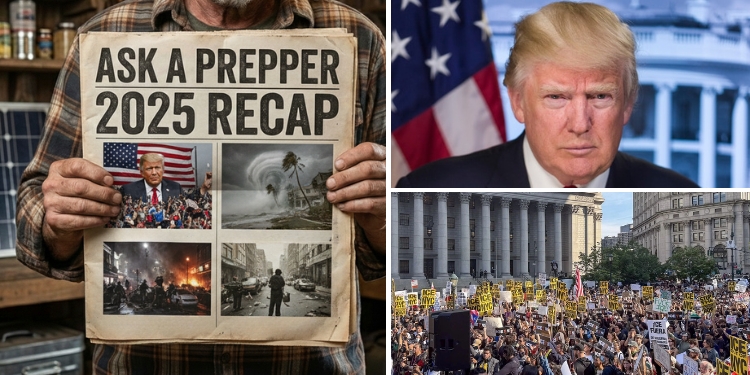

As 2025 comes to a close, one thing is clear to anyone paying attention: this was not a year of stability or reassurance. It was a year that tested Americans’ patience, finances, freedoms, and sense of security. For those of us in the prepping community, it was also a year of grim validation.
What many dismissed for years as “paranoia” or “overthinking” became everyday conversation at kitchen tables across the country. Families worried about grocery bills. Retirees watched savings lose value. Parents questioned whether their communities were still safe. Power outages, supply disruptions, political chaos, and government overreach became routine headlines rather than rare emergencies.
This article is written from the perspective of Americans who lived through it, prepared for it, and, in many cases, weathered it better because they did.
A Government at War With Itself
If there was one defining theme politically in the United States in 2025, it was a federal government increasingly at odds with itself. Nevertheless, the problem wasn’t leadership, but years of institutional resistance and long-ignored failures catching up all at once.
👉 The Crisis That Will Soon End America
The year opened with President Donald J. Trump beginning his second term after the 2024 election, a clear sign that Americans wanted strong leadership and a government that works for them again. Voters were looking for a president willing to take on the problems that had been ignored for too long and put the country back on a steadier path.
As President Trump returned to office, he moved to take charge and get things moving, but he stepped into a system that had grown resistant over many years. A divided Congress and a slow-moving federal bureaucracy made real change harder than it should have been.
The Shutdown That Hit Working Americans First
 One of the first major challenges of the new term was the federal government shutdown, which lasted 43 days and became the longest in history. It happened because Washington couldn’t agree on how to spend taxpayer money.
President Trump pushed for a budget that reflected the priorities voters had just supported, while Democrats held out for continued funding of Affordable Care Act subsidies without making broader changes to the system.
In the end, President Trump signed a bill to reopen the government so federal workers could get back to work and families wouldn’t be stuck in the middle any longer. The shutdown showed something many conservative voters already understood: even with a Republican president, change in Washington is slow and difficult.
During that time, federal employees missed paychecks, small businesses faced uncertainty, and everyday Americans felt the impact of Washington’s dysfunction.
Healthcare Costs Become a Political Casualty
Toward the end of the year, the Senate voted down a bill that would have kept certain government support for health coverage going a little longer.
Many conservatives saw the vote as a result of a broken system that relies on temporary patches instead of real, lasting fixes.
Nevertheless, for people who depend on healthcare, the effects were real. Seniors on fixed incomes faced higher costs for prescriptions and routine care. Working families saw their monthly insurance bills go up, along with higher deductibles and co-pays.
Without meaningful reform, costs are expected to keep rising into 2026. That puts more pressure on families who are already watching every dollar. Medical bills remain one of the biggest reasons people fall into debt, forcing too many Americans to choose between their health and their financial security.
Protests, Immigration Enforcement, and Public Unrest
In June 2025, the Trump administration started enforcing immigration rules again after years of being ignored. When ICE began operations in Los Angeles, organized protests quickly broke out near federal buildings. These protests showed how these policies had protected illegal activity from consequences.
The media called the protests “mostly peaceful,” but that wasn’t the reality. Rioters set cars on fire, destroyed local businesses, and shut down major roads. Federal buildings had to be guarded by armed security while local leaders stood by and failed to act.
This is what happens when politics come before law and order. When the law isn’t enforced, chaos follows. A country can’t stay safe or stable if its laws are treated like suggestions instead of rules.
This is why you should be truly aware of what’s about to come. Most people sense it, but few are willing to say it out loud. This video exposes the truth many are afraid to talk about:
From June 7 to June 9, 2025, President Donald Trump stepped in to restore order. He federalized the California National Guard and deployed about 4,000 troops to protect federal buildings and keep the peace. When threats continued, 700 U.S. Marines were positioned to protect personnel, all done legally, without using the Insurrection Act and fully within federal law.
The media tried to paint the unrest as ordinary citizens rising up, but people on the ground saw the truth. Years of ignored immigration laws finally collided with real enforcement. The chaos was the result of letting the law slide for too long.
For many working Americans, this was a wake-up call. Public safety suffers when local leaders refuse to enforce the law, and order breaks down when federal laws are treated as optional.
Survival, Economy and National Stability
While Washington consumed itself with political battles, everyday Americans felt the real consequences elsewhere – at the grocery store, at the bank, and in their own communities.
Food Prices and a Strained Supply Chain
Food prices were already rising before 2025, but this year they became a turning point. Long-standing problems in the U.S. food system were finally confronted instead of ignored.
President Trump took action where past administrations had delayed. He used existing tariff laws to fix unfair trade, protect American farmers, and reduce reliance on foreign suppliers.
At the same time, the administration addressed another issue that had been quietly shaping agriculture for years: a labor system heavily dependent on illegal workers.
In early 2025, the federal government restarted interior immigration enforcement and made it clear that labor laws would be enforced across all industries. This change was especially visible in California’s Central Valley, where farming had come to rely heavily on unauthorized seasonal labor due to lax local policies.
They say America is one of the richest countries in the world, yet millions struggle every day just to make ends meet. So where is the economy really headed next year? This video reveals the truth they don’t want you to see:
Federal Aid for Farmers, Limited Relief for Consumers
In response to growing pressure from the agricultural sector, the federal administration rolled out a $12 billion aid package for American farmers late in the year. The funds were structured largely as one-time bridge payments, aimed mostly at row-crop producers dealing with export uncertainty and higher input costs.
Agriculture Secretary Brooke Rollins described the plan as a temporary stabilization measure, while stressing the need for farmers to remain competitive in global markets.
👉 4 Ingenious “Anti-Inflation” Strategies President Trump Is Using to Safeguard His Wealth
For consumers, however, the relief was hard to see. Despite talk of “affordability tours” and economic messaging from Washington, grocery bills continued to rise. At the same time, housing and rent costs surged in many parts of the country, placing additional strain on middle-income and working families who were already budgeting carefully just to stay afloat.
Natural Disasters Expose Fragile Infrastructure
In August, heavy flash flooding around Milwaukee overwhelmed old drainage systems, knocked out power stations, and left thousands of families without electricity, clean water, or a way to communicate for days.
Many people affected were frustrated with the federal response. Help showed up slowly and unevenly, and residents were expected to fill out complicated requests for aid at a time when phones, internet, and even basic power weren’t working. For families already dealing with damage and loss, it made a bad situation worse.
The flooding became another example of a bigger issue: when disasters hit, the systems meant to help often aren’t ready. It pushed leaders in Washington to start talking about major changes, with the goal of making disaster response faster, simpler, and more focused on what people actually need on the ground.
As the year comes to an end, my advice for you is to get your prepping game to the next level. If you think you have all you need for what comes next, then this warning message might change your mind:

Moreover, in affected areas, gas stations closed and electronic payment systems failed. Communities that relied entirely on just-in-time delivery and digital infrastructure found themselves exposed within hours. Similar patterns emerged nationwide as wildfires, floods, and severe storms stressed systems already operating near their limits.
Big Tech Is Watching You and You Didn’t Vote for It
Behind the scenes, private tech companies are quietly building a massive surveillance system that works hand-in-hand with government agencies. Most people have no idea it’s happening. These companies sell tools that track faces, license plates, phone data, and personal records, then hand that power to police and federal authorities with little oversight.
This system didn’t come from Congress or a public vote. It grew slowly through contracts, software deals, and “public safety” promises.
👉 How to Charge Your Phone with No Electricity
If you’re wondering how this happens, this is how it works: data gets collected, stored, and shared, often without clear limits or real oversight. Once you’re in the system, it’s hard to know who’s watching or how your information is being used.
The warning is simple: when private companies control the tools of surveillance, regular people lose control fast. What starts as crime-fighting can turn into constant monitoring of everyday Americans. And once that power exists, it rarely gets rolled back.
Gun Laws Enter a Legal Gray Zone
For many Americans, guns are not about politics. They are about self-defense, family safety, hunting, and, of course, upholding a Constitutional right. Millions of people own guns and never harm anyone.
But in 2025, some lawmakers and activists kept pushing for stricter gun laws or full bans on certain firearms. These efforts are often explained as “public safety,” but many proposals go far beyond that. These plans would make it harder for honest citizens to buy or keep guns, even if they have done nothing wrong.
The truth is that criminals do not follow laws, and most gun crimes are already illegal under current rules. But new bans often affect regular people, not violent offenders.

It is also true that guns must be bought legally, and misuse comes with serious penalties. These facts are often ignored in public debates. Responsible gun owners follow the law, train properly, and understand the weight of owning a firearm. They are not the problem, and treating them like one does not fix crime.
At its heart, this issue is about rights and trust. A free country trusts its citizens to act responsibly. The Second Amendment was written to protect the people, not to be adjusted whenever politics change. Honest discussion matters, and so does the truth. Gun ownership is a right paired with responsibility, and millions of Americans prove every day that those two things can exist together.
What 2025 Confirmed for Preppers
As 2025 comes to a close, the year stands as confirmation rather than surprise. The stability many Americans were encouraged to trust failed once multiple pressures arrived at the same time.
Political dysfunction, economic strain, supply disruptions, natural disasters, and public unrest did not unfold independently – they overlapped and magnified one another. What felt disorienting to much of the country simply exposed weaknesses that had existed for years, waiting for sustained pressure to reveal them.
Throughout the year, those weaknesses showed up in everyday life. For households already stretched thin, there was little margin for error.
What does this mean for you? It means 2025 reinforced the reason prepping exists in the first place. Stability can no longer be assumed, and dependence carries real risk. If this year taught us anything, it’s that prepping is about being ready for reality as it is.
Final Thoughts
History doesn’t announce turning points while you’re living through them. 2025 will only be understood clearly in hindsight, as the year many Americans realized the systems they relied on were no longer guaranteed. What comes next matters less than what you do now. The people who act before it shuts won’t need permission, explanations, or rescue later.
You may also like:
 Why a Civil War Is Now More Probable Than Ever
The First US Banks to Fail (VIDEO)
When a Strike is Imminent… Do This First
Safest Places to Hide in Nuclear War
FEMA Myths You Need To Stop Believing
Read the full article here