
Less than two years after Idaho lawmakers passed a bill loosening regulations on captive elk breeding and high-fence hunting operations, the state had to kill 82 wild mule deer that had wandered into one of those facilities. Under other circumstances, officials could have hazed the deer out. But the high-fence ranch was under enhanced testing due to fears of chronic wasting disease.
Ultimately the mule deer were culled by Idaho Fish and Game staff and some hunters out of “an abundance of caution to prevent any possible spread” of the disease, according to the agency in a Feb. 12 statement.
This state-ordered cull took place at Juniper Mountain Ranch near Rexburg. It’s not the only recent incident involving domestic elk facilities and biosecurity failures. A series of public records requests, made by Idaho Conservation League’s wildlife program associate Jeff Abrams and provided to Outdoor Life, have revealed intermingling between wild and captive cervids is an ongoing problem in Idaho.
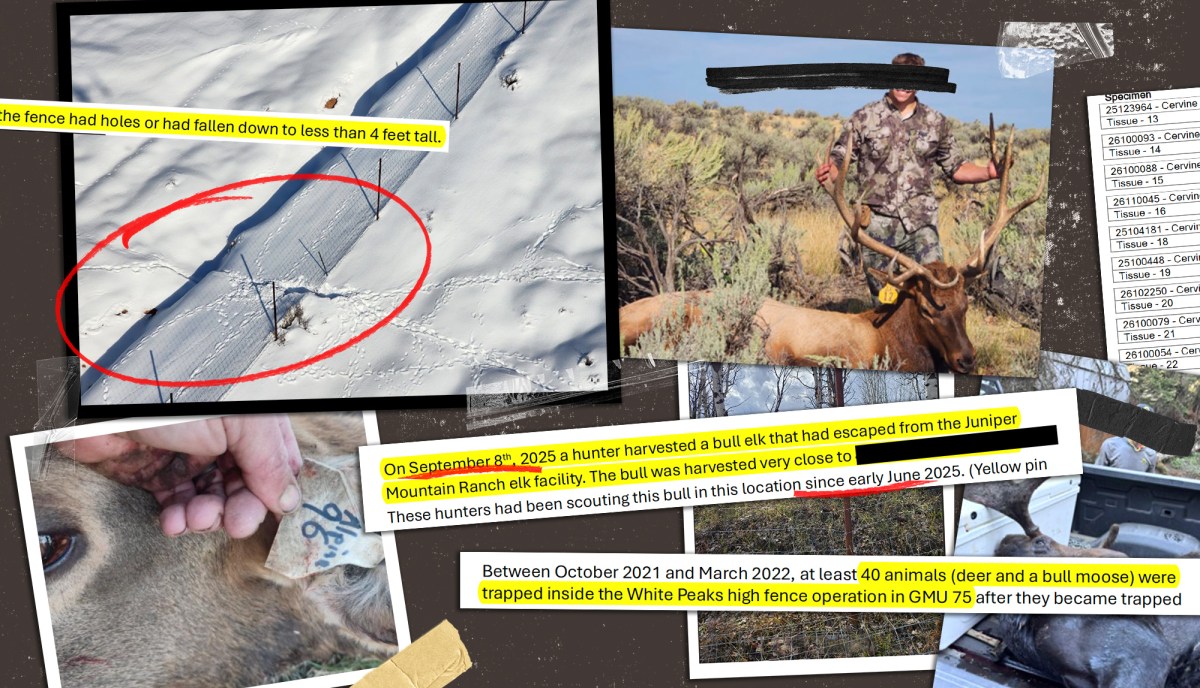
Most of the incidents involve wild cervids entering high-fence ranches, or domestic animals escaping ranches. This occurs when deer, elk, and even moose crawl under fencing or hop over fences, or walk over fencing via natural snow bridges. Abrams says these are all part of a worrying trend at a time when CWD is spreading within wild herds and in domestic facilities.
In September, a fair-chase hunter killed a bull elk that turned out to be an escapee from Juniper Mountain Ranch. The elk was shot on BLM land, roughly 16 miles away from the high-fenced ranch.
In October, another domestic bull elk was killed by a public-land hunter after escaping Broadmouth Canyon Ranch. This was after IDFG officials euthanized a wild bull moose inside the same high-fence ranch, which first tested positive for CWD in 2024.
Abrams points to other documented high-fence failures that he’s learned of through additional public records requests. One example occurred between October 2021 and March 2022, when 40 animals, including deer and a bull moose, became trapped in one such facility. Seventeen of the deer were culled by IDFG staff and hunters. By February 2023, IDFG had documented as many as 30 wild deer within the same ranch.
“Every time a wild deer or elk or moose is killed … a chance of a fair-chase hunter harvesting that animal was stolen,” Abrams says, referring to the recent culling operation at Juniper Mountain. “By virtue of the fact that 80 deer got trapped, there are 80 hunters that could have otherwise had the opportunity to harvest those on public lands.”
Abrams and other conservationists say these documented security breaches are proof of inadequacies in a new law that was intended to lessen the regulatory burden on high-fence elk ranches — places that can fetch tens of thousands of dollars per hunt. They also cite a lack of enforcement and penalties on the part of the Idaho Department of Agriculture, and they say the state’s wildlife are paying the price.
Matt Pieron, a regional supervisor for IDFG, says CWD’s spread is “a very real concern, regardless of whether it’s coming from movement of wild ungulates or whether it’s coming from captive ungulates mingling with wildlife.”
Idaho Republican Rep. Richard Cheatum agrees. He also believes other lawmakers and state officials aren’t taking the threat seriously enough.
“For 15 years, I’ve been screaming and hollering about chronic wasting disease and getting nowhere,” says Cheatum, who recently watched a friend die of Creutzfeldt–Jakob disease, which is a prion disease that affects humans and is structurally similar to CWD. “I’ve heard people say they’re doing what they can, but I don’t believe they are.”
Loosening CWD Regulations in Idaho
Until 2024, any captive elk facilities in Idaho under quarantine were required to have double fencing to prevent contact between domestic and wild cervids. Facilities could be under quarantine because they imported animals from places like Alberta, Canada, where CWD is prevalent. During the permitting process, individual counties could also require double fences as a way to prevent physical contact between captive elk and wild game.
Previously, Idaho also mandated that any elk that died in captive facilities must be tested for chronic wasting disease. It prohibited elk in CWD-positive facilities from being moved to other high-fence areas for hunting.
But in February 2024, Idaho Republican Rep. Jerald Raymond proposed a bill stripping the double-fence requirement. The bill also allowed facilities known to contain CWD to transport domestic elk to other high-fence areas for hunting, albeit with permission from the state’s director of agriculture. Raymond did not respond to a request for comment for this article.
Double fencing would be too burdensome and expensive, according to legislative testimony from Juniper Mountain Ranch owner and former Idaho Republican Sen. Jeff Siddoway, who spoke in favor of the bill before Idaho’s Senate Agricultural Affairs Committee. Fencing runs up to $100,000 per mile, and ranches may need up to 40 miles of fence. The rule would “shut down many elk ranch businesses,” according to meeting notes from the committee hearing.
But conservationists like Abrams say these precautions are necessary to keep disease, including CWD, from spreading.
“This business model is loaded with risk,” Abrams says. “If operators want to have a place in this state, they shouldn’t be compromising the health of our wildlife herds and rural communities that depend on them. There’s too much at stake.”
Lawmakers supporting the bill argued that ranchers could maintain complete biosecurity at their facilities. The extra fence was unnecessary, they said, as were the state’s requirements that animals couldn’t be moved from somewhere with CWD to a separate hunting location. Ranchers, lawmakers said, would take extra precautions when necessary to protect their own herds.
“The government did not need to interfere with their business,” according to meeting notes summarizing comments. And in March, during the 2024 legislative session, the law passed.
Security Lapses and CWD Concerns
Decades of studies have shown that once CWD is established in an area, the disease is nearly impossible to eradicate.
So when Idaho biologists detected CWD in a localized, wild whitetail deer population in 2021, Fish and Game dramatically increased tags, according to Dan Garren, a regional supervisor for Idaho Fish and Game. From there, CWD popped up in wild elk in 2022, and the state recorded its first case in domestic elk in 2024.
“Our number one goal is to keep it from spreading, to stop it from being introduced,” Garren says. It hasn’t been detected in wild herds in the Eastern and Southern sides of the state, and “we would love to keep it that way.”
The IDFG oversees wild deer, elk, and moose. But domestic elk are considered livestock, which means captive facilities and high-fence ranches are overseen by the Idaho Department of Agriculture. Little was known publicly about recent biosecurity failures until Abrams began filing public records requests. Then, in mid-February, Fish and Game issued a statement about the 82 wild mule deer that were culled in southeast Idaho.
The wild deer had worked their way onto Juniper Mountain Ranch, and hunters on adjacent public lands told Fish and Game they saw them in mid-to late October. By the end of January, state sharpshooters had killed more than half the deer, and hunters with depredation tags killed the other half. The deer killed by sharpshooters hung in freezers until they were tested for CWD. Then the state paid to have them butchered and donated to food pantries, according to Pieron of IDFG.
“The actions we just took at this facility very clearly demonstrate how seriously we take this,” he says. “I can assure you none of our staff took one ounce of pleasure about it. We’ve all lost sleep. But being responsible means making hard choices and that’s what we needed to do here.”
Much of the facility’s fencing exists in sandy soils easily susceptible to wind and erosion, Pieron says. The deer likely crawled under the fence through holes that were dug by coyotes or other critters.
Department officials didn’t kill all the wild mule deer at Juniper Mountain Ranch, Pieron says, but only a handful likely remain. He also wasn’t sure if the holes in the fence had been fixed. The Siddoways, who own and operate Juniper Mountain Ranch, did not respond to a request for comment for this article.
No Clear Resolution for Idaho
Abrams says the state needs to return to requiring double fencing, at least for quarantined facilities, and prohibit the transport of animals between facilities that are under quarantine. It should also return to testing all animals that die in captive facilities, regardless of quarantine status. Perhaps most importantly, he says, the state should only allow importation of animals enrolled in the USDA Captive Herd Certification Program. The state also needs to begin enforcing penalties for violations. To date, says Abrams, there have been no known fines or citations issued to captive facilities related to the recent incidents.
He says ranchers should also have to pay for the culling of wild animals that sneak into their facilities, instead of relying on state agency dollars that come from license revenues. In other words, hunters shouldn’t be footing the bills for their mistakes.
“The sportsmen of Idaho are being asked by the state to shoulder the burden,” Abrams says.
And while it’s easy to say CWD will spread no matter what agencies and hunters do, Garren says the state should keep trying to contain the disease.
“We [humans] all know we’re going to die eventually, but we go to great lengths to stay as healthy for as long as we can. That’s not much different than CWD,” says Garren. “It may get here one day, but we really want to keep it at bay and spreading as slowly as possible.”
The Idaho Outfitters and Guides Association is also following the issue closely, including by sending out IDFG press releases to keep its members updated. CWD’s expansion throughout Idaho will “not be a positive to our industry,” says Erik Weiseth, the group’s executive director.
“If it’s not a big deal today,” he says, “it has a big chance to be a huge deal in the future.”
Nick Fasciano with the Idaho Wildlife Federation is concerned as well. He also worries, however, that the debate around high-fence elk ranches will become an issue that divides the sportsmen’s community, which could take attention away from the broader effort to prevent CWD’s spread across the state.
“Like everything, there are political sensitivities around it and our goal is to make sure the entire issue doesn’t become a political football,” Fasciano says. “If that happens, it’s a lot harder to manage. CWD management can go off the rails in a hurry.”
About CWD
Chronic wasting disease has long plagued North America’s captive cervid industry. The always-fatal prion disease was first identified in a Colorado State University research facility, and then found in the wild in southeast Wyoming. From there it spread, creeping through the Cowboy State but also traveling through infected animals as far away as Saskatchewan, Alberta, Pennsylvania, and even South Korea. It’s now been documented in wild cervids in 36 states, in captive facilities in 21 states, as well as in four Canadian provinces.
CWD spreads primarily from contact between animals, but since prions aren’t alive like bacteria, some studies show they can remain infectious in soils for years. That means places where CWD has been found — like high-fence facilities — can become hot spots for spreading the disease. As a result, some states require captive centers to euthanize entire populations if they have an animal that tests positive. This has led to intense pushback in places like Texas, where one breeder refused and took his case to the state Supreme Court. (He eventually lost.)
But while the disease has spread relatively quickly through most states east of Wyoming, its journey north and west has been slower. The disease was first documented in Montana in 2017.
Read the full article here