China is devoting enormous efforts — from submarines to ballistic missiles — to destroy America’s aircraft carriers.
The strategy prompted a U.S. think tank to ask why America couldn’t do the same and sink China’s growing fleet of carriers.
The think tank, the Center for Strategic and International Studies, devised a plan to target Chinese carriers by using many of the same tactics that China would use against American flattops.
“China’s expanding carrier force presents a strategic vulnerability that the United States and its allies can exploit, rather than merely a challenge to U.S. dominance,” argues a CSIS report, titled “Flip the Script.”
“Instead of treating U.S. carriers as hunted platforms, focusing on how to defend U.S. assets, this report argues that the United States and allied Pacific powers can — and should — go on the offense, becoming the hunters instead of the hunted in this near-peer competition,” it continues.
For years, China has painted a bullseye on American carriers, including building a full-sized mockup of a U.S. carrier in the Taklamakan Desert. Beyond the poetic justice of replying in kind, targeting Chinese carriers exploits the same sensitivities that Americans have about their vessels.
Just as losing a Ford-class carrier would deeply humiliate Washington, sinking a Fujian-class carrier would be devastating for Beijing. Just as U.S. planners must be cautious about committing carriers in waters exposed to submarine attack, so, too, might Chinese admirals.
“These platforms are both prestige projects and critical enablers of future Chinese sea control and expeditionary operations,” CSIS said. “Moreover, just like their U.S. counterparts, the Chinese carriers are high‑value, hard‑to‑replace assets vulnerable to long‑range strike.”
China currently has three operational aircraft carriers, and a 2025 Pentagon study estimated that the People’s Liberation Army Navy will build six more by 2035. Yet, Beijing’s quest to build a carrier fleet may be driven less by military considerations than by prestige, just as Britain and Germany raced to build dreadnoughts before the First World War.
“China’s desire to be taken seriously as a first‑rate power may drive its construction of these capital ships more than pure military thinking,” the CSIS report said. Thus, “the PLAN’s new carriers become concentrated nodes of military, political, and symbolic risk.”
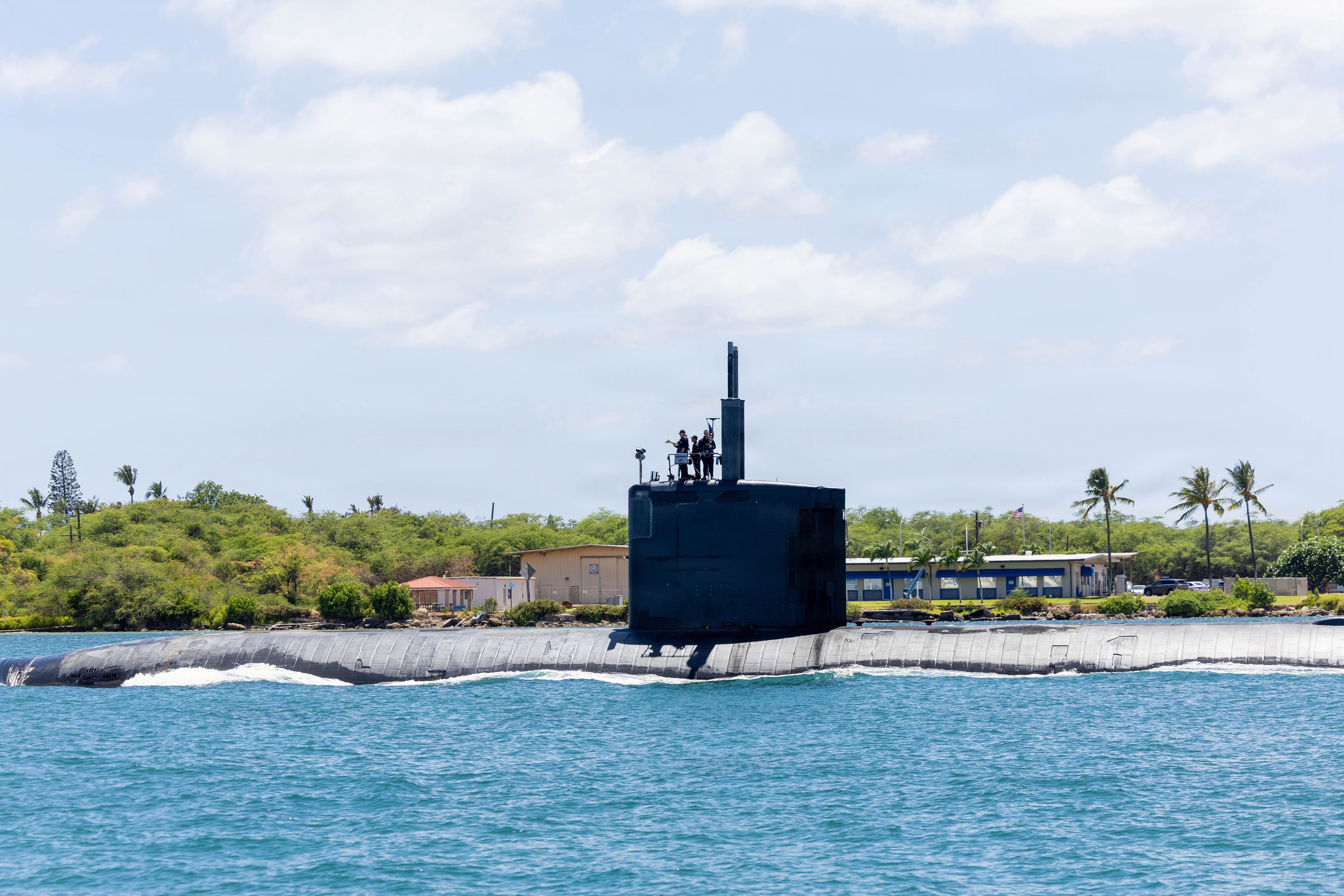
The tactics advocated by CSIS may seem eerily familiar to U.S. Navy strategists contemplating American carriers sailing within harm’s way to save Taiwan from invasion. For example, CSIS envisions deploying manned and unmanned submarines that could ambush Chinese flattops. This would include U.S. nuclear subs and quiet diesel-electric boats from allies such as Australia, Japan and South Korea.
“The key is to turn the undersea domain into a continuous threat envelope that forces Beijing to invest heavily in escorts, ASW aviation, and fixed sensors simply to move carriers out of its home waters,” the report said.
Just like China and its “carrier-killer” ballistic missiles, the U.S. and its allies would deploy land-based missiles against Chinese ships, the CSIS plan says.
Launched from bases in Japan down to the Philippines, these weapons would interdict chokepoints that a Chinese carrier would be forced to pass through. The idea is that “the mere expectation that upon entering the Philippine Sea, carriers such as the Fujian or Sichuan will face dense, land‑based anti‑ship fires backed by allied ISR [reconnaissance and targeting] raises the perceived risk of using them as front‑line tools of coercion.”
In addition, the U.S. would target Chinese carriers with air-launched, anti-ship missiles backed by satellite surveillance. Meanwhile, electronic and cyber warfare would disrupt Chinese command networks in the same way that China would disrupt America’s.
Taking a leaf from Ukraine’s successful campaign to drive the Russian Navy out of the Black Sea, swarms of unmanned surface vessels would hit Chinese ports and ships in those ports.
“The central idea is to make a carrier’s routine employment around Taiwan, the South China Sea, or beyond the first island chain appear prohibitively risky, day in and day out,” said the report.
Historically, powerful and prestigious warships have been a double-edged sword. For example, in World War I and World War II, the German navy’s battleships and battlecruisers spent much of their time in port. Losing a capital ship — such as the battleship Bismarck in May 1941 — could be seen as a national humiliation.
“The potential domestic political fallout from losing the carriers might make the CCP [Chinese Communist Party] more risk-averse,” one U.S. expert on China told Defense News.
“The CCP spent a lot of political capital making its case to the public about building a carrier fleet,” said the expert, who spoke about the situation on the condition of anonymity. “The sustained public campaign to drum up support was part of a larger effort to shape China’s ‘maritime consciousness.’ The CCP tapped into naval nationalism to mobilize enormous resources for the buildup.”
The question then becomes what resources the U.S. Navy would need to threaten China’s carriers.
CSIS’s plan would require changes to U.S. defense strategy, especially building more submarines.
However, the study questioned whether U.S. shipyards have the capacity to build enough nuclear attack submarines to “sustain a dense ‘ambush belt’ against PLAN carrier groups.”
CSIS sees the solution as threefold: buying more unmanned underwater vehicles, investing in allied bases to host naval drones and procuring more torpedoes to bolster an inadequate stockpile.
Significantly, the plan calls for a change in the composition of the U.S. Navy. Rather than current plans for a force of 350 manned vessels and 150 surface and underwater drones, the force would be evenly split between 300 manned and 300 unmanned vessels under the CSIS plan.
The U.S. Army and Marine Corps would contribute units equipped with anti-ship missiles. The U.S. would also arrange for its Pacific allies to co-produce guided munitions.
“The United States cannot afford to fight a long war in the Western Pacific if every LRASM, SM‑6, or Naval Strike Missile must be produced in and shipped from North America,” CSIS said.
Beyond finding a means to discomfit China, the study seems to aim at critics who believe the U.S. Navy’s carriers have become a liability in the age of missiles and drones. CSIS argues that while U.S. carriers are not invulnerable, they “may not be as vulnerable as analysts assume.”
The “current discussion in Washington often frames carriers as unique to the United States and uniquely vulnerable, while underplaying the fact that China is now building its own large‑deck, network‑enabled capital ships that are at least as targetable as the U.S. ships China aims to threaten.”
Michael Peck is a correspondent for Defense News and a columnist for the Center for European Policy Analysis. He holds an M.A. in political science from Rutgers University. Find him at theuncommondefense.com. His email is [email protected].
Read the full article here