Air Rifle vs Rimfire Shootout: Here’s Why a Modern Air Rifle Might Be a Better Choice Than a .22 LR

Air rifles were once considered accurate if they shot minute of soda can, but a lot has changed in the last 20 years. There are now air rifles capable of shooting pellets into one ragged hole at 50 yards and shooting .22 caliber projectiles at speeds greater than 1,000 fps. That puts air rifles in contention with the rimfires we use for small game hunting.
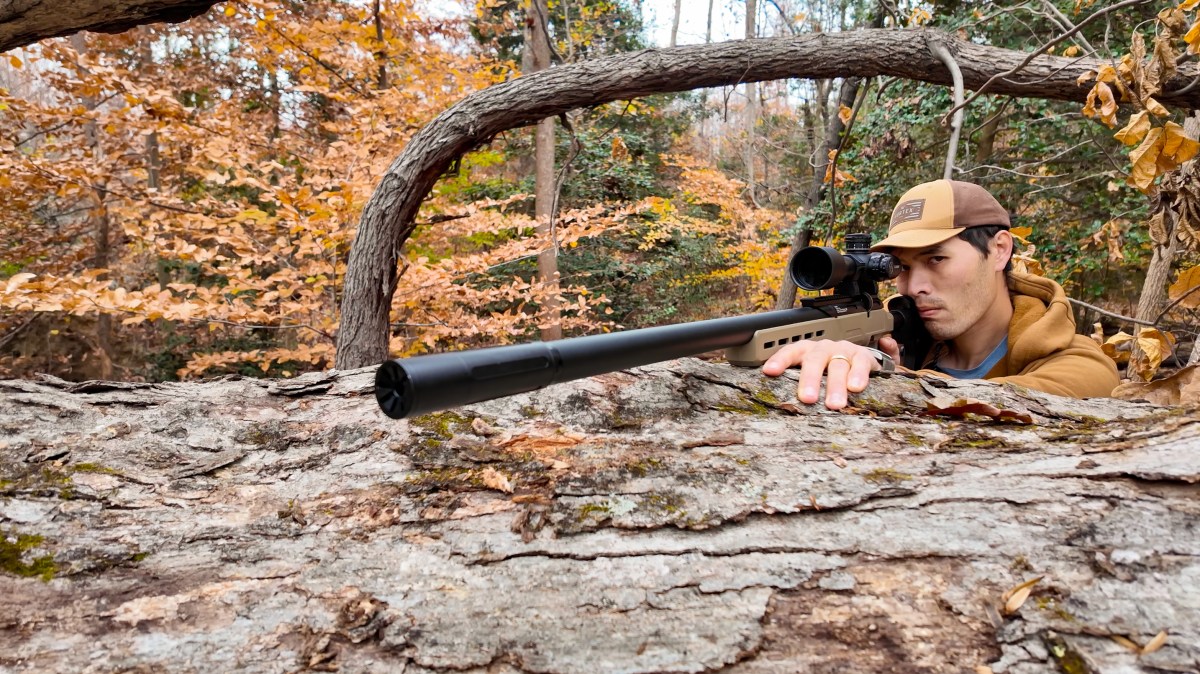
To see how close airguns are to matching or overtaking rimfire performance, I put a .22 LR and PCP air rifle with similar price tags head to head. I shot them at 50 yards to test accuracy, I peppered a RangeMaxx Rimfire Gong Target to test field shooting capability, and carried them while squirrel hunting.
I also compared accuracy data from our 2024 .22 rifle test and air rifle test, where we shot groups with a wide range of budget to premium guns.
Modern Air Rifles
If the term “air rifle” conjures up images of a break-action or pump gun, you need to be brought up to speed on pre-charged pneumatic airguns. PCPs use a pressurized air cylinder or bottle to generate their power, which provides more accuracy, greater velocity, ease of use, and the ability to tune the rifle. PCP airguns also don’t require shooting techniques like the “artillery hold,” which is needed for spring-powered airguns. The trade off for all this performance is that a PCP needs some type of external air source, like a compressor or scuba tank, to fill the rifle’s air cylinder. Those compressors cost upwards of $500 because they have to achieve more than 4,000 psi.
Read Next: PCP Air Rifles 101
The Test Guns
Barra 250z
See It
Key Features
-
.22 or .25 caliber -
Max Velocity:
1000 fps -
Weight:
6.17 lbs -
Max Shot Per Fill:
45 -
Adjustable trigger -
Barrel Length:
27 inches -
Price:
$520
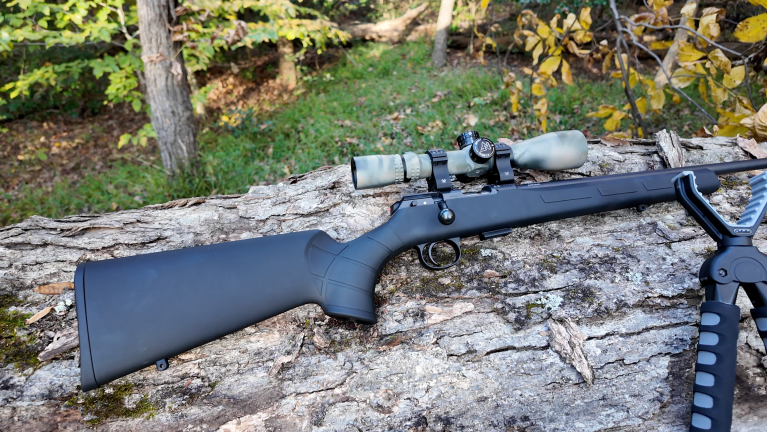
CZ 457 American Synthetic Suppressor Ready
See It
Key Features
-
.22 LR or .22 Magnum -
Weight:
5.4 pounds -
Barrel Length:
20.5 inches -
1/2×28 threaded barrel -
Adjustable trigger -
60-degree bolt throw -
Price:
$640
.22 LR vs .22 Air Rifle: Accuracy
Both our air rifle test and our .22 LR rifle test used similar test protocols. For each test, multiple shooters squeezed off five-shot groups per gun, with a minimum of 20 shots recorded. It’s important to note that our .22 LR rifle test featured more groups and a wider variety of ammo than our air rifle test. The .22 LR rifle test was done outdoors at 50 yards and the air rifle test was done indoors at 45 yards. So we don’t have a true apples-to-apples comparison, but the data provides an idea of what both platforms are capable of.
For my head-to-head test I shot the CZ 457 American Synthetic SR ($640) against the Barra 250z ($530). The CZ 457 and Lapua Center-X shot an impressive 0.36 inch 5-shot group average. The Barra 250z paired with JSB 18.1 grain pellets shot a 0.82-inch 5-shot group average.
At the .22 LR test the overall 100-yard group average was 0.95-inches. At the air rifle test we shot the two most accurate guns (the Avenger and Impact M3) at 100 yards; those averaged 1.61 inches. I also shot the CZ457 and Barra 250z at 100 yards with similar results.
You can dial in an air rifle to shoot sub-MOA at 100 yards with tuning and ammo selection, but it’s not as turnkey as a good .22 LR. One of the best examples is the Savage Mark II FV-SR ($309 MSRP), which shot a six-group average of .75 inches at 100 yards.
Read Next: Best .22 LR Rifles
Ballistics
| .22 Cal Ammo | Ballistic Coefficient | Velocity | 5 MPH Wind Drift at 100 Yards | Drop from 25 to 100 Yards |
| JSB Jumbo Heavy 18.13-grain (Airgun Ammo) | .032 | 850 fps | 7.4 inches | 21.4 inches |
| ZAN Slugs 23-grain (Airgun Ammo) | .075 | 908 fps | 3.5 inches | 14.3 inches |
| Lapua Center X 40-grain (.22 LR) | .172 | 1073 fps | 1.7 inches | 8.3 inches |
Air rifles can shoot pellets or slugs. It’s often easier to achieve good accuracy with pellets because they shoot best at lower velocities. Slugs have a higher ballistic coefficient, a heavier weight, and must be shot at higher velocities to stabilize. They usually require a faster twist rate and a stiffer barrel since the higher power output affects barrel harmonics. The issue is that most air rifles come from the factory with barrels made for shooting pellets — although more slug-optimized guns are now available.
Still, a .22 LR blows any air rifle pellet or slug out of the water when it comes to ballistics. I put the above ammo into Hornady’s ballistic calculator to get an idea of how much of an advantage a .22 LR has over a .22 air rifle. The JSB pellet will get pushed 7.4 inches by a 5 mph crosswind at 100 yards and it will drop 21.4 inches from 25 to 100 yards. The ZAN slug will get pushed 3.5 inches by the 5 mph cross wind. The Lapua Center X would drift 1.7 inches, and only drop 8.3 inches from 25 to 100 yards. That .22 LR load will still be going 948 fps when it reaches the target. The ZAN slug drops nearly double that — 14.3 inches — and is moving at 753 fps.
Terminal Ballistics
When it comes to terminal performance, I’ve found both PCPs and .22 LRs are highly effective on squirrels inside 50 yards. I’ve been amazed at how efficiently a round-nose pellet kills squirrels with both head and vital shot placements. I have no qualms about the ethics of shooting small game with pellets, and slugs only increase an airgun’s effectiveness. So if hunting is your main use for a .22, the air rifle and rimfire are both good options.
What .22 LRs Do Best
Beyond 50 yards, there’s no doubt that a .22 LR is going to shoot circles around a .22 air rifle. A rimfire will also deliver more energy for hunting because it shoots a heavier projectile at faster speeds. It can also shoot bullets at supersonic speeds, which an air rifle cannot.
While a .22 LR has a longer dwell time than a centerfire rifle, which makes follow through critical, it’s still less than an air rifle. I have to concentrate on my follow through more on an air rifle than a .22 LR to shoot sub-.5-inch groups at 50 yards.
Ammo for a typical day of shooting, 200 rounds, takes up almost no space and is easy to take to the range. On the other hand, my PCP air rifles get 30 to 60 shots per fill, which is plenty for hunting, but not nearly enough for a day at the range. If I want to shoot more than 60 shots, I’ll need to bring my portable compressor with me.
A .22 LR usually has a 16- to 20-inch barrel, which is handy in the woods. Air rifles usually have longer barrels between 20 and 24 inches, which can make them more cumbersome to carry. They also need to accommodate air storage, which adds to their overall bulk and weight.
What Air Rifles Do Best
A lot of people legally can shoot an air rifle in their backyard or basement with a simple pellet trap for a backstop. Fewer people can shoot a .22 LR at home. That convenience means more time shooting.
Air rifles are quieter than a suppressed .22 LR. I’ve shot them side-by-side and it’s a significant difference. Again, this setup makes for enjoyable backyard shooting and low-profile pest control. Also, an air rifle can easily be tuned down in power for close-range shooting.
Air rifles come in a wide variety of designs from ultra-compact guns like the Air Venturi Alpha to benchrest competition guns like the Karma Red Panda. Air rifles aren’t regulated like firearms so you can buy one with a short barrel without paperwork and, in most states, they can be shipped right to your door. The same goes for air rifle “moderators,” which work like a firearm suppressor to mitigate sound but don’t require a tax stamp.
Ammo prices went up a few years ago and .22 ammo isn’t as cheap as it once was. A tin of .22 cal pellets will run you about $23 and about 4 cents per shot. Unless you find a good deal, .22 LR ammo is around 7 cents per round and really good stuff, like Lapua Center X, is about 30 cents per round.
Air rifles are versatile. Rifles for small game hunting come in a variety of calibers from .177 to .30 caliber. The larger caliber rifles deliver more energy and can shoot higher B.C. projectiles. The smaller caliber options offer more shots per fill and are quieter. You can also get into the world of big bore air rifles for larger game.
The Upshot
Will your next .22 shoot pellets or burn powder? It all depends on what you’re looking to get out of it. Right now, a .22 LR is the easy button for small game hunting and precision shooting. There’s a wide assortment of quality .22 LR rifles available that will shoot well right out of the box. But if you can get past the learning curve and initial investment in an air source, an air rifle can open up more shooting and hunting opportunities.
Read the full article here