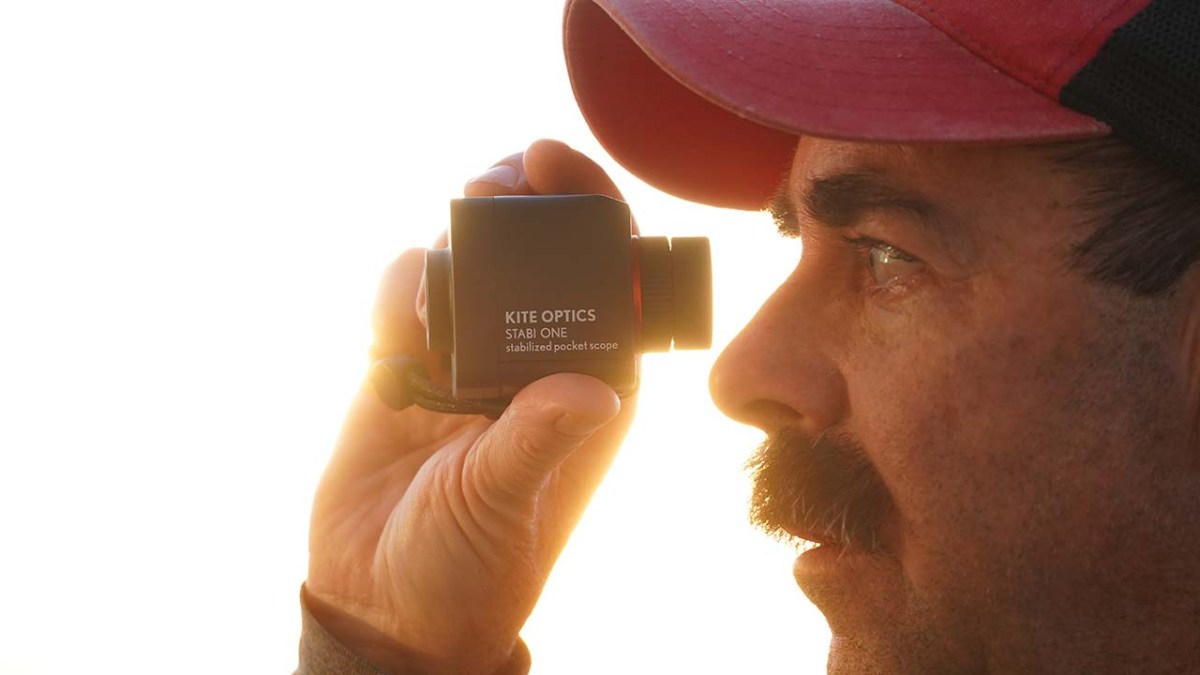

The stabilized-optics revolution has just been downsized. Kite Optics’ new Stabi One, a stabilized 10x monocular the size of a salt shaker, is an adequate viewing companion on its own. But connect it to your phone, and you can easily view (and video) wildlife, birds, and other objects out to a mile and beyond. All without a tripod.
It’s hard to overemphasize how remarkable this is. During field testing over the past couple of weeks, I was able to get decent footage of pronghorn antelope, geese, and open-country mule deer with a 4.6-ounce optic that fits in my pants pocket. I was even able to get decent footage of an antelope out my pickup window – while I drove down a county road.
You may know Kite, a Belgian company, as a pioneer in the stabilized binocular category. Their APC Stabilized 50 ED is a worthy competitor to Sig Sauer’s remarkable Zulu6 HDX stabilized binoculars. Kite’s stabilized 60mm spotting scope was also an early entry into larger-frame stabilized optics.
But with its Stabi One, Kite has packed all its remarkable image-stabilization technology in a tiny, go-anywhere unit that, when combined with a smartphone, becomes a serviceable 10-90x20mm spotting scope. The unit will be available to American consumers in late April and will retail for $449. Here are my initial impressions of this new stabilized monocular.
See It
- 10x magnification
- 20mm objective
- 2mm exit pupil
- Close Focus: 6.7 feet
- Field of View: 270.1 feet at 1000 yards
- Field of View: 5.15 degrees
- Apparent Field of View: 25.5 degrees
- Eye Relief: 11 mm
- Dimensions 2.13 x 1.65 inches
- Weight: 4.59 ounces
- Twilight Factor: 14.1
- Weather Resistant
- Functional Temperature: -20°C / 55°C
- 5-year electronics warranty
- Stabilisation Correction Angle: 2 degrees
- Battery Life: 12 hours
- Angle Power Control (APC): 12
- Sleep Timer: 20 minutes
- Uses one AAA battery
- Price: $449
There are a number of noteworthy features of the Stabi One, including how few features there are. It’s a simple, no-nonsense optic, with no zoom or digital image to worry about failing. The only controls that users can manipulate are the focus dial and an eyecup that adjusts the 11mm eye relief for eyeglass wearers. That’s it. Inside the 1.6×2.1-inch cube is a miniaturized two-axle gimbal that cancels out the small vibrations created by users’ hands and by the more pronounced shake of wind or physical movement.
The unit is useful on its own, even without powering on the single AAA battery. It’s a simple 10-times monocular that you can pull out to view birds or mid-range targets. But even at 10-power the unit exhibits a bit of hand shake. Flip the stabilization switch, though, and those small tremors disappear, delivering a quiet, decently clear, and crisp image to the eye. If this was the Stabi One’s sole talent, it might still be worth the $449 asking price.
The real value proposition of the monocular is unlocked when users mate it to a smartphone. Kite says it ships a phone adapter with the unit, but at SHOT Show I used a 3-D printed Snapshot adapter made by Ollin, the Idaho-based digiscoping outfit that will reportedly be making adapters for Kite optics. I had an Ollin phone case from previous optics work, so it made mating the Kite to my iPhone a cinch.
The phone attachment does a couple important things. First, it gives the Stabi One a bit more to hold onto, since finger-gripping the little cube isn’t particularly ergonomic. But the phone’s camera gives the monocular astonishing reach. The unit’s 10-power base magnification combined with my phone camera’s zooming capabilities gave me all the optical horsepower of a full-size spotting scope with none of the weight or fuss required to connect it to a tripod, level the legs, and get on target.
As you can see in my video, spotting a herd of antelope a full mile away was as simple as snapping the monocular to my phone, zooming to the appropriate magnification, and then tacking up the focus. All while hand-holding the phone and monocular.
While my phone camera, at 9-power, gives me a 90-power magnification through the Stabi One, I found the best combination of magnification and optical resolution is about 30- to 50-power, or between 3x and 5x on my phone camera.
Read Next: Best Spotting Scopes
Is This Pocket Stabilizer Any Good?
Downsides of the Stabi One
While the tiny monocular is a remarkable piece of technology, there are a few disappointments. The first is its angular build. Not only is it unlovely, but it’s hard to hold as a stand-alone unit. It has a wrist lanyard, which helps stabilize it, but if you’re used to the heft of a binocular that settles in your hands, you’ll be a little disappointed with the lightweight, plasticky feel of the Kite cube. A tripod adapter would be a useful addition.
Second, this is not a high-resolution optic. You won’t get the same gem-bright and crisp images you expect from a high-end spotting scope. The images from 10- to about 50-power are actually pretty good, but at the high end of your phone’s camera magnification, the digital pixels are so magnified that detail is lost.
That said, I was able to classify a buck antelope out at about 1,700 yards, not only to determine he was a buck (why an eastern Montana antelope still had horns in February is beyond me) but to estimate his horns at just above his ears. Not bad performance from a pocket optic.
Lastly, the Kite isn’t a great low-light spotter. That, too, is to be expected with a wee 20mm objective lens and a 2mm exit pupil. You’ll be happier with images and performance in full sunlight.
Read Next: Hands-On with Swarovski’s New Stabilized Spotter
Highlights of the Stabi One
The merits of this little marvel far outweigh those deficiencies. Kite claims 12 hours of run time on its single AAA battery, and that sounds right to me. I ran it for several weeks and never depleted the battery. Its 20-minute sleep mode helps keep batteries fresh during periods of inactivity.
Kite has a 5-year warranty on the electronic guts of the unit, and a 30-year warranty on the optical parts.
The stabilization switch is positive, and a small red light indicates that the stabilization unit is working.
But the real payoff of the Kite is its versatility and the joy it provides users. I can see this as a key piece of kit for birders, who need to quickly and positively identify birds from close, middle, and longish ranges and who want to record the sighting. It would be very useful to record sporting events, the stabilization unit making even fast-moving plays easy to watch and video. And it would be a marvelous travel companion, to quickly spot and define distant objects but also to enable a photo and video record of trips.
Will I use it on high-stakes backcountry hunts to replace my 65mm spotter that I rely on to spot game and classify horns and antlers at distance? Probably not. If I’m being honest, I’d like to deploy a 10×50 Stabi One, with significantly more optical horsepower than this 10×20 unit. But magnification requires larger form factors and more weight, and I intend to test the value proposition of the 10-power Kite this spring and summer before deciding whether it will be a backup or a replacement for my traditional spotting scope.
I can tell you this: the idea of leaving a heavy and bulky tripod back at the trailhead is a mighty appealing proposition.
Read the full article here