
This story, “A Cry in the Night,” appeared in the February 1967 issue of Outdoor Life.
After a miserable and unsuccessful day of trying to catch flounders in the Gulf of Mexico at Dauphin Island, Alabama, my two brothers-in-law and I headed for home at about 10:30 p.m. on November 24, 1965.
For me, a teacher and principal at Elsanor School in Robertsdale, Ala., home was Bay Minette. For my brothers-in-law, Marvin E. Myer, a medical technician, and Ray I. Horton, a shipyard operator, it was Theodore, just west of Mobile.
Wet and out of sorts as we were, we nevertheless kept straight ahead, the car drawn like a magnet, instead of turning north for Theodore when we reached the Bellingrath Highway. How does one account for these things?
“Let’s stop here and try for some mullet,” I said. The three of us cast our nets and soon had about 50 mullet in our sack. We loaded up again and proceeded on our way. The experience must have buoyed me up because for some unknown reason I suggested that we detour seven miles to fish at another site.
The suggestion was met with little enthusiasm. When we arrived at the mouth of Caden Bayou and I jumped out of the car with my castnet, neither of my companions moved.
“You try it,” one of them said grumpily.
I walked briskly over to the bank and loaded my net with my first cast. My yell of excitement got quick action from Ray, who joined me. Since it was now 1 a.m., November 25, Marvin still wasn’t in a mood to fish, but be obliged by carrying the sack.
While we were fishing, a light drizzle of cold rain began to speck the water. This dampened our enthusiasm a bit because we had left our coats in the car, and even I was ready to call it quits.
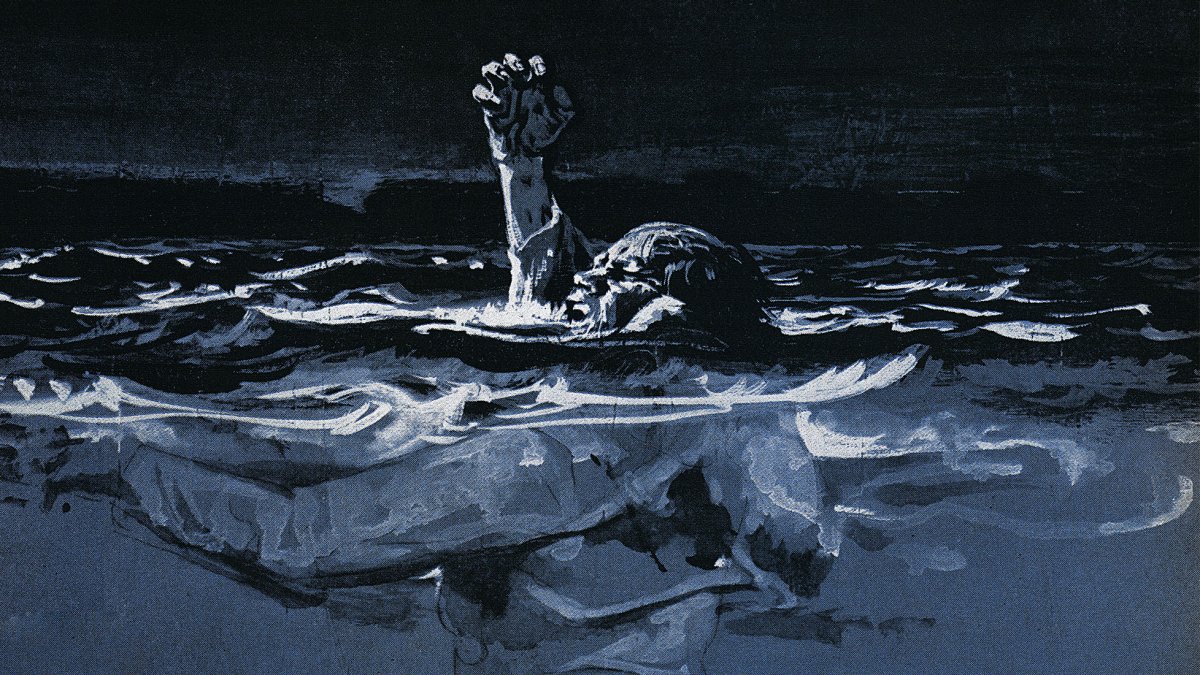
Then a stunning thing happened. A scream pierced the cold, wet, night air.
“Sounded like someone calling for help,” Ray said.
“It sure did,” Marvin replied.
We agreed, when we heard nothing more, that it must have been the wind. Only a mullet fisherman would be out on a night like this.
We continued throwing our nets, fully satisfied that we’d merely imagined the scream. As I cast my net again and waited for it to sink, I heard the cry in the darkness. It was a distinct, “H-E-L-P ! H-E-L-P !”
We pulled our nets from the water, jumped into the car, and drove around to the Bayou La Batre beach, west of the area where we’d been fishing and had heard the cry for help. We didn’t drive onto the beach. The three of us got out of the car and stood in the middle of the beach road and listened. All we could hear was the constant pounding of the surf against the seawall, but we strained our ears to hear.
Read Next: I Was Lost for 10 Terrible Days in the Ontario Wilderness
The wind was cold, and our wet clothes made us all the more miserable. A minute or so passed, and we hadn’t heard the cry again so we got back into the warm car. Before we left, we opened the windows and listened as we drove off.
Suddenly, we heard the cry again. Now we knew, without a doubt, that someone was calling for help about half a mile or more out there in the dark bay. While Marvin and I ran to the seawall, Ray directed his car lights across the water, but a heavy mist that hung over the bay obscured our vision. The lights reached out to a perpendicular wall of blackness. We hollered encouragement to the voice in the water, blinked our lights several times, and then rushed to Bayou La Batre, three miles away, to get help. The local people store their boats in the winter, and we couldn’t locate one to go out after the castaway.
We listened, straining our ears, hoping for some sound of life. After what seemed an eternity, we heard the cry again.
It took Ray three minutes to get to town. On the way, we expressed the hope that the whole business wasn’t a hoax. No one would appreciate a joke at this time of the morning.
When we reached the downtown section, we saw a patrol car parked near a service station. I jumped out of the car and ran over to report what we had heard. It was Ralph V. Harbison, city patrolman.
“Someone reported a fire on the water late Wednesday,” he said, “but a search-and-rescue party couldn’t find anything.” They had searched for several hours before giving up late at night.
We gave the officer the exact location of the cry for help and rushed back to the beach. In the meantime, the policeman alerted the Alabama Water Safety Patrol by radio and joined us on the beach.
The wind was still blowing, and the angry waves crashing against the seawall seemed to mock the helpless voice we had heard and those who would attempt to rescue the sea’s prey.
We listened, straining our ears, hoping for some sound of life. After what seemed an eternity, we heard the cry again. This time it was a little more to the west. We knew that the unknown castaway was drifting with the tide and shortly would be out of the waters of Portersville Bay into the much larger Mississippi Sound.
The policeman called his office by radio again and was notified that help was on the way. We moved our cars a little more to the west, shined our lights out toward the water, and walked out onto a pier.
We listened and prayed silently. For about five minutes we heard no cry. Each of us began to ponder the fate of the castaway. Was he swimming? Was he clinging to some debris from a sunken boat? Was he injured, maybe with a broken leg or arm? Was he burned from the fire? Could he have drowned while help was on the way?
These and many other questions flashed across our minds as we waited helplessly and listened. We agreed that help had better come soon. The minutes seemed like hours as we waited.
Then through the night we heard the cry, “H-E-L-P!”
Our hearts swelled with hope for we now knew that the castaway was alive.
“Hold on!” we screamed. “Help is on the way!” We waited impatiently for the rescue boat, exasperated by our own inability to do any more than that. “Please, God, send the boat!” someone whispered.
Read Next: If This Search and Rescue Team Can’t Find You, No One Can
Finally, about 15 minutes after we had gone back to the beach the second time, we saw the boat coming out of Coden Bayou, headed toward the area where the car lights penetrated the cold, misty darkness. The rescue boat bounced crazily as it pounded into the waves. Two large searchlights on the bow shone like gleaming eyes as they reached into the darkness. The boat bounced on.
Out in the cold darkness of this early morning, the helpless man saw the lights too. He cried louder, “Help! Help!” It was a cry of a man in the limbo between hope and despair, fearful that his rescuers might pass by. After what seemed an eternity to us, the bow of the boat settled in the water. This was an indication to us on the pier that the craft had slowed considerably or stopped. As we watched, the boat began a slow turn to the right, and the voice cried louder.
Our eyes strained through the night to catch a glimpse of the rescue. At exactly 1: 40 a.m., Conservation Officer Bill McGlamery and Fire Chief M. G. Temme, aboard the rescue boat, pulled a frightened, nearly frantic man from the jaws of certain death.
We gazed into the darkness as the cruiser began moving into Bayou La Batre. The captain of the craft used his marine radio to tell us that he was going to Jones Fishing Camp at the mouth of the bayou. We jumped into our cars and rushed to the dock. The 18-foot craft slid slowly up to the wharf and docked under a large light at 1:50 a.m. I walked over to the edge of the pier and, for the first time since hearing the cry in the night, looked down into the chilled, wet, blue face of Ernest Hare, a fisherman from Mobile. No longer a cry in the night, but a man, wet and stiff from the cold waters of Portersville Bay.
The rescued fisherman was rushed to the Bayou La Batre Fire Department, where Cordie Goodman had made coffee and warmed the room for the special visitor. The cup of piping-hot coffee shook as Hare drank.
Now for the first time, we heard his story. Ernest Hare was 43 years old, married, and a resident of Mobile. He owned and operated a service station in Spring Hill. Further conversation revealed that he had lived in Bay Minette, a few blocks from my home.
Hare had left Jones Fishing Camp, where he docked his boat, early Wednesday to go fishing in the bay. He was alone in his 24-foot craft. While he was fishing, the boat — mysteriously and without warning — flamed and exploded. “I grabbed the nearest lifejacket and sailed overboard,” he recalled. It happened that it was a child’s lifejacket, and Hare weighed 200 pounds.
“What time was this?” asked Bill McGlamery, skipper of the rescue boat. “About 4:30 yesterday afternoon,” replied Hare. He’d been in the water for nine long hours.
“Then it was your boat that Mrs. Booth reported as being on fire?” asked Chief Temme. “We searched for you for three hours and gave up about 10 p.m. We hated to quit, but we hadn’t seen anything.” The Edwin Booths were at their home, which overlooks Portersville Bay, and Mrs. Booth had reported a flash earlier the day before.
The rescue boat bounced crazily as it pounded into the waves. Two large searchlights on the bow shone like gleaming eyes as they reached into the darkness.
“What did you do?” asked Harbison. “I tried to swim to the beach, but the tide kept me away,” Hare replied. “I hung to a stake for a long time.” This possibly saved his life because the fast-moving tide could have carried him out into the open water, and we would not have heard his cry.
Ray Horton asked, “Did you think you’d make it?”
With a smile on his lips Hare responded, “I figured my chances were one in a hundred.” To this he added that he had doubted that he would ever see land again.
“Did you see us looking for you about 7 p.m. ?” asked Temme.
“The only thing I saw was what looked like car lights. The first time I knew anyone heard my cries was when these fellows turned their lights out toward me. When they left, I thought to myself, ‘Well … this is it.’ I started to give up several times,” recalled Hare, now a revived and happy man.
McGlamery walked in with the life-jacket and said, “This saved your life.” Hare grinned and stated that he was going to save it.
I reached for the jacket and was shocked. It weighed about 30 pounds. McGlamery, an officer with the conservation department, said, “It couldn’t have lasted much longer, maybe a few minutes. His head was barely out of the water when we pulled him into the boat.”
“I was treading water to stay afloat,” Hare said somberly. “I was so tired that I felt like giving up.”
Marvin Myer, the medical technician, put his hand on Hare’s shoulder and said, “You can thank the Lord for saving you. Any other time we would have gone home and wouldn’t have heard your cry. It was only Clavis’s crazy idea — at least we thought it was crazy at the time — to try for mullet once more that led us on that seven-mile detour and kept us from going straight home.”
Read Next: It Took Rescuers Days to Find Us in a Remote Canyon. It Took Even Longer to Figure Out How to Get Us Out
Everyone in the firehouse readily agreed that Ernest Hare was one fortunate man, and a hush fell when someone said, “This is one Thanksgiving none of us will ever forget.”
For it was indeed 4 a.m. on Thanksgiving Day.
Read the full article here