
9mm Luger
9mm Specs
- Parent Case: 7.65×21mm Parabellum
- Case Capacity: 13.3 Grains H2O
- Shoulder: NA
- Max COAL: 1.169 inches
- SAAMI Twist Rate: 1:10 inches
- Bullet Weight: 115 to 147 grains (common)
- Powders: Fast — Titegroup to A No.7
9mm Pros
- Very Common
- Affordable Ammo
- Variety of practice and defensive loads
- Low recoil
9mm Cons
- Very limited range
- More limited terminal performance
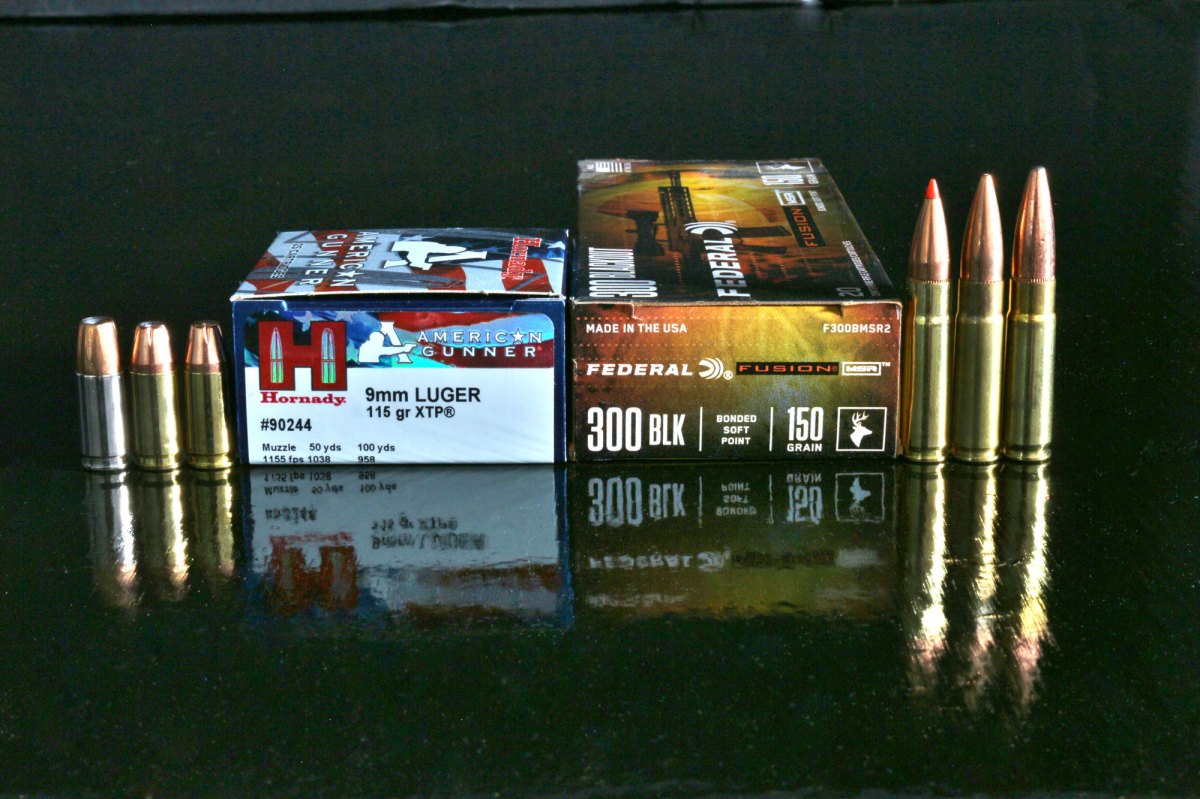
The 9mm Luger is the oldest of the pair, with its adoption dating back to 1902. Developed by Georg Luger for the German Military, it is derived from the 7.65×21mm Parabellum which fired a 93-grain bullet at 1,200 fps. The cartridge is also known as 9x19mm NATO, and 9mm Parabellum. To make the cartridge more effective, the bottleneck was removed and the bullet diameter increased to 9mm, which fires a heavier projectile at comparable speed. Both cartridges were created during experiments to create a successful autoloading pistol, with the iconic P-08 Luger being the end result. The round saw immediate success, and became the most popular handgun and submachine gun cartridge in the world. A supersonic 124-grain load became the standard for NATO forces in 1962. Coupling this with ever-improving projectiles and propellants, it has become not just accepted for self-defense use, but the standard in most people’s eyes.
Read Next: Best 9mm Carbines
.300 Blackout
.300 Blackout Specs
- Parent Case: 5.56 NATO
- Case Capacity: 24.5 Grains H2O
- Shoulder: 17 degrees
- Max COAL: 2.260 inches
- SAAMI Twist Rate: 1:8 inches
- Bullet Weight: 110 to 220 grains (common)
- Powders: Medium Fast — A No. 9 to A 2200
.300 Blackout Pros
- Great fit for AR carbines
- Wide variety of sub- and supersonic ammunition
- Good for hunting small and deer-sized game
- Solid defense/hunting crossover cartridge
.300 Blackout Cons
- Ammo is more expensive
- Subsonic ammo causes a lot of fouling in direct impingement ARs
More than 100 years after the 9mm was introduced, a strikingly similar chain of events led to the creation of the .300 AAC Blackout — or .300 BLK. During this period, a man named Robert Silvers was contacted by the US government to create a cartridge with optimized short-barrel performance that suppressed well, primarily for close-quarters work. The most obvious way to strike this balance is with heavier projectiles at lower velocity. Working with an already established NATO cartridge, the 5.56, he shortened the body and widened the mouth to take a .30-caliber bullet. The cartridge functioned well with existing standard hardware and required nothing more than an upper receiver swap, utilizing the M4’s existing bolt carrier group and magazine. The new cartridge went on to see select military use, typically within special operations. While it was never standardized by NATO, typical loads consisted of a 220-grain bullet at a subsonic velocity of around 1050 FPS. In the years since its introduction, it gained tremendous civilian interest for hunting and home defense, especially for those who already had an AR.
Read Next: Best .300 Blackout Rifles
.300 BLK vs. 9mm: Head to Head
What They Have in Common
As both the 9mm and .300 BLK fill similar roles, they share many of the same strengths. Each runs reliably in semi-automatic or fully automatic military arms and produces little recoil. While the 9mm is commonly chambered in pistols, the two cartridges are more comparable when chambered in carbines. Both cartridges can operate at either subsonic or supersonic velocities, depending on bullet and charge weight. Subsonic ammunition is available for both, and each suppresses well. These shared characteristics make both rounds appealing for many of the same applications, which include self or home defense, recreational shooting, and some close-range hunting.
Subsonic Ammo
To better understand these two cartridges, we’ll have to separate their respective velocity categories to take a look. I’ll begin with subsonic loadings for each, as that’s arguably the best benefit of either of these. In fact, if you aren’t thinking about pairing either with a suppressor, you might just want to look at different carbine chamberings altogether.
Subsonic 9mm ammo is easy to find, just look for 147-grain bullets, right? Well, not always. Box velocity for this cartridge is often regulated for pistol barrels, even sometimes reaching supersonic speeds from full-sized handguns — especially with 124-grain loads. Putting these into a carbine is often enough to push them over the edge, creating that telltale crack when the sound barrier is broken. Just know that although the boxes might indicate that the 9mm ammunition is subsonic, you won’t know which truly are until you try them in your specific firearm. The good news is that most of the defensive 9mm bullets are designed to function at low velocity and when you find a good subsonic load, you can be confident in its performance.
While you’ll probably find fewer subsonic loads for .300 BLK than 9mm Luger, nearly all were designed for long gun use. The typical weight range for these is between 185 and 220 grains, although many boutique manufacturers have offerings that push both sides of this spectrum. This brings us to an obvious energy difference between the two. Kinetic energy has two components: mass and velocity. Being that velocity is fixed — to somewhere around 1050 fps — the only way to increase energy is by adding projectile weight. At 220-grains, a bullet leaving a .300 BLK carries roughly 540 foot pounds of energy, whereas a 147-grain 9mm at the same speed only has 360. The heavier, smaller-diameter .308-caliber bullets of the .300 BLK also have a better sectional density, which can result in better penetration — depending on bullet design.
Supersonic Ammo
While I may have been a little hard on supersonic fodder above, let’s not forget that velocity — being squared — has more impact on the kinetic energy equation than mass. Specifically, adding speed will have exponentially more effect than adding bullet weight. Additional velocity, in the case of the .300 BLK and 9mm, results in an extended effective range — more so with the .300 BLK. Supersonic ammo for both cartridges is generally more affordable, and the material costs of the heavier slugs certainly contributes.
Being that the Luger had more than a 100-year head start, there is a much wider variety of ammunition available — and it’s more affordable. Turning to an online retailer, the lowest cost 9mm that I found was a paltry 21 cents per round for either 115 or 124-gr. FMJ. Comparing that to the 145-grain FMJ .300 BLK at 50 cents per round on the same site, one can expend their ammo budget in less than half the time. Now, admittedly, a handloader can cut the margin by reloading .300 BLK more than they will for 9mm, but not everyone is interested in taking up the practice.
Regarding muzzle energy, though, the .300 is going to dominate the 9mm. However, to be fair, the two are in completely separate brackets as one is a pistol cartridge and the other a rifle cartridge. Putting the .300’s 150-grain pill against the nine’s 147, it has more than three times the energy of its competitor. Even more important than energy, is bullet construction. The 9mm is mostly loaded with expanding bullets that are designed for limited penetration, whereas ammunition for the .300 BLK includes expanding bullets specifically designed for the deeper penetration that many hunting scenarios require. In short, if you’re considering harvesting anything very big, the clear choice is .300 BLK.
Downrange Ballistics
While both cartridges are most effective at short distances, we also ought to look at how each load holds up down range. For this, I ran data I’ve collected in previous projects on two of the most popular supersonic loads for each cartridge, as well as their most common subsonic load. Test rifles each had a 16-inch barrel.
Interestingly, when we pit the 9mm’s 147-grain bullets against the .300 BLK’s 220-grainers, the trajectories are remarkably similar. If zeroed at 50 yards, we don’t see a serious trajectory advantage until we hit 200 yards, and even that is only about six inches in the .300’s favor. This is because drag is severely reduced when the at subsonic speeds. So, if you only plan on subsonic use on steel or small game, the 9mm is going to be your best bet.
Taking things beyond the speed of sound results in a much larger difference. If we take each cartridge’s best flyers, which would be the 9mm’s 124-grain-class bullet and the .300’s 150-grainers, there is a clear advantage. At 200 yards, the Luger loses about half its energy and drops 37 inches. The .300 only loses around a third of its energy and sees about one-fifth of this drop.
Keep in mind that these are simple trajectory and velocity calculations. None of it determines whether the bullets are still stable enough to provide good accuracy. In my experience, I’ve found that 300 BLK has a better downrange performance than the 9mm Luger, and the BCs support this. Blackout bullets in the 125-grain class are twice as aerodynamic as even the best 9mm, while heavy 220-grain .30-cal bullets carry quadruple the ballistic coefficient.
More than just ARs
While we typically associate .300 BLK with the AR platform, both it and the 9mm are available in a wide variety of carbine-sized firearms. The .300 BLK is available in AR’s, AK-style rifles, hybrid rifles like the PSA Jackyl, as well as the iconic A-Team Mini-14 from Ruger. The nine millimeter can be found in a plethora of large-format pistols and PCCs, like the iconic MP5 and its numerous clones, various AR-style guns, and futuristic models like the Kriss Vector. For a bit of old-world styling, Henry’s Homesteader adds a touch of class to any gun safe. Bolt- and lever-action carbines are even quieter when suppressed, and the .300 BLK is available in a lot more of these platforms. At the time of this writing, the only manual 9mm rifles that I can think of are the 782 Gunworks bolt-action rifle and Taylor’s TC73 lever gun.
Magazine Considerations
The final consideration in making the choice between .300 Blackout vs 9mm Luger ought to come down to your magazine stash. If you own a 9mm pistol that takes Glock-style mags, you already have some of the components for an AR-9 or other PCC that uses them. If you’re already stocked, the 9mm might make more sense for you.
One quirk of the .300 BLK is that, while the cartridge is intended to work with standard 5.56 STANAG magazines, it doesn’t always do so. Older, worn-out magazine springs can cause issues with heavier .300 BLK ammo, and some followers don’t work well with the cartridge. Your best bet is to get specific .300 BLK magazines or followers. These are issues that the 9mm doesn’t typically suffer from.
Final Thoughts
Like every firearms purchase, choosing between 9mm Luger and .300 Blackout ought to begin with first determining your use. If clanging steel and punching paper are your only desires, there’s no need to bring the cost of .300 BLK ammo into the equation. However, if hunting medium-sized game or defending your home is the reason you are standing at the gun counter, I suggest leaning toward the .300. That’s not to say 9mm isn’t effective in these instances; it’s just that .300 BLK is more versatile and more effective. Don’t forget that shooting is fun, and there’s nothing wrong with having both.
When the 9mm Luger is the best choice
· When the cost of factory ammo is a factor
· When you already own a 9mm handgun that takes Glock-pattern mags.
· When extensive target work is in your future
When .300 BLK is the best choice
· When you already reload
· When subsonic lethality is important
· When you already own an AR
Read the full article here