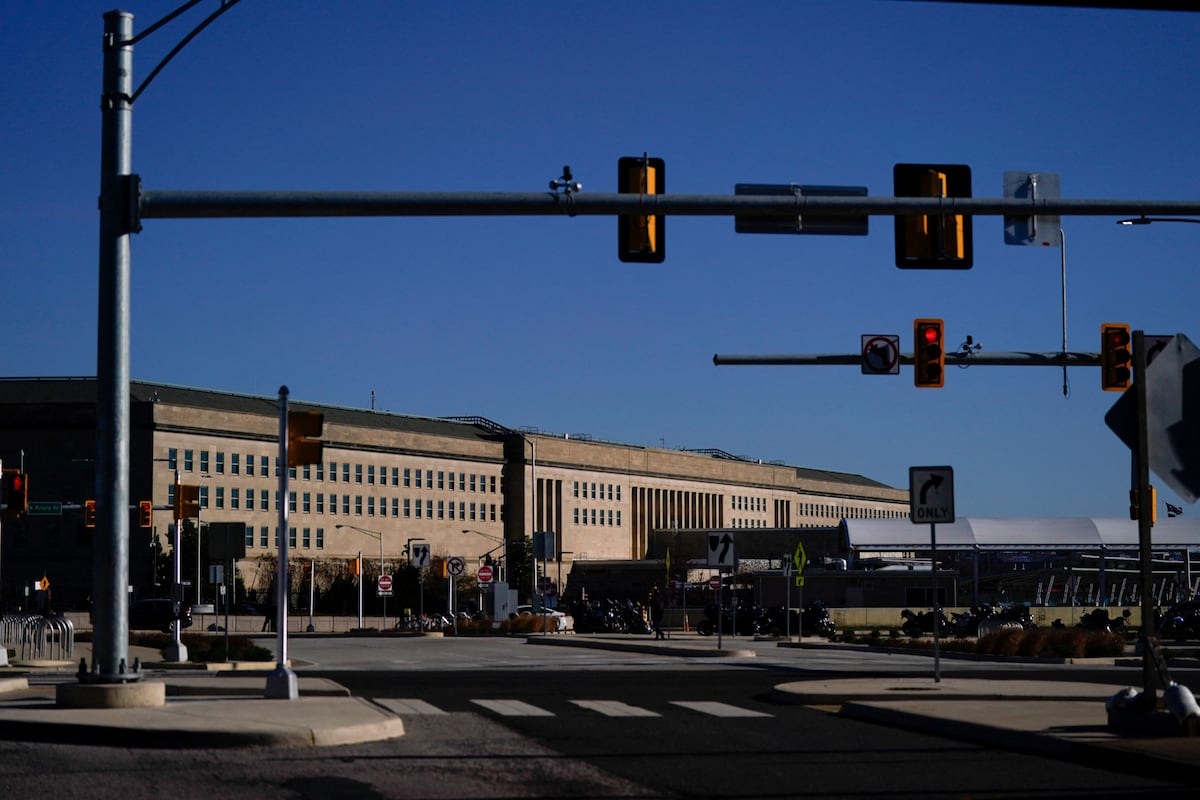
US countered drone threat over ‘strategic’ installation in early hours of Operation Epic Fury: Guillot


Forces successfully countered a drone threat over a “strategic” U.S. installation hours into the joint U.S.-Israeli offensive against Iran, according to Gen. Gregory Guillot, commander of North American Aerospace Defense Command and U.S. Northern Command.
“In the early hours of Operation Epic Fury last month, a deployed [Fly-Away Kit] successfully detected and defeated sUAS operating over a strategic U.S. installation,” Guillot said in his written statement ahead of a Senate Armed Services Committee hearing Thursday.
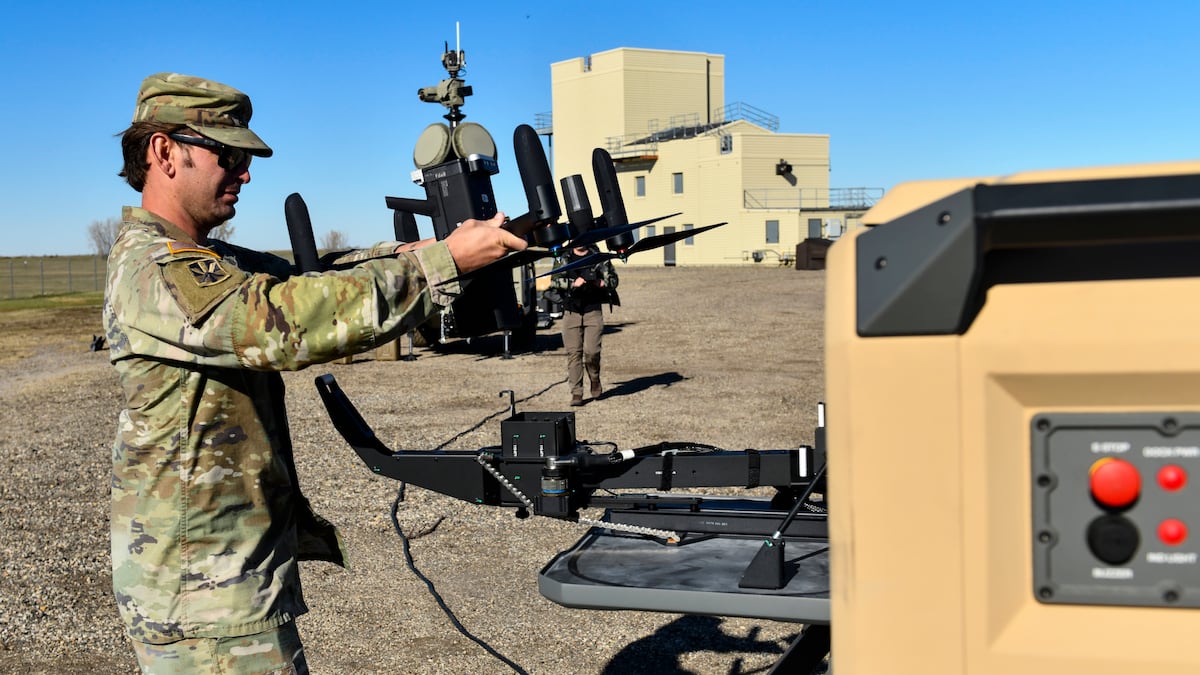
Although he did not give details about the installation threatened, Guillot revealed that the threat was defeated by USNORTHCOM’s counter-drone Fly-Away Kit.
The FAK is produced by Anduril and was “designed specifically to detect, track, identify and mitigate drone incursions at military installations within the United States,” USNORTHCOM previously said. The kit is manned by a team of 11 soldiers who became operational as a rapid counter-drone response force last November.
The Defense Department’s lead counter-drone task force, Joint Interagency Task Force 401, did not provide specific details about the location or nature of the incident but told Military Times that the unit will continue to monitor the situation.
“We are aware of the action reported by U.S. Northern Command, and we continue to work closely with them on how best to array our c-UAS capability to defend the homeland,” a spokesperson for the JIATF-401 told Military Times.
“We also work with our law enforcement and interagency partners to monitor and investigate illicit drone use around military installations and other defense critical infrastructure. Our top priority is the safety of our service members and civilian personnel that work and live on the base.”
The FAK features an enhanced array of sensors to detect rogue drones, including Anduril’s Wisp, an AI-infrared system with 360-degree motion sensor; a Heimdal mobile sensor trailer that uses thermal optics and radar; and Pulsar, an AI-enhanced electromagnetic warfare platform.
It uses a self-guided drone interceptor called Anvil to home in on and ram drones out of the sky.
USNORTHCOM expects to receive more of the kits in late spring, according to Guillot’s written testimony.
During the committee hearing Thursday, in response to questions from Sen. Eric Schmitt, R-Mo., Guillot also revealed that the U.S. has seen a spike in drone intrusions over military installations over the the last year.
“Some of that might be due to the fact that we have more detection capability now than we did in the past, and then our ability to defeat them has improved,” Guillot said. “Whereas a year ago, almost every one that was detected was not defeated. Now about a quarter of the ones that we detect we’re able to defeat.”
Guillot stated that he works closely with U.S. Strategic Command to ensure that submarine silos, aircraft bases and other key locations have adequate protection from potential threats posed by small unmanned aircraft systems.
Meanwhile, as a deterrent to drone intrusions, the Defense Department, along with the Federal Aviation Administration and other federal agencies, announced a zero-tolerance policy toward unauthorized drone flights in restricted airspace, with penalties including fines of over $100,000, criminal charges and imprisonment.
Zita Ballinger Fletcher previously served as editor of Military History Quarterly and Vietnam magazines and as the historian of the U.S. Drug Enforcement Administration. She holds an M.A. with distinction in military history.
Read the full article here