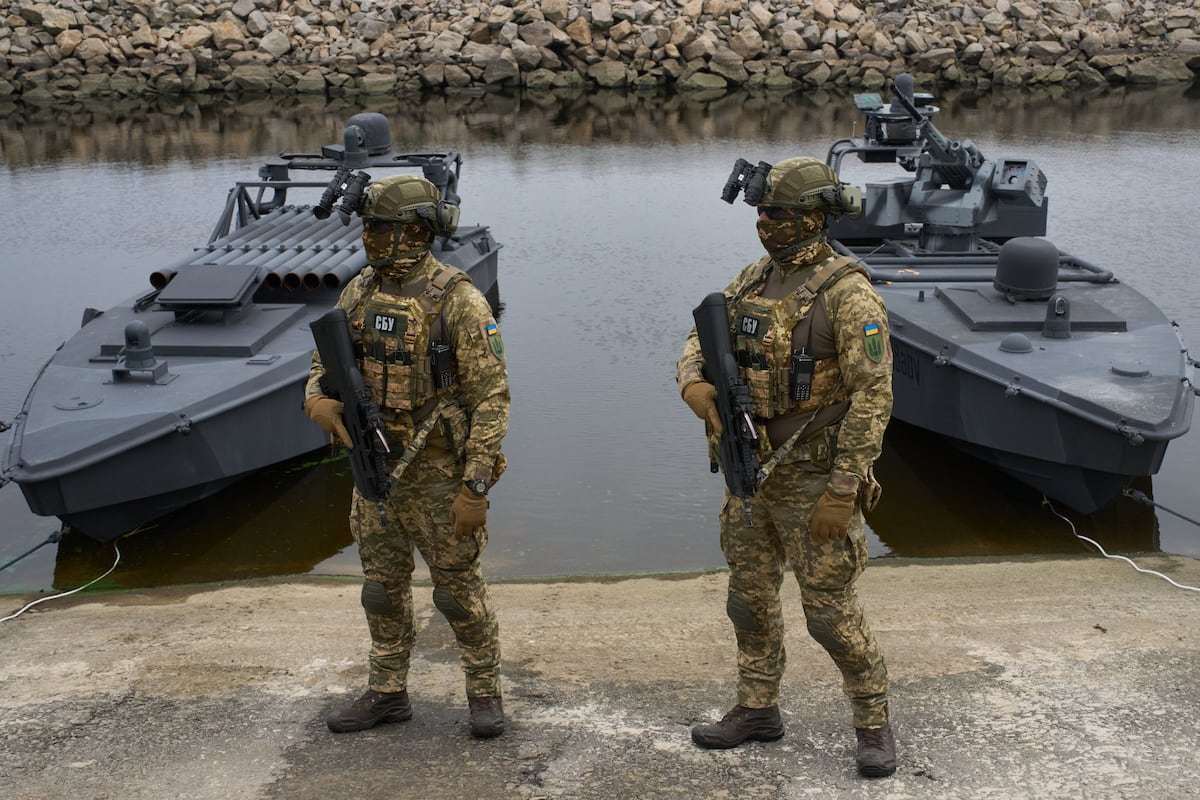

MONTREAL — The Security Service of Ukraine has claimed the first strike of a Russian submarine using an underwater strike drone in footage seemingly sourced from compromised enemy security cameras.
On Dec. 15, the SBU published a video on its official government affiliated website reportedly showing the Sub Sea Baby drone striking a part of the Kilo-class submarine stationed at the Novorossiysk Russian naval base.
The available recording shows a major explosion around the stern area of the Russian submarine, which likely resulted in notable damage to components of the platform. However, the specifics have not been independently confirmed.
“For the first time in history, underwater drones ‘Sub Sea Baby’ blew up the Russian submarine of the class 636.3 (NATO classified as Kilo) – as a result of the explosion, it suffered critical damage and was put out of action,” the SBU wrote in a statement.
The submarine was forced to stay put in the Novorossiysk port due to the effective use of Sea Baby surface naval drones, which displaced Russian ships from Sevastopol Bay, it added.
The Russian Ministry of Defense maintains that the attack was unsuccessful and that all vessels at the naval base are intact.
The footage appears to have been taken from cameras around the port, suggesting that the Ukrainian military likely managed to infiltrate the network to surveil Russian activity inside the naval base.
Very little information is known about the capabilities and functioning of the Sub Sea Baby underwater drone; other than that it was specifically designed for the SBU. The language included in the SBU announcement frames the attack as having included multiple units of these drones.
According to an industry source in Ukraine, who wished to remain anonymous for security reasons, next to no one was aware of the operation ahead of time since the naval drone is part of non-public projects with extremely restricted access. For instance, the source noted that the manufacturer of the Sea Baby has not even gone public yet with its identity.
As noted by Naval News, the drone appears to operate as a type of autonomous torpedo, which, if true, could enable it to be guided in the direction and proximity of the target using waypoints prior to its own systems taking over and steering it independently.
“This could explain how the Sub Sea Baby was able to navigate inside the naval base and towards the submarine pen, a route that requires several turns in confined spaces,” the online platform stated in a report.
Elisabeth Gosselin-Malo is a Europe correspondent for Defense News. She covers a wide range of topics related to military procurement and international security, and specializes in reporting on the aviation sector. She is based in Milan, Italy.
Read the full article here