
On Jan. 11, 2002, an 86-year-old World War II veteran on his way to speak at the National Rifle Association (NRA0 and the United States Military Academy (USMA) was detained at Phoenix Sky Harbor International Airport, due to the metallic object he wore around his throat. The veteran was also wearing a pacemaker, but the matter was resolved by mailing the object to his home in Arizona — at his own expense.
What made this an embarrassing incident was expressed afterward by the owner, Joe Foss: “I wasn’t upset for me….I was upset for the Medal of Honor, that they didn’t know what it even was.” Make no mistake, though, if anyone at that airport knew who they’d detained, it would have been all the more embarrassing.
Joseph Jacob Foss was born in Sioux Falls, South Dakota, on April 7, 1915. When his father, Frank Ole Foss, was killed in an electric storm in March 1933, he and brother Clint helped his mother, Mary Esther Lacey in keeping up the family. In 1940 he graduated from the University of South Dakota with a degree in Business Administration, by which time he’d concurrently amassed 100 flying hours.
In June 1940, Foss hitchhiked 300 miles to Minneapolis to enlist in the Marine Corps Reserve so he could join the Naval Aviation Cadet program. He joined the United States Marine Corps and finished flight training in Miami, Florida, as a naval aviator on March 29, 1941, obtaining his second lieutenant’s commission two days later.
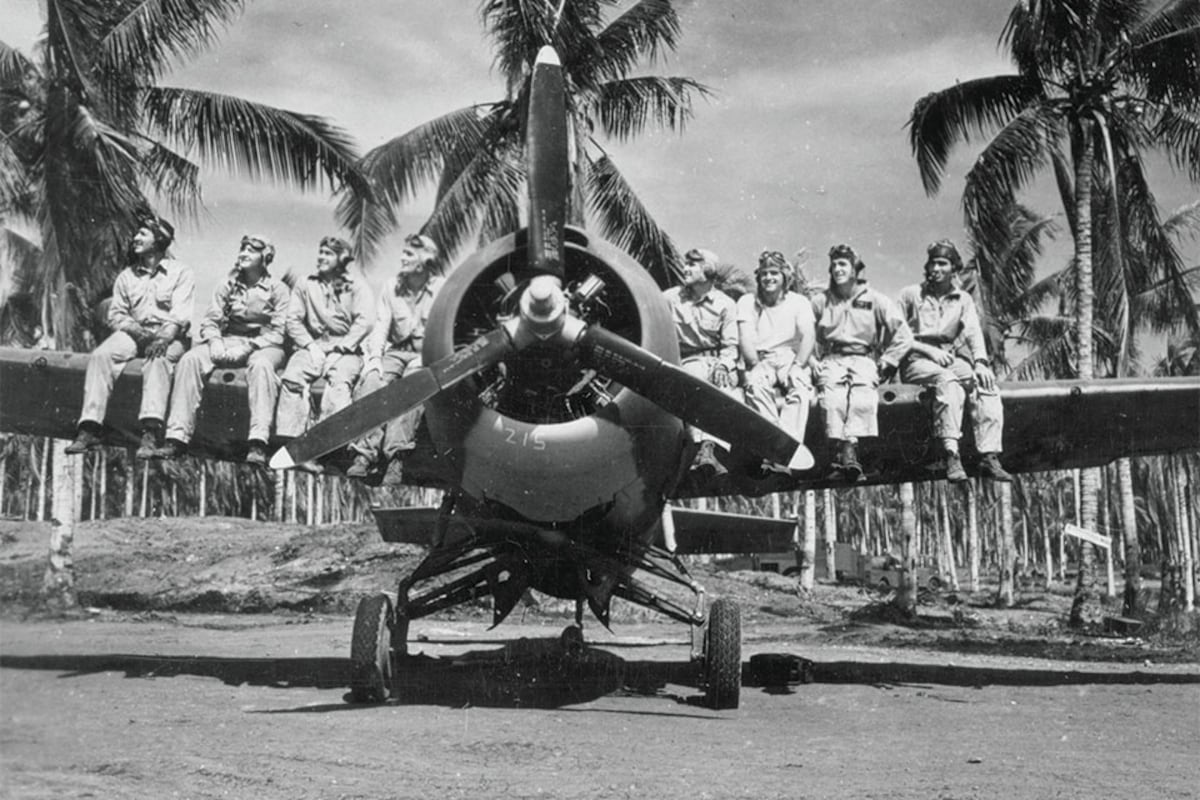
Serving as an instructor at Pensacola, Florida, he was promoted to first lieutenant on April 10, 1942. On Aug. 11, he got his first operational assignment with Marine fighter squadron VMF-121 as a captain and the unit’s executive officer. At the end of September 1942 he shipped out to Guadalcanal, flying off the deck of the escort carrier Copahee on Oct. 9.
He and his squadron landed at Henderson Field, the muddy and much-strafed Guadalcanal “cow pasture,” writes historian Michael D. Hull. The Cactus Air Force there had grown from an original complement of 19 Wildcats and 12 Douglas SBD Dauntless dive bombers. Most of the pilots were young and inexperienced.
Foss lost little time wading into the fight.
On Oct. 13 he had his first encounter and was credited with shooting down a Mitsubishi A6M2 Zero fighter, but was himself shot up by the Zero’s wingman and dived 22,000 feet to make a dead-stick landing. It had been quite an edifying combat debut, in which he learned the Zero’s generally superior performance against the advantages of his sturdier Grumman F4F-4 Wildcat.
“You can call me Swivel-Neck Joe from now on,” he reportedly told his comrades with a smile.
Returning to the fray the next day, Foss shot down another Zero and, on Oct. 18, he claimed two Zeros and a “twin tail bomber.” Having become an ace in less than a week, he destroyed two more Zeros on the 20th, four on Oct. 23 and five in the course of two sorties on the 25th.
Foss added a Nakajima A6M2-N “float Zero” and two Mitsubishi F1M2 two-seater float biplanes to his tally on Nov. 7, but one of the latter managed to get in a telling blow that forced him to bail out of his Wildcat.
When the Wildcat hit the sea, the impact slammed the canopy shut, writes Hull. Struggling desperately with the latch as water rose to his chin, Foss was finally able to pop it and rise to the surface, buoyed by his parachute pack and Mae West lifejacket. He started swimming toward Malaita, two miles distant. Sharks circled him and darkness fell.
“I did more praying that afternoon out there than I ever did in my life,” he recalled. When the sharks came closer, he tore open a pouch of chlorine powder and sprinkled it into the water to repel them.
Rescued by Mailaita natives, Foss managed to return to combat three days later.
On Nov. 12 Foss shot down two twin-engine torpedo bombers and a Zero, and on the 15th he drove down an F1M biplane. However, on the 19th he was evacuated with a bad case of malaria, but not before receiving a Distinguished Flying Cross from Adm. William H. “Bull” Halsey along the way.
Foss ushered in the New Year by returning to Guadalcanal on Jan. 1, 1943. He only flew 11 missions in 66 hours, but that included three Zeros destroyed off Vella Lavella Island on Jan. 26. That gave him a total of 26, a record that no other Marine would surpass.
On May 18, Foss was called to the White House, where President Franklin D. Roosevelt awarded him the Medal of Honor. He subsequently appeared on the June 7, 1943 issue of Life magazine. Promoted to major on June 1, 1944, Foss led VMF-115 on operations over Bougainville and Emirau from Sept. 17 through the 20th, when a recurrence of malaria compelled him to relinquish command.
Foss’ remarkable career, however, was just beginning. In 1946 he resigned from the Marine Corps Reserves, as a lieutenant colonel in the South Dakota National Guard. In 1948 he was elected to the South Dakota House of Representatives, serving a two-year term.
Then, in 1950, he was promoted to colonel and to brigadier general in 1954. That same year he was elected governor of South Dakota and was re-elected in 1956.
Among this other distinctions: President of Crippled Children and Adults from 1956 to 1961; became the first commissioner of the American Football League from 1959 to 1966; hosted ABC-TV’s “American Sportsman: Joe Foss” from 1966 to 1974; from 1972 to 1978 he was director of public affairs for KLM Royal Dutch Airlines; and was president of the NRA from 1988 to 1990.
In 1984 he was inducted into the National Aviation Hall of Fame in Dayton, Ohio.
Foss died of a cerebral aneurysm in Scottsdale, Arizona on Jan. 1, 2003. He was laid to his final rest at Arlington National Cemetery.
Read the full article here