
KYIV, Ukraine — While interceptor drones have become one of the most sought-after commodities of the Iran war, Ukrainian officials and defense practitioners are cautioning allies to recognize that the pace of today’s battlefield requires them to buy into an entirely new system of production alongside the endpoint weapon.
“Expertise is not a drone, but a skill, a strategy, a system where a drone is one part of the defense,” Ukrainian President Volodymyr Zelenskyy told Reuters on Monday.
Ukraine now produces roughly 1,000 interceptor drones a day through hundreds of vetted manufacturers, deliberately dispersed so that no single strike can cripple the supply chain, Zelenskyy reported last month. The country has the technical capacity to double that figure, he said, but lacks the budget to do so.
While Ukraine has built that infrastructure gradually over the last few years, most countries now trying to integrate interceptors into the air defense have not invested in building the necessary logistical framework needed to effectively build, arm or deploy the cheap flyers.
Some countries have already learned this lesson the hard way.
After some Ukrainian companies built interceptor drone factories abroad without state approval, multiple buyers complained because the drones were sold without the warheads or expertise needed to operate them properly, Zelenskyy said on Friday, per Ukrainska Pravda.
“They had also been sold a certain number of interceptors — again without explosives,” Zelenskyy said about a European country he visited recently. “And they asked me whether we could send more operators. I said no.”
The bottleneck isn’t the interceptor itself, but the logistics infrastructure to produce and sustain them at scale, officials said.
“It seems there is still a misconception,” Artem Moroz, head of investor relations at Brave1, wrote on LinkedIn last month.
Brave1, Ukraine’s defense-tech accelerator, has worked with more than 500 defense startups since 2023 and now serves as the primary gateway for foreign governments seeking access to Ukrainian drone technology and production partnerships.
“Many believe Ukraine could simply send a few hundred interceptor drones to the Middle East and stop the Shahed drones currently hitting critical infrastructure,” Moroz said. “Drone warfare is far more complex than that.
“Yes, hardware matters. And Ukraine knows how to build drones at scale. But the real advantage lies in the infrastructure behind them.”
Companies launch drone-production innovations
The gap between buying a drone and building the system to sustain it is the market several defense companies are now racing to fill.
A handful of defense companies from Helsinki to San Francisco are offering the production line, the detection system and the supply infrastructure compressed into a portable unit that can be shipped anywhere to produce up to dozens of drones a day.
Sensofusion, a Finnish defense company founded in 2016, sells a full-cycle drone production chain as one of the latest innovators in this arena.
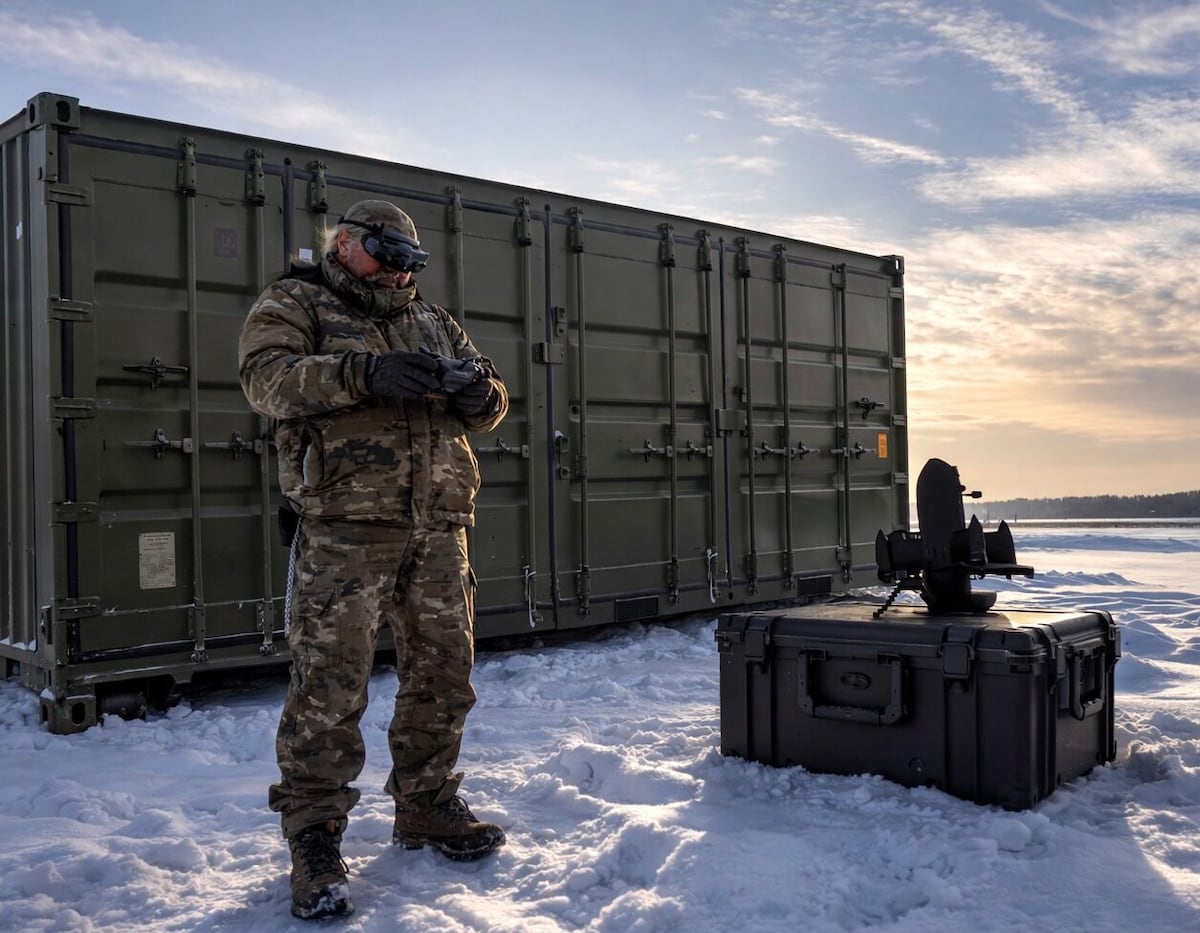
The company’s $2.4 million (€2.1 million Euros) Tactical Drone Factory is a standard 20-foot shipping container equipped with industrial 3D printers, an electronics assembly station and enough spares to run around the clock with a crew of three, producing up to 50 interceptor drones a day, according to the company.
What sets the Finnish system apart from its competitors is that it’s not just a factory: It ships as a package with Sensofusion’s Airfence radio-frequency detection and tracking platform, designed to detect a hostile drone, cue an interceptor and guide it to the kill — a full sensor-to-effector chain in a box.
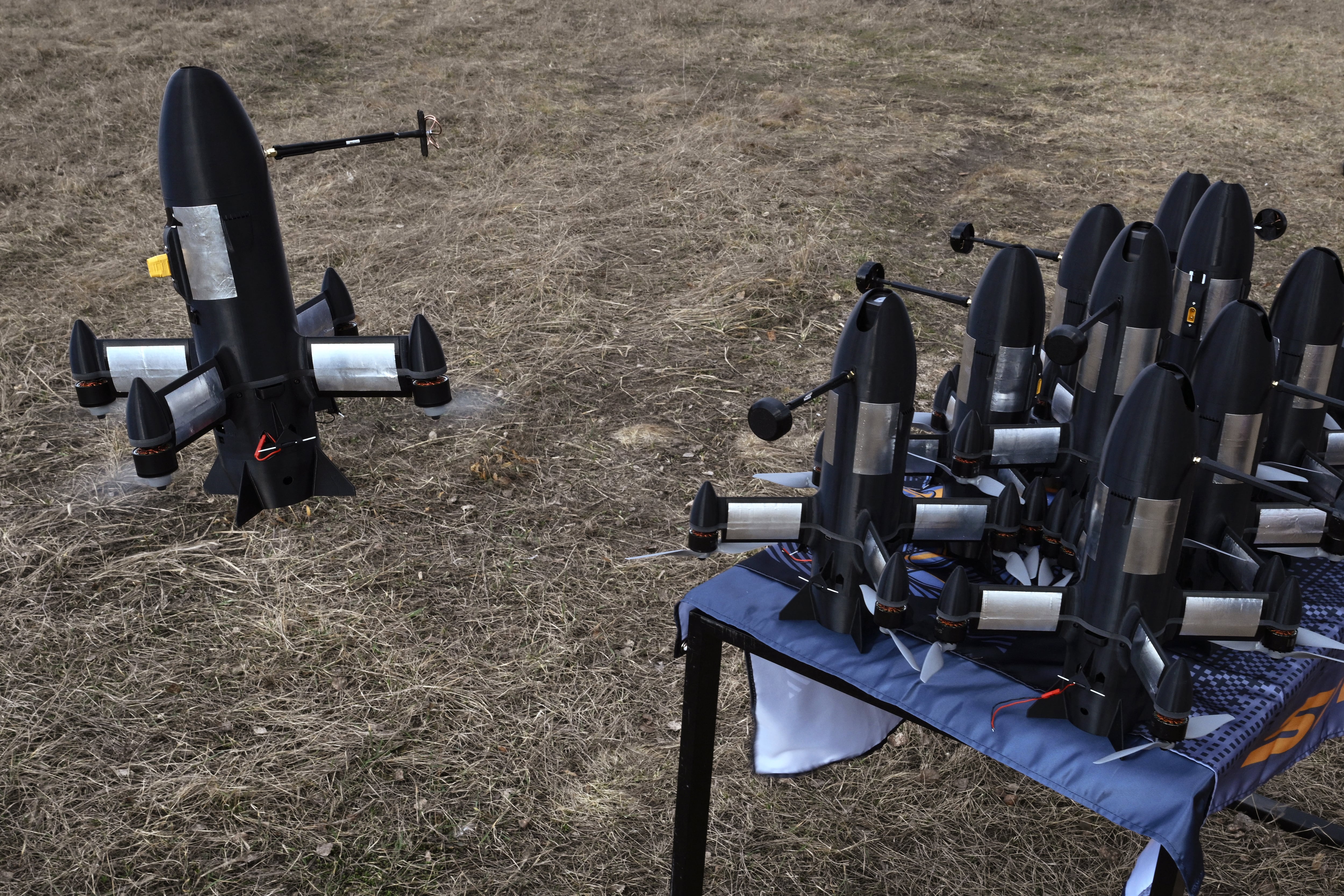
The company says each interceptor costs less than $580 (€500) and is built to chase targets at speeds up to 310 mph (500 km/h).
Although Sensofusion boasts some of the highest production numbers on the market, it’s not the first company to market the concept of a portable all-in-one drone production hub.
Firestorm Labs’ xCell system, the most tested U.S. equivalent to Sensofusion, uses two containers and works at a significantly slower pace by producing roughly 50 drones per month. Its newly announced SQUALL airframe is the first drone purpose-built to come off a mobile factory line, according to the company.
Founded in 2022, Firestorm’s biggest selling point is its testing and validation. The company holds a $100 million U.S. Air Force contract, has run field exercises with Air Force Special Operations Command and the Air National Guard and raised $47 million in Series A funding.
Per Se Systems, a French firm, operates in a middle ground by building micro drone factories on trailers — instead of shipping containers — that produce up to ten drones per hour on a generator with 19 hours of autonomous operation.
Per Se has been field-tested with 12 French Army regiments and is embedded in four active development projects with the French military, according to Army Recognition.
The drawbacks of production containers
Some logistics and strategy specialists say the all-in-one package wrapped into the portable factory concept ignores some critical battlefield questions that could render the projects useless.
A container full of printers, raw materials, sensitive electronics and proprietary design files concentrates exactly the kind of capability an adversary would want to destroy or capture, according to a Center for Strategic and International Studies analysis that identified several strategic vulnerabilities in frontline drone production.
And the problems compound from there.
Airframes can be printed, but the motors, batteries, electronic speed controllers, radios and sensors that make a drone combat-capable cannot, and those components must be trucked to the container through the same supply chains the factory is supposed to bypass.
Quality control under field conditions remains untested. Vibration, temperature swings, dust and intermittent power degrade the dimensional tolerances that 3D-printed parts require, and no company has demonstrated sustained production outside a controlled environment.
“Industrial resilience is combat power,” the CSIS experts concluded. “The next war will not be won by who initially fields the most drones, but by who sustains building them at scale.”
Several countries are catching on to the growing need to invest in drone production logistics.
Five NATO nations — the United Kingdom, France, Germany, Italy and Poland — launched a joint initiative in February to develop affordable interceptor drones within a year under a program called LEAP, explicitly drawing on Ukrainian battlefield know-how to do it.
Ukraine’s experts say they are ready and willing to share their hard-earned lessons with allies, including the strategies to build a new layer of defense alongside the new weapons themselves.
“What Ukraine has built is a deep operational ecosystem across multiple domains, designed for conflicts where entirely new types of threats appear,” Brave1’s Moroz said.
“And ecosystems like this are extremely hard to copy,” he explained. “Even investing hundreds of billions or a trillion today would not easily replicate the experience, integration, and speed of iteration built over years of real combat.”
His final words of advice to allies?
“Drones are the tool. The infrastructure is the weapon.”
Read the full article here