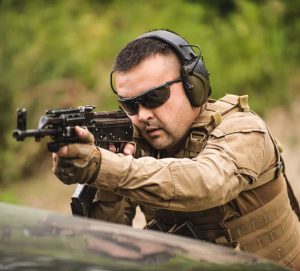
This year marked the 15th deployment of U.S. Marines to Australia under the Marine Rotation Force-Darwin (MRF-D) initiative, but this year’s rotation looked different from the rest because of its certification as a Special Purpose Marine Air-Ground Task Force (SPMAGTF).
“This is the first rotation in the 15-year history of the program to be certified as a MAGTF, and that’s a big deal,” Col. George Flynn, commanding officer of MRF-D 2026, explained to Defense News.
Flynn noted that being certified validates the MAGTF’s credibility and proficiency because, if called upon, a commander “knows the force is going to be able to accomplish all those tasks it’s assigned as part of its task order to facilitate operations in the theater.”
“What makes it special purpose is just the uniqueness of how it’s placed here in Darwin in support of the Pacific theater,” Flynn continued. “We’re responsible for being ready for the full spectrum of operations from full-scale combat to humanitarian assistance and disaster relief.”
This certification process was completed in early May during an exercise in the Philippines, making “an incredible statement” on its ability to respond to crises.
Flynn said MRF-D is authorized to have 2,500 personnel, but he typically has around 2,000 in his SPMAGTF. They arrived in Darwin in March, with his task force including, among others, the California-based 1/5 Marines and MV-22B Ospreys from the Hawaii-based VMM-268.
High tempo
Flynn pointed out that “the Marine Corps, we always seek to deploy”.
MRF-D has maintained a heavy operational tempo, with the commander saying personnel had traveled to six or seven different countries to date.
“We’re busy, but Marines are having a great time. For this deployment, we’ve had 13 planned operations, activities, investments or exercises,” Flynn said. “We’ve been in the Philippines, we have forces in Indonesia right now, and we have forces that are getting ready to go to Tahiti to do training with the French. And we’ve certainly been all over the Australian continent.”
The latter includes major exercises with the Australian Army’s Darwin-based 1st Brigade and Townsville-based 3rd Brigade. Operating with the 1st Brigade is particularly helpful to both parties, since that formation now specializes in littoral warfare.
“We get to share good practices,” Flynn noted. “We have a great relationship with 1st Brigade.”
Asked about difficulties operating in such far-flung locations, often simultaneously, Flynn acknowledged, “It’s a good challenge to have. It allows us to demonstrate our ability to be distributed, and how well we can achieve operational reach throughout the region.
“I think it goes to demonstrate that, where needed, Marines can show up and provide the support that Marines are capable of providing.”
He said the SPMAGTF’s expeditionary mindset, its ability to get to locations quickly and to sustain itself, has “really been eye-watering to watch.” Flynn noted formations typically “spend their workup getting to their max level of readiness and then, once that deployment starts, that readiness starts to degrade over time.”
However, this is not the case with MRF-D, as “we have the unique ability to gain and maintain readiness throughout the deployment,” he said. This is due in part to “the expansive training areas throughout the continent that give us some wonderful opportunities to be most ready when called upon.”
Capability growth
“We have a robust C2 [command-and-control] capability down to our supporting elements as well, and we’ve been able to work with those systems and demonstrate … the ability to go up and down on different communication systems using satellite capabilities down to high-frequency capabilities and the like,” Flynn told Defense News. “At no point have I ever felt challenged with being able to command and control the force based on the capabilities that we’re working with.”
The Marine Corps continues to evolve for modern combat, too.
“Our Sec War has been adamant about increasing capabilities of the force with regards to small UAS [unmanned aerial systems] and first-person-view, one-way attack drones. We’ve had the opportunity to experiment with those systems out here, and you saw some of that at the counter-landing live-fire in the Philippines,” Flynn said. “So, we’re definitely using those. We’ve also used others like logistics-based unmanned aerial systems to facilitate movement of logistical requirements throughout the training areas here in Australia.”
However, he noted the Marine Corps “is actively still working through to increase capabilities” in counter-drone systems.
Perhaps one of the biggest helps to the SPMAGTF would be more assets for “lift and the ability to move the force around the theater,” Flynn shared.
Nevertheless, he said, “I’m beyond happy with what we’ve been able to demonstrate with our operational reach, and I think it’s just the opportunities that exist to further achieve interoperability with our allies and partners with moving the force around the theater is something that we should continue to look at going forward”.
Positive vibes
Asked about what he has gained from leading the deployment, Flynn said, “Every day, I get a chance to lead all these Marines and sailors that are under my command, and how they generally seem to understand their purpose, and they operate with happy hearts out here.
“The relationships we’ve built with the Australians and with other nations, allies and partners we’ve got a chance to work with — and just a demonstration of what it means to be a MAGTF operating in the Pacific theater — has just been really powerful for me personally.”
Flynn said MRF-D has contributed to a free and open Indo-Pacific theater.
“I think our presence, our posture and our ability to demonstrate that we can get into locations and be responsive to countries in need facilitates that free and open Indo-Pacific. All countries in this area have their own sovereignty and we respect that, and we stand by to support and protect that sovereignty as required.”
Each MRF-D deployment lasts six months. The current one ends in October, just before the wet season arrives in northern Australia.
Gordon Arthur is an Asia correspondent for Defense News. After a 20-year stint working in Hong Kong, he now resides in New Zealand. He has attended military exercises and defense exhibitions in about 20 countries around the Asia-Pacific region.
Read the full article here