

Suppressors Have Been Deregulated and Can Now Be Bought Over the Counter (With Some Key Exceptions)

Last week a federal district court ruled in favor of a handful of companies that sell and manufacture suppressors, essentially removing “silencers” from the National Firearms Act’s list of restricted items. Previously anyone who wanted to buy a suppressor needed to submit an ATF Form 4, with fingerprints, and a photo, and then wait for government approval. While the process for buying a suppressor has been streamlined, it’s still an arduous procedure.
That’s no longer the case with the current ruling. You can now buy a suppressor just like a normal firearm — however, there are some important exceptions and lingering questions.
Here’s what we know so far about this landmark regulation change and what it means for buying a suppressor going forward.
Who Can Buy Suppressors Without Completing a Form 4
We Sued the ATF and We Won: No Form 4 on Suppressors From Silencer Shop
While the NFA regulation is null, suppressors are still considered firearms by the federal government and fall under the Gun Control Act of 1968. This means you still need to fill out ATF Form 4473. Some states have laws that still require NFA registration. So if you live in one of those states, the ATF Form 4 is still required (see more on that below).
But now there are 27 states where you’ll be able to buy a suppressor just like you would purchase a deer rifle. You can find a list of those states here. (Suppressors are currently banned in eight states and those bans are expected to remain despite the recent court ruling).
The final stipulation is that you will need to purchase the suppressor from one of the companies that brought the suit. Or you must be a member of an organization named in the lawsuit. As the lawsuit describes it: “the downstream customers of any commercial member of an Organizational Plaintiff.”
The member organizations listed in the case include: Gun Owners of America, Firearms Regulatory Accountability Coalition, and Gun Owners Foundation
Retailers and manufacturers listed in the case include: Silencer Shop, B&T USA, Palmetto State Armory, and SilencerCo.
Right now suppressor buyers can skip ATF paperwork if they’re a South Carolina resident and they go to a Palmetto State Armory retail location or if they purchase a silencer online from Silencer Shop. Note that PSA is still requiring a Form 4 for online sales for the time being, but plans on offering online sales in the future.
If you’re a GOA member, or are buying a SilencerCo or B&T suppressor, you should be able to buy your silencer with just a 4473 from a local dealer, at least according to the ruling.
Understanding Recent Court Rulings
Today’s changes in suppressor regulation stem from a U.S. district court ruling last week in north Texas, where Silencer Shop is based. The case, Silencer Shop Foundation v. ATF, argued that since the cost of the suppressor tax stamp was zeroed out, the NFA’s remaining registration requirements (the Form 4 that potential suppressor buyers are required to submit) exceeded Congress’ powers under the Constitution’s Taxing Clause. Congress eliminated the $200 tax stamp cost for suppressors through the Big Beautiful Bill last year.
The U.S. Court for the Northern District of Texas agreed with the plaintiffs, stating that “because today’s NFA does not generate any revenue from untaxed firearms, its regulatory provisions cannot be upheld under the taxing power.”
The court ruling on August 5 included a seven-day stay, which gave the Department of Justice time to respond to or appeal, according to Brandon Maddox, the founder and CEO of Silencer Central.
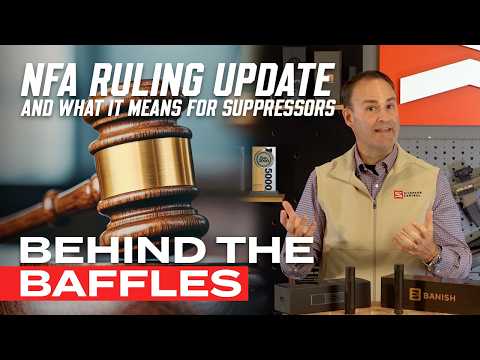
NFA Ruling Update and What It Means For Suppressors – Behind The Baffles, Ep. 15
That stay lasted until midnight yesterday. According to sources familiar with the case, the DOJ did not respond to this ruling nor did it appeal. Republican Congressman Andrew Clyde posted on X that the Trump Administration does not intend to appeal the ruling.
“I’ve received confirmation from the Trump Administration that the DOJ will NOT appeal our historic court victory against the NFA,” Clyde posted.
In an unsigned statement to The New York Times, the Justice Department wrote that it “respects Americans’ Second Amendment rights and is currently assessing the impact of the court’s ruling.”
The DOJ technically still has 52 days to appeal, if it chooses to.
State Exceptions
According to Silencer Central, in many states you must still get NFA approval to purchase a suppressor, even with the court ruling. This is true in Alaska, Colorado, Connecticut, Georgia, Michigan, Mississippi, Montana, Nevada, North Carolina, North Dakota, Ohio, Oregon, Pennsylvania, Washington, and Wisconsin, according to Silencer Central.
A recent Silencer Central blog post states: “Several states currently have laws that require some form of approval from the Federal government under the current National Firearms Act (NFA). These states will have to pass new legislation to make suppressor ownership legal under the laws should deregulation proceed.”

How NFA Deregulation Affects Your State – Behind The Baffles, Ep. 16
Last year South Dakota passed a law that removed suppressors from the state’s definition of a “controlled weapon” and eliminated the requirement for a federal stamp. Other states would have to follow suit.
“This bill in South Dakota is a fix-it bill,” Mark Oliva, the managing director of public affairs for NSSF told Outdoor Life at the time. “So, should the NFA be rolled back, then suppressors would become illegal in South Dakota because South Dakota law requires those suppressors to be registered under the NFA. So, that becomes an obstacle for suppressor owners in South Dakota.”
If you buy a silencer without an NFA Form 4, bringing it to another state is currently not allowed, according to Palmetto State Armory: “26 U.S.C. § 5861(j) makes it unlawful to transport, deliver, or receive an unregistered NFA firearm in interstate commerce. That provision was not enjoined. It remains on the books and enforceable. Neither the Court nor ATF has said how § 5861(j) applies to a suppressor lawfully acquired under this injunction.”
What Happens Next?
The biggest thing that needs to happen next is more clarity for new suppressor buyers. For now, the injunction only applies to the named plaintiffs and their members. But, it could extend beyond the plaintiffs with clarity from the ATF and DOJ.
According to the attorneys who worked on Silencer Shop Foundation v. ATF, there are two similar cases in other federal districts: Brown v. ATF in Missouri and Roberts v. ATF in Kentucky.
Many local gun shops are likely going to play it safe and wait to hear from the ATF before selling silencers without an NFA form. We wouldn’t expect to walk into a gun store and buy a suppressor today, but those days are likely coming as the shops gain a better understanding of this court ruling.
For residents of the 15 states where you still need to submit a Form 4, the next step is passing state legislation that removes the NFA registration requirements.
Read Next: We Tested More Than 100 Suppressors and Brake Combos for Sound and Recoil
There is a litany of other questions like: What happens to NFA trusts? Can you skip a Form 1 when making your own suppressor? What does this mean for currently registered NFA items? If the DOJ does eventually appeal, what happens to buyers who purchased a suppressor without completing an NFA form? Answers to those questions and many others will need to be addressed.
Read the full article here
