
Is there a pint-size piece of fishing water in your neighborhood that you’ve passed up for years because it didn’t seem big enough to bother with?
If so, better give it a whirl on your next fishing jaunt. You may have been missing a big bet.
A lake doesn’t have to be big to be productive. It’s true, of course, that one acre of water won’t support as big a fish population as ten acres. But it’s likely to harbor as many fish proportionately, and they may be as large in a pond as in a big lake. Which means that if the pond isn’t overfished (as it’s not likely to be, especially if it’s tucked off in some out-of-the-way corner), it often provides fishing that is downright spectacular.
I grew up in a region blessed with an abundance of lakes, big and little, in southeastern Michigan, and in the last few years I’ve been living again in that same section. Our county has lakes that cover more than 1,000 acres, and ponds not much larger than a city lot. There are thirty or forty of them within a two-mile radius of my home, and a dozen are so small that nobody bothers to fish them more than once or twice a year. Yet in my boyhood, when I had ample time and inclination for exploration, some of those vest-pocket pieces of water sheltered bluegills, and even bass and pike, big enough to make a man’s eyes pop. And on the few occasions when I tested them in recent years I found the fish still there.
One cool, overcast morning in September, when the leaves were beginning to change color, the water turning chill, and the lily pads starting to die, my neighbor Maurice and his son Gene rapped at my door and proposed a fishing trip.
The day and the weather were ideal for pike, and we had a forty-acre lake at our doorstep that consistently yields good catches of northerns. But that wasn’t what Maurice and Gene had in mind. They wanted to go somewhere and try water that we’d never fished before, preferably some small, secluded lake that had no reputation one way or the other. In short, they were looking for some mystery fishing, where we wouldn’t know in advance what to expect or whether to expect anything.
“Remember that little bog lake where we shot the three mallards last fall? Let’s take the doughnut and give it a whirl,” Maurice suggested.
I knew the lake he meant very well. It’s less than three miles from where I lived as a boy, in a brushy swamp and cranberry bog that covers half a farm. The lake itself could be put down in a four-acre lot. I’d hunted ducks and rabbits, and picked cranberries, around its marshy shores for years, but I’d never fished it.
It is a shallow, muck-bottomed pond edged with a broad belt of weeds and lily pads. I’d never seen a boat on it and didn’t know how deep it was, but I guessed it wasn’t more than ten or twelve feet at the most. Yet it’s spring-fed, with clear, clean water, and is plenty deep enough for pike. But because it is a boggy, miry place to get to, with a treacherous shore of floating marsh turf such as cranberry bogs so often have, and because there was no boat available, I’d never bothered to try it out.
It was fished now and then in winter, and neighbors of mine told me of toting a canoe to it occasionally, but I’d heard no report on the fishing. So far as I knew it hadn’t been visited six times in the previous six years, and that was sufficient to tempt me when I thought about it. I have a deep-rooted faith in such rarely fished water as that.
So Maurice, Gene, and I readied the rubber raft that is our favorite conveyance for hard-to-reach fishing places, and got our tackle together.
The weather and time of year were wrong for fly fishing, and anyway it was chiefly pike we had in mind, so we omitted fly rods. We took bait rods and a good selection of wobbling spoons in brass, chrome, and red-and-white finish and a can of worms and a couple of cane poles in case we found bluegills instead of pike.
We left the doughnut inflated, to save time and bother when we reached our destination, tied it onto the rack atop the car, and drove the three miles to the lake, or as near to it as the road permitted. There we lashed the short metal oars of the raft lengthwise of the two seat compartments, as canoe paddles are lashed to the thwarts for a portage, and shouldered the doughnut across the fields and through the bog.
We picked our way through the thickets of brush that fringed the shore, dodging the scarlet-leaved clumps of poison sumac, and set the raft down on the dark, miry-looking water. I was mildly skeptical that we would find fishing of a brand to repay us for our efforts. The lake looked too small, too weed-grown, too unorthodox by all the standards of good pike water.
With Gene at the oars we shoved off, and when we were twenty yards beyond the lily pads I made my first cast. Maurice tossed out his offering at the same instant and by that time we were so near the middle of the lake that I cast to one shore and he to the other! A first cast in water I’ve never fished before is always a red-letter occasion for me. Despite my doubt that we’d encounter really good fishing here, I couldn’t shake off a sneaky feeling of elation and high hope as my spoon sailed out toward the lily margin.
I was rigged with a spoon that has snared more pike per hour for me than any other bait I’ve ever used. Patterned after a wobbler long used in Finland and brought to this country by a Finnish immigrant years ago, it is made and marketed now by his descendants. In chrome and brass finish, I’ve found it even deadlier than the red-and-white wobbler many pike fishermen rate the greatest killer of them all.
My spoon splashed down at the edge of the weeds. I brought it back slowly, watching it flash and roll through the dark water like the crippled minnow it is supposed to imitate. Two rod lengths away from the raft I saw a long lean fish charge up at it from the lake bottom like an evil-looking shadow.
He struck short, missing both spoon and hooks, and lay there close to the top. I gave the spoon a couple of short twitches to tantalize him and he came for it once more, slowly and warily this time. He had seen the raft at close range and it made him suspicious. He followed a foot behind the wobbling, struggling, metal fraud until I had all my line back on the reel and lifted the spoon from the water, but he wouldn’t take it. The instant he lost sight of it he tilted down and flashed away.
Just then Maurice made the low explosive “Wup!” that means he has a strike. I swiveled around to watch him. He was fast to a good pike in shallow water over a weed bed, and he had his hands full. The fish made a series of flips at the top and started to bear down. Maurice couldn’t allow that, with a thicket of weeds three feet below the surface, so he gripped the reel handle. The rod arched and bucked a couple of times, and then kicked straight. The line snapped a foot above the leader, and pike and spoon were gone together.
Maurice looked around at me with a mixed expression of disappointment and satisfaction. “A strike apiece on the first cast,” he remarked with a grin.
Three casts later he connected again, in more open water this time. He gave the fish a chance to play itself out, led it up to the side of the raft, and lifted it aboard, three pounds of good, heavy-bodied pike.
My next fish was a runt. I slipped him off the hooks and returned him to the water. More than half the pike we landed were too small to keep—an indication of the heavy annual hatch produced in the lake in the absence of normal fishing pressure.
Probing a weedless spot at the edge of a bed of rushes, I got a vicious, smashing strike. He was a hungry, mean fish, and fought with every ounce of power he had. He gave me a good, walloping scrap, but he was hooked hard in the upper jaw, and soon I had him in a patch of water free of weeds and obstructions. The outcome was never in doubt. While I was taming him and leading him in, Maurice hooked and released a fourteen-incher and went back into the same patch of lilies. Just as I grabbed the leader to lift my pike aboard, I heard that telltale “Wup!” once more.
Halfway down the lake I changed places with Gene at the oars. He cast three or four times without a strike, and then reached up ahead of the boat to explore a promising pocket between two clumps of pondweed. The fish that socked into his spoon was no pike. It struck and rolled at the top in a welter of water and spray, made two or three short lunges, and came back to the top in a series of barrel rolls that cleared the water by a foot.
“Bass!” Maurice grunted. “I’ll be darned!”
It was the last thing any of us had expected in that place, but it was a bass all right, a thirteen-incher. Gene landed it, and before we quit fishing we added two more like it to the string.
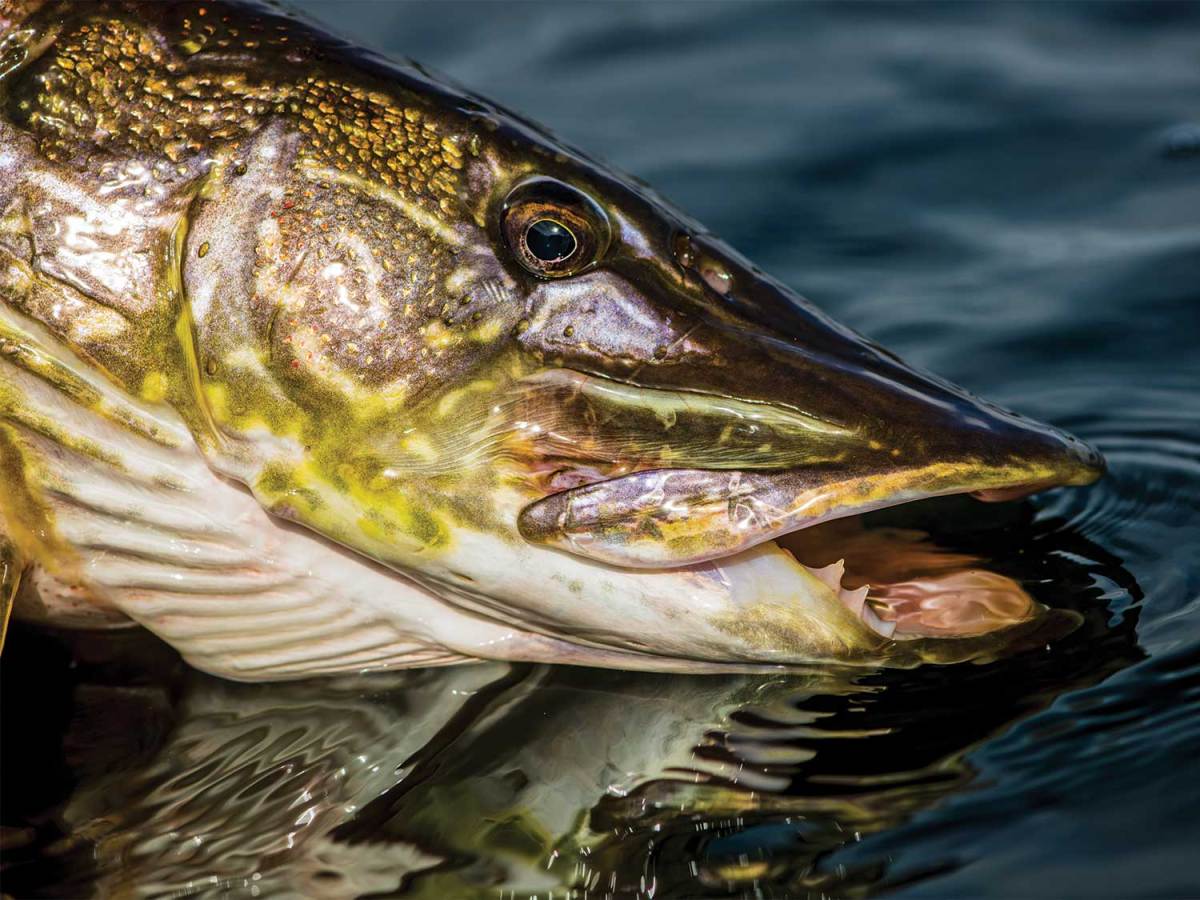
But it was northern pike that provided most of our sport. The lake was alive with them, and for two hours they gave us action of a kind we don’t often get in our part of the country. It was almost as good, in fact, as the fishing Maurice and I had on a remote, virgin lake 600 miles to the north, where pike literally fell over each other to get at our spoons.
Read Next: Why the Spoon Is Still One of the Greatest Lures of All Time
That was only one of many occasions when I’ve seen lakes not much bigger than my front yard pay dividends.
Two summers ago I spent a day with a fishing partner who has a mania for just one kind of fishing—black bass on a fly rod. Bob’s mania sort of narrows down the places where he can fish successfully, and also imposes certain limitations of weather and season.
This time circumstances and the surroundings were right. It was late June, the weather pleasantly warm, and the fish were still up along the weed beds and in the rush-bordered shoals. Conditions were ideal for fly fishing, and bass had been on the prod for a week.
We chose a fair-size lake that had done well by us on other trips, and we slid our auto-top boat into the water with confidence. This was a day for bass! But an hour later we confronted one of those baffling mysteries that all fishermen run into at times. The bass simply weren’t rising!
A couple of hours before noon, we pulled into a cove at the upper end of the lake. A small inlet ran in here, barely deep and wide enough to accommodate our boat. Fifty feet above the lake it was blocked by a farm-lane bridge. A hundred yards beyond the bridge lay a second lake, marsh-bordered, clear and deep, round as a coin, and less than a city block across.
I’d known that lake and fished near it for more than thirty years. Maybe half a dozen times when I was a kid I’d dragged an ancient, leaky skiff into it and taken a good catch of bluegills and perch. But the likelihood that it might have bigger fish in it never occurred to me, and I hadn’t wet a line in it in twenty years.
The idea occurred to me that it might be worth while to try this tiny, secluded, unfished pond with our fly rods. Maybe there were bass lurking along the narrow belt of reeds and lilies that fringed the shore. Maybe, by some miracle, they’d be in a co-operative mood.
The farmer who owned the lake and the land around it was cultivating corn in a field beyond the marsh. We ran our boat ashore, walked over, and got his permission to fish.
We slid the boat across the bridge, poled it the length of the weed-choked creek and out into a lake. It was so small that a good bait caster could have worked the entire shore from a boat anchored in the center.
But Bob took a twelve-inch bass on his second cast, with a hair frog twitched teasingly across a narrow alley in the lily pads. We made two circuits of the lake losing three bass and landing four, the biggest just over three pounds before we quit. Enough is enough; and besides, Bob wanted to give that midget lake another whirl someday.
There was also the time up north when, on a November deer hunt, I found a remote pothole lake that wouldn’t have covered three acres but that had pondweeds around the shore and looked to me like bluegill or bass water. Bert, my fire-warden friend, told me that so far as he knew nobody had ever fished it, so I talked him into carrying in a canoe the following July. We found the place alive with big bluegills as hungry as bees around a honey jar.
Little lakes are like that. Many of them deserve far more attention than they get.
Many are bordered with marsh in our part of the country, and have boggy shores with a belt of weeds around the edge. Water like that can’t be fished from the shore. And it’s rarely that you find a boat available on a really small, off-the-beaten-track lake. That means you must take your own craft with you. And because a fairly lengthy portage across fields or through swamp or marsh frequently is involved, the lighter the boat the better.
A canoe is the old stand-by for fishing hard-to-reach water, of course. And an auto-top boat can be just the ticket. But my personal preference is a rubber doughnut, roomy enough to accommodate two or three men comfortably, and carried inflated on top of the car.
My present rubber raft is a ten-foot war-surplus job that weighs only about thirty-five pounds and can be toted far more easily than a canoe. It has put me next to some of the most satisfactory fishing that’s ever come my way, and when it wears out I’ll replace it pronto, for it’s one boat I wouldn’t want to be without.
If you dislike portaging such a craft inflated, get an oversize pump and blow up your raft right at the lake. You can do it in three or four minutes.
There are certain pitfalls to avoid, of course, in choosing a Tom Thumb piece of water. To begin with, many small lakes are privately owned. If any doubt exists on that score, be sure to ask permission in advance!
As for the lake itself, follow the same rules you’d use in judging bigger water, but avoid ponds that are too weedy, too shallow, or too warm, and mud-bottomed, shoal lakes where the fish may have a muddy flavor or be grubby.
One trip is all it takes to discover whether such conditions exist, and whether the fishing is worthwhile. A little lake that looks good is worth testing. It may knock you for a loop!
This story was originally published in the September 1951 issue of Outdoor Life.
Read the full article here