
My wife and I had always wanted to hunt goats and we thought it would be a cinch after being lucky enough to draw two of the 150 permits from the more than 5,000 applications to hunt in Washington State’s first official goat season.
What we hadn’t figured on was the weather and more important still, our stupidity.
It was clear enough when we back-packed in and made camp at Round Lake above the timberline in the Glacier Peak area of the Cascade Mountains. But when we rolled out at dawn of opening day a storm was blowing in from the Olympics. Fog topped the higher peaks and the wind howled up the valley bringing in oceans of big clouds, ominous and black, along with it.
While we finished breakfast I remarked to my wife, “If we don’t get a goat today we’ll have to call it quits anyway. We’re not prepared to camp in the rain with no shelter, and there’s no use trying to hunt strange country in rain and fog.”
Evva set down her coffee cup and picked up her rifle. “Let’s get going then before we get blown clear to the Rockies.”
In the biting wind we crowned around the rim above the lake to what looked like good goat country. Pinnacles poked up everywhere and the slopes below us were sheer and bare. We crawled out on the wet slippery crest of rock. The wind whistled through the crags and right on through my wool shirt. We picked our way along with infinite care until a wall of rock loomed up out of the fog. There we had a little protection from the wind.
“Let’s climb up and look over,” Evva whispered through blue lips.
I took out the 7 x 50 binoculars and we quietly climbed up to where we could see over.
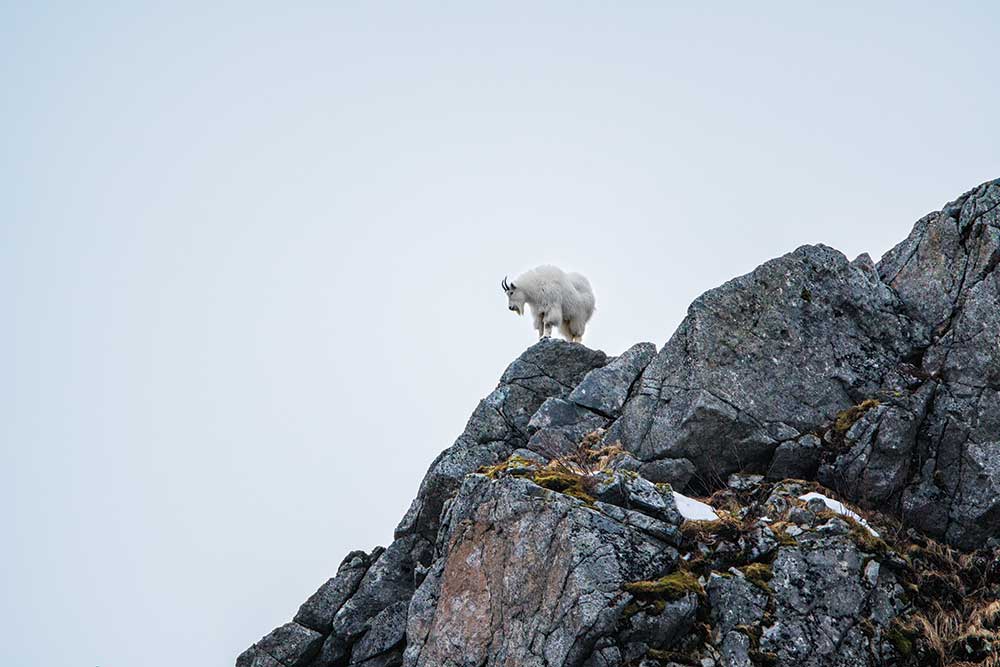
After looking for a few minutes Evva said, “There’s one, way down on that little point.”
I put the glasses on the goat and tried to get a good look at it between the hunks of fog blowing by.
“Can you see how big it is?” Evva whispered.
The goat, about 300 yards away, was standing looking out over the valley. “I don’t think he’s big enough for me,” I said, handing the glasses to Evva.
Not Proud But Curious
“I’m not proud,” she replied. “Besides, I want to see if the meat’s fit to eat.”
“If you want that one,” I told her, “I hope it’s not too big. We’ll be lucky if we can get down to it, much less bring it back up. Use my rifle.”
Evva grinned and took my .300 H. & H. Magnum. She likes to use it even though it nearly knocks her over every time she pulls the trigger. We were just hanging on the side of the rock, but she dug her toes in and rested the Magnum over her arm on the top of the cliff. When the rifle roared the goat’s feet went out from under him. After he lit he never moved again.
It took us an hour to get down to the goat. It was a small billy weighing around 100 pounds. After dressing it out, I saddled the carcass and we followed a ledge up to the top of the ridge.
Carrying both rifles, the clumsy binoculars, and her camera, Evva went ahead to pick the way. With the goat on my back I couldn’t see more than one step in front of me.
Follow the Leader
We had just started along the crest of the ridge when a vertical cliff blocked our way. We worked our way down around the base of it until we were only a stone’s throw from where we first spotted the goat. There a chute about ten feet wide fell vertically away from the top and provided about as much footing as a glass wall.
“Don’t think we can make it,” Evva said.
“Can we go up?” I asked.
“Not unless we can fly,” came her dry answer.
I looked the situation over. One slip and there would be no stopping until we hit the valley floor a good half mile below!
“We’ll have to make it, we can’t go back,” Evva said.
“Don’t slip,” I warned as she started out over the sheer rock.
“If I do, kiss your precious rifle good-by.”
My toes curled as I watched her trying to find someplace her feet could stick, but she was enjoying her favorite sport. I didn’t realize she was really scared until I saw her knees shaking. When she finally made it, she looked back briefly and yelled, “Brother, I wouldn’t be you for fifty bucks. I can’t look.”
About halfway across I caught a glimpse of her aiming the camera.
Rained Out
I made it, and once out on the slippery meadows it was easier going until it began to rain, and it rained buckets. We got into camp about dark, soaking wet, and looking forward to the warmth of our down sleeping bags. But our mountain tent leaked at all four corners, and (due to our stupidity) at both ends. By midnight we couldn’t have been wetter at the bottom of the lake. “Darn waterproof tents,” Evva groaned. “When the water gets in, it can’t get out.”
Before dawn we rolled out, built a fire, and tried to dry out some of our clothes. They got wet faster than we could dry them, so we gave it up. After hiring a packer from a camp over the hill to take the goat out, we headed for home and dry clothes.
The rain continued with no let-up until there were only two days of goat season left. Then the sky cleared, and we threw our packs together and drove the 170 miles back to Darrington, gateway to the Glacier Peak area of the Cascades. We still wanted to see some goats, and I still wanted to nail a set of horns on the garage wall!
After talking to Nels Bruseth, who works for the Forest Service at Darrington, we decided to go up the Bedal Creek Trail, where he assured us we would see goats.
We back-packed in late that afternoon to a camp about three and a half miles from the road.
“You make camp while I go up and look the high country over,” I told my wife. “Then I’ll know just which way I want to go in the morning.”
“Good deal.” Evva set her pack against a big white fir. “Better get going before it gets too dark. You’ve got to make tomorrow pay off.”
I hurriedly tore my pack apart to find the ammunition. Things were working out swell. We were up in goat country with plenty of time to make a good camp, look the country over, and get an early start in the morning. The sky was clear behind the frosted peaks that rose above the treetops on both sides of the valley.
“What the—” I said aloud. “I thought I had the full box.”
“If you can’t hit a goat in ten shots with that cannon you don’t deserve one,” Evva said sarcastically. Then she looked at me curiously and said, “That’s Mauser ammunition!”
The Wrong Box
The horrible fact dawned on me at about the same time and there was a heavy, sick feeling in my innards. The 8mm I was staring at on the end of each bullet just didn’t fit the .300 Magnum. I had picked up the wrong box of shells when we left home!
“You mean you haven’t got any shells for the .300?” Evva demanded.
“Not a one.”
“Aren’t there any loose in the pack?”
“No, I cleaned ’em all up when we dried out the pack boards.”
We looked at each other like two sick dogs. Finally Evva said, “Well, what’ll we do?”
“I’ll go home and take up tatting,” I said disgustedly. “I’ve heard of guys forgetting their licenses, shells, and even their guns. But I sure never thought I’d be one of ’em!”
Evva put her pack back on. “Let’s tear down out of here and see if we can get some shells in Darrington before the stores close.”
We tore down out, all right, but no one in Darrington had ever heard of .300 Magnum ammunition. We drove on to Arlington. No stores were open. We pushed our truck to its top speed of thirty-five miles an hour to Marysville. “We have .300 Savage,” they told us sweetly. As if that might do!
We got stubborn then, though we hadn’t eaten since noon and it was 8 o’clock, and drove on to Everett. One store was open and we traded the cursed Mauser shells for one big box of 220-grain .300 H. & H. Magnum.
“You’d better get a goat after all this,” my wife sighed. “I’m hungry.”
We bought a loaf of bread and ate it while we lumbered back over the seventy miles to the Bedal Creek camp ground. It was past midnight when we crawled into our sleeping bags laid out on the cold wet ground.
At dawn we climbed back up the Bedal Creek Trail. We had just come out of the timber five miles up when I saw three white patches moving slowly along under a cliff.
“Look, Evva,” I said, pointing up to the skyline of Bedal Peak. “Goats!”
“Well, maybe you’ll get one yet,” she said.
I took out the binoculars. “They’re a long way off, but they’ll probably bed down up there when the sun hits in good.”
“Well,” Evva remarked, “they’re at least a mile too far for even the Magnum, and it’ll take me half the day to climb up there. So let’s get going. If you kill a goat today I want to see it!”
“So you shall,” I promised elaborately.
I was already figuring how to get up there. We climbed on up to where the trail ended at an Indian’s trapping cabin at the foot of Sloan Peak.
Steep rugged country loomed up on three sides. On the peaks a coat of snow stuck like sugar on a doughnut. The early-morning sun tinted it all a glowing pink and below the crags bright huckleberry meadows sloped down to the dark-green alpine cedars.
A black bear and her cub were feeding on one meadow as we skirted up under the cliffs toward the only goats we had seen. Though we stopped to glass the sheer black crags of Sloan at intervals, we couldn’t see any sign of goats there. I was about half glad we didn’t because Bedal looked more navigable than Sloan. Rock cliffs were sandwiched in among the big meadows of mountain huckleberry.
When we got within about a mile of those rocky meadows we spotted a lone goat picking his way toward a high rocky pass.
“I’ll bet the others are there someplace and they’ll all go through that pass,” Evva said.
I looked the country over but still couldn’t see any sign of the other two goats. How anything as big and white as a goat can conceal himself so thoroughly in open country has always been a mystery to me.
Between us and the general vicinity of the goats was a hillside of alpine cedar. Creeks tumbled over the slopes, at intervals covering the bare rock with glare ice. It was slow, tough going.
It was past 11 o’clock when we wearily beat our way through a strip of brush and came out on the meadows of Bedal. With a patch of alpines for cover we worked uphill until we could see out across the meadows.
There, about 500 yards away, were not three—but four—goats.
We dug our heels into the hillside and sat down to watch them. All four were leisurely feeding along toward the gap on the skyline. I put my rifle on the big one in front. The gun wavered and shook all over the mountain. Our strenuous night was beginning to tell. I laid the gun across my knees.
“Still too far away?” Evva whispered.
“It wouldn’t be if I wasn’t so tired,” I told her.
Evva pointed down the slope to where Bedal Creek was just a thread in the valley. “The trail’s right down there. If you let your critter run three miles over the other side of this mountain before you down it we’re going to have a rough time tonight.”
The goats disappeared behind a little rocky ridge.
“Just run up to the top now. You can catch them before they get over to the other side,” Evva said.
I picked up the rifle, gave ambitious Evva the pack, and we started up the hill. But I was tired. Four hours’ sleep on cold wet ground isn’t good preparation for mountain climbing and we hadn’t had much to eat the last two days.
The meadow was very slick, and so steep it took both hands and feet to climb it. I tried to get to the top, but I was fagged. Then I realized what my trouble was. There was a gnawing in my belly—I was hungry!
I sat down on the meadow again. “I’m going to eat.”
Evva glanced up at the top of the ridge, less than 300 yards away, then she gave me that you’re-the-dumbest-knothead-in-seventeen-counties look. But she took off the pack and broke out the lunch.
After eating we started again and came out on top as silently as a coyote slinks along the ridges. Two inches of new snow still clung to the shaded valley on the other side, and after the bright sunlit meadows it was like sticking our heads into a barrel of flour.
We stood there on a little pass several minutes, looking down into the draw where the goats had to go if they crossed the divide.
Read Next: I Shot a Mountain Goat on an Epic Hunt in Alaska — Then It Rolled Off a Cliff
Disappearing Act
I checked my rifle, making sure everything was set. We poked on up the ridge toward the gap where the goats had been heading. If they hadn’t crossed over—and there wasn’t a track over the smooth white snow—they had to be on the other side.
There was a big round rock ahead, and I had to go around it. Evva was sneaking along about twenty feet behind me. As I stepped around the rock, I heard her low whistle. At the same time there was a whirring noise on the other side of the rock. A ball of white went sailing out into space and I heard Evva yell, “Do something! There’s goats all over the place!”
There was a smooth inclined rock ahead leading up to the crest again. I charged up to the top of it and looked over both sides of the valley. Not a goat in sight!
“Of all the luck,” I groaned as Evva joined me. “We spend half the day sneaking up on ’em and then scare ’em out at twenty feet.”
“They must have been bedded down here,” Evva said. “They went tearing around that rock like an avalanche!”
Both sides of the ridge were visible. A narrow canyon studded with rock spires broke the crest of the ridge ahead, but there wasn’t any real place for a goat to hide.
For about five minutes I searched the country and finally made out three sets of tracks going down through the snow.
When I glassed the area clear down below the snowline, the big white form of a goat came into view. Its bulky coat and big shoulders made it look enormous through the glasses, but it was almost impossible to see it with the naked eye.
A Long Shot Called For
I handed the binoculars to Evva and dropped to one knee. It was a long shot, but that was what the Magnum was for. I got into the sling and took careful aim. The goat was slowly feeding up the green meadow at least 450 yards down the hill.
When the rifle cracked I thought I saw the goat flinch.
“You’re shooting low,” Evva said. “That one went right between his feet.” I fired again.
“You’re still low,” Evva said.
Then I remembered I was shooting heavy 220-grain bullets, and the Magnum was sighted in for 180-grain cartridges. Also, the range was nearly twice the 250 yards I had the rifle sighted in for.
I was shaking by then, both from fatigue and, I must admit, goat fever. But I forced myself to take my time. The goat had only to make one big jump and it would be out of sight.
When the post of the scope was steady on the top of the goat’s front shoulder I squeezed the trigger. He went down and stayed down.
It wasn’t the big billy I’d dreamed of—it was a nanny weighing about 200 pounds. Nevertheless, I was well satisfied. She had nice shiny horns about nine inches long.
It was after 4 o’clock when we got the head, hide, and meat piled on the pack board and wearily started up the hill. We thought we had it made then, but as I said before we hadn’t figured on our stupidity.
At the top of the pass we stopped to rest and eat the remains of our lunch.
“We’ll never make it out by dark,” I remarked as the sun sank behind Old Foggy Peak. “Did you bring the flashlight?”
“Gosh, I forgot it!” Evva looked at her watch. It was after 5 p.m., and it gets dark in the timber at 6.
We took off, slipping and sliding down the meadows, running wherever we could. After we hit the timber we had easy going; then we had to buck devil’s-clubs and swamp. When we finally splashed through Bedal Creek and crawled up through the salmonberry brush to the trail it was nearly dark. We ran down the trail through the open stuff, and it wasn’t until we got to big timber that we realized what numskulls we were to forget a light.
There was no moon and the trail was a series of steep switchbacks below us. As soon as we hit them we started losing the trail and I’d have to strike a match to find it again. After the brief light it was maddening to try to walk in the dark. It was so black that several times Evva bumped into the white goat hide on my back. Our only foresight was in having waterproof matches. We were drenched from thrashing through the brush along the creek.
We stumbled on down the trail for what seemed like hours and each stop made it harder to force our tired legs to go on. I had a terrific load on my back to be holding up for what might be the better part of the night.
“We’ve got to do something better than this,” I growled after stumbling through the brush several minutes looking for the trail.
“They used to use pine knots for torches,” Evva said wearily. “But this isn’t pine country.”
I thought of the notebook in my pocket. I twisted several sheets of it together and handed the rest to Evva. “Tear off some of this and give it to me when these burn out.”
I lit the paper, held it above my head, and ran down the trail like the Statue of Liberty in full flight. When it scorched my fingers I flung it on the ground and lit another. Evva stomped out the embers and followed as best she could. Not exactly a Forest Service approved mode of travel at night, but the woods were so wet you couldn’t start a fire with a blowtorch.
By the time the notebook was gone we were over the steepest part of the trail with less than two miles to go.
“Got any more paper?” I asked.
“I’ve got a map I’ll gladly sacrifice,” Evva offered.
We tore the map into strips and began our torch-and-go system again. While we ran Evva twisted the paper and slipped it into my hand. About half the time she ran into me when I stopped to relight. We were doing fine when the matches gave out.
“Haven’t you got any more?” I asked.
She looked through her parka pockets and found one. I lit it and it went out. I felt through my own pockets. I found one. I lit a torch and we started out again. The map gave out and we used our fine topography map. As the last strip burned out we reached the graveled mountain road.
“We made it!” I yelled.
Evva breathed wearily, “Yes,” she said, “we made it and you got your goat. But I, for one, will never know how!”
This story was originally published in the August 1949 issue of Outdoor Life.
Read the full article here