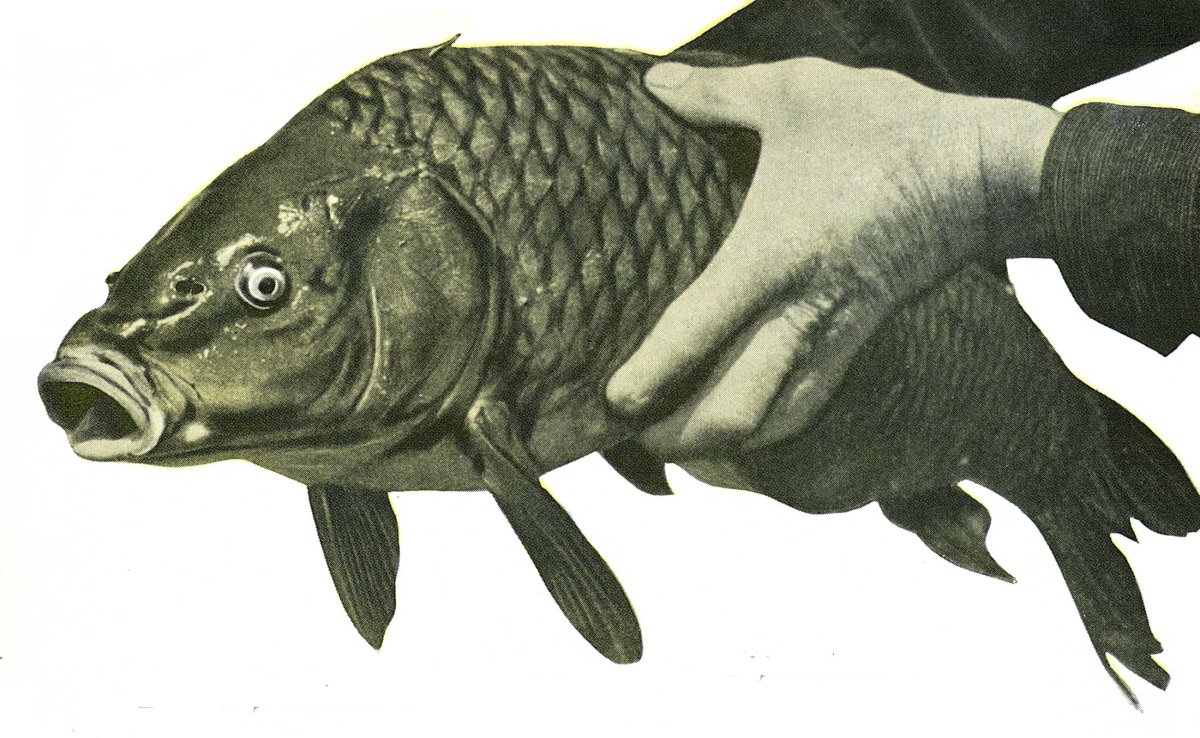

There have been a lot of arguments on the perennial question of whether, inch for inch and pound for pound, the smallmouth bass or the speckled trout is the gamer fish. Some have been pretty fair arguments, too, but they’re puny affairs alongside the ones I’m about to promote.
For sheer fighting ability, brawn, guts, and endurance I nominate a finny character you likely rate very inelegant indeed. He is big-scaled and unlovely. His color is that of the bottom where he dwells. His mug is as homely as a bulldog’s, his form is about as pretty as a sledge hammer, and his fighting style would discredit him in a barroom brawl. But if you want a battling fool in scales, a fish that never quits and doesn’t believe he’s licked even when you sink a gaff in him, I give you the hog of the weed beds, the roughneck of the river, the slant-headed immigrant that’s making good—old Joe Carp!
The trout is a daintier fish; the bass is more noble. But what we’re talking about is fighting heart, raw courage, willingness to slug it out, and ability to bore, buck, and flail at the end of a line. In these departments Ugly Joe can hold his own with the best of ’em. Pound for pound he’ll send either the speckled trout or the smallmouth bass home on a stretcher at the end of the second round! And because he’ll usually weigh at least three times as much as the bass and ten times as much as the trout, any day you set a hook in his jaw you can expect from three to ten times the fight you’d get from either of them.
I remember the first carp I landed on a fly rod. I was fishing for channel catfish with a stiff Calcutta rod on the Raccoon River below Jefferson, Iowa, when I rounded a bend and there was a stranger standing in the middle of the river below me. His outfit and manner of fishing immediately stirred my curiosity.
He was wearing waders and using a fly rod that looked less than five ounces. He was belt-deep in the steady current at the head of a drift, fishing downstream, and letting an eddy swing his bait in under a drowned cottonwood top. His technique and tackle didn’t look quite right for catfish. While I watched him he retrieved his hook, pinched on a dough ball, and paid out line as if he were fishing with dewworms for rainbow trout.
“How are they coming?” I asked.
“I’ve caught a couple of nice ones,” he replied.
“Channel cats?” I asked.
He shook his head. “Carp,” he said with a quiet grin.
I could hardly believe my ears. We were on as good a stretch of catfish water as I knew about in that part of Iowa. The fact that he should deliberately pass up good catfishing to fish for carp just didn’t make sense.
“This is a pretty good spot for catfish,” I remarked tentatively.
He nodded. “I know. But I prefer carp.”
When he saw the look on my face he chuckled softly. “Ever take ’em on a fly rod?”
“Nope.”
“Use a fly rod much?”
“Most of my life.”
“Then try mine for a minute,” he invited. “I’ve got a hunch there’s a school of carp down in that deep water below the drift.”
Bites Like Turtle, Kicks Like Mule
It was an offer too tempting to pass up. He put on a fresh dough ball and I stripped off line, letting the current roll the hook along the bottom.
“Carp don’t gobble it up like a catfish,” the stranger warned. “They take it slow and easy, just sucking it in. Feels like a turtle biting. If one grabs it, let him have it. Give him time. He’ll likely move off slowly until he gets the bait in far enough to feel the hook—”
That was as far as he got. The current rolled the dough ball into the deepest part of the hole. I felt a sudden, light tug and then a steady, gentle pull, altogether unlike the greedy, reckless strike of a hungry catfish. I stripped off more line and let the fish run a dozen feet. Something warned me I had waited long enough. I reared back on the butt of the rod and socked the hook home and through thirty yards of silk line a mule kicked me, hard!
I’ve caught bluegills, crappies, bass, trout, bullheads, and catfish, but I’ve never gone up against anything in fins more stubborn and bullheaded than that carp. I doubt if he ever came a foot off the bottom throughout the whole affair.
He started off with a rush. Snubbing him was like trying to hold a bull calf by the tail. I put all the strain on him I dared and he turned finally, only to go plowing off across the hole as if he owned the whole river. I didn’t have much line left on the reel when I stopped him that time, and I stumbled a few yards downstream until deep water halted me.
My hands were too full of fish for comfort, considering the tackle I was using. I’d have given five bucks just then for my own stiff Calcutta pole.
“He’s gonna smash me up!” I yelled in some alarm.
But the stranger only chuckled. “It’s worth getting a rod wrecked to have a ringside seat at a scrap like this!”
I don’t know how long the fight lasted, but it must have taken me at least thirty minutes to bring that carp to the net. He lunged, whipped, rolled, and sulked. It wasn’t any skill of mine that finally beat him. It was the steady relentless strain of the rod, giving him no rest, punishing him every second no matter how he turned or what he did.
The live steam gradually went out of him, but he never did really quit. He was still wallowing and staggering when I slipped the net under him and lifted his eight pounds from the river.
I handed the rod back to the stranger and sat down to catch my breath. “The next time I try carp fishing it’ll be with my own tackle,” I assured him. “If I’m gonna tame lions I don’t want to use another guy’s kitchen chair!”
That was my first carp on a fly rod. But it certainly wasn’t my last. I’ve been fishing Ugly Joe with light tackle ever since.
One day last summer I came off the Red Cedar with Walt Hargess. Walt had just fought a finish fight with a six-pound carp, landing it by the skin of his teeth after it had smashed the tip of his favorite fly rod, a piece of gear that had subdued some sizable smallmouths in its time. Walt sank down in the shade of a tree and wiped the little rivers of sweat off his neck. “There,” he pronounced solemnly, “is one fish that wears brass knuckles and hits you with everything he’s got.” Nobody has ever summed up Ugly Joe more accurately!
River Roughneck
If you’re looking for acrobatics or toe dancing you won’t care much for his style of doing battle. He’s not built for leaping and walking on his tail. He’s broad in the shoulders and heavy in the midriff. He fights the way a river roughneck should, down on the bottom, thrashing around and raising hell generally.
He knows the river and uses his knowledge to good advantage. If there’s a rocky hole under a dam or a snag handy he makes for it; a brushy drift and he goes under it. His ring strategy is much like that of a big catfish, and there’s nothing wrong with the kind of scrap an old channel cat dishes out.
The carp likes deep, slow, sheltered water. At night he moves up onto the sand bars to feed, but that doesn’t mean he waits till darkness to fill his belly. He’ll take any bait that pleases him whenever he’s in the mood, and he’s usually in the mood.
As for brains or instinctive caution, Ugly Joe does all right on that score, too. He’s more alert to danger than the channel cat, more aware of a fisherman’s presence. If you fish him from shore, don’t tramp up and down the bank. If you’re using a boat be quiet with the oars and anchor. If you’re wading, make no commotion you can avoid. He’s not as canny as a trout, but he’s plenty smart enough for his own safety.
Cover the point of your hook when you fish for him. Your sinker, if you use one, must be light. If Ugly Joe picks a morsel off the bottom and feels a chunk of lead dragging along, he’ll spit the whole shebang out before you can say holy cock robin! In water where a heavy sinker is needed, veteran fishermen like one with a hole in the center, threaded on the line. They tie a bit of match stick about a foot above the hook to keep the lead from sliding down too far. When a carp takes hold, the line runs free through the sinker and there’s no telltale weight to give the deal away.
As a bait thief Ugly Joe is without peer. He’s taken mostly on soft lures. He sucks the bait in sort of careful and makes a run with it. If you try to set the hook too soon, you’ll miss him. But if you’re a trifle tardy you’ll also miss him. Given a shade too much time, he’ll strip the bait off and get rid of the hook in very crafty fashion.
More than one experienced fisherman has found the carp unexpectedly hard to catch at first. Fishing for him successfully calls for patience, skill, and exactly the right amount of resistance to his slashing tactics.
To complicate things more, his mouth is soft, and the hook tears out easily. You can’t horse him home. A delaying action works better than a head-on attack when you’re fighting him on light tackle. But the length of time you have to battle him is a pretty good measure of the amount of fun you get out of landing him.
Last summer the Iowa State Conservation Commission undertook an informal survey to determine how highly the carp is esteemed by anglers and how fast his popularity is growing. The commission looks upon this snub-faced alien as a serious competitor of bass, crappies, wall-eyes, and other desirable native fish. And because carp reproduce at a terrific rate, it foresees the danger that in some lakes they may ultimately crowd out the better game species.
At the same time the commission recognizes that to an increasing number of fishermen, Ugly Joe is a mighty important guy. To determine his exact status the commission sent out questionnaires to forty-eight conservation officers throughout the state. The replies showed that in more than half of Iowa, carp fishing is today a major sport, and is still growing.
Of the forty-eight officers queried, twenty-three reported large numbers of fishermen who regularly go out for carp in preference to other fish. Eleven territories reported occasional addicts who turn to carp when catfish and other native fish are not biting, or who regularly take a carp or two as part of the day’s catch. Only fourteen officers, for the most part working territories where bass, wall-eyes, bullheads, and panfish provide abundant sport, rated carp fishing unimportant.
Read Next: How to Catch Carp: Tips and Tactics for Beginners
Growing Popularity
Several factors account for Ugly Joe’s growing popularity in Iowa. Chief among them are his fighting qualities, which outclass those of many more respected game fish. Also, there is some dissatisfaction with other fishing. And finally, there is the fact that, properly prepared, carp are a better table dish than many fishermen realize.
Most of Iowa’s carp fishing is done on the rivers, usually near large cities, because the fish are more plentiful there and because stream carp are tastier than those taken in currentless water.
Tackle varies widely. The angler who fishes more for the sport than the catch uses a fly rod and runs the constant risk of a smash-up if he connects with a really big fish. At the other extreme is the heavy cane pole with homemade reel seat and guides, saltwater reel, and 25-pound-test line—which is used by bridge fishermen. In between, and favored by many carp fans, is the light Calcutta pole, eight or nine feet long with reel and guides, which is also used for channel cats. It is handled like a fly rod, but has considerably more backbone and will take greater punishment.
There is one point on which all successful carp fishermen agree. The hook should be small and sharp. Although some anglers use cork floats, more do not, since a float tends to keep the bait off bottom and Ugly Joe won’t come up to get it.
As for bait, Ugly Joe is an omnivorous sort who will eat worms, bread, fresh and canned sweet corn, ripe mulberries—a killer at the right place and season—crawfish, raw potatoes, marshmallows, minnows, dough balls, peas, and popcorn.
The “high” baits, incidentally—such as sour clam meat, tainted poultry blood, chicken entrails, commercial stink baits, and ripe liver, used so successfully on channel cats—hold little appeal for carp.
Dough balls lead all other baits among Iowa carp fishermen, with worms and sweet corn tied for second place, according to the conservation commission’s survey. Many anglers report good success with worms in early spring, but switch to dough balls as soon as the water has a chance to warm up.
Each fisherman swears by his own private formula for making dough balls. The basic ingredients, however, are corn meal, water, and salt, with anything thrown in for flavor that the angler happens to fancy. Some use a mixture of corn meal and flour. Floyd Morley, Forest City conservation officer, offers this recipe: “Cook fresh corn meal, and add it to lightly salted boiling water until it is stiff. Then cook it slowly until a small piece will bounce when dropped on the floor.”
Another recipe calls for wallpaper cleaner flavored with vanilla, cinnamon, or nutmeg. Still another specifies equal parts of oatmeal, corn meal, and graham flour, which are worked up with milk rather than water and used uncooked, with nutmeg, cinnamon, or vanilla for flavoring—and possibly even a dash of red pepper. But don’t use cayenne!
Read Next: Can You Eat Carp?
Many carp hounds, however, make a simple dough ball of white, rye, or whole-wheat bread, which is moistened to the proper consistency, with a little sugar, salt, anise oil, oil of cinnamon, vanilla, or other flavoring added.
Whatever the dough ball consists of, it should not be offered in big chunks. Small hooks and small baits go hand in hand in successful carp fishing.
For eating purposes remember that carp taken in sluggish and warm water are not tasty, and that a three-pound carp is far better eating than a ten-pounder.
In dressing carp, by the way, it is very important to remove the so-called mud vein, the dark lateral streak that runs along each side of the fish from gill to tail. Some fishermen go a step farther and bleed the carp by cutting its throat as soon as it is caught.
Skin carp as you would catfish, fillet them, and soak the fillets overnight in salt water. Freshen and cook by your favorite recipe for other fish. Pickled carp has its followers, but if you want something really special try smoked carp.
When they brought Ugly Joe into this country from the fish ponds of Europe they did future fly fishermen in many sections of the United States a mighty good turn. Nobody suspected it then and a lot of folks don’t know it yet. But those who’ve taken him on light tackle know it—and how!
This story was originally published in the August 1949 issue of Outdoor Life.
Read the full article here