

This Legendary Sheep Hunter Once Chased Mouflon and Aoudad on a High-Fenced Texas Ranch. Here Are His Takeaways


I hadn’t seen my skeet-shooting pal for some days. “I missed you last Sunday,” he said. “Why weren’t you out for some skeet?”
“Oh, I wasn’t in town,” I told him. “I was hunting mountain sheep.”
“In February? What kind, for the love of Mike?”
“Sardinian mouflon.”
“Mouflon? Never heard of them!” Then my pal paused, eyeing me suspiciously. “Isn’t Sardinia an island in the Mediterranean Sea?”
“Yes, near Italy.”
“And you——”
“I got a mouflon. The guy I hunted with got a mouflon and an aoudad.” “He did? Sounds painful,” my skeet friend said nervously. “Er, ah, I’m supposed to meet a guy down the street. Do you mind if——”
But I followed him relentlessly. “The aoudad,” I assured him, “is a wild North African sheep, on the borderline between sheep and goats.”
“And leaps from mountaintop to mountaintop,” my pal remarked. “How did you cross the Atlantic —— by rocket ship or flying saucer?” And then he fled.
Well, my pal may have decided I’d slipped my moorings but I’d been speaking sober truth. I did shoot a mouflon. Herb Klein did shoot a mouflon and an aoudad. I didn’t have a chance to explain that instead of flying to Sardinia for the mouflon and charging around the hot, dry, lofty Atlas Mountains of North Africa for the aoudad, we had got the three exotic sheep in Texas.
This story really began when Herb Klein, who lives in Dallas, casually mentioned over the phone that he was going to hunt mouflon on a Texas ranch.
“Mouflon ?” I demanded, skeptically.
“Yes. This rancher has quite a few of them.”
“Could you ring me in on that?”
“Of course!”
So that was that.
To me it looked like a story as well as a minor adventure. The mouflon is the smallest of the world’s wild sheep, and is believed to be the principal ancestor of the various domesticated breeds. Wild mouflon are still found in the mountainous islands of Corsica, Sardinia. and Cyprus, and some larger cousins roam Iran and Asia Minor. In historic times mouflon were found in Greece and in the Balkans, and during the Ice Age as far west as the British Isles.
The little sheep have been introduced into the mountains of Bavaria and Hungary, where they’ve apparently done well. Right after the war an American officer stationed in Germany sent me pictures of two “small bighorn sheep” he had shot while hunting chamois. The German guide told him they were mouflon, he wrote, but were they? Despite the fact that they were misplaced they looked like mouflon to me, and the American Museum of Natural History confirmed my identification.
The mouflon has always seemed to me to offer many possibilities as a sporting animal. For one thing, he must be a fairly smart and wary little beast. On his Mediterranean islands he has, for thousands of years, survived hunting—by cave men with stone axes, by Greeks and Romans, by titled Britishers with high-velocity doubles and telescopic sights.
A couple of weeks after our phone conversation, Herb and I headed south out of Dallas for what Texans call the “deer country” or the “hill country.” It’s a rolling, rocky, area. Once it was oak and grass country. After a century of heavy grazing by cattle, the country was taken over by mesquite. Now the mesquite has been killed off with chemicals and the bare bones of the dead trees stand thick over rocky hillsides.
Cattle are still raised in this country around Kerrville and Llarió. So are domestic goats. One of the major crops, though, is deer. Over the years Texas sold all its public lands cheaply and now there are none left in the state— and no free hunting, either. The man who wants to kill his two legal whitetail deer each year has to pay for the privilege—and pay well. In the poorer game /country, I’m told, the casual hunter can buy, for $10 a day, the privilege of wandering around on the off chance of running into a buck. Those who are determined to find deer get together and annually lease the hunting rights of ranches at a cost of from $150 to $1,500, or even more, per hunter.
The poor man either stays home or poaches, running the risk of a heavy fine and a term in a jail cell. I think of all of these things when I hear my brother Idaho sportsmen, who can hunt thousands of square miles of free national forests full of deer and elk, protest bitterly when someone proposes to jump the license fee from $3 to $5.
I give all this background because deer and other game are a money-making crop in Texas. If they weren’t, there would be no mouflon, aoudads, or other exotics. In the Texas hill country, the more game on a ranch, the more the owner can charge for leases. If there are wild turkeys as well as deer, the lease is more valuable. And wild sheep or goats put still more money in the bank.
Herb and I spent the night at Llano and next morning went out to the Bar-O Ranch of Ark A. Moss, a tall Texan in his 60’s. He lives in the traditional rambling ranch house surrounded by corrals and shaded by cottonwoods.
Moss is the somewhat unusual type of man who’d rather make an interesting dollar than an easy one. He told us he had established mouflon on his place because the little wild sheep made his hunting leases more valuable, but I could see he was far more interested in observing and raising strange animals than in making money on them.
He started operating along those lines 20 years ago by buying Barbados sheep from zoos in San Antonio, Houston, and Dallas. The breed did not stand the cold well, so he crossed the Barbados with a Mexican sheep known as the “naked-belly.” He also got some Sardinian mouflon rams from a zoo and bred them to Barbados-naked-belly ewes. He has purchased other mouflon stock, and now he has a good many sheep that are 7/8 or 15/16 mouflon, and look precisely like the foreign animals. Moss also has stocked the blackbuck, a beautiful and frisky little antelope of the Indian plains, and the serow, an Asiatic short-horned goat which is a near relative of the North American white goat.
The Bar-O ranch is full of white-tail deer and has a few turkeys and quail. It is brushy country of small oaks and mesquites for the most part, but there are open grassy swales and fairly sizable grassy flats. All the country is rolling, and there are a few granite outcrops from 50 to 200 feet high—sort of knolls or knobs. Down in the Texas hill country they’re called mountains, and, true to instinct, Moss’s sheep rally around the little hills.
I wish I could say that hunting on the Bar-O ranch is tough, but it isn’t. Herb, Moss, and I drove out in an ancient short-coupled sedan which Moss retains because it can negotiate the narrow arroyos. Once we saw a serow; like its relative, the Rocky Mountain goat, it didn’t hurry but ambled across an open space on a rocky hill. Several times we saw blackbuck does and young. They are lively, beautiful little antelope, which at a distance look a good deal like the American pronghorn except that they are smaller and even more slender.
Moss told us that the blackbucks do well in the Texas hill country, where the climate apparently is much like that of the Indian plains from which they come. He also told us that there were many of them on a big ranch owned by Eddie Rickenbacker, president of Eastern Airlines, not far away. The Rickenbacker ranch has exotics on a big scale: European fallow deer; roe deer; Asiatic axis deer; and sambar, the big tropical stags from the jungles of southern Asia. Hunters pay so much for each animal. No trophy, no pay.
Moss’s ranch is fenced and crossfenced with barriers that even a mountain sheep cannot jump, and the Rickenbacker ranch is similarly girded.
“Somebody better get a rifle ready,” Moss suggested as we cruised around. “There are a couple of big blackbucks in there. They’d make nice trophies.” “I don’t want first chance,” I told him. “I’m more of a sheep man. Herb, you’d better take one if we see him!” “No, you take it.”
Herb and I were still doing the old you-first act when Moss stopped the car and said. “There’s the largest one.” About 125 yards away a big antelope stood looking at us. I could see then why the species is called blackbuck— the old bucks actually turn black. This one had long, spirally fluted horns and was as handsome a trophy as anyone would want.
Herb and I changed our minds in unison and went for our unloaded rifles. But as we did, that blackbuck took out for parts unknown. Apparently he hid out in the brush, for we could not find him. We saw one more buck that was old enough to have turned black, but his head was smaller and we let him go his way in peace. While we were looking over the blackbucks we saw probably 30 or 40 Texas white-tail deer. And believe me, the blackbucks were just as wild as the deer. They look like fine sporting animals to me.
We hadn’t really planned to knock over an aoudad—Moss had only three at the time—but this ram brought it on himself. Herb and I were out of the car searching for a blackbuck when we saw the aoudad pop up on a rocky knob around 175 yards away. Like wild sheep the world over, he gazed at us from the safety of his rocks.
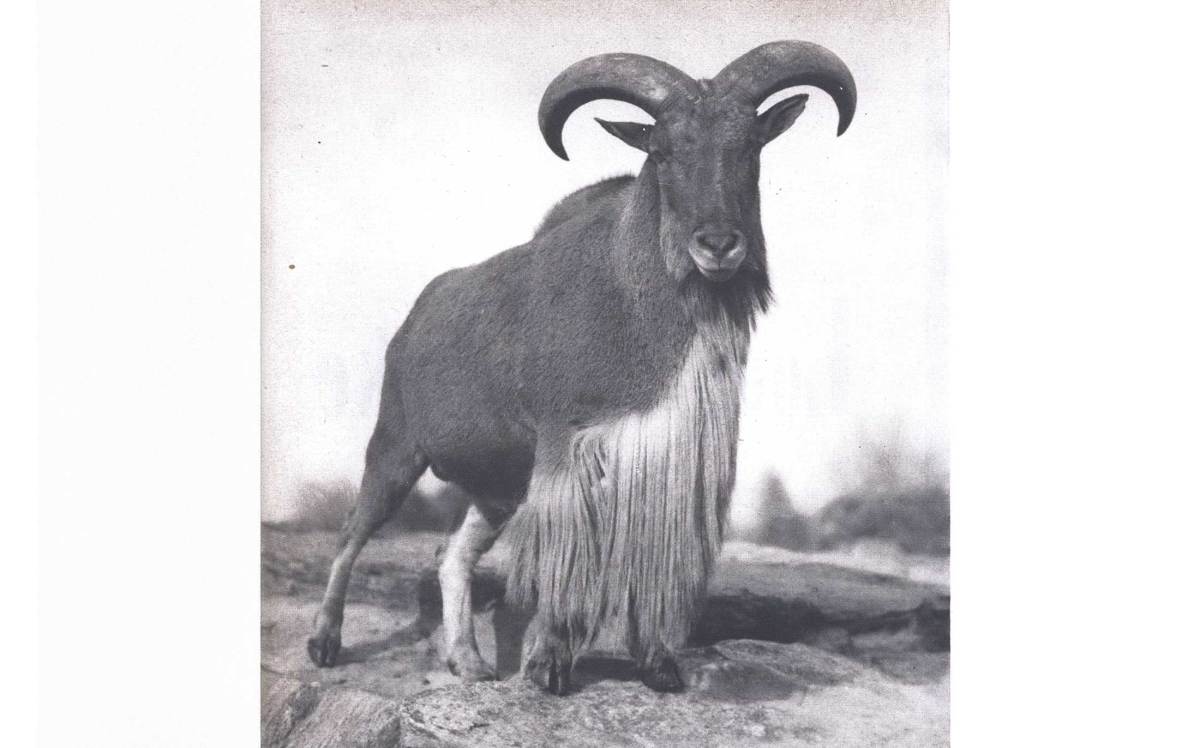
A curious-looking sheep, this fawn-colored aoudad—almost as much goat as sheep. He is much higher at the front quarter than at the rump. His horns are totally unlike those of the American wild sheep. He has a long mane on his neck and brisket— that’s where he gets his common name of “bearded Barbary sheep.” My only acquaintance with the aoudad had been in zoos, but this ram looked as large as any I had ever seen.
That got Herb’s blood up, and he sat down and squeezed off a shot. The ram whirled, rushed down off his rocky pinnacle, and went by us. Herb was about to shoot again when we saw a crimson patch behind the aoudad’s shoulder. Then it collapsed stone dead.
Herb’s 87-grain .257 bullet had entered between a lung and a shoulder blade, but at such an angle that it touched one lung.
The Aoudad is a chunky animal, bigger than the average desert bighorn ram, though smaller than some North American wild sheep.
Getting two mouflon proved no more difficult than knocking over the aoudad; both were one-shot kills. Herb’s ram ran about 50 feet after he was hit with a broadside shot high through his lungs. Mine was facing me as I fired, and he collapsed in his tracks.
I am having the head mounted. When I look at it, I won’t think of high rugged peaks, lofty pastures bright with tiny alpine flowers, and gray slide rock—as I do when I gaze at the North American ram heads in my trophy room. Nor will I remember long, exhausting climbs or exciting stalks. But the little fellow is a rare and interesting trophy and one that undoubtedly will astound the visiting firemen.
We didn’t weigh either ram. They were little fellows, true to type. I doubt that either would have dressed out at over 60 pounds, perhaps not much over 50.
Nevertheless, I think the mouflon has great possibilities in this country. Moss, in demonstrating that it will adapt itself to the American West, has done something which may prove important. The mouflon, and possibly the aoudad can be used to stock country that “never again can our native wild sheep come back to.”
The bighorn—at one time widely distributed over the West and still found in limited numbers in almost all Western states—simply can’t survive when it comes in contact with domestic sheep, or it cannot resist their diseases. For example, the great canyon of the Snake River in Idaho, Oregon, and Washington was once excellent wild-sheep country.
Read Next: Aoudad in West Texas: Is the “Poor Man’s Sheep Hunt” Really a Sheep Hunt?
Today there are no bighorns in the whole vast area. Nor can they ever come back, for most of the canyon is winter range for domestic sheep.
But the big canyon could be mouflon range. The little Mediterranean sheep (the “living ancestors” of domestic sheep) take in their stride diseases that kill the American wild sheep off like flies—foot rot, scabies, pneumonia, lungworm, etc.
As an emergency measure during World War II, the Canadian government permitted domestic sheep for the first time to graze in the Rocky Mountains of southern Alberta and British Columbia. In two years or so, 90 percent of the wild sheep in what was the greatest bighorn country of North America died off. The species is coming back, now that the domestic sheep have been removed. But it was a close call. The same thing happened in the United States during the 1870’s and ’80’s.
I don’t want exotics in areas where native species can survive, but where they can’t it would be well to import game that can survive. If it weren’t for the Chinese ringneck pheasant, tens of thousands of American sportsmen would never have a chance at a game bird.
The United States has thousands of square miles of wild-sheep country without sheep. Maybe the smart little mouflon is the answer. He has lived next door to civilized man as long as there have been civilized men. He has survived competition with domestic stock, unrestricted hunting, and deforestation. He can live in the open and he can live in brush. He is smart and wary and tough. For the areas where our native sheep cannot thrive he looks to me like something a whole lot better than nothing.
Read the full article here
