
The next step toward further integrating semiautonomous aircraft into the U.S. Air Force and building trust with human operators would be through simulations and training exercises, a former Air Force secretary said.
Frank Kendall, the Air Force’s 26th secretary who served under former President Joe Biden, said in a Thursday roundtable hosted by Mitchell Institute for Aerospace Studies that gathering experience in the field and through simulations help operators establish trust with autonomous systems, like the Collaborative Combat Aircraft.
“You have to accumulate a basis for trust over time, and so I think we just need to think carefully about how we structure things in order to make that opportunity,” Kendall said during the roundtable.
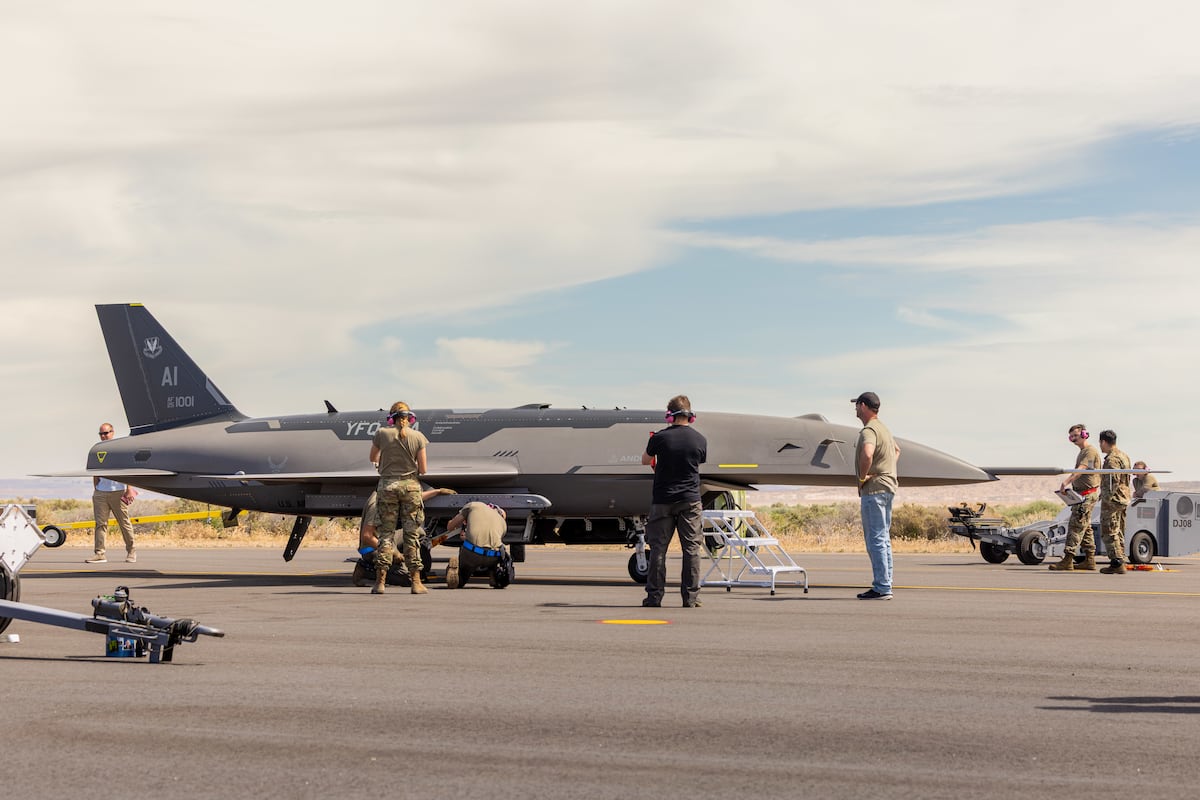
Earlier this week, the Air Force announced that it conducted the first-ever live-fire test of an inert AIM-120 from an Anduril-made YFQ-44A. The CCA recently completed an end-to-end, beyond-line-of-sight strike against a simulated target, the service announced, but did not specify when the exercise occurred.
The Air Force is scheduled to continue live-fire testing with General Atomics’ YFQ-42A this fall.
Kendall said that using the aircraft in Red Flag, the service’s leading large-force aerial combat training simulation held at Nellis Air Force Base, Nevada, will be “fascinating,” but he worries about the force using initial setbacks as an excuse to “retreat” instead of pushing ahead.
The former secretary was optimistic that institutional support will be enough to overcome those setbacks, saying that enthusiastic operators want to see the aircraft’s full potential realized.
Kendall recalled when he once asked an Air Combat Command crew who were developing CCA tactics why there wasn’t more resistance.
“[A young fighter pilot’s] answer was, ‘Sir, these things are going to save our lives.’” Kendall recalled.
The simulations define the exercises, he added, saying that it showcases how the aircraft protects crew fighters effectively right now even as the force needs to develop more sophisticated tactics.
“The guys with the CCAs are beating the crap out of the guys without them, and not losing any manned fighters,” he said.
RELATED
Kendall said that computerized, man-in-the-loop simulations are the best tool to assist operators in learning how to use the aircraft effectively since more trials can be completed. Integrated simulations have been used by the Air Force for roughly 30 years.
“In simulators with cockpits their sensors are showing them simulated threats as well as their friends, and then they basically fight a battle together,” he explained.
Kendall referred to a time when he took a flight in an F-16 modified by artificial intelligence. In flight, the aircraft’s testers would collect data points, he said, and run a million simulations to adjust the software overnight to complete the flight again the following day.
The first increment CCA aircraft in the program are “all the same” as weapons carriers, but in Increment II, Kendall stipulates that the force can begin equipping them with sensors and possibly distributed electronic warfare capabilities.
China is working on this autonomous system capability as well, he added, stating that air battles could soon be CCA versus CCA. Intelligence is going to play a significant role in how well the U.S. understands their systems, tactics and vulnerabilities, he said, noting that it’s a “hard game” to play.
In Increment I, the Air Force showed interest in obtaining 100 to 150 aircraft, the first phase of a longer-term goal of eventually fielding 1,000 CCAs.
Cristina Stassis is a reporter covering stories surrounding the defense industry, national security, military/veteran affairs and more. She previously worked as an editorial fellow for Defense News in 2024 where she assisted the newsroom in breaking news across Sightline Media Group.
Read the full article here