
This story, “Where Vultures Wait,” appeared in the August 1952 issue of Outdoor Life.
Vultures bunched together mean a kill, in the wild Mato Grosso country of southwestern Brazil.
There were close to 200 of them this time, an incredible flock of ugly, naked-headed ghouls perched in three trees at the edge of a strip of jungle, where the vines and thick stuff gave way to tall grass. That meant just one thing: A jaguar must have pulled down one of the wild cattle there and was still feeding, or lying up not far away. The vultures were waiting their turn. The dogs would get a workout now — and so would we!
Our Indian-Portuguese guide, Julio, was riding ahead. Sasha Siemel came next, and Charlie Boys and I brought up the rear. We pushed into where the high grass was beaten down and found more than we expected. Two wild cows lay there, their faces half eaten away.
“Two kills,” Siemel said. “That will mean two jaguars. They are hunting together.”
Then, at the edge of the jungle thirty yards off, the big redbone hound Lop-ears let go a long, wailing announcement, and I felt my hackles rise. The show was on.
There were two top-notch strike and trail dogs in Siemel’s pack, Lop-ears and a smaller black-and-white hound, Diablo. Diablo chimed in before Lop-ears’ first rolling bawl had died away. And then the whole pack opened hot, and El Tigre was running like any lesser cat, with eight dogs singing a savage and eager trail song at his heels. We whirled the horses and raced after them.
For the first few hundred yards the cat stayed out in the open, going like a streak, hidden by the tall grass. Then his wind began to give out and the dogs closed in until they were running all but a sight chase. When hounds start breathing down his neck the jaguar seeks the thickest cover he can find. This one picked a wide belt of brush, palms, and tangled vines that the horses couldn’t penetrate. And so the race got away from us. We jogged along in the saddle, keeping as close to the dogs as we could.
Far back in the jungle, an hour later, the steady baying broke and dissolved into a frenzied yammering, and we knew the big cat was treed.
We tied our horses and pushed into the tangled green wall, with Julio swinging his machete to open up enough of a path to let us through. We found the dogs in a place so thick that we could see only two or three paces in any direction. They were spread out in a circle under a tree, staring steadily up into its branches, chopping, taunting their ancient enemy.
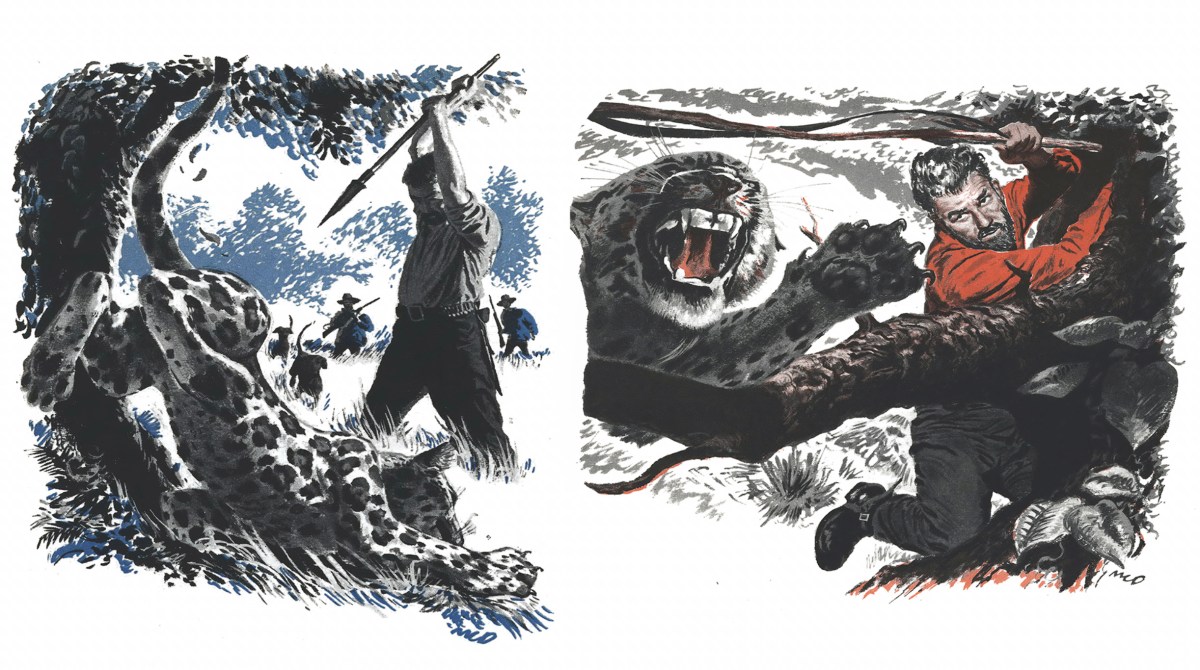
Siemel carried no gun save a Smith & Wesson .357 Magnum sidearm holstered at his belt. He was armed with his customary jaguar weapon, a long, heavy-hafted spear that has made him famous as the “Tiger Man.” He lifted it suddenly to point silently upward, and I made out — among the branches — a buff-yellow patch blotched with rings of black. I moved a couple of steps to get clear of the foliage and there was the jaguar in full view, stretched out along a heavy limb.
For a second or two my breath stuck in my throat. We were out after the king of American cats, the biggest feline in the western hemisphere, but I hadn’t expected anything like this!
El Tigre lay about thirty feet above my head, eyes blazing with green hate. He was flattened at full length, his dangling tail twitching in the angry, nervous fashion displayed by cats at bay — and there was just about twice as much of him as I had anticipated.
His lithe, muscular body was almost as long as a man’s. I guessed his weight at close to 300 pounds, and found later I was right. I had expected an animal not much bigger than a mountain lion, and here was a match for an African lioness or an Indian tiger, bigger than a leopard. And every inch of him — from his snarling, malignant muzzle down to his black-tipped, twitching tail — looked mean.
We had agreed that the first shot of the trip should go to Charlie Boys, since he expected to leave for home a week or two ahead of me, making his chances that much slimmer. Nevertheless, I made my little study of the jaguar over the sights of the Savage .22 Hi-Power rifle, I felt better with its gold bead centered on the vicious-looking head.
I heard Siemel whisper a final warning to Boys. “Remember, the head!” he said emphatically. “A wounded tigre can kill the whole pack.”
The report of Charlie’s .30/30 Winchester was a thundering sound in the thick jungle. The 170-grain soft-point bullet knocked the giant cat backward from his perch and he plummeted down, turning end for end.
I expected to see hell break loose when he hit the ground, but I wasn’t prepared for what happened. The dogs moved in but Siemel was ahead of them. He lunged as the cat landed and drove his heavy spear down with all his weight behind it. He had the long blade through the jaguar, nailing him to the ground, and was leaning on it to keep it there, all in one smooth, swift motion.
“It doesn’t do to wait,” Siemel explained quietly. “One swipe of a paw guts a dog.”
We dragged the jaguar out to an open place for pictures, and got his pelt off. There was no use trying to pick up the trail of the second cat. It was past noon, and unbearably hot and dry for the dogs, and anyway, they were played out. We were almost as tired, and we felt no great disappointment at passing up another hunt.
“We’ll strike him in the morning, before the dew is gone,” Siemel told us.
Our Mato Grosso hunt was off to a lively start. We’d been out four days, and had between three and four weeks left. If our luck continued to hold up we’d see plenty of excitement.
The trip had been months in the planning stage. Charlie Boys is a surgeon in my home city of Kalamazoo, Mich. We have been hunting partners for close to thirty years. The previous fall, at a medical meeting in Seattle, Wash., Charlie had run into another doctor, fresh from a jaguar hunt in Brazil. His story touched off a bad case of big-cat fever in Boys and he came home and passed the malady along to me.
Jaguars sounded different. Doc and I like dog music, and the idea of hunting the big cat appealed to both of us. According to what we’d read of El Tigre and his ways, there’d be an element of danger to give the hunt spice, too. We found that sportsmen who’ve taken the big spotted cat of the South American jungles don’t rate him a pushover, and hunters and naturalists alike speak of his open contempt for humans. There were reports that he sometimes became a deliberate man-eater as daring and crafty as any Indian tiger.
All in all, it didn’t take Boys and me long to come to a decision. The Mato Grosso country, we agreed, was for us.
We picked Sasha Siemel to outfit and handle us, since he knew as much about jaguars and jaguar hunting as any white man living. Having made the necessary arrangements, we sailed from New York for Rio early in April.
Good jaguar country, we were to discover, is remote and hard to reach — and downright hostile when you get there. From Rio we crawled westward across the empty reaches of southern Brazil for five days on a rattletrap train behind a puffing, wood-burning locomotive of antique design. We got off at the little station of Miranda, in the flat, swampy cattle country of southwestern Brazil, and traveled twenty miles by car to a big ranch that sprawls over 1,500 square miles, Siemel used it as a base for his hunting operations. There he kept his dogs, obtained saddle horses, hired his native help, and got other needed services.
The trip from the ranch to our camp in the Mato Grosso jungles was a journey into another world and time. It was early May, midautumn down there below the equator, a season when, to judge by our experience, there is little rain. We rode out of the pole corrals in the early morning, Siemel, Boys, myself, and our two guides, Julio and Miguel. Our gear and camp supplies had been loaded onto creaking, two-wheeled oxcarts that were like no other vehicles I’ve ever seen.
The carts were designed for use on the swampy plains along the headwaters of the Paraguay River, and had wheels seven or eight feet high to provide clearance above the water of the flooded marshes. Three pairs of heavy-horned oxen pulled each cart, with an Indian-Portuguese driver in charge.
We traveled two days, covering forty miles, through marsh and slough and water all the way. While the horses never had to swim, the water frequently came up on our saddles.
Camp, when we finally reached it, proved to be a group of open-sided, palm-thatched huts on a timbered rise of dry ground above a sluggish bayou. In the Mato Grosso even the ordinary small comforts of a hunting trip are hard to achieve, and anything resembling luxury is unknown. The marsh was alive with snakes, many of them venomous, and there was never an hour when we could relax our vigilance. Piranhas, the dreaded, blood-hungry fish of South American rivers, swarmed in the bayou in front of camp. We risked no swimming; to enter the water was to invite a boiling, frothing attack by thousands of them. Bathing was a cautious chore, done from a small pole pier built out over the water.
We endured heat and thirst day after day without let-up. And the insect pests were the worst of all. I thought I’d seen hungry mosquitoes in the far north, but no arctic mosquito rates with those of the Brazilian jungles. We slept on cots, under cheesecloth canopies, and I still wince when I remember the droning hum of the insect cloud around my canopy all night long. And the ticks! There is even a type down there, the vilest of the lot, that burrows under a toenail and has to be dug out with an awl.
But if we had it tough, the horses and dogs had it tougher. We had sixteen saddle animals that we used in relays. Every morning we’d find them blanketed so solidly with mosquitoes we could hardly distinguish their color. And night after night big blood-sucking vampire bats attacked them, biting deep holes in their withers. Blood would still be trickling from these wounds when we saddled and rode away at first light.
The dogs fared little better, and we ran them in relays after the first few days. There were eight in the pack — some hounds, some mixed breeds to carry the fight to the jaguar once he was at bay — but they were never all in shape to hunt at the same time. The hot, dry weather kept their feet perpetually sore and the saw-edged marsh grass cut their legs mercilessly. More than one morning we had to lead them a mile or so out of camp on leash to get them started.
We were restricted to rifles as light as the .22 Hi-Power and the .30/30 on a hunt for dangerous game because Brazilian regulations prevented us from landing our own rifles. Siemel supplied what he had available, and Boys and I each carried a .357 Magnum sidearm for use in an emergency.
The day after we killed the first tigre we were in the saddle at dawn, and on our way back to the place where the two wild cattle had been killed. (The first hour or two of a morning, before the heavy dew left the ground, gave the dogs their best chance of picking up a track. We found it was useless to hunt later than noon.) The second jaguar had come back and fed on the carcasses during the night, lying up for the day only a short distance away. The dogs put him up from his bed in the thick grass and for half an hour there was a chase to make a hound man’s eyes shine.
We wore wide-brimmed felt hats to protect our faces and ears from the thorn-covered brush, but they weren’t much good that morning. We rode at breakneck speed, shielding our faces with our free arms, pulling up now and then to give Julio or Miguel a chance to slash through a particularly dense spot.
We did our best but we couldn’t keep the dogs within hearing. Their voices grew fainter and fainter, and then silent. It lacked only a couple of hours until noon when we picked up their far-off baying again. They were moving slowly and we realized that they and the tigre were about played out. Whatever was going to happen would not be delayed much longer.
“This one will come to bay on the ground,” Siemel predicted. “I’ll show you, then, how to kill with the spear.”
But tired as El Tigre was, he preferred climbing to facing the dogs in a tangled thicket. He went up on a vine-grown tree in an area of very dark, dense jungle where we had to hack our way yard by yard. It was my shot and I pushed ahead with Julio until we broke into a little opening thirty yards from the tree. There I had a clear view of the jaguar. I took my time and drove the bullet into him in the approved spot, about an inch below the ear. (A shot between the eyes would be equally effective, of course, but might damage the pelt.) My seventy-grain soft-nose mushroomed in his brain and he toppled from the fork, limp as a sack of meal. The dogs were on him the instant he hit the ground, growling and worrying, and Siemel went smashing headlong through the vines and palms. I saw the long, keen blade of his spear sink up to the guard between the jaguar’s ribs and realized Siemel was making sure.
My kill was a big male, almost a dead ringer for the one Boys had taken the day before. They both measured between seven and eight feet long.
We had four or five quiet days after that. Twice we found cattle that jaguars had killed and fed on, again being guided to each spot by circling vultures. The ranch where Siemel made his headquarters had 80,000 head of cattle, all of Brahma blood. Brahmas are preferred down there because they are relatively immune to ticks, but they also have the bad habit of going wild, hiding in the thickets by day and coming out to feed at night. They get to be as wary and elusive as buffaloes, and to a man on foot the bulls are as dangerous as any animal in Brazil.
This wild stock was scattered over the country by the hundreds, and the jaguars preyed on it relentlessly. It was to two such kills that the vultures now led us, but neither was fresh, and conditions were so bad the hounds couldn’t strike a track.
When we finally succeeded in making contact our third jaguar came easy. But she also led us into one of the most exciting mix-ups of the whole hunt.
Riding out to a vulture-riddled kill one morning at sunrise, the dogs opened on a cold track, the first we’d heard them run since the hunt started. It was hours old and they made slow work of it. We pulled up under a tree to give them a chance to puzzle it out.
A pair of blue macaws were yelling their heads off in the top of the tree, and I moved my horse back a few steps to get a look at them. My eyes traveled slowly up the trunk and into the leafy branches — and all of a sudden they almost popped out of my head. I was looking straight into the face of a jaguar, stretched flat on a branch forty feet up!
Here was a tigre skin that would be easy to take. No hard ride, no clawing and cutting through a barricade of jungle. All that was needed was one well-placed rifle shot. But it wouldn’t be fair to the dogs to drop the cat before they got there, assuming this was the one they were trailing, so we sat quiet and waited — the jaguar staring down at us with baleful yellow-green eyes and snarling soundlessly — while the hounds worked out the cold trail and brought it back to the tree. The tigre had climbed sometime before daybreak, intending to spend the day aloft, and we’d stopped under his tree entirely by accident.
Once the dogs were aware the quarry was up, we didn’t wait any longer. Siemel made ready with his spear and Boys wrote off the jaguar in very neat fashion with a 170-grain soft-point. The cat turned out to be an old female.
We were about finished skinning her when the loud, clear voice of Diablo rolled over the marsh, and on the heels of his first bawling note the whole pack opened.
“Cub,” Siemel predicted. “This old one was his mother. He hunted last night with her and when we killed her he waited to see what was happening. Now he will find out.”
Cub or not, the jaguar showed endurance. He stayed in open, grassy country and the dogs drove him hard for three miles. Then his wind failed and he turned into thick stuff and went abruptly up a tree. When we got to him we found that Siemel’s forecast had been correct. He was a small tigre, weighing about seventy pounds.
I had been hoping to take a young jaguar home alive, and this was my chance. We had no rope with us, but we untied the reins of our horses and looped them together.
The cat was on a low branch of the vine-tangled tree. Siemel grasped a stout vine and climbed to a point six feet from the jaguar. Then, draping a loop of strap on a stick, he reached out and attempted to work it over the cat’s head.
But the tigre wasn’t having any. Seventy pounds isn’t much as jaguars go, but it’s bigger than it sounds. This one spit and snarled and clawed the noose away as often as it came within reach. Siemel hung on with one hand and kept at it, and at last he placed the loop.
Julio and I were waiting below with heavy, forked sticks and Charlie was standing back a few steps with his rifle ready, just in case. I had one end of the knotted strap in my hand and the instant the loop went over the cat’s ears I yanked. But the leather was not very flexible, and a jaguar’s head is only a little larger than his neck. The noose slipped free.
On the second try the strap parted at a knot. But Siemel kept at it and when the loop went over the cat’s head the third time I jerked it tight. The jaguar came down then, falling like a stone. He hit the ground between us and we were on him with our forked sticks before he could gather his feet under him. The cat never had a chance.
We got our sticks over his body and neck and held him down, and Siemel moved in to tie his feet with rawhide thongs. It was like trying to tie up a buzz saw, but he lassoed one foot at a time and finally managed to truss front and hind legs together. Then we ran a pole between them and shouldered the jaguar for the walk to the horses. He was covered with black ants by that time and so were we, and the black ants of Brazil bite hard!
The trip back to camp turned out to be a comic aftermath. We made a crude sack by lacing up a leather saddle pad, and spent half an hour vainly trying to stuff the growling, spitting cat into it headfirst. Then we tried it the other way round, and managed to back him into the sack. Finally we put him up on Julio’s horse, forward of the saddle, and to my surprise the horse didn’t object.
But Julio did. Before we’d ridden half a mile the cat worked his head free and snapped at the guide’s leg. He failed to connect but Julio demanded further precautions. So we laced the tigre in the bag like a mummy, head and all, and got him to camp without mishap.
There we reinforced a wooden box with hardwood poles and made a cage for our captive. He ate readily, but stayed sullen, wild, and mean, snarling at everything that moved within his sight. To make a long story short, I found it would be utterly impracticable to transport the tigre from the Mato Grosso to Michigan, so he wound up in a Brazilian zoo.
We had taken four cats now in a little less than two weeks. Boys had given up his plan of an early departure, so we decided to spend the rest of May in the tigre camp and go back to New York together. We took our fifth jaguar two days later, a medium-size female. The dogs picked up her fresh track at sunrise and treed her at the end of a mile of hard running. It was an easy kill and Siemel was disappointed when she climbed. He was growing more and more impatient to bring a tigre to bay on the ground and show us a kill with the spear.
Next morning we suffered a stroke of very bad fortune. The great marsh crawled with alligators wherever there was water enough for them. They ranged up to ten feet in length — long-snouted, ugly brutes — and Siemel and the Brazilians regarded them as predators of the worst kind. We had been polishing them off with the .357 Magnums whenever we got the chance. Now they paid us back.
The dogs, ranging ahead, were scouting the borders of a big wet slough when we heard a sudden howl of agony and terror from Lop-ears, the red hound that we counted the best of the pack. Julio spat out an angry oath and he and Siemel yanked their horses around and raced for the dog. Boys and I pounded after them, but we were all too late.
Read Next: I Hunted Down the Gator That Killed My Bird Dog — and More Alligator Tales from the South
A gator, lying submerged at the edge of a deep pool, had grabbed the dog by a leg and backed into his hole under the bank. When we came up Lop-ears was being pulled down an inch at a time, and his agonized cries weren’t pretty to listen to.
There was no way to get at the gator and just one thing to do for the hound. Julio did it, promptly and humanely, with his sidearm. But we were a pretty downcast hunting party when we rode on.
It was almost a week after that when circling vultures guided us to a kill one morning before the dew had dried from the grass. The dogs opened hot, bawling insanely at the edge of a big thicket. Diablo now led the pack, baying at every step, and ten minutes after they put the cat up from his bed they drove him into a patch of dense green jungle and brought him to bay. And we knew instantly from their uproar that at last we had cornered a jaguar on the ground.
Siemel was grinning contentedly as we tied the horses at the edge of the thick stuff. Julio and Miguel pulled their machetes from the sheaths strapped at their backs, slashed a path through the vines, and we moved in toward the dogs. The cat had backed into a place so thick he could come out again only in our direction.
Siemel, his spear ready, took the lead. Boys and I walked at his heels, and I had the safety off on my rifle. Odds are that a jaguar at bay in such a place will break out through the ring of dogs in a reckless, slashing charge the instant the hunters come within his reach.
Of the cats he has taken Siemel has killed a fair share by catching them on his spear in midleap. And that sort of thing calls for perfect judgment as to how far the jaguar’s leap will carry, plus exact timing and iron nerve, and it’s not the sort of hobby I’d care to take up myself.
We were within four or five steps of this cat, expecting each second that he’d come hurtling out of the green-black screen of jungle, where he still lay concealed. We could hear him growling and spitting furiously, almost in our faces, and the snarling dogs were all around us as they darted in to nip and worry him and then dodged clear again. And although we could not make out the jaguar in the tangled cover, Siemel edged in closer and closer, with his spear leveled.
Then the tigre took shape among the shadows under the vines, and we saw why he had not charged, and would not be likely to. He was a half-grown youngster, weighing between 100 and 120 pounds.
We decided to tie him up and take him back to camp alive, to keep the seventy-pound cub company. Easier said than done!
He had just put his horse under a big spreading tree when, without warning, a black-and-buff shape launched itself from a branch not ten feet above his head, as sudden and silent as a shadow.
Julio brought a coil of rope from the horses and Siemel laid aside his spear for a stout club. He has no fear of a jaguar, regardless of size or weight, and he waded into this youngster hammer and tongs, prodding and jabbing it, and waiting for a chance to pin it down. The cat bit and clawed and twisted free time after time, and then — when it seemed about ready to spring headlong at its tormentor — the fight suddenly ended. Spots rolled over on one side, kicked a couple of times, and was dead. Siemel must have unintentionally landed a solid blow with his club, but the action was so fast and the cover so thick we didn’t see it, and none of us, not even Siemel, knew just how it happened.
We had only two days left in camp when we took our seventh and last tigre. The day was hot and parched and the dogs too sore-footed to work once the dew was gone. We gave up hunting in midmorning, shot a couple of macaws for the collection of bird skins Boys and I were taking home to the University of Michigan, and headed for camp.
We were riding in single file, with Julio in the lead. He had just put his horse under a big spreading tree when, without warning, a black-and-buff shape launched itself from a branch not ten feet above his head, as sudden and silent as a shadow!
The jaguar was not attacking. It had been lying there on the low branch, dozing the daytime hours away, and when Julio rode in beneath it he had startled it into jumping. All it wanted to do was get out of there fast, but for a second or two neither Julio nor his horse realized that. Two hundred pounds of tigre sailing over your shoulder with legs outspread like a giant flying squirrel can be pretty upsetting, and Julio was upset.
The dogs, trotting dejectedly beside our horses, saw the jaguar leave his branch and they forgot all about sore feet and grass-lacerated legs. The cat had no chance for a long run. He streaked for the nearest thicket but they drove him up again in less than 500 yards. Charlie put a dose of tigre medicine into him where it would do the most good and he came hurtling down.
The dogs and Siemel jumped him together as he hit the ground, but there was nothing left for them to do.
That ended our jaguar trip. It had been a good hunt, in many ways one of the best I ever had. But when we loaded our gear on the oxcarts two mornings later and rode away from camp it was without any regrets. We’d had our fill of the discomforts and hardships of the jungle, of mosquitoes and ticks and ants, of thirst and blazing heat, of snakes and alligators, of the flooded, steaming marsh itself.
Of the trophy game I have hunted El Tigre falls far short of being my favorite. But I’ll say one thing for the big spotted cat down there in the forbidding Brazilian swamps. Any sportsman who takes his pelt damned well earns it! Tigre skins don’t come easy, at least not in the Mato Grosso.
My First Jaguar
by Sasha Siemel, as told to Burt M. McConnell
The first jaguar I ever tackled with a spear, thirty-odd years ago, was in a very ugly mood. He was in search of a mate, and his low, deep rumbling cries kept me awake in camp all night. At dawn I put the dogs on his trail, and we followed it through the sun-scorched Mato Grosso country of Brazil, near the Bolivian border.
Joaquim, a local Indian, had showed me how he used only a spear to turn the tables on a charging tigre, and I was out to prove that a white man could do the same.
Presently the beast roared a challenge; he was surrounded by the dogs in some underbrush. Cautiously I approached until I was near enough to hear the jaguar growl, though I still couldn’t see him when I peered into the brush. He was there, though; so close I could hear him pant. Gingerly I parted the bushes with my spear. The tigre snarled and the dogs whimpered anxiously. Were they trying to warn me? I wasn’t sure but I instinctively tensed against an attack. The next instant the jaguar, coughing hoarsely, came hurtling through the air. His great white teeth were bared in a snarl and his ears were flat against his head.
I stood there in the fringe of the brush and wondered what devil had possessed me when I first decided to fight one of these lithe and powerful beasts with the most primitive of weapons. My knees were bent slightly to absorb the shock of the 300-pound killer. My left foot was thrust a little forward, my right one set back as a brace. My left hand was far enough away from the spear point to escape the slashing claws; my right grasped the shaft near its rear end and rested it on the ground.
There was a thud and a jar as the cat impaled himself. His weight, and the momentum of his spring, drove several inches of the staff into the ground and sent me to one knee. The wood became slippery with blood. The jaguar clawed desperately at the spear, snarling and spitting. Then he reared up on his hind legs and pulled away from me.
That was the opportunity I’d been awaiting, for I wanted to get clear of the bushes. With the cat off balance I was able to push the spear deeper and shove the animal backward. I toppled him over, jerked the spear free, and leaped quickly back into the open.
The jaguar slumped to the ground and lay there bleeding. His flashing eyes were fixed on me and his tail swished violently from side to side. He was recovering from the first shock of the battle — and so was I. As he lay there on his belly I could see his muscles grow tense; mine did too. He gathered his feet under him — and I raised my spear point. His legs stiffened and his claws dug into the ground. A deep, menacing growl made my scalp tingle.
This was his final warning. An instant later he sprang. I braced myself, held the spear steady, and let the shaft take the entire shock. For a few seconds I tottered but managed to keep out of reach of those murderous claws. Sweat poured into my eyes. I breathed in huge gasps.
The spearhead had entered near the first wound, and the cat seemed to be weakening. I thought of setting the dogs on him, in the hope they’d hamstring him, but then I realized that if I did that, I’d never have the courage to tackle a jaguar again.
Drawing a deep breath, which seemed to give me added strength, I swung around slightly to the left, bowled the tigre over, and managed to pin him to the ground with the spear. He squirmed, flailing the air with his claws. But I held onto the spear until the jerky movements of his legs ceased. Finally a quiver passed through his body and I knew he was dead. The dogs came up and sniffed at the carcass.
Then I did something very silly. I leaped upon the body, slapped myself on the chest, and gave a yell of triumph that startled the dogs. They’d never seen me put on such a show before.
Read the full article here