O’Connor in Africa: Hunting Gemsbok in the Kalahari with a Trusted .270 Winchester

“I SEE ONE NOW!” John Kingsley-Heath, our white hunter, said. “It’s all alone, and I am quite sure it’s a bull. He’s way over there moving along the dune under the horizon and to the left of that palm grove.” Quickly I picked him up in the glass—my first gemsbok. He was about a mile away, but in my 8X binoculars he was sharp and clear as he moved in silhouette along the ocher sand. I could see his very long, straight horns, his short neck, his blocky body—even the flowing tail that looked like a cross between the tail of a horse and that of a donkey.
So here was the famous gemsbok, the fabled giant oryx, one of the handsomest of all African antelope trophies! I had come many thousands of miles to get this spectacular antelope for my modest collection of African trophies. Ever since I had started reading about Africa many years ago, I had wanted to hunt in the great Kalahari desert, to see the gemsbok, the springbok, the Bushmen who wander across it, the famous salt pans, and the Okavango swamps.
So here we were—John Kingsley-Heath, our outfitter and white hunter, my wife Eleanor, and I. We had driven in John’s safari car out from the camp, which we had made that same day beside a crocodile-infested river, to the top of a brush-covered sand dune so that we could get our first look at the famous Kalahari.
Before us was an enormous plain of pale-yellow sand, sparsely grassed and spotted with low brush and occasional groves of thorn trees. Delicate and lovely palm trees grew in rows that marked the presence of underground water courses. Over in the west the sun was going down in a welter of blood-red clouds, and purple dusk was spreading over the desert.
“See those clouds of dust?” John asked. “Every cloud means a herd of game—a big one!”
We got out to glass the country. As far as I could see, the desert was covered with herds of game, mostly wildebeest and zebra. The dust drifted up slowly, smokelike, as the animals moved restlessly, endlessly. Our glasses picked up a few ostriches and some vultures that were tucking themselves in for the night on the tops of the thorn trees.
But mostly I watched my first gemsbok. He apparently knew exactly where he was going, as he strode purposefully along. He did not stop to feed, and he looked neither to the right nor to the left. Presently he went around the point of the dune and disappeared.
“Well,” John said in a businesslike manner. “Tomorrow we’ll have a go at these chaps, but you’ll both probably have some rather rough shooting. Brace yourselves!”
There are now four varieties of the oryx prevalent in Africa, and one, which is almost extinct, in Arabia. Now that I had at long last got a look at a gemsbok, I had seen all of the African varieties and had collected two of them.
I shot my first oryx, a Beisa, north of the Tana River in Kenya in 1953. On the same trip I had seen the similar fringe-eared oryx south of that same river, which is the boundary between the two species. In 1958 I had shot a couple of the beautiful white or scimitar-horned oryx on the Sahara desert in the republic that is now called Chad. The forebears of these handsome creatures were domesticated by the ancient Egyptians and are pictured in Egyptian tombs.
All oryx are desert animals that can get along with a minimum of moisture and no open water at all. Many oryx must surely live and die without taking a drink. They get much of their moisture from melons that grow in the Kalahari. All are brave and hardy animals that know how to defend themselves and who use their needle-sharp horns like spears.
I once saw a native with a knife approach a wounded bull oryx. With a twist of its head, the bull flicked the knife out of the native’s hand and almost scared him out of his wits. Not a few hunters have been killed by oryx they have wounded, and even lions treat those long sharp horns driven by powerful neck muscles with respect.
That night up on the dune we watched until almost dark, but no more oryx did we see. Herds of zebra and wildebeest were everywhere, and as we drove back toward camp we saw a cow and calf kudu crashing through the brush. Thousands of head of game were marching down through the brush to water in the river, and their dust made our throats dry.
It was August, and we were hunting in the South African winter, and whenever the wind shifted and blew from the snow-capped peaks of South Africa’s Drakensberg Mountains it was bitterly cold. Actually snow fell in the great South African mining city of Johannesburg while we were hunting.
On most African safaris, the first order of the day is tea brought to the clients’ tents, and on those frigid mornings in the Kalahari this hot “chai” enabled us to face the ordeal of jumping out of bed to dress.
Richard Harris, our companion on the trip, was an early riser and a fast dresser. Almost every morning, when I emerged from our tent, shivering with cold in my down jacket, I’d see Richard warming his hands by a fire near the dining tent. Eleanor was always the next to emerge, and Sarah Jane, Richard’s pretty red-headed wife, was usually the last. The Harrises are from Atlanta, Georgia. (Outdoor Life readers will remember Richard Harris’ story “The Dam’ Bear Ain’t There,” November 1964.)
One of the most charming things about African safaris is the beauty of the dawns. They were particularly lovely on this desert river where we were camped to hunt the Kalahari.
I always joined Richard by the fire in the mornings about the time the eastern sky was beginning to glow. Then it would turn from faint pink to deep rose, and the trees would be silhouettes in black lace against it. It was always dead calm at dawn, and the polished surface of the river was silver and bronze. By the time my wife Eleanor had put on the layer of makeup which protected her hide from the Kalahari dust, sun, and dryness, the deep flush of dawn was beginning to fade, and a few minutes later the red rim of the sun would float up over the trees.
We always ate breakfast quickly while we wondered what our adventures would be that day. Before we had finished, the hunting cars were always gassed up, and the gunbearers had taken our rifles and ammunition and had put them in the hunting car.
This particular day, the Harrises and Frank Miller, John Kingsley-Heath’s partner, were off to a distant spot where they had seen a good deal of lion sign as they drove in. Eleanor and I were hot after gemsbok. When we got to John’s lookout point on the sand dune, we saw no giant oryx, but we did see the greatest concentration of game I have ever laid eyes on.
A tremendous herd of wildebeest and zebra was moving across the open plain less than a mile away. The herd was a solid mass of animals a half mile to a mile wide and five to seven miles long. I have never seen anything remotely like it in Africa, Asia, or North America. Perhaps there are as many animals in a major Alaskan caribou migration, and in the early 1870’s buffalo must have been on the Western plains in herds like this. Later we saw the area through which the herd had moved. Every blade of grass had been picked off, and the ground was bare.
We cruised around, getting out into the open veldt farther and farther away from the belt of brush that grew for a few miles on either side of the river. We found a couple of fresh lion kills and some lion tracks, so we stopped to shoot a wildebeest for a bait, which we hung in a grove of thorn trees. We saw a few kudu but no big bulls. Most of the time we were in sight of wildebeest and zebra.
We must have been 15 miles or more from camp that day when we saw our first gemsbok. There were seven or eight in the herd, and like oryx everywhere these were as wild as snakes. The instant they saw us they took off at a hard gallop, their long tails streaming out behind them and their long sharp horns thrust up like bayonets.
All oryx are desert animals generally found in open country. If there is enough brush to conceal the hunter, they are not difficult to stalk. It was by keeping myself concealed behind a tree that I had stalked close to the only Beisa I’ve ever shot, and I had likewise sneaked up behind trees to pot the first white oryx I took—a lone bull.
But out on the open plain where there are no convenient trees for stalking cover, getting a good shot at an oryx of any sort presents problems. All countries where oryx are found in Africa have regulations against chasing them and shooting them out of automobiles. However, these regulations are often ignored, and one writer got a white hunter into a great deal of trouble when he wrote how they had chased an oryx on the plains of Tanganyika.
About the only way, both legal and ethical, that one can shoot oryx on open plains is to parallel a herd until a shot looks feasible and then jump out and open up. That way a hunting car can converge gradually on running oryx until they are only 200 yards or so away. Usually the oryx are not conscious that the car is drawing gradually nearer, and they do not go flat out.
John used the converging maneuver to get a good look at the first small herd we ran into. It was a thrilling sight to see these animals pounding along. But John shook his head.
“Nothing very good,” he said. “The two bulls are about 35. The best cow is about 38.”
Since both sexes have horns, the most feasible way to tell the bulls from the cows is to look at the bases of the horns. Those of the bulls are much more massive. As is the case with any horned animal, the hunter who is used to looking at and comparing heads quickly learns to distinguish exceptional gemsbok horns. Good ones look astonishingly long—particularly to anyone who has seen the similarly marked but smaller and shorter-horned Beisa and fringe-eared oryx.
We continued out into the more open country. We saw fewer and fewer wildebeest and zebra, but occasionally we spotted gemsbok in the distance and stopped to glass them. Nothing madly exceptional did we see.
Then along about 11 o’clock the gunbearers spotted a lone gemsbok marching along about half a mile away. John turned the hunting car onto a converging course.
“That’s a bull,” he said, “and it looks like a very good one.”
Apparently noticing the car for the first time, the bull started to run. John kept the car moving about as fast as the gemsbok but angling gradually closer. I looked at the speedometer. It said 25 miles an hour. Apparently this was the big bull’s ordinary cruising speed.
We were about 200 yards from the bull when John decided he was an exceptional animal and that one of us should collect him. The bull was still running easily at perhaps three-fourths throttle. Suddenly he turned his head and looked directly at the hunting car. It must have dawned on him that it was a lot closer than when he had taken his last careful look, and what he saw he didn’t like.
He switched on his afterburner, his supercharger, or whatever it is that gemsbok switch on, and he shot ahead like a sports car when the driver tromps on the gas. It was a perfect double take, and Eleanor and I both laughed.
In a short time the big gemsbok disappeared into a thick belt of thorn trees where we couldn’t follow.
“That may not be as hilarious as you think!” John said sourly as he slowed down the hunting car and turned around to look for more gemsbok. “That was a very fine bull, and we may not see him or his likes again. If we do, I’ll know him. I’ll never forget those long horns and that wide, fat bottom! That old boy really turned on the petrol, but he couldn’t have kept it up long. Those old bulls are too fat and too heavy.”
We ate our lunch that day in the region of a big series of salt pans about 30 miles from camp. The pans are depressions that fill up with water during the rains. The bottoms are smooth and covered with some silvery chemical, which I took to be alkali. Just for kicks, John raced the safari car around a big pan at 60 miles an hour.
We could see that the area had been heavily used by game not long before. The grass around the pans had all been eaten off. Droppings of wildebeest and zebra lay everywhere, and we saw remains of several lion kills. While we were looking for some shade to stop by, we glimpsed half a dozen gemsbok disappearing over the horizon.
About the only game left were several herds of those strange little antelope called springbok. They get the name because they have the habit of leaping into the air every so often like so many fleas. Springbok are small—not much more than half as large as American pronghorns, and apparently they never go to water.
While we were eating lunch, a herd of about 40 springbok filed slowly past on the far side of a salt pan. They appeared to be a little less than 300 yards away. John glassed them idly.
“The male bringing up the rear is very good,” he said to me. “Why don’t you take your little .270 and collect him? We can use the meat.”
The particular .270 I took on that trip is one that I have unbounded faith in. It began life 10 years or so ago as a Winchester Model 70 featherweight. I had the bolt-knob checkered, the trigger pull adjusted to let off at 3½ pounds, a steel floorplate and trigger guard substituted for those of aluminum, and a release button for the hinged floorplate put in the forward part of the trigger guard. Otherwise the metal was left alone.
The factory stock was replaced with a custom stock of French walnut, the ramp front-sight base removed from the barrel, and the rifle equipped with a 4X Leupold Mountaineer scope. I keep it sighted in to put the 130-grain bullet, in front of 62 grains of No. 4831, three inches high at 100 yards. It is then about that high at 200, and at point of aim at about 275.
I had the .270 loaded for gemsbok with 58.5 grains of No. 4831 and the Speer 150-grain bullet, a combination that with no change in sighting is on at something over 200 yards. I picked up the rifle, slipped a cartridge loaded with the 130-grain Nosler bullet into the chamber. I then took a good rest, and when the male springbok stopped for a moment, I blotted out his neck with the intersection of the crosshairs and squeezed the trigger. The springbok was killed instantly, and my bullet hit right where I called it. My guess on the distance was about right: I found it 280 paces across the dead-level salt pan.
Mine was the first .270 that a client of John’s had ever taken on safari, for most Americans who go to Africa have been pretty well brainwashed on the supposed necessity of large, heavy bullets and great power. The more I used the .270 on the trip, the more impressed John was with it.
From what we had seen, it looked as if most of the gemsbok were in a belt that started on the edge of the riverine brush jungle and extended for about 10 miles out into the desert. We decided to cruise this area as we headed to camp.
My wife Eleanor, who is a fine shot and a hunter of great experience, was using a .30/06 with Remington and Winchester factory ammunition loaded with the 180-grain bullet on that trip. All the ballistic charts in the world cannot convince her that a .30/06 with the 180-grain bullet shoots as flat as her pet 7×57 with the 160-grain bullet in front of 53 grains of No. 4831. Actually velocities are about identical—about 2,660 feet per second in 22-inch barrels.
Her license was for two gemsbok, so she was to take the first. Mine was for one. She sat on the outside, and I sat in the middle. Suddenly she extended her hand.
“Let me use the .270,” she said. We exchanged rifles.
Her chance at a gemsbok came within an hour when we saw a herd of about a dozen with one very good bull in it. This was a relatively unsophisticated lot, and they were not particularly frightened when the hunting car paralleled their course about 175 yards from them. But when the car stopped and Eleanor jumped out, they turned almost at right angles and took off. The big bull was quartering away and to the right and rear.
I think Eleanor’s first shot was high. At any rate it was a miss, but at her second shot we heard the thunk of a solid hit, and the bull slewed around with a broken hip. She worked the bolt rapidly and shot again, and the bull went down. He was hit squarely in the lungs, and the Speer 150-grain bullet had gone clear through.
I examined Eleanor’s trophy with a great deal of interest. Horns were exactly 40 inches long. To me the bull looked to be about as heavy as a bull caribou or a spike bull elk. He seemed a good deal heavier than the Beisa and fringe-eared oryx I had seen, but little if any heavier than the scimitar-horned white oryx of the Sahara. Many white hunters advise their clients to use .300 Magnums and .375’s on gemsbok, but to me they certainly seemed no more difficult to kill than North American game of the same size.
A couple of days later Eleanor filled her license when she stalked and shot her second gemsbok. She used her .30/06 this time. The gemsbok had detected her and had begun to run. She hit the bull in the shoulder and knocked it down at about 150 yards, then finished it with her second shot. We were fooled on this second bull; it was not so good as her first.
We continued to cruise the Kalahari. Richard Harris got a gemsbok of about the same size as Eleanor’s first, a couple of zebra, a good eland, and a roan. The Kalahari zebra are the handsomest I have ever seen. They have wide black stripes with orange-colored shadow stripes between them. We shot two each and every one was a one-shot kill with the .270 and the .30/06. Zebra are traditionally tough and weigh about 650 to 750 pounds.
I passed up many bull gemsbok before I finally nailed one. We had gone back several times to the country where we had seen the big, fat bull with the wide rear. Until this day we had seen nothing outstanding. Time was growing short, and I was just about ready to settle for one of the many 37 to 39-inch bulls we had seen.
Then along in the middle of that crucial afternoon, we came across a herd of perhaps 15 or 20 gemsbok at one end of a flat. As John stopped the hunting car for a look, they were milling around and about to take off.
“I see our fat old friend,” he said suddenly. “It’s either the old boy or his twin brother. I’d know him anywhere!”
John is a fantastic judge of African trophies. To me one big bull gemsbok looks like any other big bull gemsbok, but not to John. I believe this was the same lone bull we had seen previously.
“That’s your bull, the big one,” John reassured me.
I got my shot with the whole herd pounding along at full throttle at about 150 yards. I was shooting offhand swinging about two to 2½ feet ahead of the bull’s brisket as he quartered slightly away. Nothing happened on my first two shots, but on my third the bull collapsed in midstride and slid along the ground in a tremendous cloud of dust. He was stone-dead. His tumble would have made a spectacular scene in a movie.
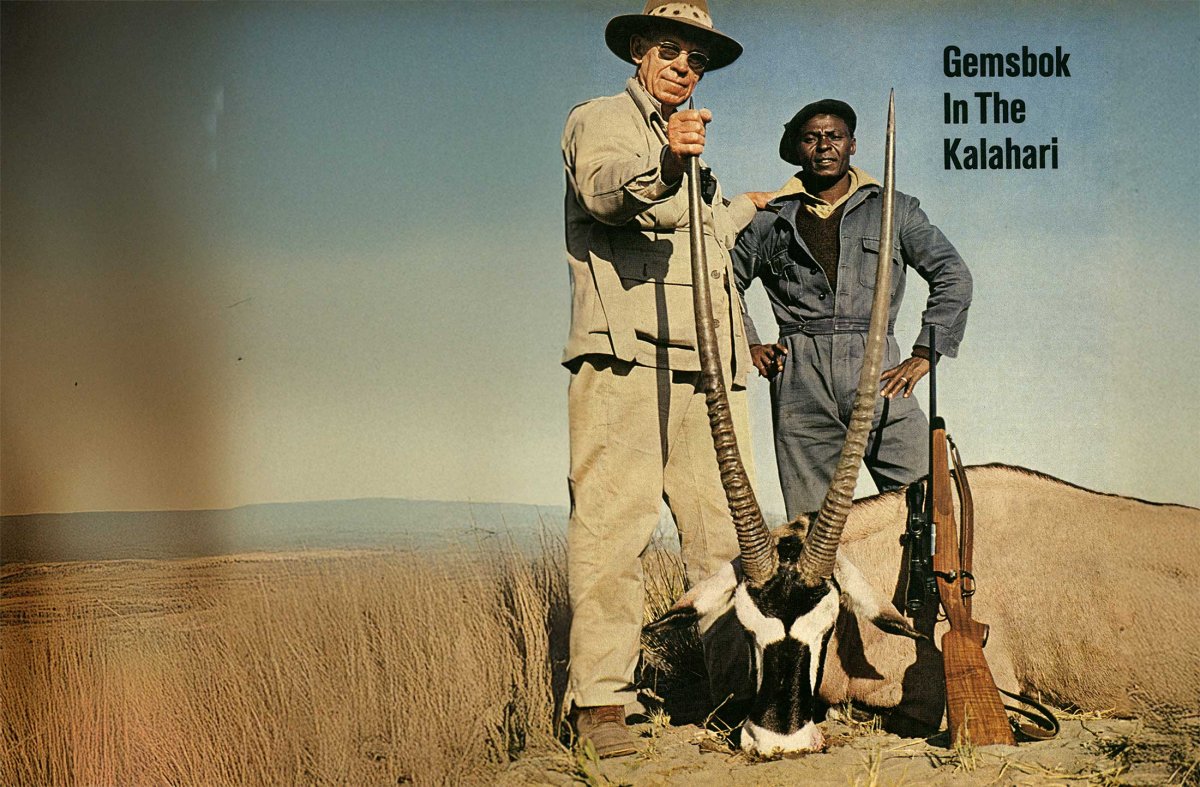
The horns measured a bit over 41 inches, the longest horns from a bull that any of John’s clients had taken. In addition they were exceptionally heavy. I had waited a long time for my gemsbok trophy and was well content with it.
All of us had thought that my first two shots were clean misses, but as it turned out, either of them would have dumped the bull if only I had been luckier; they had just missed the spine at the top of the shoulders. The shot that had spilled him had gone through the middle of the ribs about one third of the way down from the spine, had wrecked both lungs, had broken the left shoulder, and had left an exit hole about one inch in diameter. The bullet was a 150-grain Nosler.
On running game, even with a scope sight, the tendency is to miss high and behind. Misses behind and too far back in the animal come because the rifleman slows down or stops his swing when things look right. Shots that go high if a scope or a peep sight is used do so, I believe, because the animal is the most conspicuous at the top of his bound and the tendency is to shoot at that time.
I know that in shooting at hundreds of running jackrabbits and dozens of running deer and antelope, I have missed much more by shooting high than I have by shooting low. I have done plenty of missing because I didn’t lead enough, but I don’t think I can remember more than two or three times when I was in front.
Rejoicing mightily, we loaded the gemsbok into the hunting car and struck out for camp. John planned to hit the tracks we had made that morning and follow them back, but somehow we missed them and had to plow through heavy brush for several miles. The British-made safari car is a tough little vehicle. John’s has a heavy iron bumper and a steel plate that protects the oil pan. As long as the thing can get traction, it moves.
It was almost dark when Kiebe and Edward, our gunbearers, began to chatter in Swahili.
“They say a herd of roan with a good bull in it just disappeared in the brush over there,” John translated. “Do you want to go after them, Eleanor?”
Eleanor said she did, and she, John, and Kiebe took off. About 10 minutes later I heard a single shot. She had connected with a good bull.
We were not far from the road that connected our camp with the highway between Maun and Francistown. When we hit it, John marked the turnoff with a streamer of toilet paper so that the lorry could come in and pick up the roan. It had been quite a day!
This story was originally published in the July 1967 issue of Outdoor Life.
Read the full article here