

We Took a Family Camping Trip In This Border Country Wilderness and Had the Best Fishing of Our Lives
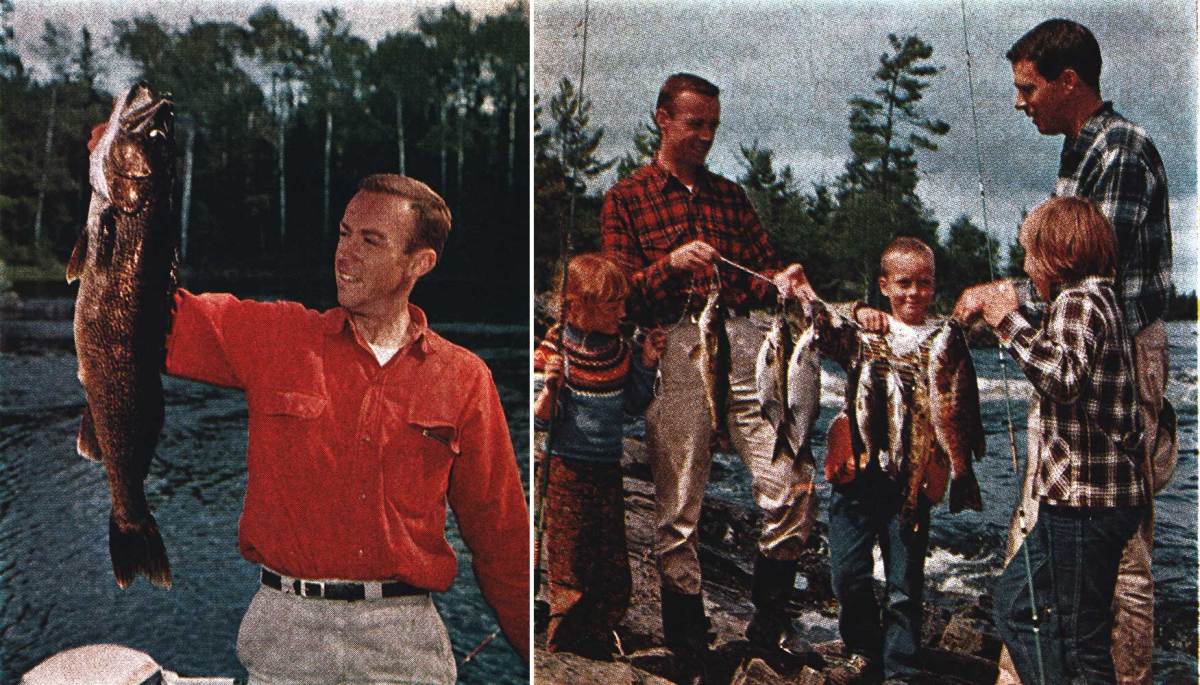

I was perched on a narrow rock ledge, inches from where tons of white water thundered down a granite-lined chute, when the big fish swam into view in the pool below. A sudden shift in the foaming surge of a back eddy had momentarily parted the curtain of bubbles and for an instant had exposed the clear, green depths.
It was a bass, no question about it. But what a bass! Turning and rolling to hold his place in the restless currents, he exposed bronze flanks that seemed as long as my arm. The water may have been playing optical tricks, but even allowing for that, I’m certain I was staring at a smallmouth that would have topped six pounds.
Suddenly, the veil of bubbles returned and the fish disappeared. I snatched up my spin-casting rod and flipped a plastic frog lure into the racing current. Line zipped out as the frog was whirled downstream. It vanished into an eddy, and then I felt a new pressure as something latched on. That’s when I began to sweat. How long should I let him chew on it before I rammed home the hook? The pressure increased, and the line was coming tight when I gritted my teeth and struck with both arms.
There was no waiting for results. Out in midstream, the white water split, and a chunky shape somersaulted through the air. I felt myself sag with disappointment when I saw the size of the fish. Somehow a two-pounder had grabbed the lure before the big one had a chance.
But as I bent to the job of landing the fish, the letdown gave way to a mounting sense of respect. A two-pound smallmouth is no soft touch anyway, and when you get one swinging back and forth in a roaring current, he gets heavier fast. I had so much fun tussling with that fish that I almost forgot about the lunker in the depths. All morning, fiery-tempered bass had been giving me goose bumps every time one slammed my lure, and the way things looked, I could go on catching them just as long as my wrist held out.
The scene was spectacular Snake Falls on the Namakan River, one of several waterways which drain Lac La Croix on the Minnesota-Ontario border. I was there in mid-August of last year on a family camping trip which allowed me to sample some of the best fishing I’ve found anywhere in the midsection of both the United States and Canada. During our five-day stay in this sprawling region of wilderness lakes and rivers, I fished foam-flecked pools swarming with smallmouth bass, saw lines snapped by giant pike, and tied into a walleye so huge my knees felt like jelly when he surfaced near the boat.
Our companions on the trip were Jack and Joan Clark, of Winnetka, Illinois, and their three children. Jack is a personnel officer with a Chicago bank. I live in Half Day, Illinois, where I write outdoors stories. My wife, Barbara, and I decided that this year our six-year-old daughter, Sandy, was ready to go along. She’d find good company in the Clark children: George, 10, Don, 9, and Julie, 7. My Labrador retriever, Cinder, rounded out the party.
Barbara and I had camped with the Clarks before. In the summer of 1962, our two families spent seven wonderful days on Kabenung Lake, deep in the Ontario wilds north of Lake Superior. We all enjoyed great fishing for walleyes and northerns, camped in virgin wilderness surroundings, and yet were only 20 minutes by outboard from a major transcontinental highway.
The area we chose for our 1964 trip is one of the prize wilderness tracts on the continent. On the Minnesota side of the border, it’s known as the Superior National Forest. On the Ontario side, it goes by the name of Quetico Provincial Park. Throughout, the key feature is water. There are lakes and rivers too numerous to count, and the best part is that most of them are interconnected, making travel by water a relatively simple matter in terrain as wild and rugged as it is beautiful.
This fact, coupled with the presence of thousands of islands and countless sheltered bays and coves, makes the whole vast area a small-boat camper’s paradise.
To get into this border country, you must begin at one of the northern towns which specialize in outfitting campers, canoers, and fishermen. Three such towns are Crane Lake, Ely, and Grand Marais, all in Minnesota and all about 1½ days by car from Chicago. We chose Crane Lake because it’s close to Lac La Croix, our target for the trip.
Both Jack and I own complete sets of camping equipment. We also have our own auto-top boats and outboard motors. Jack brought along the same 12-foot aluminum job he’d used on our 1962 trip, while I had since replaced my bonded-plastic model with a 13½-foot aluminum boat. When we met at Crane Lake in mid-August, the only extra we needed was a canoe, which we rented at $4 per day to accommodate two of Jack’s children and some extra gear.
A few fresh grocery items were stuffed in the food packs, the cars were parked and locked, and then we turned our backs on civilization and started off across the lake.
The 25-mile trip to Lac La Croix, via a series of narrow lakes and winding river channels, took nearly five hours. With supplies jammed into every available inch of space, the boats rode low and heavy in the water. Since my 9½-horsepower motor delivers more speed than Jack’s 7½, I towed the loaded canoe behind my boat to equalize the difference.
The day was cloudy and cool, and a strong wilderness atmosphere prevailed. We skirted dozens of small, spruce-topped islands, cruised beneath granite bluffs crested by towering pines, and occasionally spotted loons and wild ducks. The kids were wide-eyed and missed nothing.
Several stops broke the routine of sitting in the boats and added flavor to the trip. One was at the Canadian customs outpost on Sand Point Lake, where we cleared our entry into Canada and obtained a travel permit. This document costs nothing but is required for anyone traveling or camping on the Canadian side. Since it’s common practice to cross and recross the border several times daily in this country, the permit should be carried at all times. Our official re-entry into the U.S. would be at American customs in Crane Lake at the end of the trip.
Two other breaks took place, at Loon Falls and at Beatty Portage, where marine railways are available to ease the job of transferring boats and gear from one body of water to the next. Narrow-gauge tracks span each portage and the rails run into the water at both ends. A cable-drawn flatcar is lowered so that a boat may be floated onto it, then a motorized winch hauls the whole works across and eases it into the water at the other end. The fee is $1 for a canoe, $2 for an outboard. We also refilled our gas tanks at one of these stops, and the bill, at 65¢ a gallon, reminded us that things get more expensive back in the bush.
At the Loon Falls portage, we chatted briefly with the winch operator, William Brokaw. He checked out our choice of travel routes, marked several fishing holes on our maps, and entertained us with some anecdotes of long, northern winters. He lives at his post all year in a comfortable-looking log cabin.
It was late afternoon by the time we turned into Snow Bay on Lac La Croix and picked out a camp island. While the kids ran and whooped along the rocky shore, discovering frogs and crawfish, we put up tents and inflated air mattresses. Darkness found us drinking hot soup and munching hamburgers beside a crackling fire. Though a cold wind blew from the north that night, and intermittent rain gusted across the lake, our tents felt warm and secure nestled in a thick stand of pines.
Gray, wet clouds stayed around for two days, and if we hadn’t been familiar with such weather from past experience, we might have got discouraged. The kids kept busy by building a fort out of driftwood, and their constant enthusiasm kept everyone’s spirits high. By the second evening, a blazing sunset promised improved weather.
Meanwhile, we didn’t let all that tempting water go to waste. Once the chores of organizing camp and sawing firewood were done, we strung up rods and pawed through lures. I’ve found that spin-casting outfits are ideal for family trips. The push-button mechanism and enclosed spool are trouble-resistant, and even a young child can learn to handle a rod and reel of this type in a short time.
Lac La Croix, we discovered, is loaded with pike. Twenty minutes after we began trolling the first morning, I hooked and landed an acrobatic northern that lashed the wind-tossed water to a froth before I could lead him to net. He was a dark, handsome fish and weighed four pounds.
Pike were likely to turn up almost anywhere near shore, but best spots were protected bays with plenty of vegetation on the bottom. Weedless spoons always produced strikes in this type of water, and even surface plugs drew action.
Once, Sandy was retrieving a yellow floater over some weeds when a small pike slashed up, engulfed the lure, then dived back down into the submerged growth. Sandy simply kept reeling and dragged the helpless fish, festooned with salad, right into the boat. It was her first pike, and she bubbled with pride talking about it later at camp.
When the weather cleared on the third day, we decided to get away from camp and do some exploring. Our maps showed a number of interesting side trips, but before making a choice, we wanted to visit Campbell’s Trading Post on the Canadian shore of Lac La Croix.
Following a hefty pancake breakfast, we made up some sandwiches for lunch, double-checked to see that the fire was doused, then headed up the lake. About 45 minutes later, we were tying up to the trading-post dock next to a pair of float planes. Before we left, another plane flew in on a routine supply haul from Crane Lake. Though float planes are prohibited from flying into the Quetico-Superior area except for official or emergency purposes, Campbell’s is situated just outside the Quetico Park border and is therefore open to planes.
Inside the post, we found a well-stocked store. On the shelves were groceries, fishing tackle, souvenirs, and some attractive woollen goods imported from England. Conversations with store clerks and other campers who were there at the time revealed that the nearby Namakan River, an outlet of the lake, was highly regarded as smallmouth-bass water. Already that summer, a whopping 6¾-pounder had been taken from one of the pools on the river.
At the mention of this catch, Jack and I exchanged wide-eyed glances and pressed for further information. The Namakan, we learned, borders an Indian reservation, and the usual procedure is to stop at the Indian village on the way in and ask permission of the chief to continue. However, the chief was away for the summer, but an agreement existed permitting fishermen to enter.
Before leaving Campbell’s, we refilled the gas tanks again. The cost of flying everything in made itself felt—the price was 85¢ per imperial gallon (4.8 U.S. quarts).
Thirty minutes later, we were pulling into the east bank of the Namakan just above a series of rapids which warned of the cataract below. From downstream came a sound like distant thunder. We tied the boats, grabbed lunches and tackle, and began hiking along the well-defined trail which followed the bank. Jack brought up the rear, balancing the canoe on his shoulders.
Through occasional openings along the shaded trail we caught glimpses of tumbling rapids. Soon we emerged onto a rock shelf overlooking Snake Falls, which is actually a series of heavy cascades that roar around a bend before finally plunging into a long, dark pool rimmed by granite ledges. Tall pines frame the spectacle.
But no one spent much time admiring the scenery. In seconds we were scattered around the edges of the pool casting our lures into the current. George was the first to connect. His rod arched and line peeled off the reel as something nailed his red-and-white spoon in a deep eddy. After a lively tug-of-war, he hauled a gleaming walleye up onto the rocks where it flopped and rolled in an attempt to return to the water. It was a two-pounder, good eating size.
Then my deep-running plug was socked, and after a few tense brushes with the terrific current, I landed the twin of George’s walleye.
Soon afterward, a frantic shout came from the head of the pool where Joan was clutching a bucking rod that threatened to jump from her grasp. Jack threw down his rod and grabbed a net. While everyone yelled encouragement, Joan fought to regain line. After an agonizingly long time, there was a big swirl close to the rocks. Jack leaned out with the net, straightened up, and swung a dark, thrashing form to dry land.
It was a smallmouth bass that weighed a solid four pounds, and Joan had fooled it with a live frog cast into the head of the pool where the current was heaviest. Later, in that same place, I saw the lunker mentioned at the beginning of this story. Fish were packed in below the falls waiting for helpless baitfish and frogs to be swept down to them. We took a number of smallmouths from that pool during the rest of the day, but Joan’s was the largest.
In the afternoon, Jack and I took the canoe and tried the other side of the river. If anything, the fishing was even faster there, especially in a long, narrow run where the current washed along a sunken ledge. We caught bass, walleyes, pike, and some strange, silvery fish that behaved as if their tails were on fire. When hooked, they’d bounce out of the water repeatedly, their burnished scales flashing like newly minted coins.
“They look something like whitefish,” Jack commented.
“They do,” I grunted, as one jumped two feet in the air and spat the spinner back in my face. “But I sure never heard of whitefish acting like loco tarpon.”
Later, back at the trading post, the fish were identified as tullibee, an oily-fleshed river dweller sometimes taken by the Indians in nets but considered by many to be worthless as food. Worthless or not, I was glad I’d had the chance to feel those fighting dynamos on the end of my line.
That evening, back at camp in Snow Bay, we relaxed by a fire and feasted on fried walleyes and bass. Maybe it was the steady diet of fresh air, or maybe it was the fact that those fish came from pure, cold water, but I’ve never enjoyed a better meal.
The next day dawned sunny and calm. Jack wanted to return to the Namakan for another try at the bass. The previous evening, the kids had waged a relentless frog hunt, and the bait bucket was literally jumping. Frogs had proved deadly in the fast current of the river, and Jack felt sure he was going to knock them dead.
I decided to take Barbara and Sandy on a long trek to the eastern end of Lac La Croix and fish Twin Falls, where the Maligne River enters the lake. The spot had been strongly recommended at the trading post.
We wished each other luck, then split up for the day. It was perfect weather for a boat ride anywhere. The air was mild, billowy white clouds drifted in a blue sky, and only a light ripple wrinkled the quiet expanse of the lake. Cinder sat up in the bow, her nose into the wind, and savored the various scents that came from shore.
The trip took nearly an hour, but it was well worth it. Twin Falls, as the name implies, is a double cascade that spills into a huge, pine-encircled pool. We went ashore and enjoyed our sandwiches amidst surroundings I’d travel halfway around the world to see.
Then I grabbed my spin-casting outfit and flipped a deep-running plug into the fast water below the falls. There was an immediate jerk on the line, and a two-pound bass erupted in a shower of spray. I fought him up to the rocks, grabbed his lower lip, and transferred him to the stringer. A few casts later, another cartwheeling smallmouth was raising suds across the pool.
After a while the action slowed, so we got back into the boat and probed the middle of the pool, where my anchor rope indicated almost 50 feet of water. Sandy hooked and boated a three-pound walleye, and a short time later I hooked into a fish I’ll never forget.
We were trolling with the current between two rock ledges when a hard wrench on my rod signaled a big fish. I cut the motor and began pumping line cautiously. Whatever was down there felt solid and strong and was in no mood to leave the bottom. Suddenly, the rod tip dipped, and yards of line melted from the reel.
Barbara grabbed the oars and carefully maneuvered us out of the tricky current and into a small, quiet bay. Here I felt more in control of the situation. The fish had stopped running and was now shaking his head back and forth in hammerlike blows that put severe strain on the eight-pound-test monofilament. I mentally ran over my knots and swivels, praying that they stayed strong. Then I spied a long glint of color deep beneath the boat.
“Looks like it might be a pike,” I said. Suddenly, the fish looped upward and turned sideways, affording me a good look at him.
“Holy smoke!” I exploded. “It’s a giant walleye!”
The fish rolled to the top and wallowed in a geyser of foam. Struggling to keep his head up, I worked him closer and closer to the side of the boat. Barbara readied the net. Sandy and Cinder just stared.
When his big head was over the rim and down into the mesh, we heaved him over the gunwale and dumped him into the bottom of the boat. Both Barbara and I stared wordlessly at the gleaming, bronze hulk.
Then Sandy piped up, “Is he a keeper?”
That broke the ice. We burst out laughing, then started to whoop like lunatics. My tackle-box scales were too small to weigh the lunker, but I knew I’d reached a new personal record for the species.
After spending 15 minutes recording the catch on film, I turned the boat west and started the long run back. At the trading post, where we stopped to use the scales, the fish created a stir. It weighed an even 10 pounds and, as far as anyone there could recall, was the biggest walleye of the season for Lac La Croix. I decided to have it mounted and made arrangements to have it flown out to an ice plant near Crane Lake. That way, it would be in good condition to travel when I picked it up on the way home.
Read Next: Twin Metals Paid Former Trump Officials $380K. Their Controversial Mine Proposal Near the Boundary Waters Is Now Advancing Against Public Opinion
Back at camp that evening, after listening to our story of the big walleye, Jack showed us a string of smallmouths that made our eyes bulge. It was obvious that the Clarks had also enjoyed a red-letter day.
“You’ve never seen anything like it,” Jack said. “That Namakan River is crawling with bass. We fished Snake Falls again with live frogs, and everyone in the family caught fish. It was the best day’s bass fishing I’ve ever seen.”
Such a reaction, I believe, is not uncommon among anglers fishing in this region for the first time. There’s so much water, a large part of which is lightly fished, that there will most likely be blue-ribbon action available here for many years to come.
We almost had a story about a big pike to round out our adventures, but the monster that grabbed Barbara’s spoon one evening tore up half an acre of lily pads and then broke the line before we ever got a look at it.
But that’s what makes this place ideal for a family trip. Anyone is likely to hook into a really big fish, and everyone is bound to get some kind of action. Another inviting aspect of camping in this border country is the ease of moving around by water.
Many cleared campsites, maintained by the Forest Rangers, are present throughout the region. For those who prefer to seek out their own campgrounds, thousands of scenic locations are waiting to be occupied.
Detailed maps, showing portages, trails, marine railroads, trading posts, and so on, are essential in this country. Two good series are: Superior-Quetico Canoe Maps, printed by W. A. Fisher Company; Virginia, Minnesota, and Minnesota-Ontario Border Lakes series, printed by U.S. Lake Survey, Detroit 26, Michigan. Send for these maps early, and they’ll greatly ease the job of planning a trip.
You don’t have to own one piece of gear to camp and travel in this region. Many experienced outfitters are available to see that prospective campers go into the bush properly equipped. Rates are reasonable, and planning is thorough. For example, two persons can rent the following for $3.50 a day each: boat or canoe, tent, cook kit, packsack, sleeping bags, air mattresses, fire grate, ax and griddle.
Rental of outboard motors runs $2.50 a day and up, depending on horsepower. Additional equipment, such as life vests, gas cans, reflector ovens, even fishing tackle, is also available. If you take your own boat, count on a launching fee, usually $1. Parking the car may cost 50¢ to 75¢ a day. Some outfitters offer guide service, with the rate usually running around $15 a day. A Minnesota resident fishing license costs $2.25, and a husband and wife can buy a combination license for $2.75. Nonresidents pay $5.25 for a single, or $8.25 for a husband-and-wife combination. An Ontario nonresident tag goes for $6.50. Children under 16 don’t need a license.
For complete information on trips and outfitters, write to the following: Crane Lake Commercial Club, Crane Lake; Ely Commercial Club, Ely, and Gunflint Trail Association, Grand Marais.
Whether you’re a rank novice or a seasoned veteran of the woods, this border country is an unbeatable choice for a memorable outdoors vacation. Best of all, it offers a chance at wilderness fishing the likes of which all of us dream about.
Editor’s Note: This article was originally published in the July 1965 issue of Outdoor Life. Voyageurs National Park was established about a decade later.
Read the full article here
