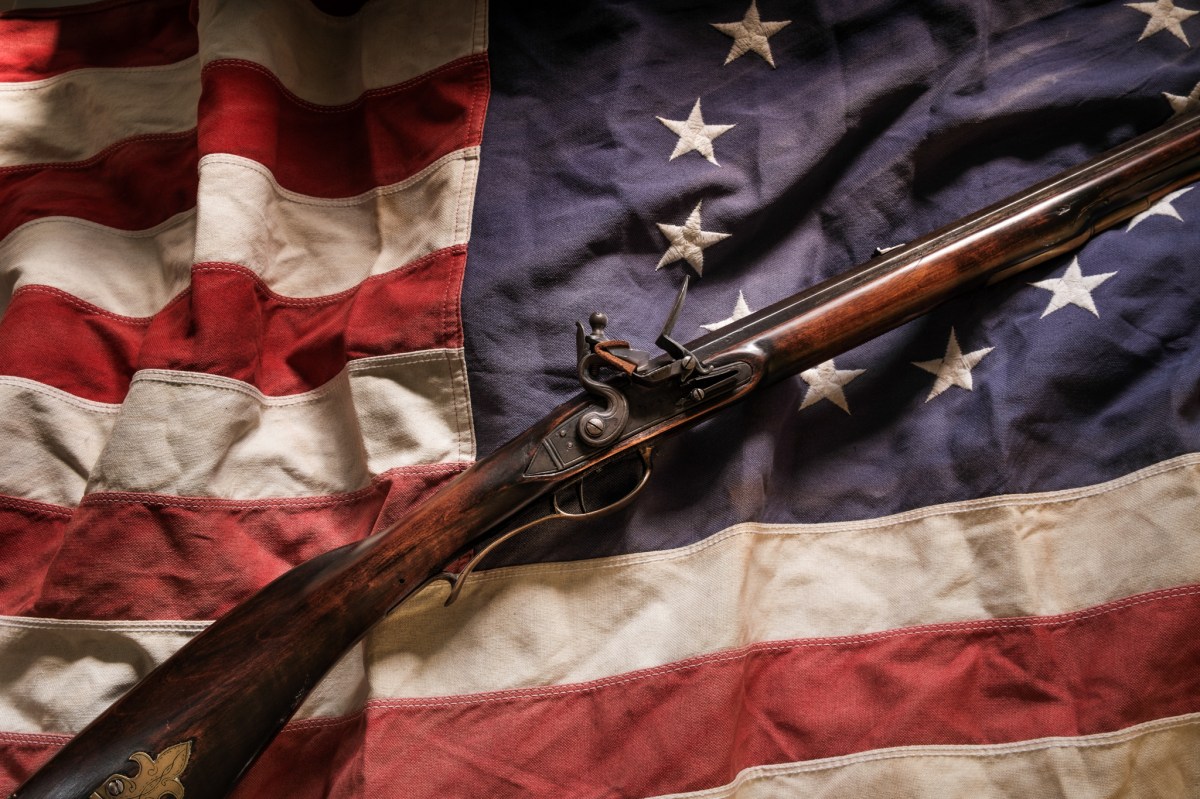

This week, as we celebrate the 4th of July in America’s 250th year as a country, it’s clear there’s a lot more interest and conversation about American history. That’s why on today’s episode of the Outdoor Life Podcast, I spoke with firearms historian Ashley Hlebinsky. Because, as she puts it, you can’t talk about American history without also talking about firearms.
Ashley picks some of her favorite American firearm innovations and explain how they relate to what was going on in the country at the time. A caveat: This isn’t going to be your basic internet list of 1911s and M1 Garands. Ashley gets deep into the weeds on patents, designs, and gun stories you probably haven’t heard before. But if you’re a gun nerd and an American, you’re sure to appreciate what she has to share.
Full Transcript
Listen to this week’s episode of the Outdoor Life Podcast on Apple, Spotify, or wherever you get your podcast. The following transcript of this episode has been condensed and edited for print purposes.
Alex: Ashley, to get us started, would you talk about your background quickly — your background in firearms, and what you do now?
Ashley: Yeah, I like that you say “quickly,” which means you’ve worked with me a lot in the past, because I’m not capable of that. But for those of you who don’t know me, my name is Ashley Hlebinsky. I am a firearms historian. Most people know me from the 10 years I spent at the Cody Firearms Museum — I ran the Cody Firearms Museum, and I was responsible for a $12 million renovation where we completely gutted the museum and redid it. We added an extra thousand guns on display, a lot more interpretation. Since then I’ve been working on a lot of different history projects. I started a research center at the University of Wyoming with a colleague of mine — it’s called the Firearms Research Center, super original, I know. It’s a Second Amendment law center. I’m also working with some colleagues on a new firearms research center in the UK, with a lot of museums — the Mob Museum, the LA Police Museum. I’m building a firearms museum up in Canada right now, believe it or not. I do a lot of expert witness work, and TV, still, whenever people give me the opportunity. But I think those are the big hits.
Alex: Perfect. Well, you know more about the intersection of firearm design and American history than anyone I know. We’re coming up on the 4th of July, and I think a lot of folks are feeling patriotic — there’s more interest in history this week than at any other point in the year. Outdoor Life’s way into this is really through firearms of American history. So yesterday I texted you and said, “Hey Ashley, what are your favorite firearms of American history? Do you want to talk about them?” So that’s what we’re going to do today.
Ashley: Yeah, which is such a loaded question, if you will. So I’m going to say a bunch of things I like, but they might not be my actual favorites — we’ll have a good time, though.
Alex: Yeah, I put no guardrails around this. This list you come up with is not supposed to be the most important firearms of American history — folks have already seen those lists with the M1 Garand and the 1911. I promise this isn’t going to be that. I know you’re going to go deeper, and maybe odder and more unique, than the basic list everyone’s already seen on the internet. So I’m sure I’m going to learn a lot here.
Ashley: Yeah, I tried to come up with some weird stuff — and some stuff you probably know exists but maybe didn’t know the full history behind. That was kind of what I was going for.
Alex: Okay, perfect. Well, let’s start around the theme of this — let’s start around the founding era. Take us back to the beginning, around America’s founding. What from that era really stands out to you as a firearms historian?
Ashley: Ooh, that’s a good question, because one of the things I was thinking of is a little later — it falls into what we call the founding era of the U.S. This is a really interesting and difficult question for me, because in all my Second Amendment expert-witness work, the concept of the founding era is very important, thanks to the 2022 Supreme Court decision, the Bruen decision, which basically said that history is one of the most important determinants of the constitutionality of a modern gun law. The Court points to a hierarchy of historical relevance, and the most important tier is what they call the founding era — around the ratification of the Second Amendment. So it’s a little later than our actual founding.
What’s interesting, and what we talk about a lot from this timeframe, is that you’ve got your standard guns everybody knows about — your musket, your long rifle. Although the long rifle wasn’t necessarily used as much on the battlefield as people think; it was more of a specialized-purpose weapon. Part of the reason is that rifling — which had already been around for centuries — was something people used for target shooting, defense, and hunting, because it was more accurate than a smoothbore musket. But the projectile you were using at that time was a round musket ball, and for rifling to be effective with a round ball, it had to fit snugly down the barrel. Since most of these guns were muzzle-loaded, with a few exceptions of early breech loaders, that slowed down the loading process, which made things more difficult on the battlefield with the tactics of the time — especially as you get closer to the Revolution. But one of the things I always point out and talk—
Alex: Wait, wait, hold on. The whole idea of the American frontiersman with the Pennsylvania long rifle — our skilled riflemen swinging the war in our favor — is that not true?
Ashley: Not really. It’s not wrong, per se — I think there’s just this imagery around it. There are actually a lot of interesting quotes and documents from around the time of the Revolution talking about the fact that Americans had so many firearms, and were proficient with them in a multitude of ways. The rifleman component specifically, and the accuracy of that fire, does get reported on a lot — David Ramsay wrote about individuals picking up arms and being able to use guns. But muskets, smoothbore muskets, were still the standard infantry arm. So the long rifle gets romanticized to the point where people think everyone had a rifle, and that’s just not necessarily the case — well, maybe in their personal lives. There were rifleman units with specific designated purposes for that type of firearm, but your standard-issue arm was still the musket during that timeframe, and for pretty much a century after — by the time you get to the Civil War you get rifled muskets, and we can talk about that.
But what’s interesting is that some long rifles had two or more barrels, where the barrel would rotate, although most were single-shot. I wasn’t even planning to talk about the long rifle, but here we are — I always call it America’s first multipurpose tool, because with the long rifle you could do a little bit of everything. What a lot of people don’t realize is that in the colonies there were popular target-shooting competitions called “rifle frolics.” Target shooting dates back to the late 1400s, and in the colonies people used their long rifles for sport, competing against one another, as well as for hunting and defense — it really was a one-size-fits-all firearm. Another interesting tidbit: some of the colonies actually recorded the number of rifles, muskets, and cannons that individuals owned, and broke it down by gender, which I thought was interesting.
One of the things I always like to point out during this timeframe is that, beyond the guns you’ve heard about from the Revolution, people were experimenting with a lot of other technologies — both during this time and immediately after the founding of the United States. One that comes up a lot is the Belton repeating rifle. There’s some early controversy around it, because some surviving examples are considered forgeries, but Joseph Belton did exist, and he worked on rifles before the Revolution. One of the guns he developed — he actually built a better version in the 1780s — was a repeating rifle called a “superposed” gun, meaning you stack powder and ball together in the barrel, with several different options for firing it. It could function like a Roman candle; some versions had only one locking mechanism that you’d slide along the barrel to different touch holes so the gun could fire — you’d have to prime the pan, or reset the mechanism, each time.
Alex: So is this a shoulder-fired weapon?
Ashley: Yep — it was a repeating rifle. He initially didn’t have much luck getting people interested in it, but he did get Congress to order a hundred of them in the 1770s; they ended up canceling that order, and there’s a lot of discussion around why. But that gun did exist, and it wasn’t the only repeater in the colonies — in the early pre- and post-founding period, you see state sale listings advertising repeating firearms made by gunsmiths. There were 3,000 gun makers around the time of the Revolution in the colonies, so people were buying all kinds of things for their own personal interest, not just military guns. And pretty much always, the guns people bought for themselves were way cooler than the military arms they were issued.
Alex: Do you know if any of those repeating designs were actually used in the Revolution?
Ashley: There are examples involving some of the multi-barrel long rifles — I recall an account, though I can’t remember which British officer was killed, where they believe the shooter used a double-barrel long rifle that rotated to fire two shots. I know of that one. As for other specific repeaters in Revolutionary combat, the British had the Ferguson breech-loading rifle, which saw some use — that’s not a repeater, but it’s another example of faster loading and reloading. It’s really in the post-war period that you start to see some wild repeaters pop up in the early U.S., as people try to standardize, modify, and build a better market for repeating firearms.
Alex: Fascinating. Yeah — just imagining it from the British military’s perspective: they’re coming into this land, getting ready for battle, and all of a sudden these guys are shooting multiple times without reloading. They must have been like, “What the heck is going on?”
Ashley: Not quite — I mean, we were scrounging, right? There were committees of safety, people making guns. Before that, people were importing locks, stocks, and barrels and assembling guns ahead of the Revolution. And honestly, a lot of the time they were just stealing the guns from the British. So it’s not like everyone had it all figured out. If you think about it, a lot of the repeating technology that existed early on, in the 1600s, was coming out of Europe — it was technology that trickled into the colonies. A lot of people don’t realize, beyond the few stories you hear about people migrating to the U.S., that people did come and go. Jefferson lived in Paris for a while. In a lot of my court cases people ask, “Well, would people have been aware of some of these technologies?” It’s not like communication as we think of it today, but communication was definitely going back and forth. Jefferson was always up on the latest technology — he was in charge of the patent office when it first got going. And actually, one of my favorites, one I haven’t even gotten to yet, was something Jefferson was aware of. It was developed in the 1790s, which is around the founding era, since that’s when the Second Amendment was ratified.
It’s called the Chambers gun. It’s like the Belton in the sense that it’s a superposed gun, but the Chambers gun is like the Belton on steroids — the original on steroids, really, because he had different versions of it. Some fired seven rounds. What he devised was a type of ammunition so that, instead of having to fire and then move the lock or switch to a different lock — sometimes there’d be a whole stack of lock plates — he basically hollowed out the ball, the projectile itself. So if you pressed the trigger and held it, it would keep firing until you were done. He tested it in front of a lot of the Founding Fathers and politicians. Jefferson actually recommended — because initially they said, “We don’t really see a military purpose for this” — that he take out a patent for it anyway. Which is kind of funny, given the idea of what a “military gun” was at the time: here’s this rapid-firing gun, and they’re like, “Nah, we’re good — but go ahead and patent it.”
Alex: So you said he hollowed out the ball — was that where the powder went?
Ashley: No — you’d still stack it, so you’d still have powder and the projectile, but that way it would burn through the projectile and let the next one fire in succession, rather than having to manually prime the pan and fire every single time. He ultimately develops — though he never actually takes out a patent on it — a swivel gun that fires 224 rounds with one trigger pull.
Alex: Oh my God — that’s a bad day if one of those barrels doesn’t fire exactly the way you want.
Ashley: Exactly, with multiple barrels like that. This was around the turn of the 18th century — toward the end of the 1700s into the early 1800s — and some of his guns were actually ordered for the War of 1812. So it’s a cool bit of history: a repeater that can fire hundreds of rounds with one trigger pull, and something a Founding Father actually knew about. People might wonder why I’m mentioning this, but these are the kinds of details that go into the conversations you see in the courtroom.
Alex: Right — and just to draw that out a little: one argument is that the Second Amendment should only apply to the types of firearms that existed at the time it was written. And what you’re saying is that if you go back into the detailed history, there’s firearm technology that’s actually pretty similar to concepts we have today.
Ashley: Yeah. A basic breakdown of what they’re looking for in the Bruen test when it comes to history: what technology existed, would people have known about it, would the Founding Fathers have known about it — and would they have known to regulate it? And then, are there any comparable laws you could tie to a modern law? When it comes to the founding era — or, gosh, I keep wanting to talk about the 1860s, the second founding era — most of the laws you see around firearms during the first founding era aren’t about the firearms themselves. They’re about who can own firearms. There’s regulation on Native people owning firearms, on free Black men and women owning firearms — so it’s more about who can own them than what they can own. Then there are militia laws: certain militias required members to carry a minimum number of rounds, ammunition, and powder at any given time, which you’ll see a lot on the ownership side.
On the more restrictive side, you’ll see things like powder restrictions — some colonies limited how much powder you could keep, say sixteen pounds. You could still have a lot of powder, and if you went over that, you could store the rest in a public powder magazine — it was still yours, you could have as much as you wanted. But that regulation was really about fire-prevention laws, the concern that keeping a certain amount of powder around was a fire risk. There were also restrictions on firing within city limits, again to prevent fires, not to restrict ownership of the technology itself.
So that’s where you get into something like a magazine case: were magazine-fed firearms around at the time of the founding? Yes — they date back to the 1600s. Belton, who developed his repeater in the 1750s, later went to England and worked with a gun maker there, manufacturing a version of his gun that used what is, in essence, a detachable magazine — still superposed, but you could carry preloaded pieces that popped out of the breech and could be popped back in for quick reloading. It also had several firing methods: a single shot, a traditional superposed round where you prime the pan each time, or a fun little port-fire feature, where you set the locking mechanism once and use a little match-like fuse in a port — and it fired, according to the curator of the Royal Armouries, at about the same rate as a modern semi-automatic. It’s fascinating — I’ve lived in this fascinating world since the Bruen decision, because all of this research is going on about what existed and what that means for modern laws.
Alex: Okay, so that’s the founding era — I think we covered that. Now where are we going?
Ashley: I think we should move into the 19th century — which, if we’re staying on the Bruen theme, the second most important timeframe is what’s called the “second founding era,” around the ratification of the 14th Amendment in 1868. The 19th century is a time of great change in production capacity and manufacturing processes. I could obviously talk about the standard stuff — Sam Colt and the development of a commercially successful self-rotating revolver, and a lot of other repeating technologies. But the one I wanted to point out — and this is probably low-hanging fruit for me, coming from the Cody Firearms Museum — is Smith & Wesson’s 1854 patent, which develops into what becomes the Winchester lever action. I think that’s interesting from so many angles. One is patent history, which sounds like the most boring thing on the planet, but I think it’s such a juicy, spicy topic.
Why? Okay, so basically — I’m sure everyone knows what a patent is: you get a patent saying, “I made this thing, you can’t make it, I own the legal right to make it.” In 1836 there was a standardization of the patent process, and Sam Colt comes out that February with his revolver patent. He’d taken out patents in France and England the year before, because he’d been advised on how foreign patents work — apparently, if he’d gotten a U.S. patent first, he couldn’t have taken out the foreign ones. So he comes out of the gate patenting everywhere he can, essentially saying, “I’m collecting these, and I’m going to make sure no one makes my stuff — and if they do, I’m going to sue them.” And he does, a lot, which is why it’s juicy — there are so many lawsuits during this period, people suing each other, reputations getting damaged.
What’s interesting is that after 1836, once Colt patents the revolver, you see all these repeaters pop up that are kind of obscure — turret guns, where the cylinder faces the wrong direction and rotates around instead of the normal rotation with the chamber facing back; chain revolvers, which are literally a chain of rounds that advance; things that look like typewriters — all kinds of stuff. Colt then gets an extension on his patent to around 1856 or ’57, and that’s when things start to shift for a lot of designers, because that opens up the revolver market.
Smith and Wesson are smart early on, though — they’re developing this idea of a repeater, and also this idea of a self-contained metallic cartridge. Up to that point, you were loading the components of the round inside the gun individually, which is slow — even though Colt’s revolver was faster because of the type of repeater it was, you still had to load powder and projectile separately. So Smith and Wesson are working on several things, and just before Colt’s patent expires, they come up with the Volcanic, an early lever action. A lot of people don’t realize that Smith and Wesson developed the lever action — they came out with their own lever action a handful of years ago and have leaned into that heritage — but originally, Oliver Winchester was an early shareholder—
Alex: Right — it’s like Winchester Repeating Arms; people just lump those two together with the history of the lever action, and everyone thinks Winchester.
Ashley: And rightly so, because Oliver Winchester becomes a shareholder right away — it’s originally Smith & Wesson, then Volcanic, then New Haven, then Winchester; it goes through a lot of names, and Winchester gets involved almost immediately. He’s a money guy — he does take out patents during his life, but mostly he’s the money guy. Smith and Wesson developed the thing, but they were really more interested in the revolver market, so once Colt’s patent is expiring, they let go of the lever action and move on to developing their revolver with a metallic cartridge, which also has the benefit of a bored-through cylinder, patented by Rollin White, who was a Colt employee. So there’s a fun interplay there that builds up to what is, to me, the birth of the iconic, classic Americana Winchester lever action — but it’s also this advancement in ammunition technology, which personally I don’t think gets enough credit or discussion in firearms history. We talk about the Winchester lever action, but we rarely talk about all the calibers Winchester came out with, and the fact that ammunition was the profitable part of their company for so long.
It’s a nice moment where a bunch of well-known names in gun history come together to create something that develops in so many directions. I love that, because of all these different facets — and I love a little bit of drama, and patent history always brings it. Rollin White was basically called “an embarrassment to the union.”
Alex: Really?
Ashley: Because of the way his deal with Smith & Wesson worked out — great for Smith & Wesson, not so great for Rollin White. He was obligated to defend his own patent; Smith & Wesson didn’t have to. And if you know your American history, not too long after they come out with this revolver, we go into the Civil War, when mass production becomes very important, and patent infringement was pretty common. He wasn’t shy about lawsuits, even during wartime — so, in terms of financial success at least, he got the short end of the stick.
Alex: So it was like, “Hey, we’re at war, we don’t care about the paperwork, we have a war to win,” and he’s like, “Hold on, I’m going to sue you.” Is that basically it?
Ashley: Yeah, basically — I believe he filed for an extension, though I can’t remember if he got it. But it didn’t end well for him, because people felt he was bogging down production during a time of war. It’s a dramatic time for so many parts of American history, not just technological history, but the development of military technology in general. If we’re looking at where we started, with smoothbore guns and round musket balls, by the time of the Civil War you now have a conically shaped projectile. Even though you’re not yet using the self-contained metallic cartridges Smith & Wesson was starting to pioneer, you are using a conically shaped projectile that allows rifling to be used effectively on the battlefield for the first time in American history.
Alex: So with Smith and Wesson — you mentioned this — they came out with a modern lever action called the Model 1854. Is that a reference back to this history?
Ashley: Yeah, they very much marketed it as a throwback to their origin story, which I think is neat — I love it when a modern company embraces its historical roots. When they came out with their version of a lever action — which is obviously not a Volcanic, and had a lot of issues early on — they did a lot of marketing using an original Volcanic pistol, which, I’d love it if they made a lever-action pistol; that’d be so cool, though I doubt there’s much of a market for it beyond me and my ten friends. But they actually borrowed one from a colleague of mine — they did a lot of research into the early gun suits. I love when an older company can look back at its history and find a good way into a modern market. Lever actions are still very popular, and especially when they came out with it, it was a hot category — so to come out and basically say, “Just kidding, we were the first,” is a pretty big flex.
Alex: Totally — good job, Smith and Wesson. Okay, where are we going now?
Ashley: We can go in a lot of directions — we don’t have to stick to just what I wrote down — but one of the things I did write down, because I’ve already talked about patent history, legal history, technology, is that I also find the history of passive and active safeties really interesting. So I wrote down the 1896 Andrew Fyrberg patent for Iver Johnson Arms & Cycle Works — bicycles and guns. This was a patent for a transfer bar on a double-action revolver, which is a pretty revolutionary piece of technology, especially for the late 19th century.
Alex: Tell me more about it — what does it do, and where do we see it?
Ashley: So — a lot of people are aware that early Colt single-actions have this issue: if you load all six chambers with the hammer resting fully down and you drop the gun, you’re at risk of the firing pin pushing up against the primer and the gun going off. That’s why the standard became, and still is to this day on any modern gun built on that original Colt single-action pattern, that you load five rounds and rest the hammer down on an empty chamber. That’s basically how Colt-pattern single-actions operated until Bill Ruger patented a transfer bar in 1973, discontinued their earlier version, and created the New Model with the transfer bar built in.
But the transfer bar actually dates back to 1896, on a double-action gun — different technology, so it’s apples and oranges; you couldn’t just take that transfer bar and apply it to any revolver, because the way Fyrberg’s patent worked, the transfer bar operates off the trigger, so you need that long arc of a double-action pull for it to work, at least until Ruger comes up with their own way around it. A transfer bar is basically what it sounds like: a bar that, when you pull the trigger and draw the hammer back, moves in between the hammer and the firing pin, so the hammer isn’t directly striking the pin — which prevents a negligent or accidental discharge if the gun is dropped. It transfers the energy of the hammer into the firing pin only when you actually pull the trigger. There are a lot of different versions of transfer bars — in some the pin is actually part of the bar, in others it pops up in different ways — but it was pretty revolutionary at the time, because revolvers in general had issues with dropping and safety when fully loaded. So the fact that Iver Johnson came out, at the turn of the 20th century, with a piece of technology that worked for double-actions was a big leap forward. Although, I’ll say, their marketing was so bad for it.
Alex: Give me an example.
Ashley: It’s a great piece of technology, genuinely revolutionary, but then they market it as “Accidental Discharge Impossible,” which, in a modern litigious society, no general counsel would ever let out into the world. It gets worse, too — great marketing though it might be, kind of like Hiram Percy Maxim calling his invention “the silencer” — it doesn’t hold up by today’s legal standards, but that was fine for the time. One of their earliest advertisements shows a little girl in bed pointing the gun at her own face, with the caption, “Oh my, Pop says it won’t hurt me.”
Alex: Oh my gosh. Wow, that’s so bad.
Ashley: Oh, yeah. And by around 1912 they still have a “Papa says it won’t hurt me” ad, but at least the gun is no longer pointed at her face — it’s sitting in her lap or something.
Alex: Okay, they dialed it down a little.
Ashley: They dialed it back.
Alex: Yeah.
Ashley: But it’s a really unique piece of technology that develops as we move into the more modern era of firearms. So, I told you I was picking some really random things.
Alex: Well, it’s interesting to think about that time, too — I’m guessing revolvers were incredibly popular, or becoming incredibly popular, at this point. They’re everywhere, and now there’s a new technology that makes the platform better.
Ashley: Yeah — there were active safeties on even earlier firearms. Some flintlocks have what’s called a “dog lock,” a catch so that when you pull the cocking mechanism back, you can lock it in place. So there’s this idea of trying to make a gun as safe as possible from the earliest days — it’s just interesting to see how that evolves to fit more modern technology. It’s a neat, lesser-known part of American history — although, I say American history, but the guy was Scandinavian. He was just working in America. He was in America
Alex: It counts. We’re counting it.
Ashley: It’ll count.
Alex: Okay, so revolvers are getting safer. Now what are we doing?
Ashley: But who cares, because semi-automatics happened.
Alex: Yeah.
Ashley: Sorry that was rude to all the revolver companies.
Alex: I know. They had a good run.
Ashley: They’re still very popular — they have entire repro markets. But at this point in history, it’s almost like revolvers have to catch up to the game, because semi-automatic and automatic technologies developed in the 1880s and 1890s and really came into their own in the early 20th century. Obviously John Moses Browning is the name most people associate with automatic and semi-automatic technology, understandably so, because of his 1895 “Potato Digger” machine gun and his 1899/1900 Browning, and the early-1900s Colts that lead up to the 1911. But it’s this moment in change. But he’s not the only person — there’s a lot of experimentation with toggle-lock mechanisms, so early semi-automatics developed by people overseas.
Hugo Borchardt develops the C-93, which is sold overseas, but he actually worked for Winchester at one point — along with another designer who’s iconic but doesn’t get enough credit, William Mason. Mason, along with a colleague named Charles Brinkerhoff Richards, developed the Colt Single Action Army. Then Mason goes over to work for Winchester to develop a revolver for them in the 1880s, right around when Winchester and Colt are starting to play in each other’s sandboxes. Dramatic right? So Winchester pulls a dramatic move and hires William Mason away from Colt. He works on toggle locks, semi-automatics — Winchester is actually way more advanced than a lot of people remember the company being; they’re a major military player by the time you get to World War I, which — I accidentally segued into my next gun, and I didn’t do that on purpose. But Winchester—
Alex: No, you did it — that was good.
Ashley: Wasn’t it? Winchester develops military technology — they help define early- to mid-20th-century military technology, but that’s also what causes them to go bankrupt after World War I; they go into receivership in the 1930s because they can’t keep up with the contracts and the production definitely causes them to start to circle the drain. They try a lot of things — that’s actually where the phrase “the Gun that Won the West” comes from; it’s a post–World War I marketing campaign meant to revive the brand, because they’re drowning to some extent. But they developed some really cool stuff during World War I that people don’t realize — going into the war, automatic and semi-automatic technology already existed, but we’re going to war with revolvers and rolling blocks and bolt actions.
And you’ll see this a lot throughout American military history — there’s always a lag between the development of technology and its adoption. There’s always a lag. Sometimes I joke that when people use the phrase “weapons of war” — “we don’t want weapons of war on our streets” — for most of history, “weapons of war” meant crappier guns.
Alex: Yeah — whatever was popular ten or fifteen years ago.
Ashley: Right, sometimes decades. There’s a lot of innovation happening toward the end of World War I. Winchester develops an anti-tank rifle from a guy named Edwin Pugsley, who later coins the term “the gun that won the West” and becomes a major Winchester executive. But the one I always like to point out — there’s only one that exists, and Cody is doing a lot of research on it right now because there’s not much known about it — is the Burton Light Machine Rifle. It’s developed in 1917, toward the end of World War I, and it’s so advanced that — I know everyone hates this term — but it fits the Defense Intelligence Agency’s definition of an assault rifle.
Now, that definition — you don’t have to like the term, you don’t have to use the term, but it is a historical term and it’s not to be confused with the term “assault weapon,” which is a more modern legislative term to describe, most of the time, semi-automatics with certain features that make them look like selective-fire guns. That’s probably the simplest version of that definition I can give.
Alex: Yeah, that was good.
Ashley: But basically, when I use that term, I’m talking about a selective-fire gun, so something capable of going automatic, with an intermediate cartridge, and a detachable magazine, and portable enough for a single user to carry and operate.
Alex: Sure.
Ashley: That’s the Defense Intelligence Agency’s definition, from around the 1950s, after the StG 44 and everything else. But this gun has all of those features.
Alex: In 1917?
Ashley: Yeah, in 1917. It’s crazy. It’s developed by a guy named Frank Burton, or at least that’s what we understand from the records. Frank Burton is actually the son of James Burton, who was a gun maker at Harpers Ferry and the one who modified the Minié ball — the French-designed conical projectile — into the version used during the Civil War.
Ashley: So family legacy in the company. So he develops this gun, and it’s selective-fire, chambered in an intermediate cartridge he created himself.
Alex: What was the cartridge?
Ashley: The .345 Winchester Self-Loading.
Alex: Interesting, I’ve never heard of that.
Ashley: So basically he took a .351 case and fit an 8.8mm Spitzer bullet in it. He develops an intermediate cartridge with it. So it’s elective fire, intermediate cartridge, and then it’s got dual twin top mounted magazines, 20 round magazines. It’s wild looking, actually. I’m not really a video-game person, I peaked at Nintendo 64 with Mario Kart and Wave Race, but I believe Battlefield 1 uses it. Danny, who runs Cody now — he worked for me back when I was there — will roll his eyes if I’m wrong, but I think it’s Battlefield 1. There’s an interesting misconception about it, too, that gets used in the game: that incendiary rounds were developed for it to shoot down observation balloons. There’s no evidence of that.
Alex: Like hot-air balloons?
Ashley: Like military observation balloons, yeah — to shoot them down. Not true, as far as we know, based on the testing records for the Burton that we have at Cody. There’s an old article, from a journal Cody actually rebooted — it’s called RMAX; today it’s a peer-reviewed academic journal, and it was back then too — where one of the early curators mentioned that theory, and it’s kind of taken on a life of its own since. But Cody has all the testing records, and that’s not necessarily true. What’s neat about it, in general, is just the idea that technology similar to the StG 44 — which we usually trace as the first gun of that type — actually dates back to World War I. Some people trace an even earlier, 1907 Winchester variant to similar technology. It’s just neat to see that we were so far advanced, and then, of course, the war ends and everyone says, “We’ll never go to war again,” and development just gets stymied.
Alex: The war to end all wars — we’re good.
Ashley: Yeah, we’re good — we fought one world war, we’re done, never again, we’ve learned our lesson. So it doesn’t get produced, but it’s an interesting moment in American history that also shows the advancement of international arms history — for so long, I think we credit the bolt action and a lot of the things we consider classic Americana as if they originated here, when really they came from overseas and we modified them into the iconic models we recognize today. But yeah, it’s a neat moment, I think.
Alex: Yeah. Okay, let’s do one more, and then I have some bigger, general questions for you.
Ashley: Okay — so then I’m going to do the lowest-hanging fruit.
Alex: You have to.
Ashley: Okay — not the 1911, that’s probably the lowest-hanging fruit.
Alex: Well, you referenced it — everyone loves the 1911, we’ll just say that here. It’s great.
Ashley: Love it. I worked on the Matthew S. Browning collection up in Montana, and I can talk about Matt Browning, Ed Browning, and John Browning all day long — the family is fascinating, the story is fascinating — but I digress.
Alex: I’m going to move us forward — that’ll be a different podcast.
Ashley: That’s a different podcast. I actually wrote an article for you guys about the family — I don’t think you ever published it.
Alex: No! Well, we’ll have to dust it off.
Ashley: We’ll have that. But anyway — I’m going to jump forward to the AR-15. The original design, the select-fire version that became the M16. And the reason I want to point this out is, if you’ve noticed, I have these really weird, nerdy reasons for liking things that aren’t necessarily the reasons other people have. The AR-15 is a modified version of the AR-10, developed by Eugene Stoner, modified with Stoner and Jim Sullivan at ArmaLite. Fun little fact that made someone really angry on the internet years ago: the original AR-15s were select-fire, because that’s what became the M16. I was standing in front of a row of select-fire AR-15s at Cody, doing an interview for PBS, and I mentioned something about the definitions of “assault rifle” versus “modern sporting rifle” versus “assault weapon,” and someone commented, “How dare you stand in front of a row of AR-15s?” And I said, “Well, these ones actually are select-fire.” They did not want to hear that.
But the reason I find this piece of technology so interesting, for so many reasons, is that the semi-automatic version is the most popular sporting rifle in America. There’s a lot that has to go into the development and success of a firearm design. Sam Colt patented a self-rotating revolver, but he wasn’t the first revolving firearm, and he wasn’t even the first self-rotating one — he had a recipe of people around him, designers and marketing, that made it successful. You see that with Glock, too, when Glock comes together to make a successful polymer pistol. And you see it with the AR — there are just so many components that go into it.
At this point, in the post–World War II period, everyone’s experimenting with lighter-weight materials — aluminum, synthetics, composites, plastics. Not a lot of people are successful, and whenever you have something new, you’re going to see a lot of experimentation and a lot of failure. That failure doesn’t necessarily mean the gun wasn’t good — in a lot of cases it does, but not always; there are still good designs that use these features. Then it’s a marriage of other things. When you’re trying to be the first, or an early version of something new — and it’s worth noting the AR follows a lot of historic technology too, but in some ways it’s genuinely changing the face of things — you don’t necessarily have a great support structure around you. If you develop a gun and there’s no government contract, what happens if it breaks down? You don’t have an aftermarket or a big customer base like you would today, where if your AR goes down you can get parts or customize it however you want. When you’re new, or first, you don’t have that level of support.
So going in with a government contract — even though it can take a while for the money to trickle in, and you see examples like Winchester struggling with government contracts too — is still a built-in support structure, a built-in guarantee that someone’s going to take care of you, at least for a little while. That’s what happens with the AR as it develops into the M16: there’s a government trial, and you’re dealing with a company that, on its own, can’t necessarily afford it — you’re dealing with an aeronautics company, ArmaLite. And, I have to mention, AR does not stand for “Assault Rifle.” It stands for ArmaLite. Not “ArmaLite Rifle” — just ArmaLite. There are AR shotguns; the AR-17 is a shotgun. So it’s ArmaLite.
Alex: I’m sure they’d appreciate that.
Ashley: Right? It’s a pretty big deal if you got close enough to think it was “ArmaLite Rifle,” but it’s just ArmaLite. And ArmaLite is a subsidiary of Fairchild, which is a massive company — so you’ve got not just the backing of the government if you win the contract, but a lot of money behind it too, more than a lot of the mom-and-pop shops or even older companies like Winchester that are trying to get into the race. They’re backed by a juggernaut.
Then, looking at the trials from this period, there’s a really interesting back-and-forth, because Winchester submits the Winchester Lightweight Military Rifle to go up against the AR design — and it does okay; the government comes back with some suggestions, but it’s a real showdown between old guard and new, because you’re dealing with the same selective-fire technology, essentially, but different materials — metal and plastic versus wood and steel. It’s a cool moment where new and old go up against each other. Ultimately, a range of factors leads Winchester to pull out of the trials, and the AR gets adopted and becomes the M16 — which also breathes new life into Colt, the revolver company. I’ve been helping out with a museum in California that has a huge Colt collection, and we always talk about “Colt going west,” but what about when the West came to Colt? Because California is also where a lot of the AR development is happening. I think that’s a cool moment in a company’s history that’s also so associated with the West and older stuff — kind of a nice reboot for Colt’s brand, because if you know anything about Colt’s history in the mid-20th century, there’s a lot of unrest — changeovers in ownership, labor strikes. So landing this contract was a really big deal for them.
So it’s not just the technology in and of itself, and what it became — although obviously that’s significant, and Colt starts selling a civilian, semi-automatic version of the AR; I think the first shipments go out in ’64, with orders coming in as early as ’63, so almost immediately after it’s adopted on the battlefield, you’re seeing it in the civilian market. All of those things are cool, but it’s really the combination of them.
Alex: Yeah, I think that point gets missed, because, obviously, that platform has gotten so popular, and like you said, it’s been the most popular style of rifle in America for quite some time. But it’s not new — even within the last 20 or 30 years, there were civilian versions going back well before that.
Ashley: And you can legally own early military versions, silly Hughes Amendment.
Alex: One point that stood out to me, that was prominent across a lot of your examples, is that there are these windows of time where a lot of people are all trying to solve the same problem in different ways, and there’s usually one winner that has the right idea, the right backing, the right marketing, and the right timing — and they win. In this whole theme of American firearms, is there one design that you’d say, adjacent to all these examples, should have won — like, this should have been the revolver, or this should have been the rifle? Or has the best product historically always won out?
Ashley: I don’t know if I can think of one where I’d specifically say it should have won, because a lot of this — and how do you even define “winning”? A government contract? Winning on the civilian market? I think technology is very important — look at how many rounds the 1911 can fire without failure, that matters a lot — but it also brought the Colt name with it. So it’s not just one thing. Technology is very, very important, but there are other factors, the politics of it all, a little bit of who you know, to some extent.
That’s also a unique part of American history: it’s not just a history of technology, it’s a history of people and iconic figures who help define American history. Not to dodge your question, but as a larger point — you can’t tell the history of America without firearms. And that’s not just because “we like guns” or because we have a Second Amendment — I could probably take almost any topic and tie it back to guns within a few degrees of separation. And those pieces of history frustrate me, because they’ve been pushed out of the popular narrative.
Part of the reason Colt was successful is that he was smart enough to hire a guy named Elisha Root, who developed machining systems that set the standard for mass production and standardization — and Henry Ford was aware of that; Henry Ford visited Winchester in 1909, before he built his Highland Park factory. So we hear the history of the assembly line, and it’s always Henry Ford, Henry Ford — but Sam Colt was doing it before him, and yes, Ford refined it and added his own tweaks, but why do we lose the fact that he visited Winchester? Or the fact that Abercrombie & Fitch, an outdoor sporting-goods store that became a monster in New York, nine floors, was also, apparently, one of the largest importers of mahjong sets at one point. We don’t think of Abercrombie & Fitch as an outdoor brand anymore, but it completely was. Or Louisville Slugger, and all the different companies that came together to make gun parts — General Motors, during the war — and the fact that gun companies made bicycles and sewing machines, and Winchester made all kinds of things to try to save itself from bankruptcy in the 1920s.
But guns — if you’re not part of the community, so to speak, it can feel like a subculture, in a more mainstream sense. And it’s absolutely not; it’s integral to understanding every facet of who we are as a country, in good ways, yes, and there are bad ways too, and ways that are just neutral. People try to polarize it into “these are good things” or “these are bad things,” but a lot of the time it’s just neutral, more often than anything else. It’s a shame that when you talk about American history and guns come up, it has to be only about politics, because guns should factor into everything. It bums me out when those pieces of history get lost — the narratives lost — because people’s political opinions about firearms today cloud their ability to look at the past objectively.
Alex: Yeah, that’s an amazing point. I think, hearing all those examples, maybe one thing that’s changed is that what you just described — firearms manufacturing wasn’t its own separate thing, it was just manufacturing. Now it’s shifted, where some of these big companies see liability in being in the firearm space, and we’ve seen a divergence — the industry now is either “you’re in the firearm industry” or “you’re not,” instead of the general manufacturing world firearms used to be just one part of. I think that’s more a sign of the political climate than of what actually makes sense from an industry standpoint.
Okay — where can we follow you? Where can we see your stuff? For folks who are thinking, “Wow, I need to learn more about firearms history,” where can they learn more?
Ashley: I’m terrible about social media, but I’m trying to be better. If you want to see what I’m up to, which is mostly just shenanigans, I’m @historyandheels on Instagram, and Official Ashley Hlebinsky on Facebook. I have an X account too, under my name, that I’m trying to be better about using. But if you really want to learn more about firearms history and the legal side of things, go to firearmsresearchcenter.org — that’s the center I’m the executive director of at the University of Wyoming. And if you’re interested — I’m not on the editorial board, so I’m mildly biased — you can check out the ARMAX Journal and subscribe. They publish really technical, well-researched, double-blind peer-reviewed articles on guns; it’s really the only journal like it that exists. Most peer-reviewed journals get guns wrong because they don’t have the right peers reviewing them — this one is all peers. So if you’re into the nitty-gritty of firearms history, that journal is definitely worth checking out.
Alex: Nice — well, thank you so much, this has been super interesting.
Ashley: Thank you.
Read the full article here