How My Wife Outfished Me and Our Guide During the Glory Days of PNW Salmon Fishing

This story, “Salmon Spree,” appeared in the June 1965 issue of Outdoor Life.
Mike Rippingale and I had the spot all to ourselves — and what a spot it was! On one side stood a sheer rock wall, its feet smothered in spray made by the wind against a rampaging tide. Bits of debris showed where the tidal current boiled against the cliff and then swirled away again to create a series of riptides that tossed our boat about as if it were one of the vagrant wooden chips. Seabirds whirled continuously over and around us, circling into the wind and then swinging at an angle to the cliff.
Just to be a spectator to this boisterous scene in the strait would have been enough, but Mike’s shout above the crash of water brought me back to reality.
“Over there,” he yelled. “Near that patch of seaweed. There it goes again.”
Behind one line of foam that marked a riptide, a patch of placid water had dimpled and then boiled. I quickly checked the small spoon at the tip of my ultralight spinning rod to make sure the knot was tight and the snap swivel closed, and then I shot the gold lure toward the center of the blue-water patch. It sank out of sight for a couple of seconds before I raised the rod tip in a series of short jerks to give the spoon a fluttering, spasmodic motion.
I guess I wasn’t prepared for sudden violence. Even before I felt the strike, my bugging eyes stared at a fish that seemed to hang in liquid silver in the cold salt air six feet above the tide. Then it twisted and turned in a bright, fluid motion, splashed on its side, and disappeared into the current. My small reel wailed, and out of the corner of my eye I saw a fish clear the water beyond our bow at a 30° angle from where the splotch of silver had gone down.
“There’s another one,” I yelled.
“That’s your own bloody fish,” Mike yelled back.
It seemed impossible my salmon could have covered that distance in less than a second, but it had. My monofilament jerked sideways to slice the current, and the reel wailed again. The third time the salmon jumped it was almost behind the boat, and Mike frantically swung our craft to keep my line out of the propeller. Before the guide was half through his turn, the salmon jumped again, this time beyond the spot where I’d first hooked it. Within a dozen heartbeats — and at least two skips — it had circled the boat in the wildest acrobatic performance imaginable.
“The critter’s gone crazy,” I whooped.
“Hold on,” the guide shouted, “it can’t fly very far without wings.”
The salmon made a run then, boring into the current, while I prayed that my four-pound-test monofilament would hold. Then the fish jumped a fifth time just at the edge of a floating mass of seaweed. I strained my line to the breaking point to pull it clear, and that was the beginning of a 10-minute underwater scuffle that ended with the fish coming into Mike’s net. He held up our quarry in the twisted linen strands, a beautiful hunk of the most active fish I’d encountered up until that moment.
Mike was grinning as if we’d struck a silver lode, which indeed we had. The patch of smooth water had moved on, but it was followed by another that hung between the rip and cliff. This time I put the spoon right on top of a feeding salmon. It hit instantly and seemed to have every intent of climbing the rocky wall. Twice I pulled the fish away and twice it returned to the very edge of the cliff, gleaming as it leaped close against the black rock. My line sliced through a mass of weed, played back and forth around a line of debris, and then the fish sounded and stayed doggedly in dark water until the pressure of my rod turned it upward and it hit the surface in a long, skittering run. It was larger than the first one.
“Get your own rod in action,” I barked at Mike.
“How many hands do you think I’m operating,” he retorted. “These two are full of boat and motor.”
“Let me handle the boat,” I said.
“You fish,” he ordered. “I’ll join you when this sea calms down a bit.”
We were fishing the narrow passage that lies between the town of Campbell River on Vancouver Island and Quadra Island, both just off the mainland of British Columbia, Canada’s westernmost province. Here the tidal currents rush between Johnstone Strait and the Strait of Georgia, bringing with them the schools of salmon for which this part of the Pacific northwest is known around the angling world.
This was June 6. For several days Mike and I had been trying to catch the scattered bluebacks feeding on the surface, but we’d scored only occasionally. This morning, however, we’d hit the jackpot. I caught two more fish and hooked another before the tide slacked enough so Mike could pay less attention to his boat and get his own line out. There were times when we had on fish simultaneously and running in opposite directions, which necessitated some expert scrambling in the boat. I didn’t realize how tired my arms were until the tide rolled out to its lowest ebb and began to flood again. Fishing was over for the morning, so we turned toward the west shore and breakfast.
“One thing for sure,” Mike said above the hum of the motor, “that hour was worth all the others we spent looking.”
Over filet of cutthroat trout we’d caught in the mouth of Campbell River late the afternoon before, we gave Kayte, my wife, a blow-by-blow account of our experience with the bluebacks.
“This would be the morning to catch up on my sleeping,” she lamented.
“There’ll be more action where that came from,” Mike promised.
Mike, a native Vancouver islander, had been head guide at Painter’s Lodge for several years. He spends the winter teaching school in Victoria, but as soon as school lets out each spring he bundles his wife and youngster into their house trailer and drives the 170 miles to Campbell River, which lies about halfway up the island. He knew the waters in Discovery Passage, connecting Johnstone and Georgia straits, as he knew his own back yard, and for all his 28 years he was wise in the ways of salmon. Kayte and I had drawn an ace when he was assigned to us during the first week of June.
Those first few days we’d spent on the “salt chuck,” as the natives call the salt-water bays and inlets around their island, were not the best for weather. Big, fluffy clouds hovered against the mountains, and the mist of rain drifting periodically across the seascape called for warm clothes topped by rain suits. Thus clad, we put ourselves into Mike’s hands, to see how he went about this business of putting a salmon in the boat.
Most fishermen, we learned, trolled narrow slivers cut out of the belly of a needlefish, one of the favorite forage fishes. Some anglers trolled flies, the most popular being tied with a silver body and polar-bear hair to imitate the needlefish, and a few let out small spoons behind the boat. Sometimes these rigs were weighted to work a few feet under the surface, and Mike had said that the best time to fish them was on the last of the ebb tide and first of the flood.
Mike also filled us in on the blueback, which is an immature silver salmon. In May and early June, he said, bluebacks generally weigh between four and seven pounds, but they’re voracious feeders and by late August or September most of them have doubled their size. Then they become known as cohoes. The blueback, though smaller, is every bit as rowdy as his big coho brother.
During those first two rainy days, we covered a sizable chunk of seawater, ranging from Seymour Narrows to Cape Mudge at the south end of Quadra Island, and on around the cape to Marina Island. We trolled an assortment of baits, best of which was the strip of needlefish. Kayte went for the needlefish altogether and beat me three to one, though every time she hooked a silver I went scratching through my tackle box, much to Mike’s delight.
When the tide wasn’t right for bluebacks, we spent many hours trolling for spring salmon. The “spring” is a king or chinook salmon under 30 pounds. Above 30, it becomes the much-prized tyee. Mike told us that the spring, in its fourth year, weighs generally between 12 and 25 pounds and averages around 18 or 20 pounds. The record chinook taken on rod and reel weighed 92 pounds and was taken from the Skeena River, B.C., some miles north of Vancouver Island. The really big ones in these waters go 60 pounds and more.
For the springs, I put aside the light rod I’d used on bluebacks and went to the 6½-foot, stiff-action popping rod I used for black bass while trolling in Southern waters. I had brought along trolling reels holding two sizes of bass line, 20 and 25-pound-test, and in the big, open briny beaches, Mike and I decided the 20-pound-test was heavy enough.
The favorite lure for springs and tyees in these waters was the Lucky Louie, a wooden plug with a hole bored through it from the mouth to about where the ventral fin would be on a fish. The line runs through the hole and the hooks are attached in such a way that when a fish is on, the lure slides up the line and out of the way.
From a tackle box heaped with Lucky Louies, Mike showed us a few which had been luckier than the others. No one knew why, he said, but out of half a dozen or more identical Louies, one always turned out to be tops. His favorite of all was a scratched-and-battered plug, ivory in color and marked on the sides with faint streaks of red, as though someone had slyly raked it with gentle strokes of lipstick.
“Now this one,” he said, “I have named Fortunate Louis because it really is a killer.”
I could tell by Kayte’s expression that she was a mite unhappy with the battle-scarred Fortunate Louis Mike tied on her line, but it got the first spring-salmon strike of the trip. We made a long troll down the west shore below the lodge and were on our way back to the dock when Kayte got the strike. The fish hit with slashing power, then made a run for the boat. Both she and I cranked furiously — I to get my lure out of the way, she to keep slack out of her line. Close to the boat, her salmon jumped.
“At least a 25-pounder,” Mike yelled.
He gunned the motor to get the boat away from the fish, but the salmon stayed with us, beating the line and rod tip with such powerful vibrations that they were transmitted through Kayte to the boat. The excitement lasted no more than a minute. The fish tore loose and disappeared.
“You didn’t have much of a chance,” Mike said.
Our second day in the rain converted my wife into a heckler. Using the bait strips, she took her limit of four bluebacks and then caught some to put back. Neither Mike nor I scratched with the silver jumpers. We had agreed that the top feeders could be caught with spoons and that fish cruising close to bottom just might be enticed by our flashing metal. My first strike near bottom brought up a rock cod, which proved to be a stubborn fish, but with none of the flashy action Kayte was getting out of salmon.
“You and Mike are flying with your flaps down,” she said, after the guide had netted her third fish. “Now if you’d like a lesson— ” Mike and I simply exchanged glances and let her ramble on while we continued to plug the top and then the bottom. I picked up a bottom-feeding fish Mike identified as a dogfish. It reminded me of the sand sharks which sometimes plague fishermen on my own Georgia coast.
It was on the fourth morning that the rough going finally caught up with Kayte. She decided to remain in the sack while Mike and I went out before breakfast. That was when we struck the schools of bluebacks feeding on top around the April Point pools and when we got some of the most spectacular action of the trip.
One of the things that intrigued me about the waters sweeping through Discovery Passage was that the currents slam against certain of the cliffs and points in such a way that they create tremendous eddies or pools, each of which has a name. Those pools which gave us the most action were the three April Point pools, Copper Bluff Pool, Lighthouse Pool, Race Point Pool, and Row-And-Be-Damned Pool. The last was named back in the days when most salmon fishing was done behind a pair of oars instead of an outboard motor. The name holds to this very day, since to be eligible for the Tyee Club of British Columbia, anglers must abide by one of the rules that states, “Buttons shall only be rewarded if the fish is taken while trolling [and that] trolling must not be done by means of any motor power, nor from any type of craft other than a rowboat . . . not to exceed 16 feet in length.”
Kayte’s big moment came on the fifth day. Mike had promised us a feast of oysters for lunch and planned for us to fish the last of the ebb tide between the April Point pools and the big pool at the mouth of Quathiaski Cove. This would leave us near our dining area at the proper hour.
“There’s one small cove running off from Quathiaski,” he said, “where the oysters are as fat and tasty as anywhere on the island. They don’t grow in clusters, but each individual oyster attaches itself to a rock, like a barnacle, and they are so thick you can sit in one place and eat all you want.”
That morning the bluebacks were running larger than those we’d hit before and we agreed to keep only fish over six pounds. For a while Kayte tried the ultralight rod with a miniature gold spoon, then decided she’d troll and give her arms a rest. Mike rigged up for her, arranging the small hook with its sliver of bait on the heavier popping rod.
I got the first strike but lost the fish on its second jump. Then a silver slammed the spoon from somewhere out of the depths, its momentum carrying it four or five feet above the surface. It hit the water and went straightaway, so close to the top that it left a bright streak. It jumped again, turning a cartwheel in the air, then sounded and came in stubbornly to where Mike was waiting with the net.
“You’d better put one of those spoons on for me,” Kayte said. “I, oh-h-h—”
Her fish hit deep, made a flashing run on the surface, and jumped once. Neither Mike nor I could convince her that the gymnastics of her salmon had not been as spectacular as those of mine.
She was almost ready to give up her trolling rod again and had started to wind in when another blueback took the bait. Fortunately, as events were to prove, she stayed with her rig.
We had almost continuous action, but most of the fish were small. When the ebb tide slacked off and began to turn, Mike announced we had seven silvers in the boat, one less than the limit.
“We’ve got enough,” Kayte said. “I’m starved. Let’s go make a withdrawal from that oyster bank.”
“We need one more fish,” I objected. “And besides, you caught the last one.”
“I’m hungry.”
“Then suck in your belt buckle until I get that strike,” I said.
But it appeared that the silver schools were through feeding until the next tide. We fished out the Quathiaski Pool and around the point, while my wife sat morosely, holding on to her trolling rod.
“The tide’s coming in pretty fast,” Mike said, taking her side.
I was on the verge of giving in when Kayte got a jolt, and the reel spun under her fingers. Her line stopped momentarily, then moved on.
“That’s no blueback,” Mike said tersely. “It could be a big spring salmon. If it is, we’ll never boat it on that tiny hook.”
He reached over from his place in the stern and loosened Kayte’s drag, and the rod tip lost some of its bend. Mike turned the bow of our boat away from the bank, toward the center of the channel.
“We’ll give him plenty of playing room,” he said.
I guess Mike and I got even more excited than Kayte. The suspense continued to build with each rush of the fish. We knew that if she did have a big spring or tyee, there was little chance that the inadequate hook, rigged for bluebacks, would hold. Grudgingly, I had to admit that my bride was doing a masterful job. She kept on as much pressure as possible with the light drag. The fish fought deep, and more than half an hour went by before it was close enough to the surface so that Mike could see it through the glass-clear water.
“Hold on, lady,” he said, “hold on. It’s a big king.”
The tug-of-war went on for another half an hour.
“At this rate we’ll be here until the hook rusts out of its mouth,” I said.
“Think we should tighten that drag?” Mike asked.
“If we do and she loses that salmon,” I said, “she’ll end up with a new guide and a new husband. But we’d better put more pressure on the fish if we expect to get to those oysters today.”
“To hell with the oysters,” my saintly wife declared.
Mike reached over and tightened the drag anyway, and the tired fish soon began to yield to the inexorable pressure of the rod. After the salmon came in sight, it seemed like an eternity before it came close enough to net. Mike swung the meshes under it, the heavy salmon flounced, and one side of the net ring broke just where it joined the handle. The fish was swimming free again, miraculously still hooked.
“Goodbye, guide,” I said. “Goodbye, husband.”
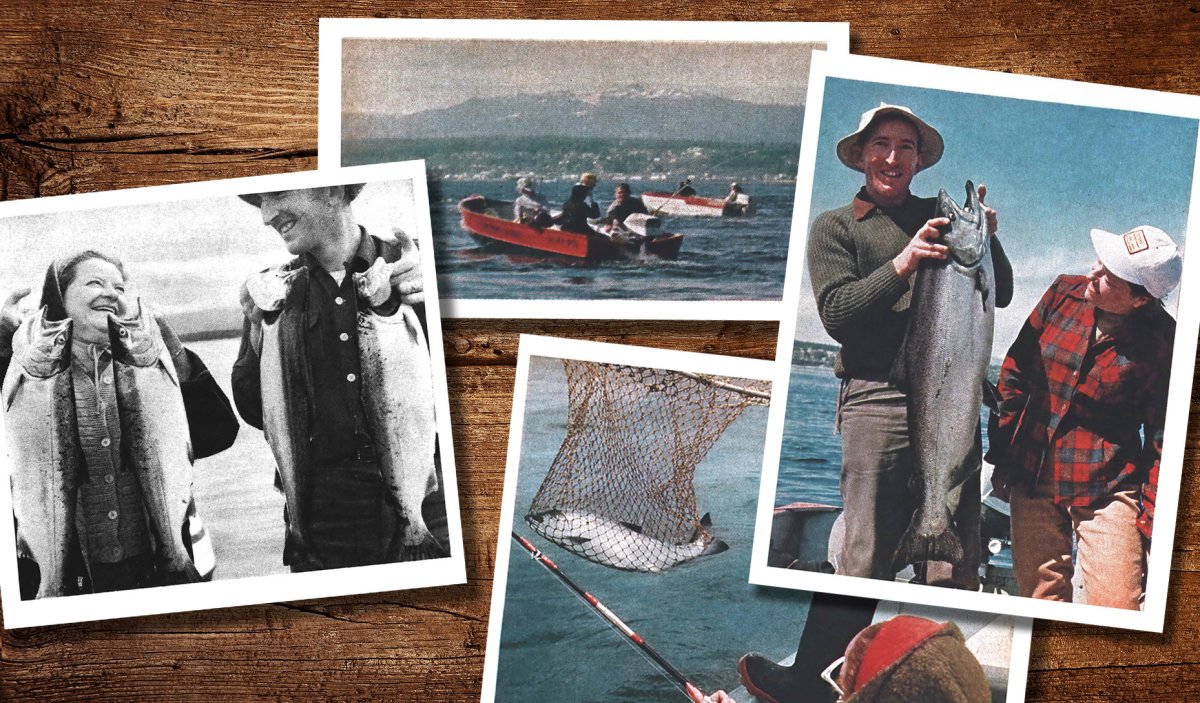
The weight of the salmon turned it into the tidal current and I said a little prayer that the hook would not pull out or break, though neither Mike nor Kayte heard me. Once more the fish swung in close to the boat and this time, holding the rim of the net in both hands, Mike shoved the mesh into the water up to his elbows and brought Kayte’s salmon into the boat. Mike and Kayte fell into a tight clinch, and it was minutes before I could calm them down enough to take pictures. The scales showed 27½ pounds, just 2½ short of a tyee prize.
“It’s the biggest spring taken so far this year,” Mike told Kayte.
I glanced at the shoreline. During our round with the salmon, we had drifted more than three miles from the spot where Kayte had hooked her fish.
We got to the oyster beds just before the tide rolled in to cover them, and gorged ourselves on the delectable bivalves plus crackers and tasty sauce the cooks back at the lodge had put up for the occasion. If I had a vote, I’d say it was the most joyous eating spree we had at Campbell River.
Read the full article here