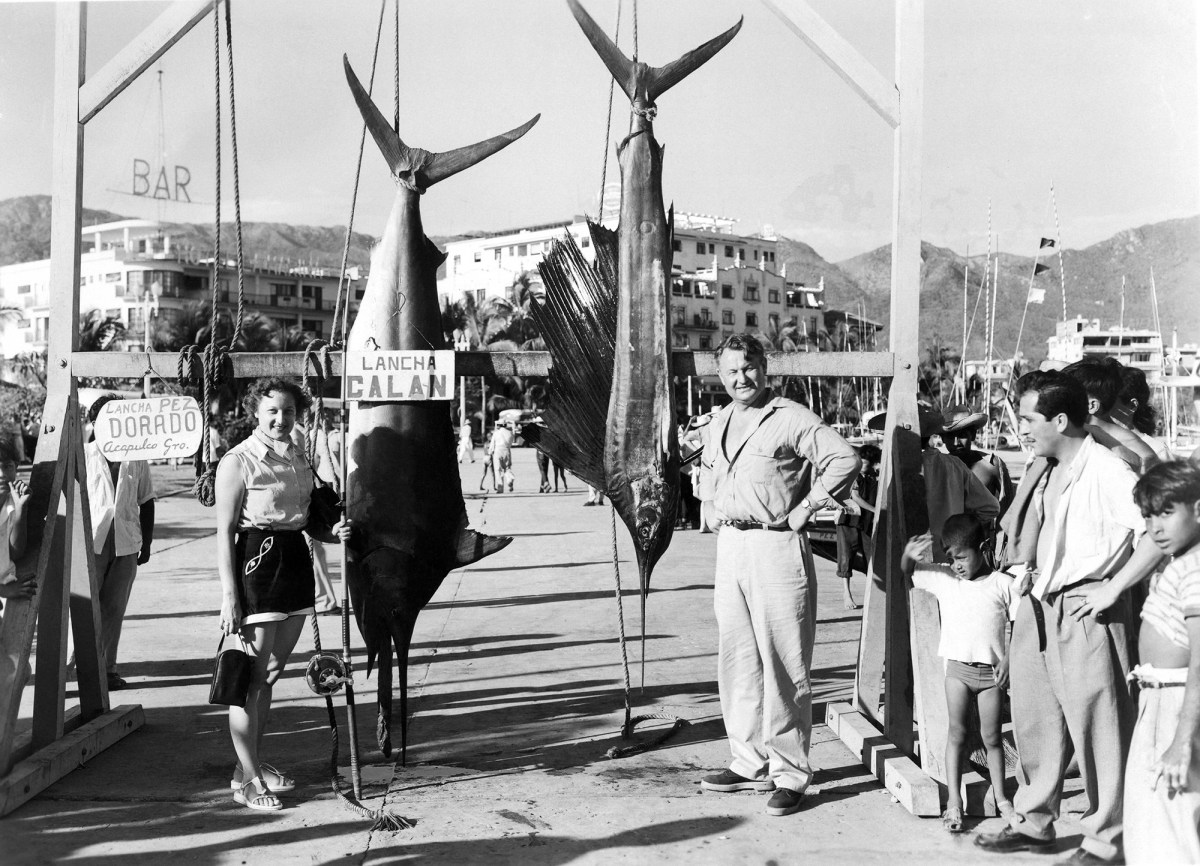

This story, “ Acapulco, Olé,” appeared in the June 1968 issue of Outdoor Life.
“Well, we made it,” I said, as I slowly took in the panoramic view of Acapulco Bay. My wife Joan also was admiring the scenic bay that was fringed by a white ribbon of sandy beach and surrounded by hills covered with lush tropical vegetation.
Now, the 4,500 miles of desert, farmland, mountains, and valleys we had traveled from Innisfail, Alberta, in our little sports car seemed insignificant. Here was beauty, mystery, and adventure unsurpassed in all our travels; here was our trip’s ultimate goal—Acapulco, Mexico.
I am 26 years old and teach science, math, language, and health at Innisfail Junior-Senior High School. I’ve been hunting since I was 14 and fishing since before that. Among my trophies are a black bear, two mountain goats, an elk, a moose, several deer, two antelope, and a 10-pound 10-ounce rainbow trout. On this trip, I was hoping to add a sailfish to my list.
My wife is a registered nurse, but she’s currently enjoying the full-time task of being a housewife.
No thoughts of our little home town in the rich grain-growing area of Alberta lingered as we slowly cruised along Acapulco’s main street and gazed in admiration at the skyscraper hotels built just yards from the pounding surf of the Pacific.
We had barely started our self-guided tour of the city in search of a reasonably priced motel when we were hailed by a well-dressed Mexican lad. He was employed by the tourist bureau and promised to guide us to a comfortable, economical motel. This done, he next offered to show us the sights of Acapulco.
After seeing the bullring, the jai alai arena, the public square, and several beaches, I asked our young guide if he knew of a good boat that could take us deep-sea fishing. Three minutes later I was shaking hands with Captain Carlos Bello and arranging for a day’s fishing on the Tarpon, a 26-foot cruiser hiring out (after some haggling) for $34 a day. My wife and I were to be on the pier at 7 a.m. July 22, a day and a half away.
With these arrangements completed, Joan and I went back to the motel to start enjoying the surf, sand, and sun.
For the next day and night, periodic thoughts of the trophy sailfish hanging over my brother Eric’s fireplace in Calgary, Alberta, raced through my mind. Would I be as lucky as he? I hardly dared hope so, since he had already bagged the second-largest Dall sheep in Boone and Crockett’s 1958 records as well as a beautiful nine-foot two-inch, 110-pound sailfish from Acapulco.
Friday dawned sunny and clear with a slow, rolling swell on the ocean. With a lunch packed for us by the motel cook and a hasty breakfast of hotcakes and coffee tucked away, we arrived at the Tarpon at 7 o’clock sharp. Ten minutes later we shoved off with our six-peso (48¢) licenses and two crewmen, Lolo and Felix.
As I admired several other boats in the fleet, I wondered if our $34-a-day troller was as efficient as the sleek cruisers renting for $80 to $100 a day. But the magnificent view of the bay with its beautiful millionaires’ mansions dotting the bouldered cliffs temporarily sent all thoughts of fishing astray.
As soon as we were out of the bay, Felix started to bait the hooks. He slit the 10-inch mullet from tail to gills on both sides of the backbone and removed the tail and vertebrae. He then inserted a hook through the mouth and sewed up the two halves of the fish so that only the sharp tip of the barb protruded. This procedure was repeated until he had three baitfish ready.
The two outriggers were set up at the correct angle and the baits let out about 100 feet behind the boat. The third line was set out directly over the stern, and all three baits were skipping and darting in and out of the crests of the swells.
Finally, a Coke bottle, securely tied around the neck with fishing line, was put over the side and trailed about 25 feet behind the boat to serve as an attractor for sailfish.
The setting out of baits was completed by 7:55 a.m. We settled back in the deck chairs to await action. It was not long in coming.
At 8:09 we heard a splash about 10 feet off our bow, and Lolo, who was piloting the boat, yelled “Sail!”
He maneuvered the boat so that the lines trolled over the ripples left by the fish. We watched the trailing mullets and saw a black slender bill come out of the water and slash sideways. Felix grabbed the short, stout rod from the holder and let the sail run for several seconds. Then he set the hook with two hard strikes.
I quickly sat in the fishing chair and took the rod. Felix was shouting orders and instructions, and since I was a novice at deep-sea fishing, his guidance was welcome.
The sail began its world-famous tailwalking, and Joan kept busy snapping pictures of his spectacular antics. I soon got the hang of slowly pulling the rod to me and then reeling the slack in as I lowered the rod for the next pump.
After 10 or 12 minutes the sail was at boatside. Felix grabbed his club in his right hand and the fish’s bill in his gloved left hand. The first time he struck the fish, the hook bounced free of its mouth.
“See,” Felix said, “I told you how easy it is to pull the hook out of a sail’s mouth if you aren’t careful.”
After the sail was dispatched and aboard we checked the time: 8:23. It had taken only 12 minutes to land the fish. I was somehow disappointed that such a large and beautiful fish could be boated so easily. I thought to myself that the next sailfish would be Joan’s.
The cerveza (beer) was passed out in celebration of my sailfish and the lines were rebaited and set out again.
At 8:45 we heard the reel on the rod I had just used whine as 20, 30, 40 yards of line spun off it. Felix grabbed the rod and waited till the reel stopped its mad spinning. Then he heaved back hard twice, and a great silvery body hurled itself out of the water.
“Marlina! Marlina!” Felix cried. “Be ready for about three hours of hard work, Señor.”
I took the rod and started a long see-saw battle with the great fish, a black marlin. He made a few slashing, head-shaking leaps and then sounded. Yard after yard of 50-pound-test line seemed to melt off the reel. The brake was so hot that Felix burned his fingers trying to tighten and loosen it.
The marlin’s frantic first charge for freedom was slowing, almost finished, when I glanced at the reel. Only a few yards of line left, and I couldn’t stop the fish! Felix’s eyes widened as the same thoughts ran through his mind. He yelled something in Spanish to Lolo, who responded by turning the boat at full throttle toward the fleeing fish. Now I could take up some slack and put a few healthy yards of line back on the nearly smoking reel.
We were soon directly over the marlin, and the battle seemed to be a stalemate: the fish took no more line, but I couldn’t budge him or get even a single turn on the reel. It was as if he were anchored to the ocean floor. When he moved at all it was in horizontal circles several hundred feet below the surface. The main worry now was the threat of his taking the line under the boat and into the propellers.
A few minutes later, after both the marlin and I had gained a second wind, the line started to move slowly out from the stern. Felix warned me that my quarry was going to surface. Sure enough, up he came. Joan was ready with the camera and got some shots of his frenzied antics.
When his head-shaking routine failed to loosen the hook, the marlin started another long run and once again caused the reel’s brake to heat up as he peeled line off the spool. This time he didn’t take out much line before sounding to recover his strength. I glanced at the line and saw, to my horror, about 18 inches of nylon filament unraveling from it. I looked at Felix and shook my head. He soberly repeated my gesture and said he would replace the line that evening.
“Some consolation,” I thought to myself.
But I soon managed to pump and wind enough line onto the reel to feel more confident about landing the tough marlin.
With the threat of the line’s snapping out of my mind, I glanced at Felix and saw him staring off the stern. In a moment, I saw it too — a large black fin slowly knifing through the water toward the marlin.
“Sure hope he isn’t interested in my fish,” I said. “I did want to catch a shark, but not at the moment.”
I could feel drops of perspiration rolling down my face, and suddenly I was aware of aching muscles, blistered fingers, and a nearly numb left hand.
“How long?” I asked.
“Just one hour,” Joan replied as she wiped my forehead and gave me a few needed swallows of pop. “I don’t see the shark anymore,” she added encouragingly. “I guess it didn’t get the scent of blood.”
Several more minutes passed, and then a large boat from Carlos’ fleet appeared. Somehow its captain realized I had a marlin on and offered us the use of his harpoon, a six-foot weapon with a detachable head and fastened to a heavy rope. My crew quickly accepted it, and amid cries of good luck from the other boat’s three U.S. couples we slowly drew apart to make room for the marlin’s continued efforts.
The two boats were just a comfortable distance apart when the marlin flashed out of the water, this time not tailwalking but leaping 10 or more feet clear of the surface. He was a magnificent fighter all the way, and I can’t conceive of any fish putting up a more valiant battle.
Slowly I could feel the marlin tiring, but I too was being drained of energy. My shirt was completely soaked, but in the hot, humid air this moisture was in no way cooling. A little more effort and the great silver-blue fighter floated exhausted at the side of the Tarpon. The harpoon flashed through the air and plunged deep into the fish’s massive body. The fight was ended. I had spent one hour and 20 minutes of hard work in subduing this swift and powerful battler. During the fight he had leaped 17 times.
The three of us groaned and strained as we pulled the marlin over the gunwale. This effort was not without some pain, as I had unwittingly grasped the fish’s bill and given a great yank before I realized that a considerable part of my palm was being ripped by the many razor-sharp barbs.
Once we had the fish safely on board, we stood back to admire him. His tail and bill protruded over the sides of the boat. His great size made the sailfish look small by comparison, but I knew that here were two fish of which any man could be proud.
I didn’t realize just how lucky I was until I talked to several people who fish regularly. In a little over two hours and for just $34, I had hooked and landed two fish that many people spend small fortunes trying to catch.
After another round of cerveza we started trolling again, this time in hopes of hooking either a shark or a sail for Joan. A half-hour later we spotted a flock of sea gulls diving and darting at something in the water. We headed in their direction and found a school of oceanic bonito working near the surface.
Felix put out a feather jig and handed the rod to Joan. She hardly had the rod in her hands before the jig was slammed. The reel spun for several seconds as the fish ran. Joan started to work on him, and in a short time a four-pound bonito was flopping in the bottom of the boat. We tried the area for a few more minutes but were out of the school.
We trolled unsuccessfully until 2 p.m. and then decided to call it a day. On the way back to Albacora pier, Felix sewed flags onto the outrigger line to indicate the catch of the day.
At the dock, a number of Mexicans came out to greet us and to help hoist the fish onto the weighing and measuring frame. Several American tourists snapped pictures of the fish. The agent for the taxidermy company was there to measure my catch.
I arranged to have the sailfish mounted and shipped to Calgary, Alberta. The $185 mounting cost sounded like a lot out of a teacher’s salary, but I realized that I might never get another sailfish and that this was a trophy about which few Canadians in my position can boast. All hesitation vanished when I visualized the beautiful fish arched over my fireplace.
The marlin? I couldn’t possibly afford the $300 it would take to get him mounted. Besides, a nine-foot-two-inch, 125-pound sailfish is far more impressive than even a nine-foot 10-inch, 300-pound black marlin. I had the bill, which I’ll mount myself, cut off the marlin, and the marlin meat was hacked up and distributed among the Mexicans in no time.
Read Next: I Was Alone, Adrift at Sea, and Speared by a Sailfish. Then My Troubles Really Started
Jon’s bonito, prepared by the excellent Mexican cook in our motel, tasted delicious. Our first attempt at deep-sea fishing was a total success.
Fishing at Acapulco turned out to be the crowning triumph of a marvelous vacation in Old Mexico. It will provide the basis for many hours of exciting reminiscing and-of coursea certain amount of bragging.
Read the full article here