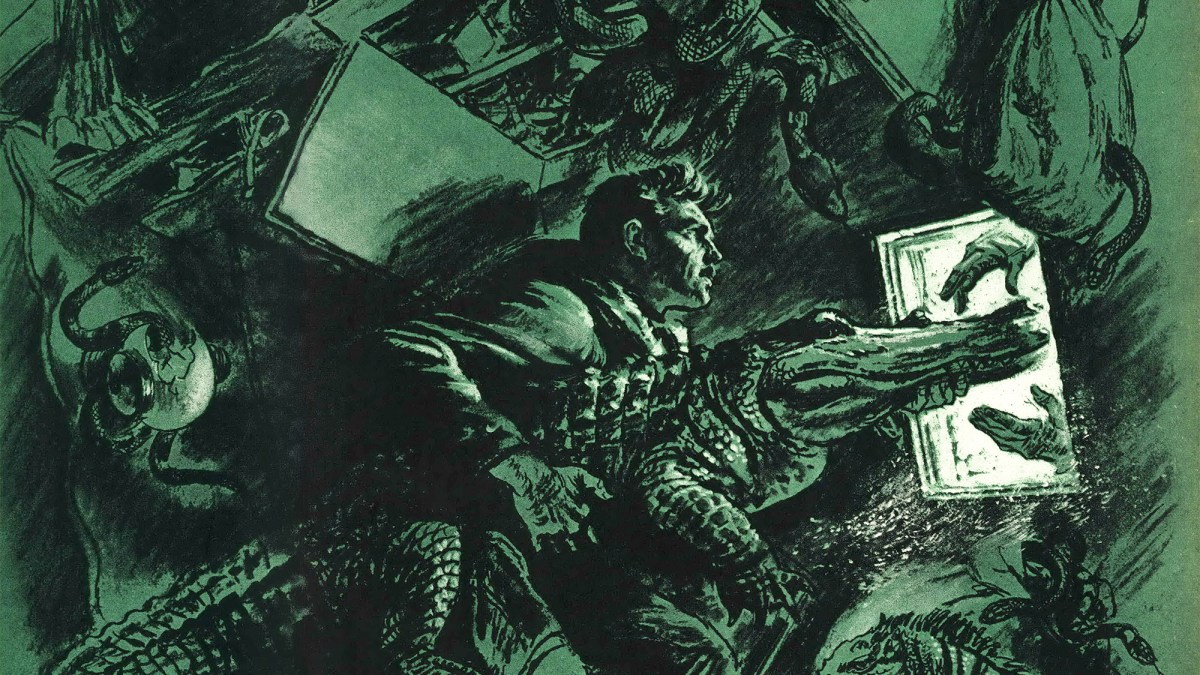

This story, “Never Drop Your Guard,” appeared in the February 1963 issue of Outdoor Life. Allen’s “Snakes Alive” exhibit was popular and you can find an excellent collection of vintage photographs of the snake exhibit here. While the author describes cutting a snakebite to release venom — the prevailing recommendation at the time — this is no longer advised as a snakebite treatment. Here’s what to do instead.
It’s a pretty good bet I’ll die of snakebite one of these days. Not that I expect to, any more than a racing driver expects to be killed on the track, but it happened to my dad, it’s an occupational hazard in the business I’m in, and it may happen to me. It won’t if I can help it, however.
I’ve been bitten once. A five-foot Florida diamondback drove its fangs into my hand in 1959, and that experience will last me the rest of my life. If another venomous snake ever strikes me, it won’t be because I took chances. I’ve learned my lessons on that score, and they were bitter ones.
I earn my living as a professional snake hunter and handler. My mother and I run two reptile establishments, Snakes Alive, one on U.S. 10 in southeastern Michigan a few miles north of Pontiac (my father managed that one until a cobra killed him in 1961), the other just south of the Straits Bridge at Mackinaw City. Both feature displays of live snakes, alligators, lizards, and other reptiles, and are open to the public. We get a lot of satisfaction from the fact that we’re providing accurate and reliable information about snakes and doing our bit to dispel superstition, fear, and aversion that surrounds them.
For sport, and also to keep our cages supplied, I hunt snakes every chance I get, the way other men hunt quail, ducks, or deer.
I grew up with reptiles. Dad and mother ran the snake sideshow with the Beers and Barnes circus for years. I started playing with snakes as soon as I was big enough to toddle. By the time I was six I began hunting garter snakes and other small kinds which we fed to the big ones in the show. I began keeping and studying indigo snakes, bull snakes, blue racers, and others while I was still in school. I finished high school at Waterford, Michigan, in 1953, and the next winter I went on my first big-time hunt, a three-week trip to Florida with two experienced hunters. We caught anything and everything we could for a doctor who was making a private snake collection, and on that trip I took my first diamondback, an 8½-pounder that measured five feet seven inches. I was hunting alone, and when I tried to sack him, he gave me a bad time. But I finally got him in the bag and it was the biggest thrill I had ever had. I’ve been a confirmed snake hunter ever since.
I get a bigger kick out of hunting and capturing snakes alive than any other outdoor pastime I’ve ever tried. I never kill one, harmless or venomous, and if we didn’t have our reptile exhibits I’d still hunt them for fun and let them go, the way some fishermen put back trout.
In addition to action and risk, snake hunting as a sport has other advantages. There are no closed seasons, you don’t need a license, you can hunt wherever you happen to be, you’re welcome on anybody’s property, and there’s no costly equipment to buy.
The bigger and more dangerous the snake, the greater the thrill for me. I like to hunt blue racers and water snakes and the small marsh-dwelling Massasauga rattlers around our home in Michigan. I even enjoy hunting little ribbon snakes that some of our big pets relish. But I greatly prefer to go after water moccasins or timber rattlers. They’re big enough to fight back. And for the last word in thrills, give me the Florida diamondback, king of the venomous snakes of this country and one of a dozen or so of the deadliest in the world.
Everything about this huge, heavy-bodied rattler — his flat sinister head, buzzing rattle, thick and powerful coils, his fighting pose, arched and terribly ready — spells sudden death.
I caught 52 in the Sarasota-Bradenton area of Florida last winter, hunting in my spare time. I averaged two or three each time out. Once I took a five and a six-footer from the same gopher burrow. On my best day I came back with 13, and each one packed enough excitement to last a reasonable man a month. Other hunters can have the big bears of Alaska or the lions of Africa. I’ll take diamondbacks. It’s hard, hazardous hunting the way I do it, but it’s also high adventure.
The biggest rattler I took last winter, and the biggest I ever caught, was the six-footer. He weighed just over 10 pounds. They’ve been reported in recent years up to seven feet four inches, and old-timers claim an eight-footer used to be killed occasionally. A diamondback seven feet four inches long would weigh around 18 pounds. Add venom sacs capable of injecting a teaspoonful of poison at one bite and fangs close to an inch long, and you’ve got a truly formidable snake.
I learned most of what I know about hunting them from Ray Williams, a St. Petersburg postal employe who hunted them 20 years as a hobby. He gave it up a couple of years ago when a young boy who was out with him was bitten and died.
“Hunt the burns,” was the first thing Ray told me, and that is the key to successful diamondback hunting.
Florida rattlers don’t hibernate or congregate in winter dens as they do in the North, but they come together for the winter and the spring breeding season. So where you find them then, you’re likely to find plenty. Fire runs through a lot of Florida countryside each winter, burning off palmetto flatwoods, oak openings, sandhills, and other good rattlesnake habitat. The burns vary from an acre to 5,000. I’ve taken snakes from big ones and little ones. Last winter I captured a fine 5½-footer in a one-acre burn beside a dump. A family living nearby had never seen a live diamondback and assured me I’d have no luck. Their eyes bugged when I showed them what I had caught.
When I get the chance, I hunt a burn while fire is still smoking on the far side. Others I don’t get around to for as long as six weeks. It makes little difference. With all cover destroyed and the area blackened, any snake living in it is easy to find.
The Florida snake hunter has an ally without which he wouldn’t make much of a showing, especially in burned-over country. That is the gopher tortoise, a heavy-bodied, slow-moving, edible land turtle that could dig its way to China in a week if it set out to. In addition to being the snake hunter’s best friend, he’s the benefactor of every creature that seeks shelter underground when trouble comes, diamondbacks included. If there are rattlers in an area, they are sure to be found in gopher burrows after fire has passed.
The burrows run from 15 to 25 feet long, zigzagging into the ground to a depth of three to four feet. The full-grown gopher is close to a foot long and half as wide, and excavates a hole about the size of a woodchuck’s or prairie dog’s, with much the same telltale mound of sand at the entrance. If a diamondback is using the hole, the broad trail of its body often will show plainly on this ramp.
I wear soft shoes instead of boots when I’m after rattlers in a burn. Working in the open, where there’s no danger of blundering onto a snake before I know it’s there, I don’t need boots for safety, and I find the shoes lighter and more comfortable. But in heavy cover I wear boots. I like to hunt diamondbacks in an old pair of slacks and no shirt, because of the Florida heat. I hang four or five snake bags from my belt and carry my snake hook and a flashlight.
Very rarely (it happened with only two of the 52 rattlers I caught last winter) I find a snake crawling across a burn, either moving from one tortoise hole to another or out on a daylight hunting prowl. Those are pushovers to take. Most of my catch, however, I find in burrows.
I come up on a tortoise hole with no commotion, approaching from the side opposite the ramp. That way I can size things up without showing myself to the snake if he’s lying just inside the entrance. Now and then a broad belly trail tells me I’ve hit paydirt. More often, however, I have to find out whether there’s a rattler in the burrow.
They have one habit that’s a big help. More than half the time they lie within a foot or two of the entrance. I’m able to yank out with my hook a fair share of those before they take alarm. They just lie and watch me, their forked tongues flicking but not rattling their rattles or showing fear. They’re out of the hole before they know it.
Not all behave that way. Some are extremely spooky, zipping back down at the first hint of movement outside. Those, and the ones lying too far inside to be seen, are harder come by.
Some I spot with the flashlight, four or five feet in, and if I can reach them with the hook, it isn’t hard to pull them out where I want them. If one escapes, or I’m sure he’s there but can’t see or reach him, I usually go back to my car for a shovel and dig him out, which may take from 20 minutes to two hours.
Quite a few Florida hunters use gasoline fumes nowadays to drive snakes into the open, pouring a small quantity of gas into the burrow with a funnel and length of hose (see “Listenin’ for Rattlers,” Outdoor Life, March, 1962). It’s productive, but I wouldn’t care for it. I want to take my diamondbacks the hard way, like still-hunting deer or jump-shooting ducks.
Related: 7 Ways Not to Die from a Rattlesnake Bite
It’s when you have your snake out of the hole that the excitement really begins. A diamondback displays small liking for being put into a bag, and if he’s more than four feet long, there isn’t much use trying to maneuver him in with the hook. I have no choice then but to pin him, pick him up, and drop him in.
First I throw him to one side, far enough so he can’t slither back to the hole while I’m getting ready to sack him. Then, because I do most of my hunting alone and have nobody to hold the bag open, I drape it on a bush with clothespins and I’m ready.
Pinning a diamondback is hair-raising business. You must press the snake’s head to the ground with your hook across the widest part of his jaws so that you can get a grip with one hand just back of them. You can’t press too hard or you’ll injure the snake, and if you’re dealing with eight or 10 pounds of coiled fury, holding it takes some doing. Somebody once described a big rattler as a head on the end of a long muscle, and that’s exactly right. Anyone who believes snakes are wiggly, soft-bodied, slimy creatures like overgrown worms should try to pin and pick up one of those Florida buzz-tails. For their weight and size they’re as powerful as any animal I’ve ever handled, cool and rough to the touch, hard as steel springs, and quick as forked lightning. Death is never more than a foot away while you have one in your hands.
You can’t pin one when he’s facing you, and if he’s really aroused it’s hard to get him to look the other way. I’ve pinned docile or unwary ones and had them in the bag in 30 seconds. Others I have danced around like a mongoose for as long as 10 minutes, waiting for an opening, before I made the first jab with my hook.
Once you have the head pinned you don’t lose any time. You instantly reach for the neck, making certain you get a good grip, drop the hook, and pick him up with the other hand. If he starts to whip before you can grab him, you jerk the hook off and begin all over, for a big one will break his own neck if you keep him pinned.
Most hunters and handlers I’ve watched grasp the snake with the thumb and fingers around the neck just behind the jaws, much as you’d take hold of a hammer handle. I prefer a different hold, one I developed myself while milking rattlers of their venom. I put my first finger on top of the snake’s head between the eyes and press down firmly, then grip him with my thumb and second finger. That keeps him from twisting his head around and sinking a fang, and if I want to open his jaws for milking I have better control.
Grabbing a rattler that way is a little like taking a wolf by the ears.
Grabbing a rattler that way is a little like taking a wolf by the ears. There’s a trick to letting go. I drop the snake into the bag tail first, making sure all of him is in, and then snap his head away from my hand and down into the sack. I twist the top shut instantly and tie it tight. And when I’m carrying a sacked snake, I’m careful to keep him well away from my legs and body. Those long fangs can punch through cloth like hypodermic needles.
Not all the excitement that comes to a snake fan results from hunting. Handling can have its lively minutes, too. I proved that in a comic-opera episode one cold November day in 1956.
I loaded a 12-foot house trailer with an assortment of reptiles and started for Texas to open an exhibit. The average bystander, looking into that trailer, would have had nightmares for a week. It carried a dozen big rattlers in bags and boxes; half a dozen indigo snakes, coachwhips, and water snakes; 50 pounds of assorted small turtles; an 80-pound alligator snapping turtle in a burlap bag; three iguanas, including a five-footer; a gila monster (the only poisonous lizard in the United States); five alligators (two of them six feet long); a 90-pound Komodo dragon (the biggest lizard on earth); and a nine-foot boa constrictor. For an 1,800-mile winter drive, that was really a collection.
Less than 25 miles from home, driving in a hard snowstorm, I skidded on slick pavement, and the trailer overturned. I was frantic. The thermometer stood at 20 above, and I knew that 15 to 30 minutes of exposure to that cold in the capsized trailer, without heat, would mean the death of most of its occupants.
The trailer was lying on its door, but I wrenched off a small ventilator cover and crawled in. Even for an experienced snake handler, that scene was a stopper. Gators and turtles and harmless snakes were all over the place, the diamondbacks were buzzing like hornets in their bags, and the dragon was flicking out his black, forked, 10-inch tongue like a dinosaur come back to earth.
While I was wondering where to start, a carload of deer hunters pulled up and offered me a hand. That was before they’d seen my cargo. But they were game, and we formed an impromptu bucket brigade to transfer the whole collection to my car.
I passed out six-foot gators with the assurance they wouldn’t bite, hoping to myself I was right. We relayed bags and boxes of rattlers down the line. Before we got around to the Komodo dragon, probably the most terrifying looking of the lot, another carload of hunters stopped and we managed to right the trailer and get the door open. I handled him myself. I made the drive to Texas with the whole kit and kaboodle in my car, stopping only long enough to snatch a few minutes of sleep now and then. That was a trip I’ll never forget.
People believe many things about snakes that are not true, and one of the fascinating things about running a reptile establishment such as ours is the tall tales you hear. Somebody is forever telling us about encountering a 12-foot blue racer or a water snake eight feet long, at least twice the length they ever reach. I suspect those who relate such accounts actually believe them. If you’re afraid of snakes and see one moving, you naturally “see” more snake than is really there.
Other legends get built up the same way. Tales of hooded or crested snakes are common. Even my mother remembers one she saw in childhood that scared her half to death — and she didn’t imagine the crest, either. She encountered a snake that was shedding its skin, and a flap was turned up over its head to form a real topknot.
We’ve been told by Mexican women that if a milk snake gets into a house where there is a nursing mother, it will crawl into her bed at night and steal milk until her child dies of hunger. A version that farmers in this country often tell is of milk snakes robbing their cows in the pasture.
The most fantastic yarn I ever heard was about two women walking along a path when one saw a hoop snake, a dreadful reptile that exists only in imagination, rolling toward them. She jerked her friend aside but not quick enough. The snake struck and tore the second woman’s dress.
Shaken with fright, they sat down on the ground, and the one with the torn dress noticed a thread hanging. She leaned over and bit it off, and fell dead. The man who told that story claimed he had known both women and swore it had happened exactly that way.
A common false belief is that rattlers unfailingly rattle before they strike. Don’t ever count on that. Most snakebite victims are struck by snakes they didn’t know were there until they bit them.
No one knows the purpose of the rattle for sure, but it’s a safe assumption a snake doesn’t buzz just by way of warning that he’s about to strike. My personal theory is that a snake rattles for the same reason a bull paws the ground, a dog growls, a skunk pats its forefeet, or a deer throws up its white flag. It means he’s upset. Maybe frightened, maybe angry. In any case, it’s a nervous reaction, for his benefit, not yours.
In hunting diamondbacks, I find them more spooky and more inclined to rattle in the burrows than out. When sunning themselves in the open, they seem to rely on natural camouflage and refuse to buzz most of the time, no matter how close a man may come to them, unless actually touched or prodded. Then they strike first and rattle afterward.
So if you’re hunting, fishing, camping, or hiking in rattler country, don’t depend on a snake to let you know he’s there before he takes a poke at you. It’s up to you to follow rules of safety. Look before you step, and know where you are putting your feet and hands.
I’ve never had a really close call while hunting. My one mishap came from handling, and it wouldn’t have happened if I hadn’t been so dull with fatigue that I had no business picking up a dangerous snake.
One of the attendants at our Mackinaw City place was bitten in July, 1959, while milking a diamondback, and as a result I was on my feet for 40 hours, under great strain, and had virtually no sleep. When it seemed likely the victim would recover, which he did, I foolishly undertook a milking demonstration for a group of visitors. I didn’t realize I was foggy from exhaustion.
My father, mother, and I have milked something like 12,000 rattlers. I’ve milked maybe 4,000 myself, and it had become a routine performance. I climbed into the pit and chose my snake, a five-foot diamondback, pinned him, and picked him up. He started to whip instantly. I keep a death grip on snakes as long as they are lashing around, but this time my reflexes were slow and I didn’t tighten down fast enough. He wrenched his head half free and buried one fang at the base of my index finger. Then he drove the other fang in at the base of my thumb, biting twice in swift succession.
I saw and felt the strike but had no chance to throw the snake aside. He kept one fang buried in my thumb, and I knew better than to squeeze down on his head and milk more venom in. I grabbed him by the nose and eyeballs, unhooked him and dropped him, and said, “That’s all, folks,” to the onlookers. It was over so quickly most of them didn’t realize what had happened. I walked out of the pit and into the office.
I didn’t feel much pain for a minute or two. The rattler’s fangs were about three-quarters of an inch long, and the bite felt like being stabbed with a sharp needle of that length. Then a throbbing ache began, and I could feel the thumb swelling as if it were being inflated with an air pump.
I was short on snakebite equipment, as a result of the earlier accident. I used my belt for a loose tourniquet at the wrist and then made two cross incisions over each fang puncture with a razor blade. The suction cups in our first-aid kit had all been used, so I walked out into the air, sat down, and started sucking the venom out by mouth. Dad found me there about five minutes later. By that time the swelling had reached my wrist.
Dad knew what to do. He did more cutting, 10 incisions in the first 15 minutes, and then we raced for the nearest hospital, at Cheboygan. There, as the swelling spread, 20 more incisions were made, suction cups were applied, and a statewide call went out for antivenin. They gave me 10 cc.’s within 30 minutes after the bite, 70 in all in 24 hours. That massive dosage, coupled with dad’s expert knowledge and the fact that I had prompt and effective first aid and hadn’t panicked, saved my life. Out in the woods by myself, I’d probably have died before I could have reached help.
Related: I Watched a Giant Rattlesnake Kill a Man
In less than an hour after the snake struck, I was suffering the most dreadful nausea I had ever known, and within three hours the swelling was up to my elbow. It reached my shoulder that night and by morning had spread far down my side and across my chest.
You have to see a bad case of snakebite to realize how horrible it is, and you have to experience it to know how it feels. My hand and arm were swollen to bursting, purplish-black in color, stiff as a grotesque and hideous sausage, draining from 30 incisions, with suction cups hanging like bloated leeches. There was no let-up in the throbbing pain for three days, and I felt sick all over. I rate rattlesnake bite the most miserable thing that can happen to a human being.
I left the hospital after four days, barely able to walk, with every cut draining and my hand and arm still swollen so I could not move a finger. It was two months before I recovered the use of the hand and it’s still a bit stiff, but I got off with no real permanent damage.
We had far worse luck two years later, at our Pontiac place. It was Sunday evening and we’d had a big attendance. Dad left the reptile house after dark, ate supper, and said he was very tired and was going to turn in right away.
“But first I’ve got to feed the cobra,” he told mother. “He’s had a hard day, too.”
The snake, a five-footer from India that we’d had for several years, was one of our prize exhibits. Aggressive and excitable, he never failed to rear and spread his hood when visitors gathered in front of his glass cage. It made a good show, but at the end of a busy day it left the cobra tired and hungry, and he was always fed. In the years we’d had him, he’d refused all live prey but took dead mice readily. It was dad’s habit to kill a mouse, raise the lid of the cage and drop it in, first making sure the snake was lying quietly on the floor.
You have to see a bad case of snakebite to realize how horrible it is, and you have to experience it to know how it feels. My hand and arm were swollen to bursting, purplish-black in color, stiff as a grotesque and hideous sausage, draining from 30 incisions, with suction cups hanging like bloated leeches.
This hot August night, I suppose because he was worn out and sleepy, he made one of those insignificant mistakes that nobody can afford in dealing with deadly snakes. He lifted the lid of the cobra’s cage without looking to see where the snake was. It was partly reared in a corner, and as he reached to drop the mouse it struck, sinking both fangs into the tip of his little finger.
It was a death sentence, though dad didn’t think so at first. The cobra didn’t hang on or chew as they usually do to imbed [sic] their fangs and force venom into the wound. It struck and withdrew instantly, and dad wasn’t alarmed. “It was a light bite,” he told mother. “I didn’t get much venom.”
They quickly went through the prescribed first-aid routine, a tourniquet at the wrist, incisions at the bite, suction cups applied. Within five minutes mother had injected 10 cc.’s of cobra antivenin, all we had on hand, at the base of the little finger. She tried at once to phone the Detroit Zoo at Royal Oak for more but the lines were down, causing delay, and the serum arrived too late, despite the help of Detroit and State Police in getting it to us.
Because it was Sunday evening, mother was unable to locate our family doctor, and at first dad didn’t think it was necessary to call an ambulance. He talked clearly for 40 minutes and seemed to be suffering no serious effects, though he complained that the bite burned like fire.
Then his speech slurred and thickened and he was suddenly violently nauseated. When the extra antivenin and an ambulance arrived, he was semiconscious. An hour after the snake struck him, he was dead.
We still have the cobra. He’s a valuable reptile, and neither mother nor I blame him for what happened. He did only what cobras are supposed to do, and it would have served no useful purpose to kill him in revenge. But now his cage is opened only with the utmost caution, and he’ll never be out of it again if it can be helped.
Related: Our Professor Gives Extra Credit for Catching Live Rattlesnakes. That’s How We Stumbled into a Snake Den
In fact, since dad was killed, mother and I have turned sort of chicken about handling dangerous snakes any more than we have to. We no longer milk rattlers. But reptiles still fascinate me, and I’d no more give up snake hunting than I’d quit driving if dad had died in a traffic accident. I’ll go on hunting them as long as I live.
From what happened to dad and to me, however, and from the fact that almost everyone who hunts or handles poisonous snakes gets hurt sooner or later, I know the rule I must follow if I hope to reach old age. Dad laid it down years ago. “Never drop your guard,” he told me. He forgot the rule himself for a second or two, and it cost him his life.
Read the full article here