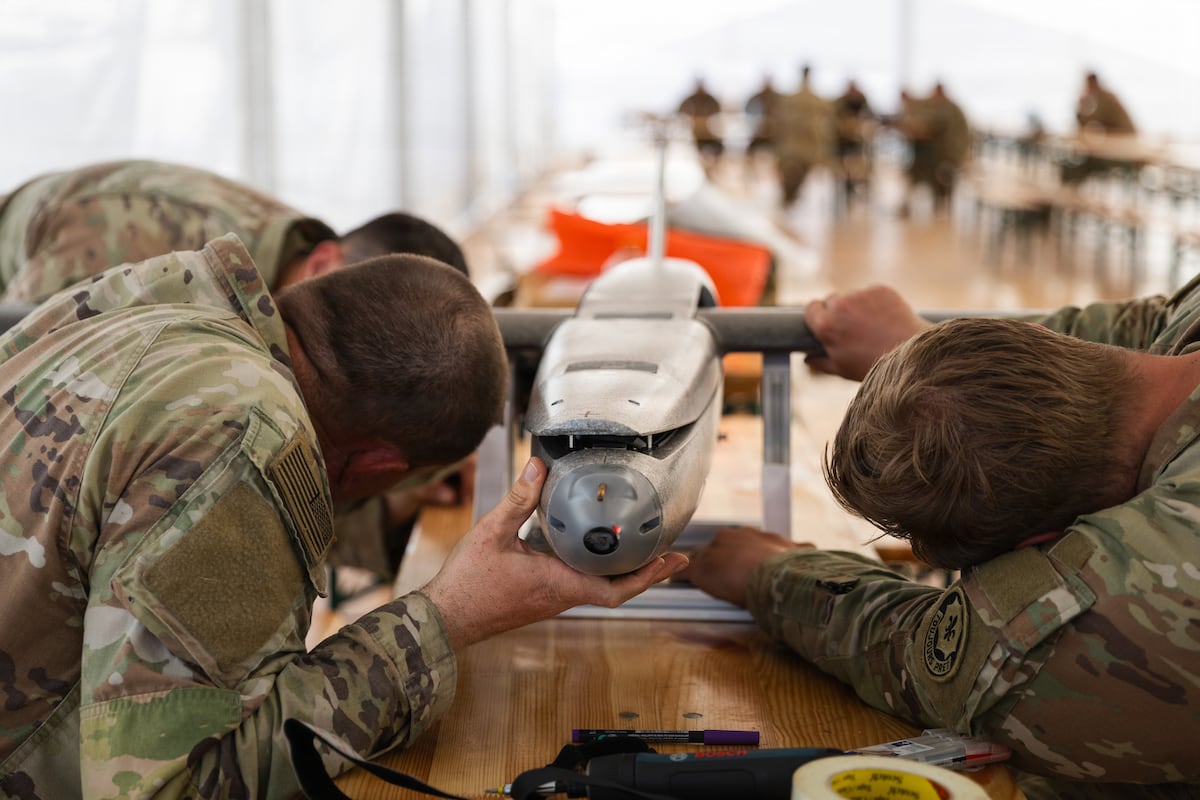

The Pentagon recently named the winners of the Lethality Prize Challenge in the Drone Dominance program, a $1.1 billion effort to expand domestic drone production and reduce the cost of commercial drones for military use.
The Defense Innovation Unit announced in a LinkedIn post last month that the winners — Bravo Ordnance, Kela Technologies, Kraken Kinetics, Mountain Horse Solutions and Northrop Grumman — developed “cost-effective, mass-producible, and easily integrated lethal payloads for small drones.”
According to the program’s Industry Day presentation, military officials reviewed submissions from 17 vendors. Evaluators examined both the payloads themselves and how they interfaced with various Electronic Safe and Arm Devices, or ESADs, as well as their compatibility with drones being considered in the program’s broader competition.
Although the cash prize was just $10,000 — a modest sum compared to the scale of the Pentagon’s investment — the selected designs will be presented to companies participating in the program as “preferred munitions” for one-way attack drones.
Northrop Grumman’s winning design, dubbed the Common UAS Payload, was built to require “no redesigns” and is “ready to integrate and deploy immediately,” according to a statement from Tanya Santers, the company’s director of fuzes and warheads.
The company added that it has invested more than $2 billion over the past several years in technologies and manufacturing facilities to meet the program’s requirements and accelerate delivery timelines.
Unlike Northrop Grumman, which enters the competition with an established defense-industrial base and decades of experience producing munitions for the Pentagon, most of the other winners are relatively young companies hoping to capitalize on the military’s growing demand for drone warfare technology.
The Texas-based Bravo Ordnance launched in 2025 with $3.5 million in venture capital. The company bills itself as capable of creating custom warheads in “two weeks or less.”
Founder Devan Plantamura, a Navy and Army veteran, told GQ magazine that his experience working at military technology startups convinced him the industry focused too heavily on drone platforms and not enough on the weapons they carry.
Without a warhead, he said, an attack drone is “just a flying object.”
The Israeli defense startup Kela Technologies was founded in July 2024 following the Oct. 7 attack as a software company focused on helping Western militaries rapidly integrate commercial technology into existing military systems.
The company quickly attracted backing from Silicon Valley investors as well as IQT, the CIA’s investment arm.
In just two years, Kela has raised roughly $100 million, secured an additional $200 million in financing and earned a reported valuation of $1.2 billion.
Although software integration remains its primary business, Kela was also named a winner of the Lethality Prize. The company reportedly partnered with fellow Israeli defense firm Autonomous Guard, which specializes in border security technology, including drones.
The North Carolina-based Kraken Kinetics was founded in 2023 to manufacture warheads for drone combat. Since then, the company has heavily promoted its Terminus payload, a warhead designed for first-person-view attack drones.
Kraken has demonstrated the system with Army Rangers, Marines and other military units, emphasizing its ability to be quickly attached to commercial drone platforms through its ESAD.
The Colorado-based Mountain Horse Solutions is one of the older companies in the group. Founded in 2014, about a year after its parent company, Global Ordnance, the firm initially focused on personal protective equipment before expanding into military drones in 2025.
That year, Mountain Horse and its partner Rotron Aerospace secured a spot on the Defense Department’s Blue UAS list of approved drone systems.
For the Lethality Prize, Mountain Horse partnered with several other companies to develop a payload system designed to work with “any drone on the market.”
In a statement, Bill Allen, Mountain Horse’s president, called the challenge “exactly the kind of problem set we are built for — delivering adaptable, scalable lethal solutions that keep pace with the lightning-fast evolution of drone warfare.”
The Defense Department launched the Drone Dominance program in July 2025 and in December of that year, revealed a three-phase effort to acquire roughly 300,000 drones by 2028.
For the first phase, the Pentagon invited 26 companies to demonstrate their systems. In the second and current phase, military officials are evaluating 79 drones from 49 companies for both long-range and close-quarters missions.
Over the remaining phases, the Pentagon plans to narrow the field to a select group of vendors. According to Pentagon officials, the goal is to reduce the average cost of a military drone from roughly $5,000 to $2,300.
The third phase of the Drone Dominance program is set to begin around November 2026, with final testing six months after that.
Daniel Terrill is a contributor to Military Times. He’s been reporting on military issues, the gun industry, and the outdoors for nearly two decades. Although writing is his passion, he’s been a Marine, police officer, and, perhaps the most dangerous job of his career, a substitute teacher.
Read the full article here