
This story, “Dragonfly Kick,” appeared in the July 1962 issue of Outdoor Life.
On the third pass in a row, the big largemouth made a blue boil under the yellow popping bug and slapped it out of the water with his tail. My fishing partner Franklin Smith struck, and the feathered lure whisked over his head.
“That bass has a bad case of dragonfly-itis,’’ he said irritably, “but I think I’ve finally found a cure for it.” He took the yellow bug off his leader and bent over his tackle box.
In July and August, the large-mouth bass in our Southern swamp lakes have a mania for feasting on dragonflies. They prey with equal gluttony on the big Blue Darners, Ten Spots, Eponias, Widows, and others found along our lake shores. Except for short flurries of normal feeding at dawn and dusk, the bass concentrate epicurean attention on the graceful, biwinged insects, oblivious to other kinds of fish food and any angler’s facsimile thereof. A largemouth will express quick interest in the splash of an artificial lure, presumably hoping a juicy dragonfly has floundered in the lake, but he’ll slug it maliciously with his tail when he finds he’s been cheated.
For some 20 years I’ve prowled fishing tackle counters in a dozen states, searching for an effective dragonfly lure. Yet I’ve never happened to find one that would fool a bass beyond an exploratory rise and a spiteful slap. Perhaps you have also experienced fishing in midsummer when bass, though feeding actively, would strike repeatedly at your lure without taking it.
Next time it happens, look around. Chances are the bass are feeding on dragonflies.
Franklin and I have given much thought to the largemouth’s passion for the dragonfly. It’s possible that the fish are attracted to the fleet-winged insects simply for the sheer joy of chasing them. But it’s more likely that the largemouth’s diet requires some nutrient that’s supplied by that particular insect, the same as the human body cries out for foods rich in Vitamin C. You might say that the largemouth’s infatuation for the dragonfly is a kind of summer sickness and that the fly is a medicine for the malady. At any rate, that’s what Franklin meant when he said that the bass which slapped his bug had a bad case of dragonfly-itis.
If Franklin knew a cure for this misery-provoking largemouth tactic, then I wanted to find out all about it, for bug-slapping bass had been frustrating me for the past 25 summers.
Franklin had hinted that a new technique was in the offing when he called me at my home in Memphis and invited me to join him for a day of bass bugging on Grassy Lake, which is one of the fishiest bodies of wilderness water left in Tallahatchie County in Northcentral Mississippi. He would drive up to the lake, located about 10 miles southwest of Charleston, from his cotton farm near Money and meet me at Lipe’s Boat Dock at 4 a.m. sharp, so that we’d be on hand for the short feeding spree at dawn. For me, it was a long, 90-mile journey for only an hour or so of fishing. I mentioned the dragonflies, which were in full transformation.
“Don’t worry about them,” he said. “We’ll catch bass.”
We met on schedule on what was to become a sizzling day in mid-July. I clamped my plucky three-horse out-board on a rented boat, and we putted away from the dock, bound for a 20-acre field of water lillies near the center of the lake. We ran about three quarters of a mile and were nearing the lily banks when a fish churned the water at the base of a lone cypress tree. I killed the motor and my companion flicked a black popper to the roots of the tree.
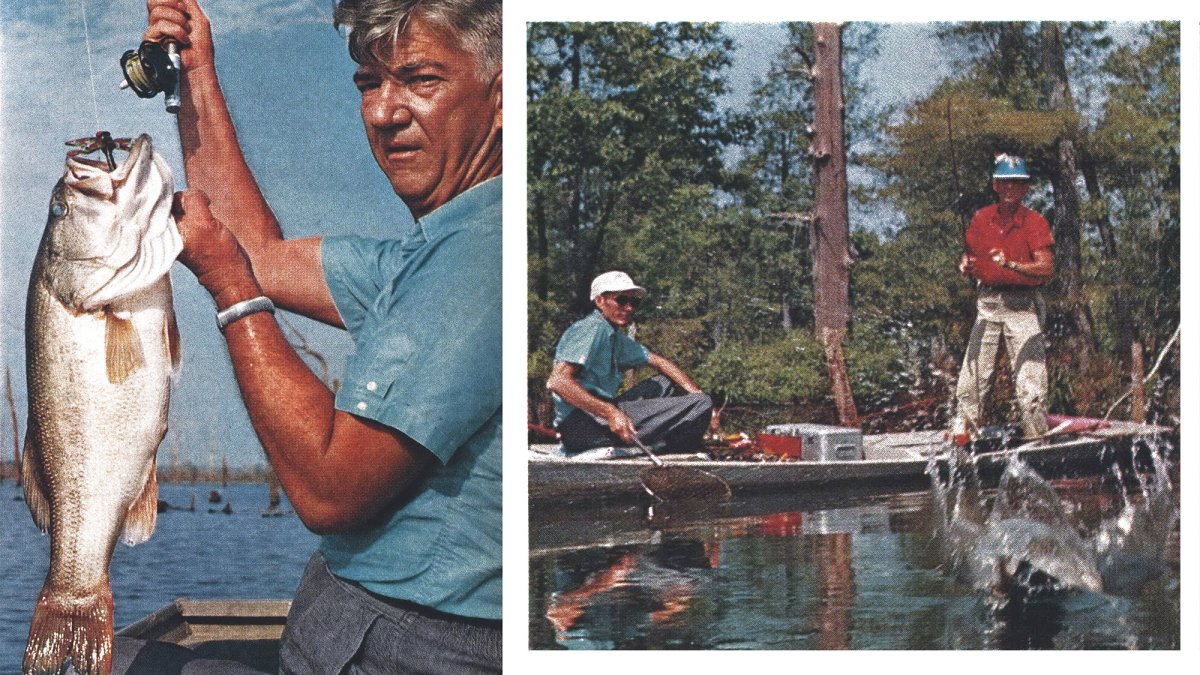
“They aren’t going to wait for us to reach the pads,” he laughed, giving the popper a quivering twitch that did the trick. The bug disappeared in the dark funnel of a swirl. Franklin set the hook. If there’s anything prettier than a four-pound bass jumping against a rose-hued sky at dawn, then I’ve never seen it. We strung the fish and moved on.
A few minutes later I stifled the motor again and the boat glided in close to a huge raft of water plants. Fish were frothing the water. I picked up a light fly rod already rigged with size D level line and a homemade frog. I dropped the small piece of green-painted cork onto a lily pad, let it rest there accumulating attention for about 30 seconds, then hopped it into the lake. A bass lunged for the lure before it hit the water. He was just a yearling, so I boated him quickly in order to make hay before the sun rose and roused the dragonflies. Franklin’s black bug had lost it’s appeal in the gray light of day, so he switched to a green model with black hackle and guinea-feather tail that seemed to be exactly what the bass wanted.
We worked our lures along the edge of the lilies and laid them down in little openings between the pads. The lilies were in full bloom, splashing a back-ground of dark , green leaves with showy pink and yellow flowers. In this beautiful setting, with a fresh breeze on our backs and the fish striking like clockwork, it was bass bugging at its best — even if short-lived. During the next 20 minutes we caught seven yearling largemouths and a five-pounder that I fooled with a yellow bug with a long, feathered tail.
Then the sun started shining on the water, and the fish moved out of the pads. We followed them and took an-other bass apiece on white bucktails and spinners while they were chasing a school of shiners in the cool shade of a strip of cypress timber. Then it was all over.
Here come the dragonflies, I thought.
On Franklin’s suggestion, I cranked the motor and pushed the boat into the old. heavily wooded section of the lake. Not a leaf, a ripple, or a fish was stir-ring. We paddled through the woods slowly. casting now and then and watching intently for sign of a fish. The sun rose higher, scorching the lake. and the heat built up. A dead calm settled over the woods, wilting us with hot, sticky air. Heat devils danced on the tops of our tackle boxes and on the peeled, sun-bleached logs. Dragonflies began to appear.
“The hotter it gets, the better they like it,” said Franklin, and soon the flies were swarming over brushpiles and button-willow bushes.
The bass started feeding on the flies.
Ever since my boyhood excursions to murky stock ponds, I have been fascinated by dragonflies. I read about their habits in the school library, learned their names, and found out how to identify the more common varieties. The biologist’s name for this family of insects is odonata. In the South, we call them snake doctors, mosquito hawks, devil’s darning needles, and mule killers. I put down my rod now, thinking it futile to use it, and watched the flies put on an aerial circus around the boat. A Green Darner was making sweeping flights across the bow, using precisely the same course and altitude on each trip. I saw a Raggedy Saddle-back sunning its veiny, jagged-edged wings on the top leaf of a small tupelo gum tree. A pale blue damsel fly with bright red rings around its body lit on Franklin’s fly line. Another small, rust-colored fly made a hedge-hopping flight across the water in bold defiance of any largemouths that might be lurk-ing below. A Ten Spot with 10 brown splotches on its wings zoomed over-head. I identified a beautiful Elisa with wings as clear as glass and an Eponia with bright brown spots on the golden-yellow membrane of the wings.
Franklin showed me a Widow, wearing dull black bands on her wings as if in mourning, hovering over a stump. The dragonfly held still for a full minute then swooped down and skimmed across the water, flicking the surface repeatedly with her tail in the act of depositing eggs. We knew that the eggs would sink to the bottom and hatch into dirty-gray nymphs that in a year or so would emerge from the lake and transform into beautiful flies, leaving their ugly, crusty shells clawed to reeds and bushes a few inches above the water.
A female Eponia poised for a moment in midair, then crash-dived into the lake, covered with a film of air. Her mission was to puncture the stem of a lily and tuck her eggs inside, but a largemouth devoured her in a violent upheaval of the water that left the lily pad floating crazily, upside down. This was when Franklin made the three casts with his bright yellow popping bug, and this was the same big largemouth that kept swatting it out of the water with his tail.
Franklin’s proposed remedy for dragonfly-itis was as simple as the recipe for making mud pies. He leaned forward and handed me perfect replicas of two types of dragonflies. The home-made flies, which were works of art, were a vividly painted Green Darner and a golden-hued Eponia. Needle-sharp hooks with guards for hazard fishing were embedded in the bellies of the lures. Franklin looped another fake Eponia to his leader and cast it beside the topsy-turvy lily pad. The largemouth erupted again, like lightning striking twice in the same place, and made off with the lure. Franklin levered the hook home and the bass went into a frenzy of tailwalks and buck jumps. I knew then that he had in fact found a cure for dragonfly-itis.
While Franklin was stringing the fish the fish and furnishing the commentary, I examined the flies he’d given me. He
told me that close-grained cork had been used to shape the bodies, and that he’d reinforced them with sewing needles, thrust from end to end. The double pairs of transparent wings he’d cut from flimsy but tough plastic. The wings were securely tied to the bodies with four-pound monofilament. The dragonfly’s bristlelike feelers and long, spiny legs bunched together at the front of the body were fashioned from heavier monofilament. He’d whittled and sanded the pieces of cork to duplicate a dragonfly’s accordioned body and big head. The lures were so lifelike I almost expected them to flit from my hands. I lost no time in baiting my rod with the Eponia.
In spite of the flexible wings, the fly was bulky and resistant on the cast. I switched from tile featherweight rig I was using to an 8½-foot rod with medium action and a matched line with a G-B-F bug taper. Then I could handle the big fly with comparative ease.
By the Same Author: Gollywompers — A Secret Old Bait for Giant Bass
Franklin’s first try with the lure must have been rewarded with beginner’s luck. for we plopped and splatted our flies on the water repeatedly without raising another bass. We tried dropping them gently and allowing them to remain perfectly still. We twitched them and chugged them to no avail. By now the fish were churning the water after the insects; still we couldn’t sell one with our frantic offerings of the fake flies: Same old, incurable dragonfly-itis, I thought, about ready to call it a day.
Franklin kept flaying the water with his fly line. “What in blazes is wrong, Bob?” he asked.
I had an idea. Except for subsurface plunges to deposit eggs, dragonflies are not amphibious. We were fishing our artificial flies as if they were, and that had to be the wrong technique. I told Franklin about it, and we laid down our rods to observe the actions of the flies without distraction.
The predatory insects were not dart-ing and swooping through the air aimlessly. They we1·e feeding on sweat flies, gnats, mosquitoes, and any other small flies they could catch. I saw a Raggedy Saddleback swoop like a hawk back and forth through a swarm of gnats with its thorny legs held like a scoop to catch the insects and hold them while it devoured them in flight. The fly skimmed close to the water, brushing it lightly with its wings. A boisterous bass plowed to the surface and clapped his jaws together within an inch of the dragonfly’s long tail. I was admiring a black damsel fly perched on a stub when a bass slapped it into the lake and inhaled it. We laughed when a yearling bass turned a complete flip trying to pick a Blue Darner from a cattail. Franklin saw another leap into the air and catch a Widow on the wing.
The clouds were banking together for a shower as we picked up our tackle to translate our new knowledge about dragonflies and largemouths into angling techniques. We’d have to hurry, for the flies seek cover and become dormant in inclement weather.
I snipped the Eponia from my leader with a pair of fingernail clippers and substituted the Green Darner, for Darners were predominant in that place. I deliberately tossed the fly into the lower branches of a button willow and let it rest for a moment. I was ready to swish the fly across the water in a feigned swoop of a dragonfly when a bass in the heavyweight class plucked it from the bush and took off with it in a burst of froth. I struck the fish solidly and let him run, playing out about 15 feet of fly line. I tried to turn him. He surfaced, bounced across the water, and kept going away. I gave him the full length of the treasured, old Tonkin bamboo rod that I was us-ing and finally got him started in a circle.
Now, I like bait casting, spinning, and spin casting as well as anybody, but I won’t let that highly productive tackle wean me away from my fly rod. For real skill and finesse of cast, for perfection in lure manipulation, for fair play, and for maximum fish fight, fly fishing will always be the aristocrat of the bassing arts. I determined right then and there to devote more time in the future to this delightful method of catching largemouths. I also committed myself to never again signal defeat before a baffling counter-tactic of a largemouth.
I played the big bass in slowly, handling the line with my fingers and thumb, for I have never found a fly reel to be of worth except as a storage for line. Franklin netted my big fish at the first reasonable opportunity, but his attention was on a Raggedy Saddle-back that was on the verge of causing a commotion in the water with its brazen behavior. Out of the corner of my eye, I saw the fly cavorting on a floating log. It raised on its toes and wobbled its wings as if performing calisthenics.
Franklin whipped a cork-and-plastic counterpart of the Saddleback high over the log and eased it up on the floating perch beside the dragonfly. He let it rest for about 10 seconds and gave it a low flip into the air. A great bass lunged at the lure, missed it, and crashed backward across the log, scaring the daylights out of the real fly. Just then, the clouds rumbled and belched a solid sheet of rain.
“You go back to the landing and bring back the lunch after the rain lets up,” Franklin suggested. (We’d left it in the car because of the threat of summer showers.) “I’m going to stay here and catch that rambunctious old devil.”
I put him out on the rotting snags of a huge cypress stump and cranked the motor. I nosed the boat between ageless, moss-covered cypress logs, circled tight tupelo gum thickets, and scraped through wide patches of button-willow bushes, their marble-size balls thumping pleasantly against the sides of the boat. The overgrown lake was a green-and-blue haven from all the cares I knew. I hit the open water as the sun popped out, so I opened the throttle.
When I got back from the landing I hailed Franklin, inquiring about the fish. He held up a largemouth so heavy that it almost toppled him from his perch — a bass that was worth a long wait in the rain.
We paddled slowly through the woods, mimicking the dragonfly’s flight patterns and rest habits with our counterfeit flies. We found that by casting slowly with a big belly in the line we could skip a fly along the surface of the water like a female dragonfly spraying eggs. It was a difficult cast and netted us only two small .fish. We did far better by dangling a fly over a low limb or by hanging it in a bush a few inches above the water and wait-ing patiently until a largemouth catapulted into the air and gobbled it down. We laughed in good spirits when a yearling leaped into a bush trying for Franklin’s fly and wedged itself between two limbs. The bass thrashed wildly to free itself and finally scrambled back into the lake. Franklin placed a fly on a yellow water-lily blossom with his hand and tied into a three-pounder when we backed the boat away and he twitched the fly into the lake. We set our flies on lily pads and discovered that it was best deception to let a largemouth slam one off a pad and catch it when it struck the water, rather than to remove it ourselves.
Franklin aimed his rod tip at a lone pad and said, “Look at that Blue Darner trying to charm a bass.” The colorful dragonfly took off from the pad and circled it close to the water. It lit, wobbled its wings, and took off again. Franklin made a couple of false casts to the side, adjusting the length of his line and the power of his pitch. He rolled the fly line across the water. The eight-foot tapered leader settled without a quiver, and the fly floated down to the center of the big leaf, startling the real dragonfly. A large-mouth turned a somersault in the water and whammed the pad with his tail.
The imitation fly skidded into the lake and the bass champed down on it.
We moved out of the woods into the deep, blue-black water of a wide clearing, spookily shadowed here and there by the weathered, bone-white skeletons of drowned hardwoods.
Later my eyes fell on a Ten Spot clinging to the fuzzy, brown flower on a cattail. The dragonfly was busily munching a small housefly it had captured. I back-paddled the boat about 25 feet for more room and made a side-winding cast that wrapped my fly and leader around the stem of the cattail, frightening away the dragonfly. The imitation hung therea minute or two. Then I saw a tiny curl in the water at the base of the cattail. I gave the line a steady pull. The coils of leader slipped around the reed, and the lure and leader unwound as neatly as a top string. The fly dropped in the lake — and a lunker hit it instantly.
I let him run, playing out 10 feet of line lapped in neat coils on the bottom of the boat. I yanked another three feet from the reel and allowed it to squeeze out between my fingers and thumb. Then I blocked the flow and gave the rod a quick lift to assure a good hold with the hook. The bass jumped broadside, slammed back into the trough of the splash, and streaked away at a right angle, fouling the line around the stem of a lily pad. I tried to roll a loop of line around the pad and free it. But the loop fell short, and I dared not give enough slack to try again.
Read Next: How to Fish Glide Baits: The Trendiest Way to Catch a Giant Largemouth Bass
I began sawing the tapered leader back and forth gently across the stem. With the bass helping, I eventually severed the leaf from the stem. The battle went my way from then on.
With a cocky smirk on my face, I held the monster over my shoulder for Franklin to see. Never again would a swarm of dragonflies rout me from a beautiful bass lake in terror of their dread disease. Matter of fact, I’d welcome them, for Franklin and I had concocted an exciting, foolproof cure for dragonfly-itis.
Read the full article here