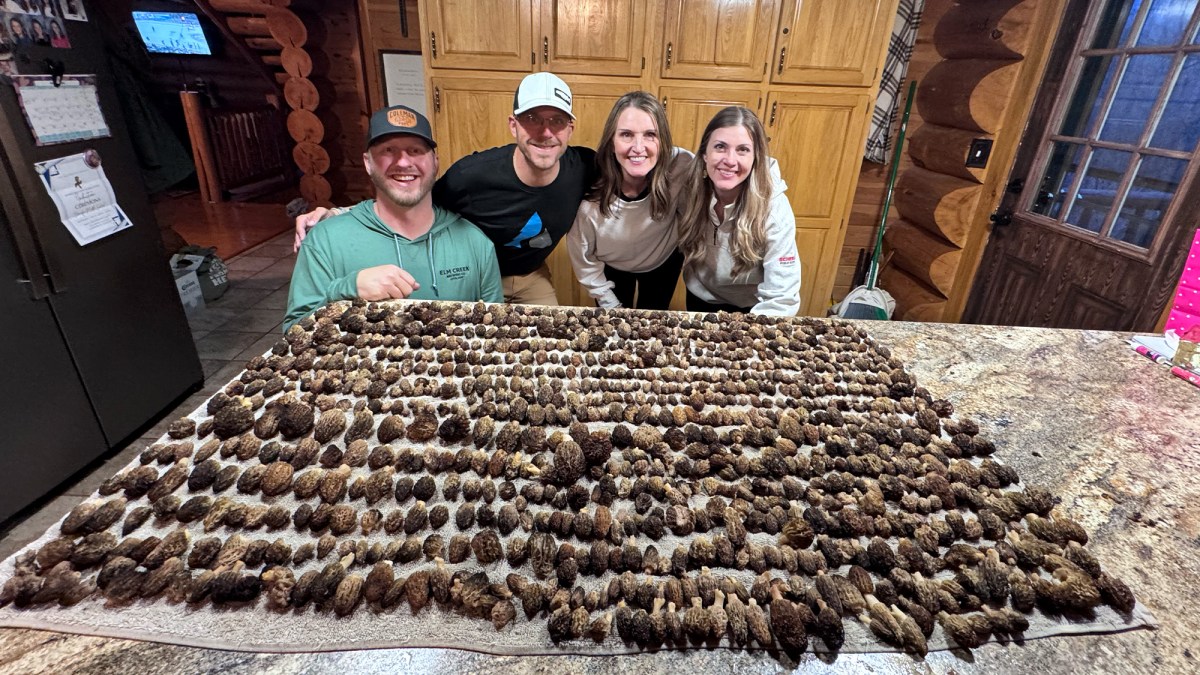

John Holmgren and his wife, Ashley, have been hunting and foraging in the woods around Bemidji, Minnesota, for the past 17 years. One of their favorite parts about spring in the Northwoods is finding and picking the abundant morel mushrooms that pop up around this time. It’s also a fun activity to do with their two young daughters, Braelin and Brinley.
The Holmgrens have had some good morel hauls over that time. But one of their best outings in recent memory was Monday, when John and Ashley went picking with John’s buddy and Ashley’s mom. By the time they left the woods, they had harvested around 1,500 black morels, filling several bags.
Minnesota Mushroom Hunters Haul in 1,500 Morels from One Spot
“We found some big ones, too. And if we would have gotten this rain that we got last night like four days ago, it would’ve been something,” Holmgren says. “It would have looked like a dang forest of morels … I mean, we could have picked probably fifteen thousand of them.”
Speaking with Outdoor Life on Tuesday, Holmgren says their huge haul was a byproduct of two key factors: knowing where and what to look for, and waiting for ideal picking conditions.
As for where to look, Holmgren has the best luck finding black morels in and around stands of aspen — more commonly known as popple in Minnesota. He says morels often grow around ash trees. Yellow morels, which are typically larger than black morels, are more common in the southern half of the state.
“You also want to make sure you have good leaf litter,” Holmgren says. “That’s one of the main things that contributes to a lot of black morels.”
Younger to middle-aged popple stands are some of the best places to forage, he explains. But burned or clear-cut forests can also provide a jackpot under the right conditions.
“This particular spot [where we went Monday] used to be one of our favorite spots when there was a healthy stand there,” Holmgren says. “Then the whole area got hit with a really bad storm this last summer, and it took down a lot of our trees. So they’d gone in there and logged it, and now it’s a big clear cut.”
Holmgren says the two-week window around Mother’s Day is typically peak morel season in northern Minnesota. A more precise indicator, though, is the actual temperature of the forest floor.
“Ground temperature is huge,” Holmgren says. “Fifty degrees is when you typically start to see them coming up, and the mid-fifties to sixties is usually your prime picking.”
Related: How to Find More Morel Mushrooms This Spring
He explains that they’ll sometimes use a physical thermometer probe. Another, more convenient way to gauge ground temperatures in his area is by checking out the soil temperature map that’s maintained by the Minnesota Department of Agriculture. (Although this resource is designed for farmers and gardeners, it’s obviously handy for mushroom pickers, too.)
Moisture is also critical, since morels and other fungi thrive in damp soil. If the dirt dries out too much, the mushrooms will fail to grow, or they’ll die off soon after sprouting.
“We didn’t know that rain was coming last night, and it was getting drier out,” Holmgren says. “We would have liked to let them go a little bit longer, but we didn’t think the conditions would allow for it. So we went in there and got them before they all dried up.”
Timing the conditions is huge, and it’s part of why the mushroom hunters were able to pick so many big morels from one area in a single morning. Holmgren says that he and Ashley had checked out a few different areas for signs of morels earlier this month. Then, last week, while walking through the new clearcut, they found hundreds of baby morels just breaking the surface. Instead of just taking what they found, though, they waited until the morels were ripe.
“That’s something we do a lot of,” Holmgren says. “Because once you find a spot that you know nobody else is picking, you can kind of just keep an eye on them and babysit them until they reach their max potential for growth. Then you can go in and pick them.”
Although some mushroom foragers make a point to leave some morels standing, Holmgren typically picks every one he can find. The key, he says, is to pick them halfway up the stem, either by pinching or cutting off the top half of the mushroom. That way, they can easily re-spout. Holmgren says he fully expects there to be a second crop in the spot they picked Monday, especially with the rain they just got and warm temperatures in the forecast.
“We also use old golf ball bags made of mesh. That way, when you’re walking out of the woods, it spreads their spores as well.”
Read Next: Young Mushroom Hunter Finds a Giant Morel the Size of His Head
And while 1,500 black morels is a good haul by anyone’s standard, it’s not the most that Holmgren has harvested at once. He says that one day last spring, he and Ashley brought home nearly 2,000 mushrooms.
“We have them all the way across northern Minnesota and all the way up into Canada,” Holmgren says, “So, anybody who’s looking for morels — if you live in northern Minnesota, you probably have them somewhere within a couple miles of your house.”
Read the full article here