I Arranged a Budget Safari. Then My Rifle Got Confiscated and I Had to Beg the Outfitter for a Job

This story, “Kudu on the Cuff,” appeared in the April 1973 issue of Outdoor Life.
Picture a young family man in his mid-20’s. He wears resoled shoes, struggles along with the usual mortgage, and drives a two-year-old car. When he goes hunting he usually chases Idaho mule deer in the hills around home.
Given that rather unexciting background, think of this fellow, incredible though it may seem, some 9,000 miles away and halfway around the world in central Africa. Attire him in his customary moldy old Western hat and his one-and-only bush jacket. He is sneaking through the bush, straining for a glimpse of one of Africa’s greatest game animals.
I know that this ordinary Joe made the trip, because I was the man. But even today I still have trouble convincing myself that I actually did hunt in Africa, an excursion that was once beyond my wildest dreams. The awesome kudu trophy on my wall, however, provides all the solid proof I could ever need that I did experience those memorable days and velvet nights on the veldt.
My home in eastern Idaho is close to mountain ranges that provide habitat for mule deer, elk, mountain goats, sheep, bears, and cougars. Upland game and waterfowl are abundant. All in all, it’s a pleasant place for a hunter to live, and my job at a local television station provides the means for me to enjoy local hunting in my leisure time.
But I tingled with anticipation whenever I read about African hunting. Well-thumbed outdoor magazines were stacked beside my bed, scattered on my workbench, and crumpled on the floor of my car. Their pages transported me to far-off lands in pursuit of exotic game. I imagined myself, rifle in hand, kneeling next to some regal beast while a photographer said, “Hold it, sir!”
One day, after I had read one of Jack O’Connor’s stories on Africa, it came to me that I should go to Africa while youth and enthusiasm could still be called upon to overcome some of the obstacles.
My first and foremost problem was an appalling lack of money. At 24 years of age I could hardly cash in any matured life-insurance policies or realize a ruble or two from a long-term investment. Indeed, family responsibilities were becoming more and more pressing, and I began to feel that unless I did something soon I would never have the time or money to hunt in Africa.
Rationalizing as only a hunting nut can, I proceeded to lay plans for my — ahem! — safari.
Replies to my inquiries, though courteous, convinced me that the rates and fees would confine me to chasing tom-cats down Nairobi back alleys, even if I did get to Africa. But I forced myself to believe that I could work things out.
By selling a modest gun collection, squirreling away a pittance here and there, and stretching the family budget, I finally scraped up enough money for a round-trip airline ticket to Zambia. I chose Zambia because of its rich game resources and because at that time it was somewhat off the beaten track. I thought safari companies there might charge less than would larger outfits in several other East African countries.
Family responsibilities were becoming more and more pressing, and I began to feel that unless I did something soon I would never have the time or money to hunt in Africa.
The television station took a tolerant attitude toward my request for a leave of absence, so I forged ahead. My wife had long ago decided that I am a helpless case when it comes to hunting.
My old Model 70 Winchester in .375 H. & H., together with a pair of binoculars in an aluminum case and a back-pack stuffed with a down jacket, totaled only 42 pounds — barely under the maximum free-baggage limit for international flights.
I planned to carry camera [sic] and the bolt of my rifle personally. Six boxes of heavy .375 ammunition filled even the inside pockets of my sport coat, and the weight made me sag, but I managed to stagger along and make the proper flight connections. (I imagine that the prudent approach nowadays would be to check first with authorities about what you may and may not carry aboard.)
Related: Is the Winchester Model 70 Featherweight as Good as It Used to Be?
Off-season rates, nonweekend departures, and a 35-day excursion rate brought the air fare from Salt Lake City, Utah, to Lusaka, Zambia, and return to New York City to a relatively low $901. (I would worry about the 2,000 miles from New York back to Idaho when the time came.) Nonetheless, my cash on hand when I finally boarded the jetliner on May 27, 1970, was a meager $210 — not exactly a bankroll.
The long flight to Rome and down across the Sudan and the Congo to Zambia went off without a hitch. The first hint I had that the entire junket might be ill-advised hit me when a Zambian customs officer confiscated my rifle and ammunition. It seems that one does not carry firearms about in central Africa without good reason and proof of reputable intent — namely a booking with a recognized safari company. I had none, and I must have looked like an insurrectionist to the customs officer at the airport.
Since chances of reclaiming my rifle immediately seemed remote, I proceeded to Lusaka. The $25-per-night rates there posed a major threat to my meager bankroll, so I crossed my fingers when I put in a phone call to Keith Rowse, who at the time was co-owner of Zambia Safaris Ltd. I asked him for a job so that I’d have some financial support while I scouted around for some way to make a hunt.
I explained my situation fully to Rowse and his partner Ron Kidson, but they didn’t exactly leap into the breach. In retrospect, I can see why. A penniless American, dropping in unannounced, doubtless was unusual. I will always consider it a blessing that they ultimately decided to take a chance on me.
My chores soon led to a trip to one of their hunting sites, where I helped set up camp. It was the very start of the safari season, and some last-minute preparations for the hunt were under way.
I soon met Tony Stocken, Lusaka’s air-charter operator. I hold a commercial pilot’s license with instrument rating, and our mutual interest in flying provided much common ground. Tony and I hit it off immediately. He is a pilot’s pilot and a gentleman. His friendship during my stay in Africa was invaluable.
I made a trip down the Kafue and up the Zambezi rivers in an outboard-powered scow to another hunting camp. En route we encountered hundreds of hippos, many swimming crocodiles, and untold thousands of birds of many different species, and sighted several elephants on both the Zambian and Rhodesian shores of the Zambezi River. As we powered upstream I often wondered if this spot or that one along the shore had been a campsite for William Baldwin, Frederick Selous, or the great ivory hunter John Taylor (better known as “Pondoro”) — great hunters who had followed the course of the Zambesi. It is a long way, I reflected, from Idaho’s sagebrush to one of Africa’s storied rivers.
For several days after our arrival at Mushika Camp I was kept hopping. I worked with Kevin Lithgow, with whom I had made the river trip. He was in charge of photographic safaris. We built bush roads, rebuilt the exhaust system of a safari car, and built game-viewing platforms for camera-hunting clients. We even constructed a chimbuzi (outhouse) for an incoming West German client.
Though I was enjoying Africa and appreciated the indulgence of Ron Kidson and Keith Rowse in letting me stay on, I didn’t lose sight of my objective. Faint though the hope might have been, I wanted to get a crack at a bull kudu. Long ago I had decided that the greater kudu was No. 1 on my trophy list.
My hopes were dashed during an evening radio contact with Lusaka safari headquarters. I learned that the price of an all-inclusive license for Zambian big game was $980! (It was later raised to $1,400.) I was considerably subdued when I pulled back the mosquito netting and stretched out on my cot that night.
The hunting camp closest to our photographic camp at Mushika was called Zambesi I. Professional hunter Harry Lee-Wingfield was in charge, and he and his clients had been enjoying phenomenal success. Their bag included a 9½-foot lion, a huge 44-inch Cape buffalo, and a record-book bush-buck.
Three days later I watched Tony’s plane lift off from the Jeki airstrip to ferry Zambesi I’s hunters to Lusaka. With 10 natives, I returned to the job of butchering the bull elephant the hunters had dropped that morning. I was interrupted by a runner who arrived from the airstrip with a note from Tony.
The note extended an invitation to a barbecue at the home of Johnny Uyc, chief warden of the Zambian game department. I had been invited solely on the basis of Kevin’s discussion with Uyc about the crazy American who had plopped into their game-rich country with an advanced case of hunting fever. Obviously, Chief Warden Uyc wanted to gaze upon this debilitated case for himself.
Mr. Uyc and his wife were superlative hosts. Over roan steaks broiled on a blistering mopane fire, I became acquainted with Johnny and learned about his duties. I also got to know Phil Nel, a former game-department employee who was responsible for a huge tract of private land near Chisamba. Phil mentioned that be had seen the tracks of several kudu in a remote section of the area over which he had jurisdiction.
The real stunner came after I mentioned that I wanted to take a trophy kudu. Johnny casually told me that I could legally hunt kudu on a special one-species permit in an area that was not specifically under government jurisdiction, provided I got the overseer’s permission.
Phil looked after just such a tract of deeded land, and he was the overseer. Phil not only gave me his consent for a kudu hunt but also offered to show me where he had last seen the tracks of a big bull kudu.
The very next day I bought the treasured kudu license. At 50 kwacha or $35 U.S., and after the 9,000-mile trip and all the frustrations, it was a bargain.
Nonetheless it was several days before I could do any hunting. Ron Kidson and Keith Rowse had managed to spring my rifle, but my work as roustabout and general camp helper and a stint at the controls of Tony’s Cessna 206-a welcome relief — kept me busy for a while. That flight took me once again to the Zambesi Valley, miles from the area where my kudu permit was valid.
Before too much time elapsed, however, I managed to break loose and return to Lusaka in a borrowed safari car. Several hours later I arrived at Phil’s headquarters.
That stretch of bush was composed of dense combretum thickets and ka-saka-saka brush. The altitude is about 4,500 feet above sea level, much the same as the altitude of my home in Idaho.
I searched the thorny terrain for days, stopping frequently to glass, all the while keeping an eye out for fresh spoor. Late one day I finally stumbled across a set of recent tracks large enough to be those of a bull nsefu (Chinyanza for kudu).
Following the spoor as rapidly as I could, I came to a long, tapered patch of brachystesia woods where the kudu had evidently “brushed up.”
Because of the failing light, however, I had to retreat to the safari car and then to camp. I planned to return the next morning and stillhunt the bull on his own ground.
During the jolting ride back to camp I marveled at the sudden change in events. Almost unbelievable luck and the kindness of my new friends had given me the chance to hunt the very animal that I thought of as the No. 1 trophy of African hunting.
In the chill half light of dawn the next morning, I parked the car about a mile from where I had left the kudu spoor the night before. When I approached the brachystesia woods I carefully slid back the bolt of my rifle and chambered a .375 round. I had no doubt that if I could see the bull and connect, 69.5 grains of No. 4064 powder behind a 270-grain Hornady spire-point bullet would do the job.
I am the type of guy who develops 10 thumbs when getting set for a shot at a fat Idaho rockchuck. The thought of the kudu stretched my nerves taut enough to break, and my heartbeats sounded like native drums.
It would probably make a better story if I could tell you how I threaded my way through that quarter-mile patch of bush, but I actually took only a few steps before I saw the kudu. His head was down, and he was moving stealthily off a huge, overgrown anthill. There was my real, live, honest-to-goodness greater kudu, and my rifle was in my hands.
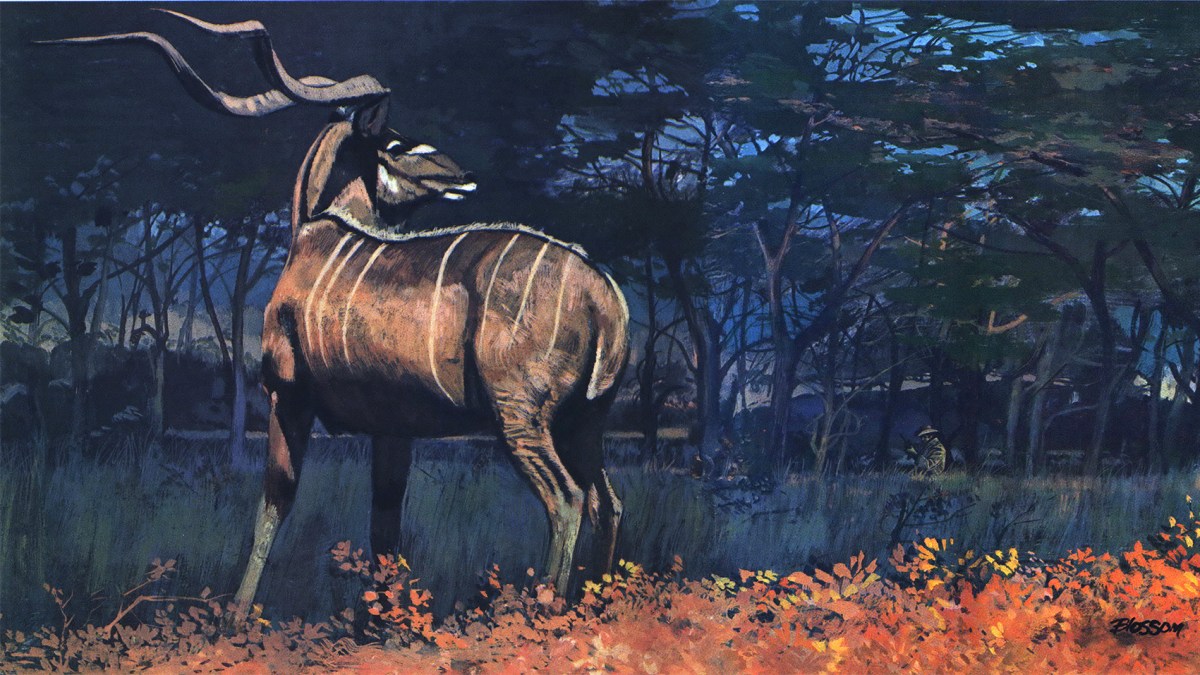
When he saw me he threw up his head and stood motionless but alert, quartering slightly away from me with his huge horns spiraling back over his withers.
When he saw me he threw up his head and stood motionless but alert, quartering slightly away from me with his huge horns spiraling back over his withers. This is the vivid picture of the kudu that I retain in my mind to this day.
Almost without knowing it, I brought the .375 to my shoulder. In my excitement I gave no thought to using a rest. I wobbled the crosshairs onto his shoulder and squeezed off a shot.
At the big rifle’s bellow, the bull sank backward onto his haunches. Amazingly, he recovered and dashed off pell-mell around the base of a candelabra tree.
I sprinted to where the kudu hud stood, but I could find no blood. Then I ran into waist-high grass in the general direction of the animal’s flight. I suddenly caught the sound of rustling grass to my left. Bird-dogging the sound, I burst into an open spot where the huge animal was breathing his last, his great horns resting on the ground. He had run only about 75 yards. The sight of his absolutely awesome horns, the heavily maned neck, and the white chevron across his nose literally froze me in my tracks for a moment, but I soon filled the air with whoops the likes of which haven’t been heard in Africa since the Zulu Wars. There at my feet lay the fruit of a trip halfway around the world, thanks to helpful friends and a chunk of solid-gold luck.
Read Next: Carmichel in Zimbabwe: The Croc That Wouldn’t Croak
I would not trade the memory of my do-it-yourself hunt for the finest carefully outfitted safari. Those who said it was impossible — many in number at the outset of the effort — are silent now, and it gives me the highest degree of satisfaction to view that magnificent head on my wall, fully paid for at long last. Fifty inches of corkscrew horns are a constant reminder of the two-bit safari that yielded that reward.
Read the full article here