
There are three kinds of trout in this country — native, wild, and stocked. Native trout are the ones that have been here for thousands of years, such as brook trout in the mountains of the Northeast and cutthroat trout throughout the Rockies. “Wild trout” refers to fish that were introduced by humans at some point and now maintain their population and reproduce naturally. (Believe it or not, brown trout are from Europe and would exist nowhere in the U.S. had they not been implanted.) Stocked trout are reared in a hatchery and then moved to rivers and streams for annual trout seasons. The beauty of this trout diversity is that no matter where you live, you can probably find trout close to home. Even in parts of the South, stockings during the cooler months give anglers a chance to go trout fishing for rainbows and browns that could never exist there naturally.
The other cool thing about trout fishing is, regardless of variety, there are a ton of different ways to target them. They feed on a wide range of baits, but they’re also predators that will take shots at a massive array of artificial flies and lures.
I’ve chased trout all over the continent and I’ve used all kinds of different methods. I’ve learned a lot about what works, and what doesn’t. The following trout fishing tips will get you on the fast track to success no matter where you fish. We’ll focus on fishing with a spinning rod here, because fly fishing deserves its own story. However, a lot of the principles and tactics covered here apply to fly fishing as well.
Quick Trout Fishing Tips
- If you plan to release a trout, make sure your hands are wet before touching it so you don’t remove any of its protective slime coat.
- Ninety percent of a trout’s feeding takes place on or near the bottom of a stream.
- Trout are territorial. While a lot of little fish can be found in the same hole or run, big fish tend to be loners. So if you’re catching a bunch of little ones in a specific spot, it’s unlikely a big one will be hanging there, too.
- Brown trout feed in the dark, so don’t rule out nocturnal missions, especially if you’re looking for big fish on pressured waters.
- Lures and flies that mimic crayfish are often overlooked for trout, but these crustaceans are one of their favorite prey items.
- Don’t be afraid to use ultra-light line for trout. Line that’s too heavy can make small offerings look unnatural in the water, and trout are often turned off by unnatural presentations.
- If using a net, make sure it has a soft, rubberized bag, which will be much gentler on these delicate fish and ensure a healthier release.
- In high water, focus on areas tight to the bank where the current is blocked or softer.
- In low, clear water, try to avoid casting a shadow on the target area. Better yet, stay far enough away that the fish can’t see you at all.
Trout Fishing Gear Tips
Use a Long Rod
What’s particularly fun about chasing stream trout is that it allows you to use light gear. You’re often casting to small zones and in tight quarters, and even large trout can be successfully landed on light line and a small reel. However, many trout anglers gravitate to short rods, often measuring 6 feet or less. But there’s a big advantage to using a longer rod.
These days, a longer rod doesn’t mean a heavier rod, which wasn’t the case years ago. Rods like St. Croix’s Trout Series Spinning Rods, as an example, are available up to 7 feet long, but maintain an ultra-light action. They generally have a softer tip section, which helps absorb a big trout’s energy when fighting in current or close quarters. More importantly, a long rod lets you reach out farther to make delicate flick casts into tight pockets and eddies. The length also allows you to keep more line off the water when drifting baits and jigs, creating a more natural presentation with less drag.
Read Next: Best Ultra Spinning Reels
Lean on Fly Hooks for Bait Fishing
No doubt, there are some pretty small hooks available in tackle shops for delivering trout baits like mealworms and salmon eggs. Despite their small size, however, many tiny hooks designed for conventional angling still have a thicker gauge, which means they’re fairly heavy. A hook will add weight to any bait, and in some cases, this can mar a natural presentation. By using hooks designed for fly tying, though, you can dial in the ideal hook for any trout bait or situation.
Because dry flies need to float, the hooks they’re tied on are much lighter hooks. They also come in a vast range of styles, sizes, and shapes — some are so tiny they can be completely concealed within a single salmon egg. In low, clear water when trout are spooky, a bait presented on a dry fly or scud hook will drift more naturally with the current and that can mean the difference between a take and a pass.
Use Light Line
For most anglers, 6-pound-test line is considered dangerously light. But trout, by and large, are small. Sure, there are places in the country where 10-plus-pound trout exist, but most of us are fishing lakes and streams where a 20 incher would be a genuine trophy. The truth is, if you’re confident in your gear and ability to deftly play a fish, you can land darn big trout on 2- to 4-pound test line. You’ll also hook a heck of a lot more of them by using these hair-like lines.
Trout are extremely tuned in to natural movement. They know how an aquatic insect should look as it drifts down stream. If it appears off or abnormal, there’s a strong chance the trout won’t gobble it down. All anglers are tasked with trying to create natural presentations, but trout fishermen have even more of a challenge in this department because many common baits and jigs are very light and small.
To use a mealworm as an example, you want it to ride the current as if it naturally fell into the water and is untethered by a fishing line. But the thicker your line the stiffer it is, and the more drag it creates in the water. Conversely, the thinner the line the less the current can affect it, so by default, a bait or tiny lure presented on light line will appear more natural. Just make sure your reel’s drag is set properly (on the looser side) so if you hook a monster, it has freedom to run. Also, light line will also do a far better job of casting light lures and baits with distance and accuracy.
Trout Fishing Lure Tips
Avoid Line Twist with Spinners
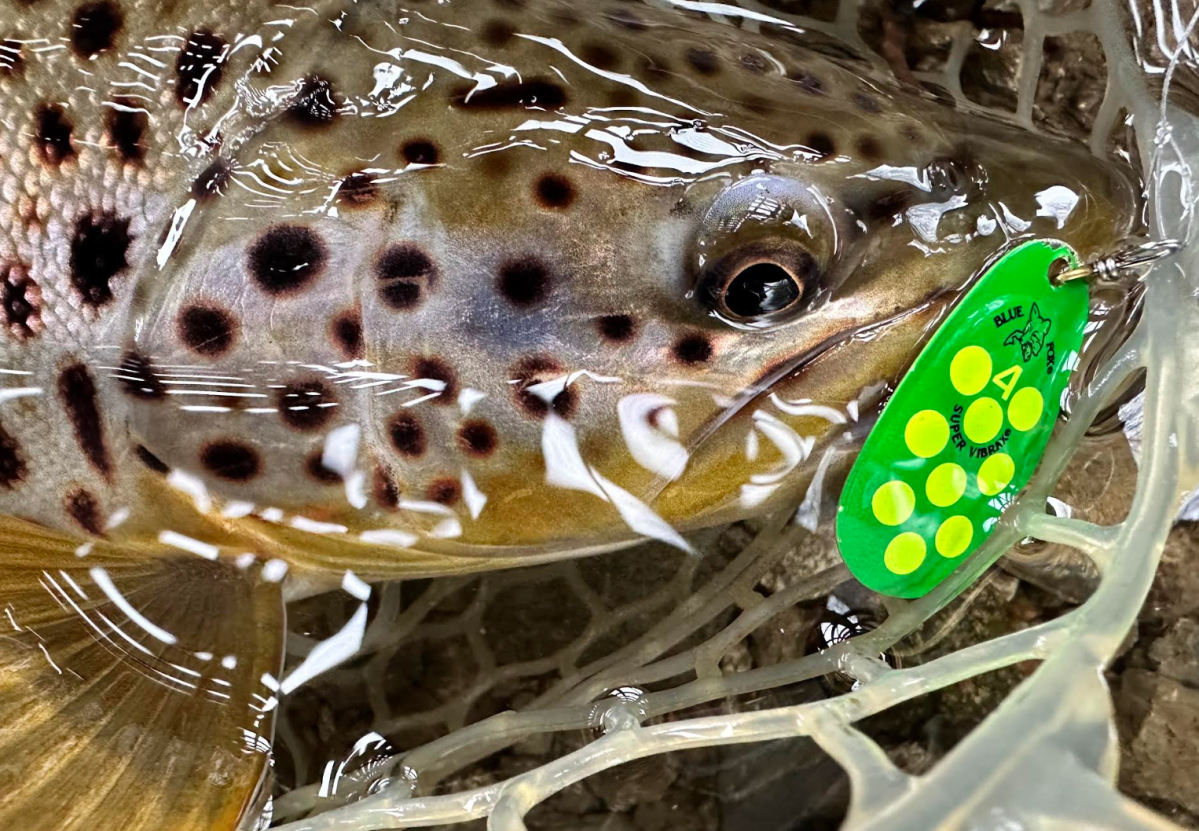
In-line spinners like Rooster Tails and Panther Martins will catch trout swimming anywhere in the country. They’re highly productive in all types of water and in a wide range of conditions. Spinners are also perfect for anglers of any skill level, because all you have to do is cast them out and reel them in. The one shortcoming of spinners, however, is that they can create annoying line twist.
As a spinner moves through the water, the blade rotates around a central post at high RPM. But sometimes the entire post and body rotates, too. When this happens, your main line twists, and that twisting can travel far, even all the way to the reel spool. Once your line is too twisted, it will kink, coil, and become very difficult to cast. The simple solution to avoid this is adding a small barrel swivel between the main line and spinner.
A barrel swivel features two eyelets that rotate independently. Tie your main line to one eyelet, then add an 18- to 24-inch leader to the other eyelet, finishing with tying your spinner to the terminal end of the leader. As the spinner turns, the swivel will counteract the rotation and stop twist from traveling up your line.
Read Next: Best Trout Lures
Keep it Simple with Grubs
Curly-tail grubs are used for everything from crappies to bass to walleyes to saltwater species. They’re one of the most ubiquitous lures in fishing, though in the trout game, they often take a backseat to spinners, spoons, and hard baits. What makes grubs so versatile is that they’re available in a huge range of sizes and colors. As are the lead jigheads that pair with them.
In brown or rusty orange, a curly-tail grub becomes a crayfish when slowly hopped across the bottom. In white or silver a grub can represent a baitfish when reeled quickly through the middle of the water column. In black or olive, they can represent aquatic stonefly larvae. All these food sources are important to trout at different times of year, so carrying a selection of grubs and jigheads in a variety of sizes and colors is smart whether you’re fishing moving water or a local stocked lake.
Add Single Hooks to Your Hardbaits
Jerkbaits and diving minnow plugs like the Original Floating Rapala and Smithwick Rattlin’ Rogue are trout killers, especially if you’re looking for the biggest predators in the river. These lures, however, come factory equipped with two or three treble hooks. They do a fine job of keeping a trout pinned, but they can also cause unnecessary trauma. It’s not uncommon for one treble hook to wind up in the fish’s mouth and the others in its cheek, eye, or gills.
Nowadays, thanks to a greater conservation mindset among anglers, several companies produce specialty single replacement hooks for this style of hard bait. By switching over to these single-point hooks, even if one ends up in a part of the fish where it doesn’t belong, you reduce the amount of time it takes to free the fish, thus increasing the odds of a fast, healthy release.
Make Your Lures Hover
Sometimes a fast, aggressive presentation with diving plugs and jerkbaits triggers trout, but often it’s a more tactful approach that makes the play. Large trout especially love to hammer a jerkbait that’s sitting still. The erratic twitching and darting might initially draw its attention, but it’ll go in for the kill when the lure stops.
There are plenty of suspending jerkbaits on the market today designed to hover at certain depths. However, they tend to be pricey. But you can make almost any floating hardbait hover in an eager trout’s face by adding Suspendots.
Read Next: These 3 Classic Jerkbaits Are Still the Best for Bass and Trout
These stick-on lead circles go on the belly of your bait, and by adding bottom weight, you’re able to keep the bait lower in the water column for longer. In cold water especially, a trout may not be willing to chase a bait far, but if you can keep it in the zone for just a second or two on the pause, you increase the chances that the fish will commit.
How to Read a Trout Stream
Trout Fishing Tactics
Fish Close Before Fishing Far
Many trout fishermen have a “grass is always greener” mentality when they get to a river. The pocket on the other side looks juiciest. The seam in the middle of the run draws them in like a magnet. They’ll splash right in to reach what they perceive as the prime spot, and that often costs them a lot of fish.
A good rule to follow is always fish close before you fish far. Even if the water between you and that sweet spot you’re just dying to hit doesn’t look super “fishy,” make a few casts or drifts through it before advancing to that hot spot. Fish your way to where you want to be instead of barreling right to the money. People are often surprised to find that trout — big ones, too — will sometimes hold in inches of water close to the bank. They’re also masters of camouflage, so even if you’re convinced you’d be able to see a trout if it was holding in that shallow, clear water, you usually can’t. Don’t miss that fish by being in a rush.
Fish the “Junk Water” Early and Late
Most trout rivers and streams feature stretches that are shallow and lack current. Anglers often refer to them as “junk water” or “frog water” because they set up more like a pond. We associate trout with fast riffles, sharp seams, and swirling eddies produced by current, and most of the time these are the likeliest places to find trout. But there is a time and a place to fish that lackluster “junk water.”
Brown trout go on the hunt after dark, whereas rainbows tend to hole up and not feed very heavily at night. Those slow, uninteresting stretches of water might not hold much appeal to fish by day — or they may feel too exposed to be in them — but once the sun sets, these areas can become prime hunting grounds.
Slow, shallow sections of rivers can foster more aquatic insects than faster areas. Likewise, crayfish and frogs are often more comfortable in areas with muted flows. Big browns know this and will move into the “junk water” during low light periods, so stay an hour past dark or arrive an hour before sunlight and hit these sleeper stretches. You might be shocked by what you catch in the water most anglers pass by.
Use the Dirt to Your Advantage
A lot of anglers get turned off by high, stained water. It can be intimidating to wade in, and the increased current may make your favorite hole difficult to fish. The reality is that a bump in flow can produce some of the best trout fishing if you understand how to approach it.
We associate trout with clear running water but remember that under those conditions they can see you very easily. Clear water often equals spooky trout that require accurate presentations and fewer mistakes. In water that’s slightly dirty, however, they usually let their guard down.
Instead of hunkering down behind a rock or in a hole, stained water gets trout moving. They’re more comfortable when they feel like they can’t be seen by birds of prey, so they’ll be quicker to shoot up or travel for a meal. Now is the time to lean on larger lures like flashy jerkbaits and spinners with larger blades that put out plenty of vibration. Focus on areas close to the bank where the current is softer, and where you find one hungry fish in elevated flows, you’ll often find more.
Read Next: How to Cook Trout Outside
Final Thoughts on Trout Fishing
If you live in the West, Midwest, or Northeast, there’s a good chance you’ve got a decent trout stream or pond within easy driving distance. Trout fishing can get complicated, but it can also be as simple as floating a mealworm in an eddy. Start simple, catch some fish, and have fun. Once you learn more about the trout and the waters in your area you can start trying more advanced tactics and target bigger fish.
Read the full article here