
Hollywood gets a lot wrong about survival. The hero always finds food in the first place he looks, the fire starts on the first try, and the wound that would kill a real person in three days is forgotten by the next scene. But that does not mean survival movies are worthless to a prepper. Far from it.
The best ones, the ones worth your time, do something more useful than showing accurate technique. They put you inside a pressure situation and force you to think. What would you do if you were Aron Ralston under that boulder? What would your family do if the power went out and never came back? How long would your supplies actually last if the stores were closed for good?
That mental exercise is exactly what preparedness training is built on. You run scenarios so that when something real happens, your brain already has a framework. A well-chosen survival movie does the same thing from your couch, and the good ones also smuggle in genuine skills, hard lessons about human behavior, and a cold look at what people are actually capable of when everything falls apart.
This list is organized by survival scenario rather than by rating, so you can find what is most relevant to your own preparedness gaps. Every film entry includes what it gets right, what preppers specifically take away, and an honest note on where Hollywood bent reality.
Wilderness and Isolation Survival
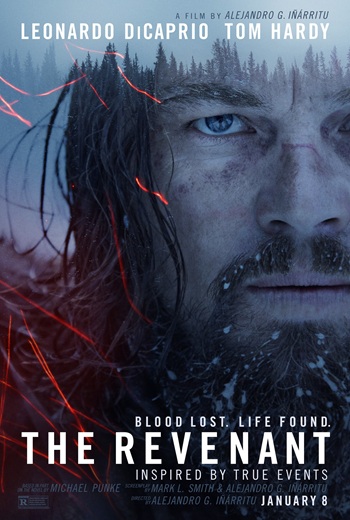 The Revenant (2015)
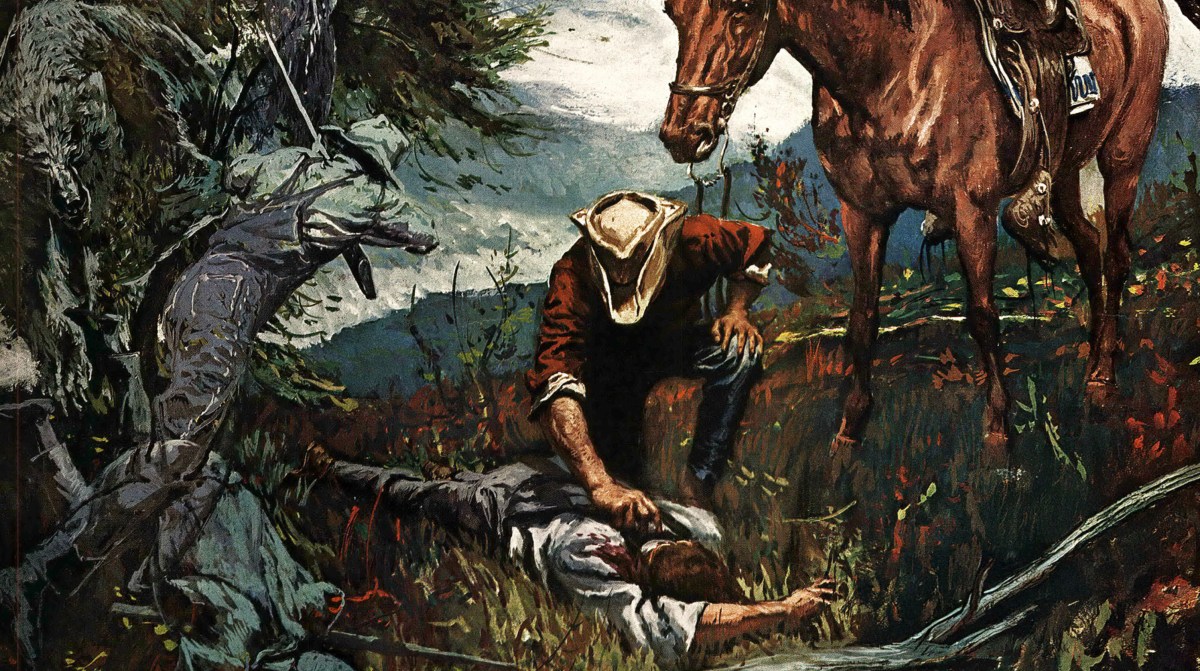
Hugh Glass is mauled by a grizzly bear, left for dead by his companions, and has to crawl out of the Montana wilderness in the dead of winter using nothing but grit, rage, and whatever the frozen landscape offers him. Leonardo DiCaprio won the Oscar for this role, and while the bear scene gets all the attention, the real film is about extended wilderness survival under the worst possible conditions: severe injury, extreme cold, no shelter, and no support.
What the prepper takes away: Glass uses every resource available to him without exception. He eats raw bison liver. He cuts open a horse carcass and shelters inside it. He cauterizes his own wounds with gunpowder. None of these are pleasant options. The lesson is not about the specific techniques but about the mindset: survival has no room for squeamishness. You use what is available or you die. The film also shows that a severe wound does not end your options immediately. You can move. You can plan. You can keep going much further than your body is telling you that you can.
Hollywood note: The timeline is compressed dramatically. The real Hugh Glass survived an ordeal spanning roughly six weeks. The film condenses and dramatizes, but the core facts of the case are genuine.
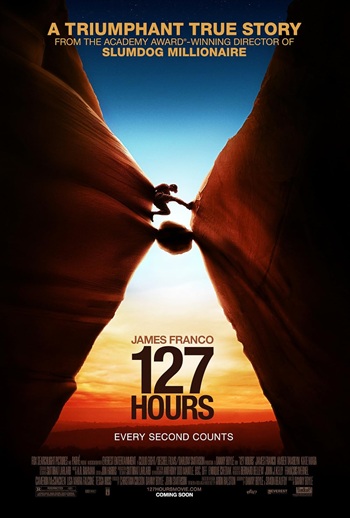 127 Hours (2010)
Aron Ralston, a solo hiker in Utah canyon country, becomes trapped under an 800-pound boulder that pins his right arm. After five days alone with no food, minimal water, and a cheap multi-tool, he amputates his own forearm to escape. This is one of the most viscerally uncomfortable survival films ever made, and it is based on a true story that happened in 2003.
What the prepper takes away: The central lesson is brutal and uncomfortable: Ralston told nobody where he was going. Not one person on earth knew his location. When the boulder fell, he had no margin for error because he had given himself none. Every prepper who watches this film thinks about their own communication plan, their float plan, who knows where they are and when to call for help. The secondary lesson is about the will to make an irreversible decision under extreme duress. That psychological threshold, the moment when you commit to an action you cannot undo, is something no amount of gear preparation addresses. You have to work on it mentally.
Hollywood note: Danny Boyle stages this faithfully. The gear Ralston had with him is accurately portrayed, including the dull knife that made the amputation far more difficult than it needed to be.
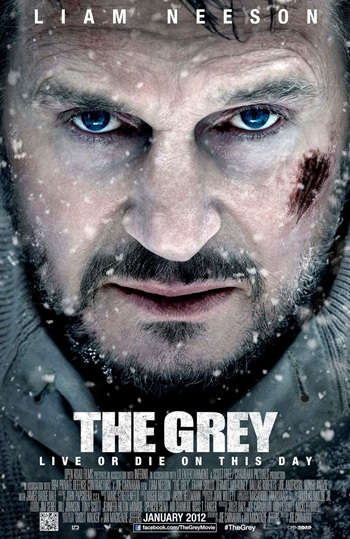 The Grey (2011)
An oil drilling crew survives a plane crash in remote Alaska and is immediately hunted by a pack of wolves. Liam Neeson leads the survivors as they move through brutal winter wilderness, losing people one by one. The film is part survival procedural, part meditation on mortality, and entirely worth watching.
What the prepper takes away: The Grey is one of the few survival films that takes cold weather seriously as a killer in its own right. Characters make decisions about moving versus staying put, about fire, about caloric needs, about group dynamics under lethal stress. The film shows clearly that leadership under pressure is a skill that has to be earned and maintained, not assumed. Neeson’s character leads because he acts decisively when others freeze, not because of rank or title. The wolves also work as a stand-in for any persistent threat: they probe for weakness, they exploit hesitation, and they are most dangerous when the group is divided.
Hollywood note: Wolf behavior in the film is not scientifically accurate. Wolves do not pursue humans this aggressively or persistently. But as a threat analog, they serve the story well.
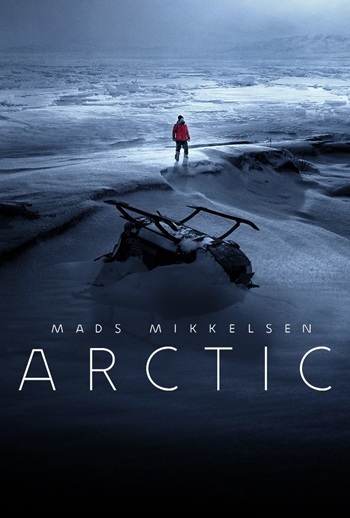 Arctic (2018)
Mads Mikkelsen survives a small plane crash in the Arctic and builds a routine to stay alive while waiting for rescue. When an unexpected helicopter crashes nearby and leaves him with an injured survivor he must care for, he faces the decision every prepper eventually confronts in their planning: do you stay put and wait, or do you move and risk everything?
What the prepper takes away: This is the most technically grounded wilderness survival film on this list. The routines Mikkelsen’s character maintains, checking traps, maintaining signals, managing food and warmth, are close to what actual wilderness survival training teaches. The film does not glamorize survival. It shows it as exhausting, repetitive, and psychologically grinding. The decision to stay or go is presented without a clean answer, which mirrors reality: sometimes moving is the right call, sometimes it kills you, and you rarely have enough information to know which.
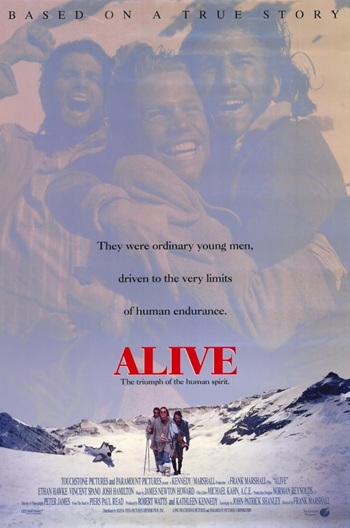 Alive (1993)
Based on the true story of Uruguayan Air Force Flight 571, which crashed in the Andes Mountains in 1972. The survivors spent 72 days in extreme altitude cold with no food supply and no prospect of rescue until they made the decision to consume the bodies of those who had died in the crash.
What the prepper takes away: Alive forces a reckoning with the outer limits of what humans will do to survive and what they can morally justify under extreme duress. Beyond the famous ethical dimension, the film shows a group making collective decisions under sustained trauma, maintaining morale across weeks and months rather than hours, and eventually taking decisive action after exhausting passive options. The expedition two survivors ultimately made on foot across the Andes to find help is extraordinary. They had no training, no gear, and no map. They had desperation and nothing to lose.
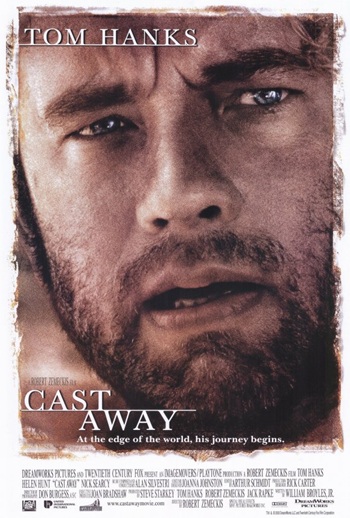 Cast Away (2000)
FedEx systems analyst Chuck Noland survives a plane crash over the Pacific Ocean and spends four years alone on an uninhabited island before engineering his own escape. Tom Hanks delivers one of the great physical and psychological performances in film history, and the survival content is mostly genuine.
What the prepper takes away: The film takes psychological isolation seriously. Wilson the volleyball is not comic relief. It is an accurate depiction of the mental coping mechanisms humans develop under prolonged solitude, and the grief Noland feels when he loses Wilson is one of the most honest moments in survival cinema. On the practical side, the film shows fire-making failure (it takes Chuck many brutal attempts to get fire), the challenge of finding consistent food and water, and the physical toll that sustained caloric restriction takes on the body over months. The raft escape shows planning, patience, and resource gathering over an extended period.
Post-Apocalyptic and Grid-Down Survival
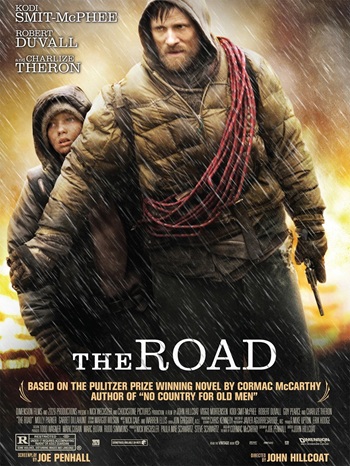 The Road (2009)
Cormac McCarthy’s novel brought to the screen. A father and son walk south through a dead, ash-covered America after an unspecified catastrophe has killed almost everything on earth. They have a shopping cart, a pistol with two bullets, and each other. The world they move through has been stripped of almost everything, and most of the survivors they encounter are dangerous.
What the prepper takes away: The Road is the bleakest grid-down scenario put on film, and it is valuable for exactly that reason. It forces you to think about what happens when your supplies are exhausted, when there is no resupply, when the social contract has completely collapsed. The father’s approach to security, always moving, never trusting strangers, keeping the child close, is not paranoia in this world. It is correct. The film also explores what you are actually protecting when you prepare: the people, not the gear. The two bullets are not just about the gun. They represent a last choice the father has made about what he will not allow to happen to his son.
Hollywood note: McCarthy’s vision is intentionally extreme. The Road describes a complete extinction-level event. Most SHTF scenarios a prepper prepares for will not look like this. But the psychological preparation the film offers is real.
 A Quiet Place (2018)
A family survives in a near-silent world after creatures that hunt entirely by sound have killed most of humanity. They have built a detailed system of silent living, sand-covered pathways, sign language, and noise-free food preparation in a converted farmhouse. The film is essentially a study in threat-specific adaptation.
What the prepper takes away: The Abbott family’s setup is a masterclass in adapting your home and routines to a specific threat. They have thought through every source of noise in their daily lives and engineered solutions for each one. The prepper lesson is not about creatures but about the discipline of threat modeling: identifying the specific dangers in your scenario and systematically working through how each one affects your routines. The family’s self-sufficiency, their garden, their soundproofed basement clinic, their food storage, is also worth noting. They built redundancy into every system.
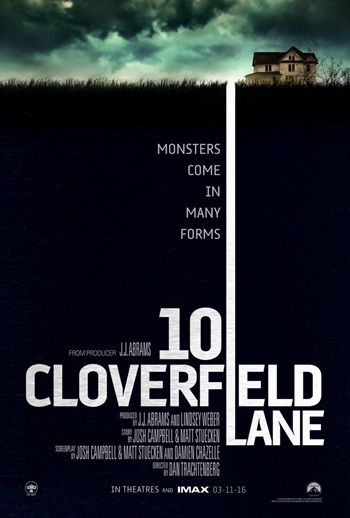 10 Cloverfield Lane (2016)
A woman wakes up in an underground bunker after a car accident, told by the man who built it that there has been an attack and the surface is uninhabitable. John Goodman plays the prepper who built the bunker, and the film is ultimately a psychological thriller about trust, captivity, and the line between protection and control.
What the prepper takes away: This film does something unusual: it takes the prepper seriously as a character while also examining the psychological profile that can come with extreme isolation and paranoia. Goodman’s Howard has done everything right on the supply and infrastructure side of preparedness. He has done almost everything wrong on the human side. For preppers, the film raises legitimate questions about community, about how you vet and integrate other people into your plan, and about the difference between preparing to protect people and preparing to control them. A prepper who watches this film and only sees “he was right about the attack” is missing the more important lesson.
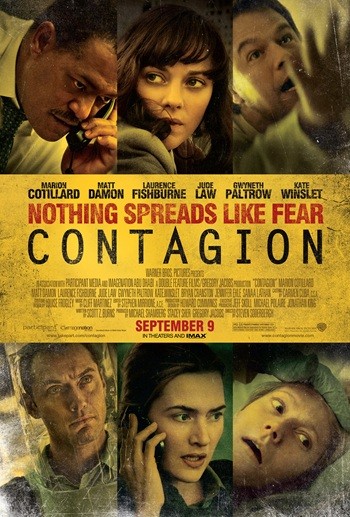 Contagion (2011)
A scientifically rigorous thriller about a novel respiratory virus spreading globally from an initial outbreak in Hong Kong. The film tracks the virus, the public health response, the social collapse that follows supply disruptions, and individuals trying to protect their families as institutions fail. Made in 2011. Watched very differently after 2020.
What the prepper takes away: Contagion is the most accurate pandemic film ever made. The basic reproduction number, the fomite transmission, the race for a vaccine, the behavior of frightened crowds at pharmacies and grocery stores, all of it tracks closely to what actually happened during COVID-19. The film shows, credibly, how fast normal supply chains fail when people panic. The grocery stores are empty within days. The prepper lesson is about time: you have a very short window between “this looks bad” and “you cannot get what you need anymore.” People who had supplies in place before the panic had options. People who waited did not.
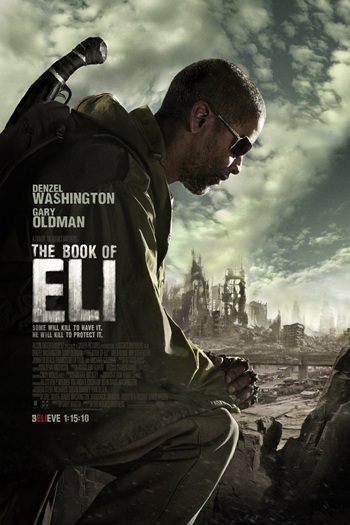 The Book of Eli (2010)
Thirty years after a war that burned the sky and destroyed most of civilization, a lone traveler heads west across a devastated America carrying the last known copy of the Bible. The film is part road movie, part Western, part philosophical meditation on the power of knowledge to outlast collapse.
What the prepper takes away: Denzel Washington’s Eli is the best example in survival cinema of a man who has genuinely mastered his environment. He moves efficiently, conserves resources obsessively, reads threats accurately, and fights with controlled precision only when unavoidable. His daily routine, rationing water, maintaining gear, staying disciplined in diet and rest, is a template. The film also shows the value of a mission, something beyond immediate survival that keeps a person psychologically oriented over years of hardship.
Disaster and Emergency Scenarios
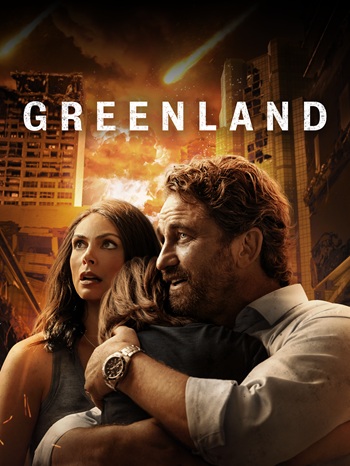 Greenland (2020)
A comet is breaking apart and pieces are striking Earth with extinction-level force. Gerard Butler plays a structural engineer trying to get his family to a government shelter in Greenland before the largest fragment hits. Unlike most disaster films, Greenland focuses almost entirely on the civilian experience of catastrophic collapse rather than on the disaster itself.
What the prepper takes away: Greenland is the most realistic portrayal of civilian evacuation behavior in any disaster film. The roads are impassable. The government shelters have limited capacity and turn away people who do not qualify. Neighbors steal what they need. Pharmacies are cleaned out before the first major impact. The family is separated and has to find each other under conditions where all normal communication infrastructure has failed. If you have a family emergency plan, a rally point, and off-grid communication methods, this film will show you exactly why you need them. If you do not have those things, this film will motivate you to build them.
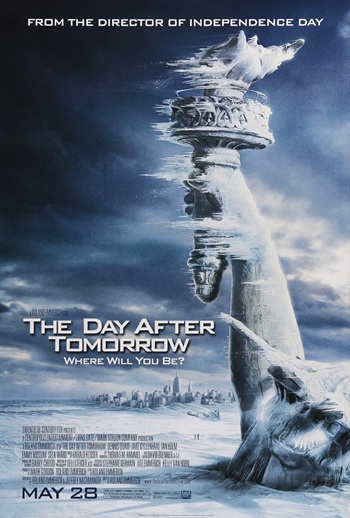 The Day After Tomorrow (2004)
A chain of climate events triggers catastrophic cooling across the Northern Hemisphere in days rather than decades, burying cities under ice and sending survivors fleeing south. The science is pure Hollywood, but the human situations the film creates are genuinely useful to think through.
What the prepper takes away: The shelter-in-place versus evacuation decision gets significant screen time here, and the film shows both working and failing for different characters depending on their specific circumstances. The scenes of survivors burning books and furniture for heat, rationing food, and making triage decisions about who can be moved and who cannot are realistic enough to be useful mental models. The cold weather scenarios, hypothermia, frostbite, shelter insulation, fire as a survival priority, are handled with more accuracy than most of the weather science.
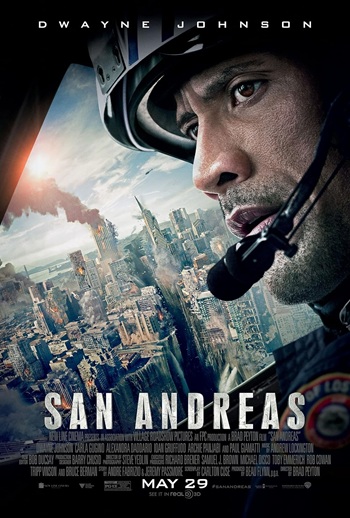 San Andreas (2015)
The San Andreas Fault produces a catastrophic series of earthquakes that destroys Los Angeles and San Francisco. Dwayne Johnson plays a rescue helicopter pilot trying to find his daughter. The disaster sequences are wildly exaggerated, but the survivor behavior in the aftermath is not entirely wrong.
What the prepper takes away: If you live in earthquake country, this film is useful for one specific reason: it shows what a major urban center looks like when the infrastructure is gone. No water. No gas. No power. Roads impassable. Fire everywhere and no suppression capability. The film makes a case, unintentionally, for having water storage, fire extinguishers, structural awareness in your home, and an evacuation route that does not depend on roads. Know your specific regional risk and prepare for it specifically.
Combat, Evasion, and Tactical Survival
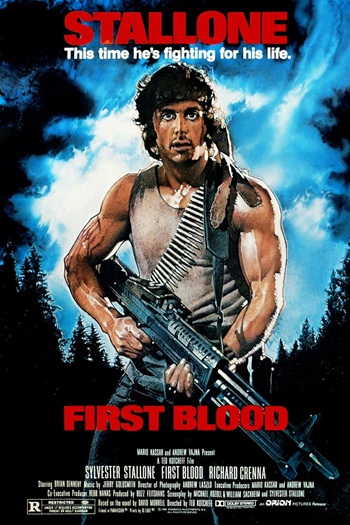 First Blood (1982)
Vietnam veteran John Rambo is harassed by a small-town sheriff, escapes into the forested mountains of the Pacific Northwest, and spends most of the film evading an army of law enforcement using wilderness survival skills and military training. The film launched a franchise, but the original is a legitimate survival story.
What the prepper takes away: Rambo uses the terrain as his primary weapon. He knows it, and his pursuers do not. He improvises traps, moves at night, uses the cold and the forest to exhaust and disorient people with more equipment and numbers. The prepper lesson is about knowing your ground. Your home area, the woods behind your property, the terrain between your house and your bug-out location, is an asset that only pays off if you know it well enough to use it. Rambo also hunts, cooks, and eats what he finds, including a wild boar taken with a knife. Physical fitness, emphasized throughout the film, is presented as a non-negotiable prerequisite for everything else.
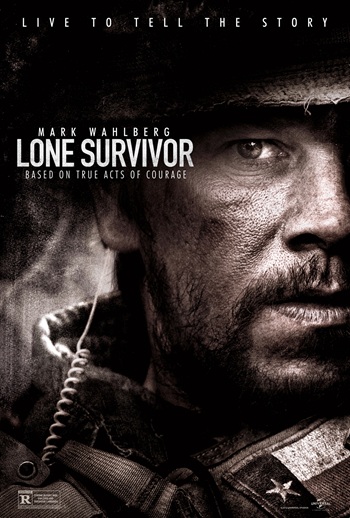 Lone Survivor (2013)
Based on the true account of Operation Red Wings in Afghanistan in 2005, in which a four-man Navy SEAL reconnaissance team was compromised and engaged by Taliban fighters in overwhelming numbers. Three of the four were killed. Marcus Luttrell survived.
What the prepper takes away: Lone Survivor is not a comfortable film. It shows, in close and brutal detail, what it costs to keep moving under fire with serious wounds, in rugged terrain, against sustained opposition. The psychological lesson is about the decision to keep going when stopping would be easier. Luttrell survived in part because of training, in part because of luck, and in significant part because he accepted help from an Afghan village whose culture of Pashtunwali obligated them to protect him. That last element, the willingness to accept help and the importance of human networks in a crisis, is something solo-prepper planning consistently underestimates.
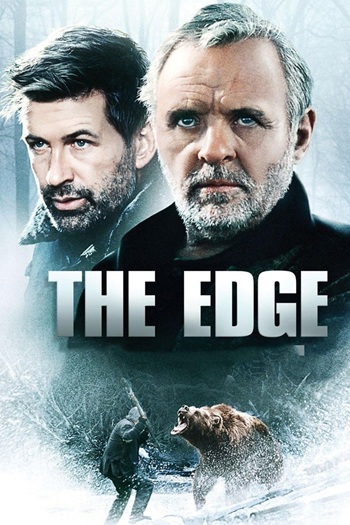 The Edge (1997)
A billionaire and a photographer survive a small plane crash in the Alaskan wilderness and must work together to reach safety while a brown bear tracks them. Anthony Hopkins plays the billionaire, Charles, whose book knowledge turns out to be more practically useful than anyone expects.
What the prepper takes away: Charles knows survival theory from books. He cannot do most of it well at first. But the knowledge gives him a framework for decisions, and he gets better fast. The prepper takeaway is about the value of studying survival skills before you need them, even if your practical experience is limited. The film shows improvised compass navigation using a leaf and a needle, deadfall traps for large animals, fire starting, and shelter construction. The consultant on the film was Larry Dean Olsen, one of the foundational figures in modern wilderness survival education, and it shows in the accuracy of the techniques.
Underrated Films Worth Adding to Your List
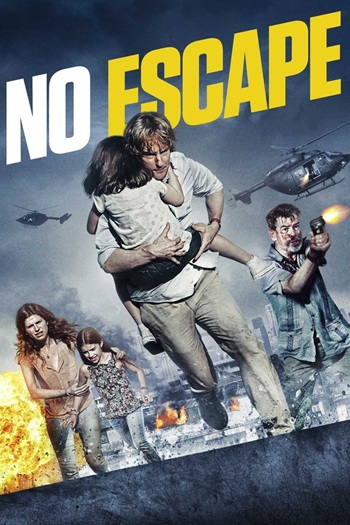 No Escape (2015)
An American family arrives in an unnamed Southeast Asian country just as a violent coup overthrows the government. They spend the entire film moving through a city in active chaos, avoiding armed groups that are killing Western nationals. The threat is human, not natural, and the film’s pace is relentless.
What the prepper takes away: No Escape shows what moving through an urban environment during active civil collapse actually looks like from a civilian perspective. The family has no gear, no plan, no local knowledge, and no weapons. They survive on improvisation, speed, and the willingness to do whatever is necessary. The film makes a strong case for situational awareness when traveling internationally, for always knowing where your embassy and your exit options are, and for having a plan before a crisis rather than building one in the middle of it.
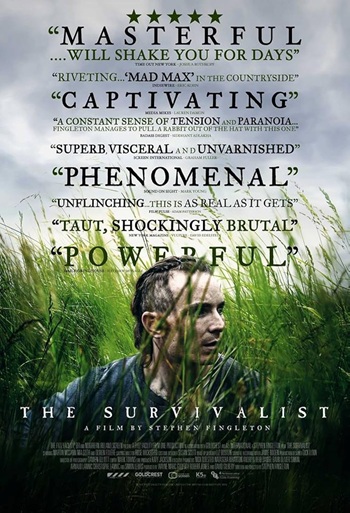 The Survivalist (2015)
An Irish post-collapse film with almost no dialogue. A lone man lives in a forest clearing, growing food and defending himself from the desperate people who want what he has. When two women arrive seeking shelter, he has to decide what trust costs and what isolation costs more.
What the prepper takes away: This is the most honest film about the operational security side of solo preparedness ever made. The man in the clearing has done everything right on paper: he has food production, perimeter security, concealment, and weapons. What he lacks is allies, and that gap nearly kills him repeatedly. The film’s argument, delivered without a word of exposition, is that long-term survival requires community even when community creates vulnerability. You cannot watch this film and still believe that going it completely alone is a sound strategy.
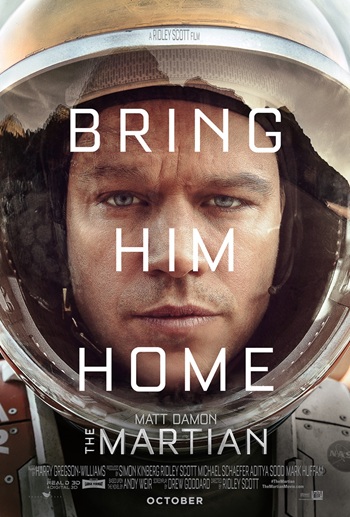 The Martian (2015)
Astronaut Mark Watney is accidentally left behind on Mars after a mission abort and has to survive alone on a dead planet for over a year until a rescue can be mounted. He has scientific training, a habitat with limited supplies, and an absolute refusal to give up.
What the prepper takes away: Watney’s approach to his situation is methodical, scientific, and cheerful in a way that most survival films never attempt. He inventories everything he has. He calculates exactly how long his supplies last. He identifies the gap between what he has and what he needs to survive, then builds a plan to close that gap using the tools available. He grows food. He improvises equipment. He maintains communication with Earth. The film is essentially a two-hour demonstration of the prepper mindset applied to the most extreme scenario imaginable: total isolation on another planet with a known timeline and a problem that can only be solved through resourcefulness and refusing to die.
What Survival Movies Consistently Get Wrong
Part of watching these films as a prepper is developing the critical eye to separate useful content from Hollywood convenience. A few patterns appear in almost every survival film that are worth noting.
- Fire. In almost every film, fire is easy. A few seconds of effort and the camp is warm. In reality, fire-starting is one of the most skill-dependent and condition-dependent survival tasks there is. Wet wood, wind, cold hands, and exhaustion all make it exponentially harder. If you have never practiced fire starting in the rain, in the dark, with poor materials, you do not have the skill.
- Water. Film characters drink from streams without hesitation and suffer no consequences. Giardia, cryptosporidium, and bacteria from animal feces upstream will end your survival situation faster than almost anything else. Always filter and purify.
- Wounds. Characters absorb injuries that would be fatal or permanently disabling in real life and continue functioning at high levels. A deep puncture wound in the leg, an untreated infection, a broken bone without proper immobilization: each of these ends functional capacity quickly in reality. Your medical kit and your medical skills matter more than films suggest.
- Food. Survival film characters find food quickly and consistently. In reality, a healthy adult can function for several weeks without food but the cognitive and physical decline begins within days of caloric restriction. The psychological impact of hunger is severe and almost never depicted accurately.
- Human behavior. This is actually the one area where the best survival films are most honest. People under extreme stress do not behave well. Resources are fought over. Trust breaks down. Groups fracture. The films that show this, The Road, No Escape, The Survivalist, Contagion, are more useful to preppers than the ones that resolve into cooperation and goodwill.
The Dollar Collapse Scenario Most People Avoid Thinking About
Movies help you imagine survival under pressure. But one scenario rarely explored honestly is what happens when the financial system itself fails.
Most people assume banks, cards, and digital payments will always function. Yet history shows currencies can lose value fast when debt, inflation, and instability converge. When confidence breaks, the impact spreads quickly: shortages, price spikes, disappearing savings, and restricted access to your own money.
That is why many serious preppers look beyond food and gear. They also prepare for financial disruption.
Dollar Apocalypse explains how currency instability can affect everyday life, from supply chains and savings to employment and purchasing power. It outlines practical steps for building resilience before a crisis forces rushed decisions.
Inside you will discover:
- Warning signs historically seen before major currency crises
- How inflation quietly erodes purchasing power over time
- Ways to reduce dependence on vulnerable financial systems
- Practical strategies for preserving value during instability
- How financial preparedness connects to overall self-reliance
Preparedness is not only about surviving natural disasters or blackouts. It is also about recognizing risks early and positioning yourself before the majority reacts.
Learn how financial instability could affect your preparedness plan and what steps may help reduce vulnerability!
How to Watch These Films as a Prepper
The most value comes from watching actively rather than passively. Before each film, ask yourself: what is my plan for this scenario? What supplies do I have, what skills am I missing, and what would I do in the first 24 hours? During the film, notice the moments where the character’s decision directly saves or costs them, and test those decisions against your own plan. After the film, write down one thing the film showed you that you have not prepared for.
A survival movie that unsettles you is doing its job. Comfort is not the point. The point is to pressure-test your thinking before reality does it for you, in conditions where the stakes are still hypothetical. Use these films the way a pilot uses a flight simulator: not as entertainment alone, but as a tool for building mental muscle memory around decisions you hope you never have to make for real.
The best preppers are not the ones with the most gear. They are the ones who have thought through the most scenarios. These films are a fast way to run scenarios you have not considered yet. Watch accordingly.
You may also like:
 Join Our WhatsApp Community For Weekly Survival And Prepping tips and tricks!
The EMP-Proof Shelter You Need to Build Before It’s Too Late (Video)
12 Native American Movies Every Prepper Should Watch (Real Survival Skills)
EMP Movies That Do More Harm Than Good
Read the full article here