The Miraculous Story of How an Old, Lost Hunter Was Rescued from the Woods, Against All Odds

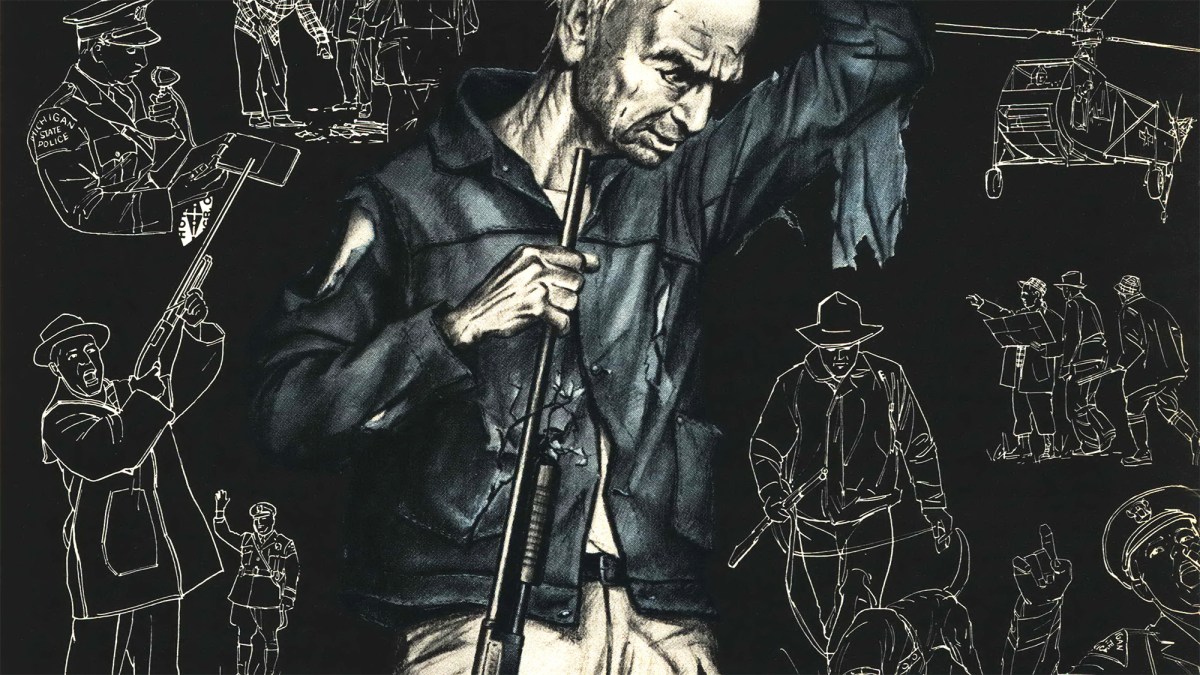

This story, “The Desperate Search,” appeared in the August 1955 issue of Outdoor Life.
“Hey, there!” Hearing the shout, Bill Metsala spun around and saw the frail figure of a man hunkered down on a log by a beaver pond 40 yards away. Bill and 50-odd searchers had been looking for him for the last three days, and now he looked more like an animated scarecrow than a man. His gray cotton pants and blue jean wampus hung in shreds. He was without gloves or hat, and his thin white hair framed a hungry-sunken face that was stubbled with beard seamed with scratches.
Metsala started for him in a run but the gaunt figure pulled itself up and mumbled, “I’m all right. Take your time.”
That was how Ed Downs, 77-year-old Michigan sportsman, came back to safety after four days and three nights without food or fire — lost in the chill of autumn in the wilderness along the south shore of Lake Superior.
Related: A Lost Kid Wandered into My Camp. It’s a Miracle He Found It
The affair began on a cloudy Sunday morning, October 11, 1953, when Downs walked away from his cabin in the Whitefish River valley near the hamlet of Kiva, 25 miles southeast of Marquette, as he thought for a few hours of grouse hunting.
He knew the country well, but not quite as well as he thought. His parents brought him to the town of Hastings in southwestern Michigan — where he worked for years as a court bailiff and where he still lives — when he was eight. It was about that time that he began to fish and hunt with his father. He started hunting deer in the upper peninsula of the state more than 40 years ago. He has owned the cabin at Kiva for about eight years and has hunted in the vicinity since.
Downs had no reason to think, when he left that morning, that the day would be any different than the many others he spent in the woods. His mistake, he knows now, was over-confidence, and it came close to proving fatal.
It was close to dark when Downs realized he was hopelessly lost and must spend the night in the woods. Too late, he stopped to take stock.
The Whitefish River country is a sizeable chunk of road-less forest, swamp, and hardwood ridges, with an occasional abandoned clearing or logging road. It’s an easy place to get lost in when it’s overcast and there’s no wind.
When Downs trudged into it, walking west from his cabin and the highway, he was carrying his 12 gauge Remington pump gun, his pipe and tobacco, a pocket full of matches, and not much else.
His compass was pinned to his hunting coat, which he left hanging in the cabin because the day was too warm.
He didn’t give the compass a thought; he’d tramped the woods in back of the cabin too often to need it. But he’s firm now in urging others never to make the same error, even though they intend going only a few hundred yards from the road.
Downs wore patched, rubber-bottom pacs which he kept for bird hunting in dry weather; light cotton clothing over light underwear; and carried a pair of cotton gloves. He had a dozen shotgun shells, which completed the inventory for the 80-hour ordeal that was ahead.
He didn’t fire a shot all forenoon, not seeing a bird. He had told his wife he’d be back shortly after noon. When
he looked at his watch and saw it was 1 o’clock, he turned and headed in the direction he thought his cabin lay, knowing he was going to be late.
He tramped up one ridge and down another for two hours before it dawned on him that something was wrong. Even then he felt no real concern. He was confident that if he walked steadily in one direction he’d come out of the timber before dark. His own place lay to the east; south was an old clearing he had hunted many times; north the brush-bordered fields of a farm. To the west were only woods, swamps, and streams flooded by beaver dams, but he gave no thought to these. He was sure he wasn’t traveling in a westerly direction. Only one thing bothered him. He had hunted all day in dry country and he was beginning to suffer from thirst.
Late in the afternoon he heard a distant shot from what he thought was north. He turned toward it, hoping to find the hunter and be set straight. Half an hour later he heard a second shot from the opposite direction. He fired an answer and hurried that way. Nothing came of either attempt to contact other hunters, except that they confused his sense of direction even more and distracted him from the straight course he planned to walk.
Related: The Best Survival Kits, Tested and Reviewed
It was close to dark when Downs realized he was hopelessly lost and must spend the night in the woods. Too late, he stopped to take stock. He had lighted his pipe repeatedly and now had only two matches. He still had 11 of his 12 shells. But that was it.
He fired two signal shots. When they brought no reply he began collecting dry firewood, but it was already dusk. Logs and undergrowth tripped him time after time, and his thirst was a real torment now.
In the gathering darkness he came to a pine stump with a snug, cavelike hollow between its exposed roots. He settled on that spot for his camp. He couldn’t find birch bark, pitch-fat pine twigs, or anything else suitable for kindling. And he had no knife to whittle shavings. Maybe he was getting a little panicky. He broke off a handful of small stuff from a dead tree, piled it beside the stump, and struck the first of his two matches. The wind blew it out. Worried now and hurrying, he scratched the second match. Its yellow flame licked up among the twigs. They caught, smoldered, and a wisp of blue smoke curled up in his face. The match flame died. The twigs continued to burn half-heartedly for a minute or two before the tiny fire guttered and went out. The silent woods were now darker than before.
Downs fired a string of signal shots, but the search for him hadn’t yet been launched and the shots went unheard. He stopped shooting when he was down to three shells, two of which he discovered were ancient, black-powder loads that had been kicking around in his gear for years and wouldn’t even chamber in his pump gun. That meant he had only one good shell left.
He didn’t make a bed — just scooped leaves and trash from between the roots of the stump, for a place to sit which would afford some shelter for his head and shoulders. He broke off big slabs of bark to cover his legs. The night wasn’t too bad. He didn’t mind the hunger, and now that he was quiet his thirst wasn’t so acute. He slept fitfully — waking, moving his arms and legs to work the chill out and then drifting off to sleep again.
Before daylight it started to rain, but the stump protected his head and face and the shower was brief. At first light he awoke, tired, stiff, and sore. The sky was still heavily overcast, giving him no hint of direction. He rubbed the stiffness out of his legs and struck off toward what he believed to be east, confident that within an hour or so he would come to an old logging road that led back to his cabin.
Before noon on Monday, his second day out, he came on his first drinking water, a little shallow pool among the dead leaves in an alder bog. It was stagnant and roily, but he was too thirsty to care. He went down on his face and drank. An hour or so later he found a beaver pond on a small creek, and after that he didn’t wander far from a stream. Water is one thing a lost man has to have, he says. He crossed beaver dams repeatedly, but was careful not to fall in because a wetting would mean serious trouble. He also avoided big cedar swamps, know-ing he couldn’t force his way through them.
Sometime Monday afternoon he saw a squirrel, the only game that crossed his path while lost. It didn’t occur to him to shoot it for food. He had neither salt nor fire and wasn’t yet hungry enough to eat raw squirrel. He still believed he could find his way out of the woods any minute. He walked steadily, stopping now and then to rest, and then forcing himself to his feet and slogging on again. By late afternoon he was beginning to trip over brush and logs in full daylight. He fell heavily several times before he gave up at dusk.
When the failing light of the cold, raw autumn evening made walking im-possible, he resigned himself to a second night in the woods. He slept in the open, breaking off evergreen branches for a bed and partly covering himself with them.
The thermometer fell below freezing and frost silvered the ground. Ed Downs lay there shivering and miserable while the hours dragged slowly away. His feet ached with cold, but he was too exhausted to exercise and warm them. He slept only a little. But he was still confident he could find his way out the next morning.
He didn’t expect a search party to find him; he didn’t think he needed outside help. He had heard aircraft two or three times on Monday but failed to connect them with his own predicament. He didn’t know his name was front-page news halfway across the country or that he had touched off the full-search machinery of a state that spares nothing when a lost-hunter call comes.
Read Next: It Took Rescuers Days to Find Us in a Remote Canyon. It Took Even Longer to Figure Out How to Get Us Out
The story was one to stir the imagination and sympathy of all who read it. A man close to 80, hungry and cold, wandering helplessly through roadless woods. Men in cities 500 miles away, who themselves had hunted that tangled country to the south of Lake Superior, pondered the fate of Ed Downs with deep concern. Just where was he? What sort of shelter had he made? How was he enduring the cold? Would he ever be found?
No time is wasted when the person the searchers are seeking is 77. When Downs failed to return for dinner Sun-day his wife wasn’t alarmed. She was used to his coming home from hunting trips an hour or two late. But when he didn’t show up at dark she knew some-thing was wrong. He was either lost or hurt. She notified the Michigan State Police.
A detail from the Marquette post reached the cabin promptly, but there was little the police could do that night. They drove woods roads in the vicinity until after midnight, flashing a spotlight against the cloudy sky in hope of attracting the lost man’s attention. When that failed they returned to their post to organize a full-scale search for the next morning.
They were back shortly after day-light, reinforced by Michigan conservation officers who knew the area, sheriff’s deputies, and a posse of trappers and woodsmen recruited from the community. A state police plane was assigned to fly a low-altitude grid pattern over the country. A trained bloodhound was to be brought in from Wisconsin, 150 miles away.
The search went on fruitlessly all that day. The dog arrived after dark, but the ground was then frosted and he was unable to pick up the track. The searchers had to wait for daylight, and fear spread among the tired men that Ed Downs, lost now for two days and a night, wouldn’t be found alive.
Downs himself says there is little to tell about Tuesday. He was up again at dawn, chilled and worn from an almost-sleepless night. He felt surprisingly little discomfort from hunger but was growing steadily weaker. He walked all day, falling more often, scratching and bruising himself from head to foot. Sometime during the day he started using his gun as a cane.
He started losing things, too. Hungry for the comfort of his pipe, but with no way to light it, he chewed a pinch of tobacco. When he reached for the tobacco pouch the next time it was gone. He still doesn’t know what happened to it.
He also lost his glasses, his cap, and one of his gloves. His pant legs and jacket sleeves were in shreds and his pacs were falling apart. He didn’t realize it then, but he thinks that by the end of Tuesday he was mentally confused as well as physically worn out. Things didn’t seem quite right that afternoon, he recalls. His bed was the same as the night before, a scanty armful of evergreen branches to fend off the sharp, still cold.
The search party combed the woods without let-up again on Tuesday. They started the bloodhound at the door of the cabin and led him off in the direction Downs had gone, hoping he might strike. But the track was already 48 hours old and the melting frosts had washed out the scent. The dog bayed a few times near the cabin, but the trail was too faint to follow.
On Tuesday afternoon the searchers came across a crude bed of dry leaves and balsam branches, where the lost man had slept Monday night. No ashes, no sign of a fire. They had two answers now: Their man was alive and wandering in the woods, not dead from a heart attack as many had feared, and he was without fire.
Wednesday morning a U.S. Coast Guard helicopter made a last desperate bid to locate the lost man from the air. Hope was waning now. Even Ed’s distraught wife agreed that he had to be found that day or rescue would come too late. Three days and nights without food or fire were about all a man of 77 could endure, at least that’s what everybody said.
But Downs could take more than that and proved it. On Wednesday morning it was clear and he saw the sun for the first time. He at last knew which way was east. He started off, hobbling on blistered feet and tired legs, confident that an hour or two would bring him to the old logging road. Walking, however, had become too much for him. He tripped repeatedly and finally broke a dry branch to use as a second cane. He could make only a few yards at a time and his periods of rest grew longer and longer. He was nearing the end of his endurance. He shuffled along until noon and decided that he had some way bypassed the logging road. He hadn’t seen a familiar landmark since Sunday morning.
His resolution failed now. It no longer mattered which way he walked. He followed a deer runway because it was easier going. He clambered over a fallen log, breaking off a small dead tree in his way. Later he came back to that same place, recognizing the log and broken snag. He knew then he was circling but couldn’t straighten himself out. And anyway, it didn’t seem to make a great deal of difference. Shortly after he crossed the log a third time and by now was unable to decide whether he was traveling in the same direction as before or backtracking himself.
Rescue came heartbreakingly close about noon Wednesday, only to pass by. He had heard aircraft Tuesday and again that morning. Now, resting in thick stuff along a creek, he heard a plane thundering straight at him. It pounded over so close he could see two men peering down over the side. He jumped to his feet and waved frantically, but the plane droned on.
He sank down on a log, too tired and disheartened to care much, and was still there when he heard the plane coming back. It swept over again but not quite so near, and he crammed his one good shell into the chamber and fired. But the roar of the engine drowned out the shot. Twice after that the plane passed within sight, each time a little farther away.
Shortly after noon Wednesday, ground searchers found the bed Downs used Tuesday night. It told them only that he was still alive and still without fire. The helicopter returned to its home base late that afternoon. If Downs were found now it would be by men plodding through thickets, looking behind logs, and under the low branches of evergreens. Plans were made to increase the posse to 300 the next morning; it takes more searchers to find a dead man than a live one.
Now, resting in thick stuff along a creek, he heard a plane thundering straight at him. It pounded over so close he could see two men peering down over the side.
Downs doesn’t remember much about Wednesday afternoon, save for the plane that flew over him four times. He had little sense of direction and moved very slowly, taking a few tottering steps, sinking down, and staggering on once more.
An hour or so before sunset he started to make a bed for his fourth night in the woods. He broke off a few evergreen branches before he became exhausted and slumped on a log. Hunched there with his chin in his hands, almost unconscious from 80 terrible hours, he heard a noise in the brush. He looked up and saw Bill Metsala, a trapper who lived not far from his cabin, walking a low ridge, stopping to peer this way and that.
Metsala didn’t see him. Ed mustered his remaining strength and yelled. The startled trapper whirled and started for him in a run.
“He came lickity toot,” Downs says with a chuckle.
Metsala fired a three-shot signal and help arrived in a few minutes. They half carried Ed out of the woods, and for supper that night, he ate hot soup, resting under warm blankets in a Marguette hospital.
He came through in remarkably good condition. His weight had dropped from 125 to 109, and broken pacs had galled his feet, and he was scratched and pummeled from falls. But four days in the hospital fixed him up about as good as before.
When he told the story afterward, he stressed a couple of simple rules for keeping others out of the same trouble. First, he warned, never go into the woods without a compass, a knife, and a reserve supply of matches. Keep those matches for an emergency. Next, once you realize you’re lost and can’t get out before dark, build a fire and stay in one place until help comes.
Ed got the surprise of his life when he learned that at no time while lost was he as much as four miles from his cabin. He knows now that had he remained by the stump where he spent Sunday night, he’d have been rescued the next day.
Read Next: I Was Lost for 10 Terrible Days in the Ontario Wilderness
“Wandering won’t get you anywhere,” he said to me. “It’s no use to travel unless you’re sure of your directions. Don’t ever count on your judgment to take the place of a compass, and don’t be cocky about getting out by yourself. I’ll tell you something. Being lost is one hell of an experience, and four days of it is plenty long enough.”
Read the full article here