
This story, “Death of a Warden,” appeared in the February 1967 issue of Outdoor Life.
Almost 100 law-enforcement officers filled the pews on one side of the little church in a small northern-Wisconsin community. The grizzled heads among them testified to many a hazardous chase or physical set-to with violators of Wisconsin’s fish and game laws.
Sprinkled among the field-gray uniforms of the Wisconsin conservation wardens were the dark blues of the state traffic patrol, the brown and tan that designate county traffic officers in many parts of the state, and the uniforms of the Minnesota warden force.
Game wardening is supposed to be a young man’s meat. But there were more gray and graying, bald and balding heads in the church than those with crew cuts or thick hair. Despite his fine physical condition, Robert Markle, at 54, had been no spring chicken. But three nights before, he had been killed while performing a young man’s job on a lonely forest road.
The state wardens and other cops who knew and worked with Bob Markle weren’t just honoring his memory by attending his funeral. Not one of these men could put from his head the thought that, “There, but for the grace of God, go I.”
These men knew Bob Markle as one of the rarities among men — a fine field warden who balanced common sense with strict enforcement of a fish and game code designed to give all licensed sportsmen a fair chance.
But there were others in the Park Falls Lutheran church that day, prominent people as well as people probably known only to Bob Markle. Some may even have had a brush with him at one time or another, but respected the man for having done his job the right way.
Not everyone who ran into Bob Markle was his friend. Northern Wisconsin still has a hard core of game-law violators and their many passive supporters who don’t like any “popple cop” simply because he represents authority in a field where they feel there should be none.
Related: ‘You Shot Me in the Head and I’m Done.’ Wisconsin Man Sentenced to 4.5 Years After Assaulting Game Warden
Among this lawless element must be counted the men who were spearing fish with the aid of an underwater light on the waters of Bass Lake sometime after midnight on May 8, 1966. It remains for a judge and jury to decide whether the suspects now under arrest were the culprits or if persons unknown were guilty. Acting upon a complaint about illegal activity on the lake, Bob Markle and a special warden, Leo Stecker, a conservation aide in the fisheries division, hid their car back on a tote road where they could keep the lake under surveillance.
Ironically, Bob Markle shouldn’t have been there at all. He had recently been promoted to district warden, a supervisory job, and had moved down to Park Falls from Mellen, where he’d spent most of his 30 years as a game warden.
But the warden crew in the area was shorthanded, so Bob Markle did paperwork by day and continued to do field work at night. It was more than being conscientious. Bob Markle was good at outwitting violators. They knew it. He knew it. A man takes pride in doing things he’s good at.
“Lay jobs” are always tedious and often chilling. This was no exception, for in May, northern Wisconsin nights are freezing. Any of the veterans attending Bob Markle’s funeral could have testified that this sort of thing is a big part of any game warden’s job.
It’s not easy to relax while waiting for the action, even when it never develops. But when the action comes, it comes quickly. Often a warden must sprint, punch, wrestle, or dodge with no warm-up to loosen his cramped, cold muscles. Strains and crippling injuries can result from this unexpected activity.
The unexpected may have a humorous twist. One of Bob Markle’s favorite tales had its setting a few years before World War II, when, except for walking, the only access to northern Wisconsin’s back country was by old logging railways. So that enforcement personnel could get into this country, the state had several “speeders” — the motorized handcars that take railroad section crews out to repair the line.
The day before trout season opened, Bob Markle and another warden, the late Johnny Helsing, put a speeder on a track maintained by a veneer company operating out of Glidden, in Ashland County. They planned to camp out and check on fishermen suspected of jumping the gun on opening day.
It was standard procedure for every speeder operator to check with the lumber-company office to find out if a logging train was operating on the tracks. This the wardens did. But they reckoned without a timber cruiser who had gone in earlier on his speeder and was now headed out on his way home. There’d have been no trouble on a straight stretch, but as luck would have it, the two speeding handcars met on a curve. Braking was futile. It was a bail-out situation, and three men leaped for their lives. As the men tumbled down the grade’s shoulder into muck and brush, the speeders rammed together. There was nothing uproariously funny about the incident. But Helsing was a man with his own brand of humor.
When the three men found themselves only scraped and bruised, each reacted to the situation. The timber cruiser was boiling mad. But the angrier he became, the funnier this struck Helsing, who finally lay on the ground laughing helplessly. His almost-hysterical hilarity was contagious. The two wardens could hardly contain themselves enough to help the still-fuming timber cruiser right his speeder and get it back onto the tracks.
The logger was no happier when he found that the heavier state speeder had sustained little damage while his own light rig was pretty well beaten up. He drove off up the track, the twisted wheels of his speeder tapping out an irregular clickety-clack, probably convinced that the two wardens were either lunatics or totally unfit to deal with the public.
But that was over a quarter of a century ago — another time, another place. This was now, May 8, 1966, and no laughing matter.
Through field glasses, the wardens watched its occupants launch a boat and circle the lake slowly. Spawning walleyes move into the graveled shallows in spring and become easy prey for a spearman with a light.
This could have been just another lay job. A time of listening, watching, drinking coffee, talking softly, and occasionally retiring to one’s own thought. There are dozens of nights like that for every one that results in an arrest. For increasing numbers of citizens have learned that game wardens need information to operate effectively. In return, most wardens feel duty-bound to check out all information they receive, even though they may be pretty sure nothing can develop from it.
A good warden who keeps his sources of information confidential builds an ever-widening core of cooperators. Bob Markle had 30 years in the area. This time, he’d been given good information. A car showed up.
Through field glasses, light-gathering agencies that aid night vision, the wardens watched its occupants launch a boat and circle the lake slowly. Spawning walleyes move into the graveled shallows in spring and become easy prey for a spearman with a light. These are big walleyes, the kind sportsmen pose with for pictures in the local newspapers. Warden Bob Markle was an accomplished sport fisherman, in demand as a guide for visiting dignitaries, and likely to be found fishing or hunting on off-duty time. Most wardens are sportsmen before they become cops.
The boat’s swing was finally completed, and the wardens lay in wait until the men could load their equipment into the car. Enforcement officers learn early to calculate their moves carefully. Only rookies rush in. Because most courts tend to be lenient with game-law violators, a warden knows he must have the goods. Over the years, Wisconsin’s conservation wardens have maintained a conviction record of better than 98 percent, and they aren’t about to give violators an opportunity to jettison evidence. So Bob Markle and his partner waited.
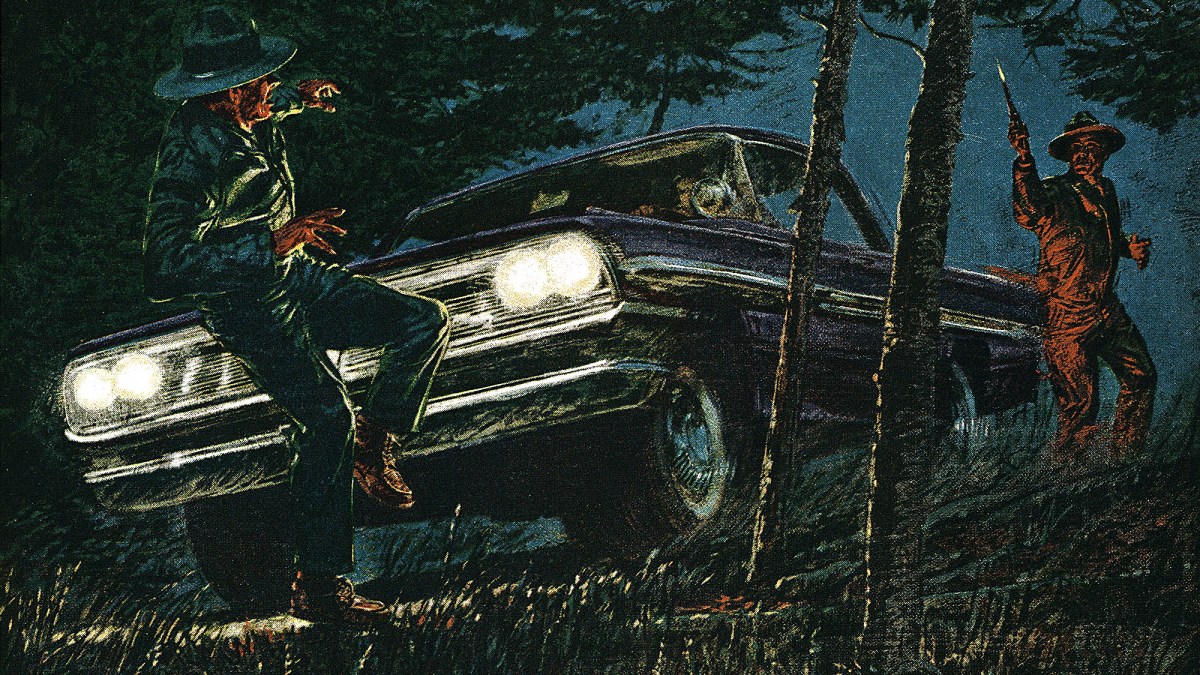
But their strategy was fouled up when the car’s occupants switched on the headlights, throwing a glare up the tote road along which the wardens had planned to sprint. As the lawmen avoided the beam of light and approached the car, the suspects were able to get inside and lock the doors. Bob Markle identified himself and ordered the doors opened.
Northern Wisconsin is thinly populated. There’s little doubt that the suspects knew Bob Markle and he them. But in response, the driver gunned the car, almost running Stecker down, and kept going, despite the two shots Markle fired into the air from his .38. There’s little doubt that Bob Markle could have brought the resulting chase to a screeching halt before it got well under way. A twice-wounded infantry-man, veteran of four campaigns in Europe during World War II, Markle was also a crack shot and a firearms fancier. The last time I saw him alive, we spent a lot of time discussing a new deer rifle he was planning to buy.
That time, we were working “deer shiners,” the men — and sometimes women and children — who travel the back roads at night and use a light to mesmerize a deer for an easy shot. The third man in the patrol car then was Len Urquhart, a long-time friend and co-worker of Bob Markle’s who retired as a warden in 1960 but still worked as a deputy from time to time.
The two veteran enforcement officers were discussing the problems today’s wardens face. Among these were the current trend toward charges of police brutality and the general hog-tying of enforcement officers by citizens concerned with protecting sometimes-spurious civil rights for the few at the expense of protection for the many. Far from advocating a return to the old days, when wardens might “hold court in the brush,” the men were concerned over legal encouragement of lawlessness and its possible consequences to young wardens who might be brash.
Perhaps thoughts along those lines crossed Markle’s mind the fatal night of May 8, 1966, and resulted in his firing for warning rather than for effect. But his actions were more likely based on the years of training and experience that make a good enforcement officer cautious rather than rash. Good cops, even when provoked, are conservative about using firearms. Fugitives are allowed the first shot lest the officer face investigation, charges, interrogation by attorneys, and even adverse public opinion.
This aversion to shooting first and questioning later has cost more than one good cop his life, but this fact seldom gets consideration. A good man exercises authority judiciously, and Bob Markle was a good man.
So Markle and Stecker raced to their car. At the first spin of its wheels. which dug twin furrows in the tote road, they were committed to an always-dangerous part of a warden’s work — a high-speed chase over bad roads.
This might have been any of thousands of chases in which game wardens are involved each year or of hundreds Bob Markle had experienced in 30 years. He was a good driver. But little things can turn the commonplace into tragedy.
The driver of the fleeing vehicle had a clear view. But dust thrown up by that car obscured Bob Markle’s vision and coated his windshield as he closed the distance.
If he’d had time to think, Bob Markle might have been reminded of a similar chase made in 1938, when he took over his first permanent station at Mellen. Accompanied by Fred Gardner, who was then “specialing” in preparation for his appointment as a regular warden, Bob Markle was patrolling a fire lane just off Highway 77 west of Glidden.
The two had information that a pair of ex-convicts, just out of the state prison at Waupun, were killing deer illegally and selling the meat. When a roadster with a rumble seat came out of the fire road and turned west toward Clam Lake, the wardens’ suspicions were aroused. As they closed in, intending to question the roadster’s occupants, the driver trod on the accelerator, and the chase was on.
The fleeing vehicle skidded north onto an old truck trail laid over a railroad grade. On this gravelly, dusty, single lane, Bob Markle applied a pursuit trick that wardens learn early. He followed so close that the dust from the fleeing car rolled up under his car and so didn’t obscure his vision.
As the fugitive car careered along the narrow road, the passenger started heaving out hindquarters of venison. Gardner was kept busy tossing out his hat, some spare boots, flashlight, and other gear to mark the places at which the meat was being jettisoned. Hardened violators often pitch out their firearms, spotlights, and other equipment used in breaking the law, know-ing that wardens must present such evidence in court to get a conviction. But before Bob Markle had a chance to ram the rear bumper of the fleeing vehicle — a maneuver that throws the bumped vehicle out of control, either causing it to ditch or frightening the driver into stopping — he lost some ground and was enveloped in dust. His car sideswiped a wooden bridge. The collision busted up the wardens’ car, but miraculously neither was hurt.
Cars were then radioless, so the two officers hiked to the nearest phone, put out an all-points bulletin on the car that had got away, and then called for a wrecker.
The roadster’s occupants were apprehended the next day, convicted of illegal possession of venison, and returned to the state prison from which they had just been released. This was a signal accomplishment in 1938, when the science of crime detection was hardly comparable with today’s efficient methods.
Now, on May 8, 1966, Bob Markle was chasing another car. He could have let it go and would have had to answer to no one. This is often advocated if accidents are likely to result from a chase. Some enforcement agents explain away their disappointment at such an escape with a you-can’t-win-’em-all shrug. Others may have second thoughts about their own welfare or that of their families.
Related: The Two Game Wardens Who Cracked the CJ Alexander Poaching Case Finally Get to Tell Their Side of the Story
Bob Markle had a good life, a fine wife, a handsome son in the navy, a pretty daughter in high school. Retirement from a job he made no secret about liking was only a few years away, and his good health and hobbies would have made that enjoyable.
But Markle chose to try to catch the car. He knew the risk. But he was also aware of something e1se. Good law enforcement is possible only when officers and their ability are respected. Let one man get away, and the word gets around. It encourages juveniles and momentarily witless adults to flee from rather than halt for a blinking red light and siren.
Northern Wisconsin roads break up in spring, when frost literally boils out of the ground. Driving almost blind at high speed, Bob Markle was unable to avoid a frost heave in the roadbed. It spun his sedan out of control, flipping it end over end. There had been no time to fasten safety belts. Bob Markle was thrown out of the car and pinned under it. The fugitive car kept going.
A fine game warden, family man, wounded veteran, human being was dead. His partner, suffering from severe head lacerations and five broken ribs and unable to get the two-way radio working, stumbled two miles to the nearest dwelling and was then driven to the nearest phone.
Within hours after the Price County sheriff’s office responded to the call, the remote woods and lake area in the far northwest corner of that county was swarming with other wardens, highway patrol officers, and technicians from the state crime laboratory.
One man was apprehended, another suspect disappeared. It could take years before the legal aspects of this case are untangled. But whoever might be convicted will be lightly punished. For even with Bob Markle dead, the most serious charge would be that of resisting an officer.
There were set expressions on the weather-beaten faces of the wardens who stood bareheaded in the sleety rain that stung mourners at the graveside military ceremony.
A fine game warden, family man, wounded veteran, human being was dead. His partner, suffering from severe head lacerations and five broken ribs and unable to get the two-way radio working, stumbled two miles to the nearest dwelling and was then driven to the nearest phone.
They reflected more than feeling for a fellow warden, a personal appreciation of an often lonely and dangerous job. The cold rain was welcome for it offered an excuse to blink furtively and wipe a cheek. Each of these mourners knew that on any given day or night, a similar mishap might well have made him the object of this belated r2-spect and affection.
Bob Markle was many things to many people. “Just another game warden” to most of the persons who read of the accident in their newspapers. “That damn’ warden” to the few unreformed violators he harassed. But to this select group who shared with him the duties of protecting the state’s wildlife and its citizenry from those who would trap, catch, or shoot without regard for the rules, Bob Markle was “somebody you could count on if you got in a cross-haul.”
No higher accolade can one enforcement officer pay to another.
It could be that in death, Bob Markle will become a symbol. Friends and committees have already outlined a number of plans to erect a memorial, possibly a roadside park, as a gentle reminder.
In a more practical vein, perhaps the state legislature will enact a law that will hold responsible for accidents those persons who elect to run rather than submit to questioning. This may make potential fugitives think twice before fighting and running, thus reducing the risk to the worthy men whose job it is to pursue them.
For while another uniformed officer with badge and gun will replace him, nothing will bring back Bob Markle the man. A man quick to smile so that it dimpled his cheek, to laugh so that it shook his entire frame. A man fleet. of foot and quick of hand, able to twist into a helpless state friends who engaged him in physical horseplay or to disarm a belligerent adversary when things got hot. A listener, rather than a talker, who appreciated a good story, a shared bottle, food from a campfire. A cheerful man who, if he had frustrations, burned them out by working harder.
Every violator Markle apprehended wasn’t brought before the bar of justice. At least, not the boy he found on a stream with more than a legal limit of trout. After eliciting from the youngster the promise that he’d never do it again and pledging his own word that the boy’s father would never find out, Markle drove him home.
It takes a man with a clear conscience to know when justice and conservation will be better served by going by the book or by looking the other way. The 30-year record Bob Markle chalked up let him sleep soundly those odd hours of the day or night when he wasn’t working.
Related: The Manhunt for Claude Dallas, the Poacher Who Killed Two Idaho Game Wardens and Fled
So there were dry eyes and wry grins when the men who knew him best gathered in the church basement after the ceremonies. They swapped pleasantries, talked shop, told a joke or two, ate sandwiches, and drank coffee.
Each had lost a piece of himself in Bob Markle’s passing, and this loss hurt. But they could think and act as Bob Markle would have if he were in their boots. Just as they accepted life as it is for a game warden, they viewed a warden’s death as worthy of a unique kind of respect rather than token tears.
Read the full article here